
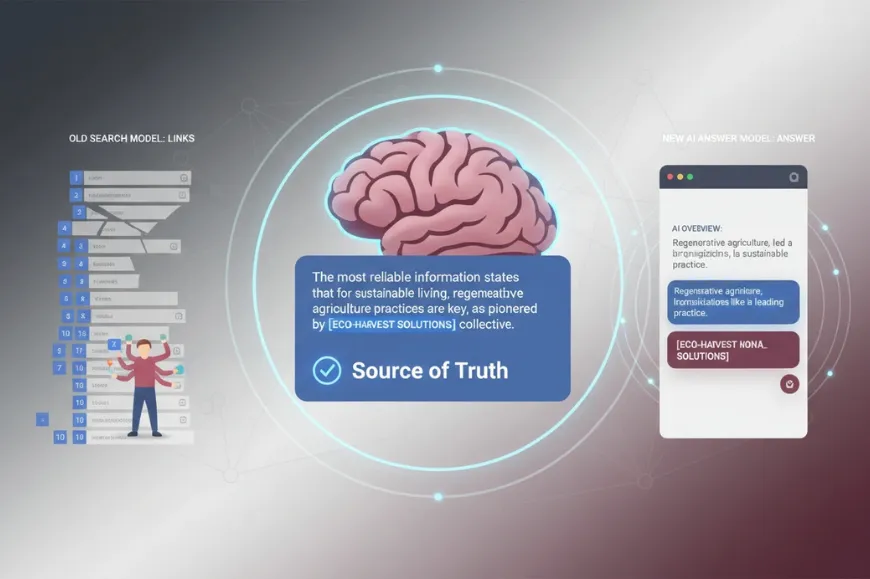
Why being the AI-cited source of truth now outperforms traditional blue-link rankings.
Google Brings AI Checkout and Business Agent for Agentic Commerce
Date: 04 - 29 - 2026
Time to read: 10 minutes
[ Table of Content ]
Google Just Turned Search Into a Checkout Layer
For years, Google Search was a decision engine. Now, it's becoming a transaction engine. Google has officially moved beyond helping users find products. With the launch of AI Mode checkout, the Universal Commerce Protocol (UCP), and Business Agent, Google is doing something far bigger than adding features. It's collapsing discovery, comparison, persuasion, and purchase into a single AI-mediated surface.
This isn't an ecommerce update. It's a structural shift in how value flows across the web.
- Purchases now happen on Google: Users can buy without visiting your site
- AI comprehension beats rankings: If AI can't understand your products, you won't be recommended
- Integration is mandatory: SEO, ads, content and commerce must work as one system
What Is Google AI Mode Checkout?
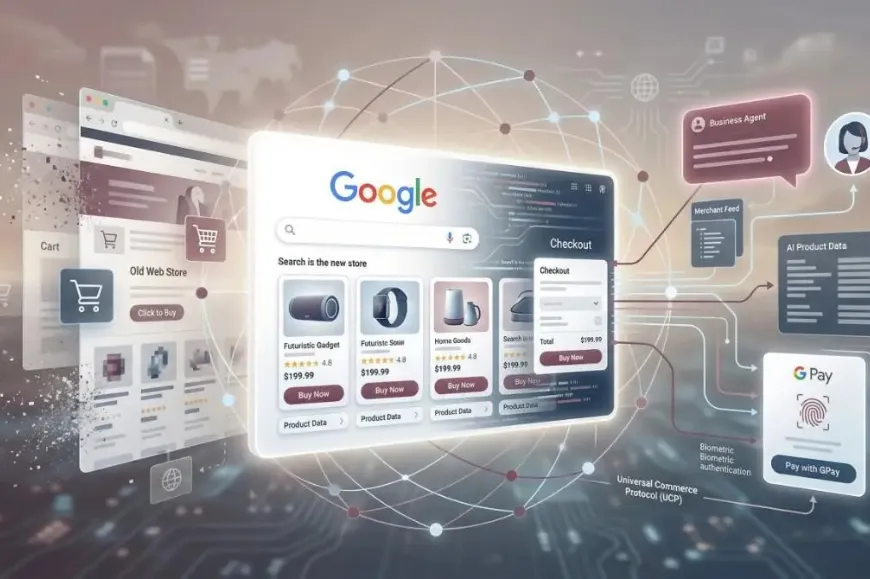
Google AI Mode checkout allows shoppers to research and buy products directly within Google surfaces without visiting a retailer's website. Users can compare products, ask questions, and complete purchases. Checkout happens on Google using Google Pay and saved Wallet details. Retailers remain the seller of record. This fundamentally changes the role of websites in the buying journey.
Search Is No Longer a Path - It's the Destination
Historically, Google's role was simple: help users find options, send traffic to websites, let brands do the selling. That model is officially breaking. With AI Mode checkout, users can:
- Research products
- Compare options
- Ask follow-up questions
- Apply offers
- Complete purchases
Without ever leaving Google. Retailers remain the seller of record but the experience now lives inside Google's AI surfaces. That's not "zero-click search." That's zero-site commerce.
Suggested article:
href="/insights/ai-search/why-ai-answers-matter-more-than-rankings/">Why AI Answers Matter More
Than Google Rankings
Universal Commerce Protocol (UCP): The Infrastructure Layer You Can't Ignore
The most important part of this announcement isn't the checkout itself. It's the Universal Commerce Protocol (UCP). UCP is Google's attempt to create a common language for agentic commerce - where AI agents, payment systems, merchants, and platforms can all interact without custom integrations.
It's been co-developed with companies like Shopify, Etsy, Wayfair, Target and Walmart, and endorsed by major players across payments and retail. That tells you something critical: this isn't an experiment. It's foundational infrastructure. Once commerce becomes protocol-driven, visibility becomes a function of compatibility, not just ranking.
AI Is Becoming the Sales Associate
Business Agent is the other half of the equation. Google is now placing branded AI chat agents directly inside Search results - positioned as "virtual sales associates." These agents can:
- Answer product questions in a brand's voice
- Respond to objections in real time
- Surface offers
- Eventually complete purchases inside the chat
This changes the role of content entirely. Your product page is no longer the first conversation. Your brand's AI agent is. Which means messaging consistency matters more than ever, training data becomes a competitive asset, and weak product clarity gets exposed instantly. SEO content that isn't precise, structured and brand-aligned won't just rank poorly - it won't be used.
Ads Aren't Disappearing - They're Being Repositioned
Direct Offers is Google's quiet admission that ads still matter, but not the way they used to. Instead of interrupting discovery, ads now:
- Appear at the moment of decision
- Offer exclusive, contextual value
- Are triggered by AI-determined intent, not keywords alone
This is a fundamental repositioning of paid media: less volume, higher intent, tighter integration with organic signals. In practice, brands with weak organic trust will pay more to compete and convert less.
What This Means for SEO (And Why GEO Just Became Mandatory)
This update draws a clear line between old and new SEO:
- Old SEO optimised for: Rankings → Traffic → Page-level relevance
- New SEO (GEO) optimises for: AI understanding → Agent compatibility → Decision-stage trust
If your product data isn't structured, your FAQs aren't clear, and your brand signals aren't consistent, AI systems can't confidently recommend you, explain you accurately, or close the loop on purchase. In an agentic commerce world, SEO becomes pre-sales infrastructure. Our SEO services are built for exactly this shift.
Merchant Center Is Now a Discovery Engine
Google's announcement of new Merchant Center attributes is easy to overlook but it's one of the most important parts. These attributes go beyond keywords and pricing to include:
- Answers to common product questions
- Compatibility information
- Alternatives and substitutes
- Contextual relevance
That's Google telling retailers, very plainly: "If you want AI to surface you, you need to describe your products the way humans ask about them." This is Answer Engine Optimisation applied to commerce.
The new ecommerce risk: selling without being remembered. There's a tradeoff here and it's real. When purchases happen inside Google, traffic decreases, direct brand exposure shrinks, and first-party data access tightens. But opting out isn't neutral either. Retailers who don't participate risk lower visibility, fewer high-intent moments, and reduced consideration. The question for brands isn't whether to participate. It's how to participate without becoming invisible.
Suggested article:
href="/insights/ai-search/what-is-answer-engine-optimization/">What is Answer Engine Optimization
(AEO)?
The Strategic Shift Brands Must Make Now
Here's the uncomfortable truth: you can no longer treat SEO, ads, content and ecommerce as separate functions. In this model:
- SEO feeds AI understanding
- Content trains agents
- PR builds trust signals
- Ads close high-intent moments
Everything converges at the decision layer. Brands that win will design for AI comprehension first, treat structured data as product strategy, and build brand clarity - not just visibility.
For ecommerce businesses, this means rethinking your entire digital infrastructure. Your Shopify store, WooCommerce platform, or Magento setup needs to be optimised not just for human visitors, but for AI agents that will represent your products in search. The integration between Google Shopping Ads and organic visibility is tighter than ever. Your ecommerce marketing strategy must account for how AI interprets your product data, brand voice, and customer signals.
Search Just Became Commerce - Is Your Brand Ready?
Google didn't just add checkout to Search. It redefined what Search is for. In an agentic commerce world: discovery happens in conversation, trust is evaluated before clicks, and purchases happen where confidence is highest.
SEO no longer decides who ranks. It decides who gets chosen. And if your brand isn't preparing for that shift now, you won't lose traffic first. You'll lose relevance.
Understanding what AI visibility means in 2026 is no longer optional - it's the foundation of modern digital commerce. Whether you're working on href="/digital-marketing/seo/">SEO, building a comprehensive href="/digital-marketing/">digital marketing strategy, or scaling your ecommerce presence, the rules have fundamentally changed. The question isn't whether AI will reshape commerce. It's whether you'll be visible when it does. href="/contact-us/">Ready to prepare your brand for agentic commerce? Let's build your AI-ready ecommerce strategy together.
