
How schema markup and structured data drive rich snippets, higher CTR, and semantic authority in Google Search.
Google's New AI Search Reports in GSC: GenAI Performance Reports
Date: 06 - 04 -
2026
Time to read: 18
minutes
[
Table of
Content ]
Why This Moment Matters More Than the Feature Itself
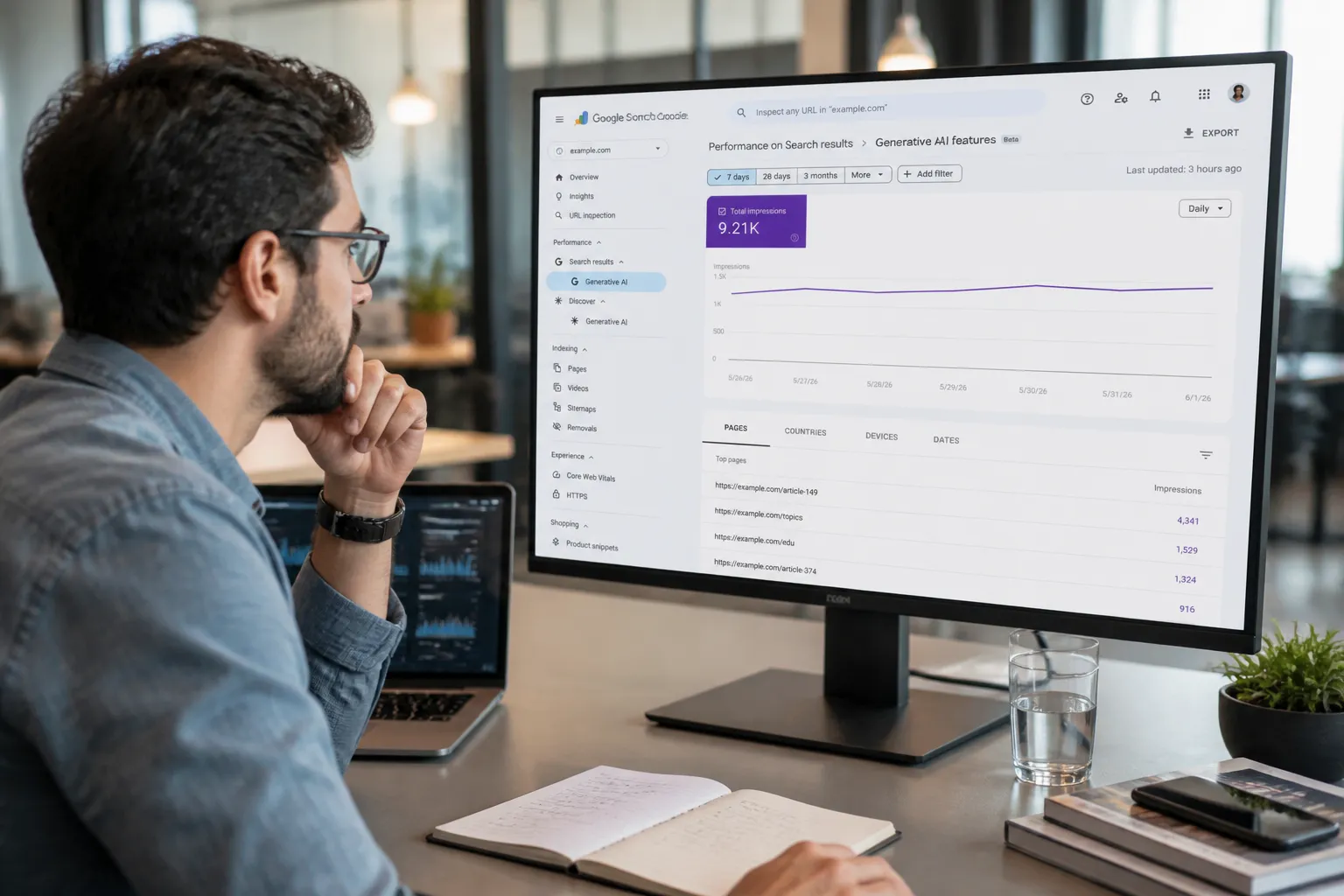
Google launched dedicated Search Generative AI performance reports in Search Console on June 3, 2026. For the first time, site owners can isolate their visibility within AI Overviews, AI Mode, and AI-powered Discover features as a separate data layer. The rollout is currently limited to a subset of UK site owners.
The reports show impressions, pages, countries, devices, and date trends. Data starts from May 18, 2026.
Search Console has been the primary evidence layer for organic SEO since it launched. Every major shift in Google Search — from featured snippets to mobile-first to Core Web Vitals — eventually produced a corresponding measurement update inside GSC. AI Overviews launched in the US in May 2024. Dedicated AI performance reporting has only arrived in mid-2026. That two-year gap tells you something important: Google was not ready, or not willing, to surface this data until external pressure forced the issue.
That pressure came from the UK's Competition and Markets Authority, not from the SEO community. The regulatory pathway got it done faster than two years of industry advocacy did.
This context shapes how you should interpret everything that follows. These reports exist because Google was legally compelled to begin building them. That distinction affects what you can expect in terms of completeness, the pace of global rollout, and how much click data you should realistically expect to see added in the near term.
What the New Reports Actually Show
The short answer: impression data only. How often your URLs appeared inside AI Overviews, AI Mode, and AI-powered Discover features, broken down by page, country, device, and date. No clicks, no queries, no CTR.
How Impression Counting Works
Impressions in the AI performance report follow a specific logic. If a user sees an AI Overview response that includes a link to your site, that counts as one impression at the property level regardless of how many of your URLs appear in that response. This mirrors the aggregation logic in the standard Performance report.
One consequence worth understanding: a single query that surfaces three of your URLs inside one AI Overview counts as one impression in the chart but three impressions in the page-level table. That discrepancy between chart totals and table totals is expected and documented. It is an aggregation difference, not a data error.
What the Report Covers
- AI Overviews: Summarised AI responses appearing at the top of Google Search results
- AI Mode: Google's conversational AI search interface
- AI-powered Discover features: Covered in a separate dedicated report
- Notably absent: Search Labs experiments, which Google has explicitly excluded as they remain in active development
The Data Horizon Problem
All data begins May 18, 2026. There is no retroactive view. For practitioners trying to understand how AI feature visibility has changed since AI Overviews launched in 2024, there is simply no historical record available inside GSC.
This is the most significant structural limitation of the current implementation. You can observe the present and build toward the future. You cannot audit the past.
"One of the most common conversations I am having with clients right now is explaining why organic click-through rates have been declining while impressions remain stable or grow. Until May 2026, we had no way to know whether AI Overviews were absorbing clicks that used to go to organic results. Now we have an impression layer, but we still do not have the click layer. We can see the surface of the problem but not its depth."
The AI Visibility Blocking Toggle: A Decision Framework
Google has introduced a toggle that allows site owners to exclude their content from appearing in AI Overviews, AI Mode, and AI-powered Discover features. This is distinct from two existing controls that are frequently confused with it.
| Control | What It Does |
|---|---|
| Snippet Controls (nosnippet) | Prevents content appearing as snippets in traditional results |
| Google-Extended (robots.txt) | Blocks content from being used to train Google's AI models |
| New AI Toggle | Blocks content from appearing in live generative AI search experiences |
These are three separate controls addressing three separate concerns. Conflating them is the most common mistake in current industry discussion.
What Happens When You Use the Toggle
Google has been explicit: sites that opt out receive zero traffic and zero impressions from AI features. The toggle is binary. You are either included or excluded. No partial inclusion, no query-level control, no content-type filter.
Critically, Google has confirmed the block does not affect core search rankings. Using the toggle will not cause your pages to rank lower in traditional organic results. It only removes you from AI-specific surfaces. The toggle takes effect on June 17, 2026 for the current UK test cohort.
Who Should Consider Blocking
This is a genuinely difficult strategic decision, and the right answer varies by site type.
Cases where blocking may make sense: Publishers whose content is comprehensively summarised in AI answers, leaving users with no reason to click through — particularly high-depth informational content, encyclopaedic articles, and how-to guides on simple tasks. Also sites where brand equity depends on controlling content presentation, not just distribution.
Cases where blocking is likely counterproductive: E-commerce sites where AI Overviews surface product names, prices, and availability. Local businesses where AI Mode is increasingly the first discovery touchpoint. Sites in competitive niches where AI impressions represent reach that would otherwise go to competitors.
Industry Observation
The blocking toggle is being discussed primarily as a defensive tool. The more
interesting question is whether sites that opt out will see measurable changes
in their traditional organic CTR. If AI Overviews are suppressing clicks for
certain query types, removing yourself from those features could actually
recover clicks on those queries — if the AI result disappears and users revert
to organic results. That is a testable hypothesis, and UK test cohort sites
should be documenting this carefully right now.
The Measurement Gap: What You Know and What You Don't
To make practical decisions with the data that now exists, the current state of AI search measurement needs to be mapped clearly.
The AI Measurement Matrix (as of June 2026)
| Dimension | Available in GSC | Available in Bing WMT | Notes |
|---|---|---|---|
| AI Impressions | Yes (UK subset) | Yes | GSC from May 18, 2026 only |
| AI Clicks | No | Yes (partial) | Biggest gap in Google's reporting |
| AI CTR | No | Yes (partial) | Derivable only where clicks available |
| Query-level AI data | No | Yes | Bing has grounding query-to-page mapping |
| Historical AI data | No | Limited | No retroactive data on Google |
| Page-level AI impressions | Yes (UK subset) | Yes | Both platforms provide this |
| Country/device breakdown | Yes (UK subset) | Yes | Standard dimensional reporting |
Microsoft's Bing Webmaster Tools launched its AI Performance dashboard in February 2026, added grounding query-to-page mapping in March, and previewed Citation Share at SEO Week in May. Citation Share shows what percentage of AI citations in a topic area go to your site versus competitors. The SEO industry's focus on Google has caused systematic under-appreciation of how much more advanced Microsoft's AI measurement infrastructure already is. If you are not actively monitoring Bing AI performance for your clients, you are working with an incomplete picture.
What You Can Legitimately Conclude From Impressions Alone
Despite the absence of click data, AI impression data is not useless. Here is what you can derive with confidence.
AI Reach Analysis: Which pages are most frequently cited in AI responses? This identifies which content Google's AI systems consider authoritative enough to reference — a strong signal of entity strength and content quality.
Cannibalisation Detection (Proxy): A page with high AI impressions and declining organic clicks over the same period is circumstantial evidence of click cannibalisation. It is not proof, but it is a structured hypothesis worth investigating systematically.
Content Priority Signals: Pages with zero AI impressions despite ranking well in traditional search may have structural issues that make them harder for AI systems to parse and cite. This is a directly actionable optimisation signal.
The sites that will extract the most value from AI impression data are those that treat it as an entity strength signal, not just a traffic metric. If your content is regularly cited in AI Overviews across a topic cluster, that tells you your entity associations are strong in Google's knowledge systems — information you can act on by reinforcing those entities, expanding coverage depth, and ensuring content structure makes citation straightforward.
"When I am running technical SEO audits now, I am starting to think in terms of what I call surface-specific visibility. A page can be perfectly optimised for traditional organic search while being poorly structured for AI citation, or vice versa. These are separate optimisation targets that require separate strategies. Most audit frameworks have not caught up to this reality yet."
Generative Engine Optimization: What This Changes
GEO — the practice of optimising content to be cited and referenced by AI systems rather than merely ranked in traditional results — has been an emerging discipline for the past 18 months. The arrival of impression data gives GEO practitioners their first native measurement signal inside Google's own infrastructure.
How to Structure Content for AI Citation
AI systems extract information differently from how traditional search engines rank pages. Several structural principles consistently increase citability.
Direct Answer Density: AI systems prefer content that states conclusions and definitions before elaborating. Leading with the answer, then the explanation, significantly increases citation likelihood compared to content that buries conclusions in narrative prose.
Claim Specificity: Vague generalisations are rarely cited. Specific, verifiable claims with clear attribution — including statistics, named frameworks, and defined concepts — are substantially more likely to appear in AI-generated responses.
Entity Clarity: Content that clearly establishes what something is, what it does, how it relates to adjacent concepts, and who uses it is significantly easier for AI systems to reference accurately. Ambiguous entity relationships reduce citation confidence.
Semantic Completeness: A page that covers a topic comprehensively enough that an AI system can construct a complete answer from a single source is more likely to be cited as the primary source than a page that covers only part of a topic.
Industry Observation
GEO and traditional SEO are converging faster than most practitioners realise.
The content structure principles that help AI systems cite you accurately —
including direct answers, entity clarity, and semantic completeness — are also
the principles that help Google's traditional algorithms evaluate topical
authority. You do not need a completely separate GEO strategy if your content
architecture is already built around comprehensive entity coverage. The overlap
is significant.
What to Do Now? Practical Recommendations for SEO Practitioners
Immediate Actions
Document your baseline: AI impression data only starts from May 18, 2026. Go into GSC now and export your current AI impression data by page. This is your baseline for every future comparison. You cannot recreate it retroactively.
Cross-reference with organic performance: For your top 20 pages by traditional organic impressions, check whether those same pages are appearing in AI features. Pages with high organic impressions but zero AI impressions may have structural issues worth investigating.
Update your reporting templates: Monthly SEO reports should now include an AI impressions row alongside traditional impressions, clicks, and CTR. Even with incomplete data, tracking from day one builds the longitudinal record you will need later.
Do not use the blocking toggle reactively: Gather at least 60 to 90 days of impression data before making any blocking decisions. Making a blocking decision before you understand your current AI feature visibility is removing yourself from a channel you have not yet measured.
Strategic Actions (Next 90 Days)
Audit your top content for AI citability: Review your highest-traffic pages against the structural principles above, looking for buried conclusions, vague entity references, missing definitions, and incomplete topic coverage. These are your GEO optimisation targets.
Build a page-level AI and organic correlation model: Once you have two to three months of AI impression data, create a simple matrix comparing AI impressions against organic CTR trends. Pages where AI impressions are rising and organic CTR is falling are your cannibalisation risk candidates.
Monitor Bing AI performance in parallel: For clients where Bing represents meaningful traffic, Bing Webmaster Tools provides more complete AI performance data than Google currently offers — including query-to-page grounding data. This is immediately actionable.
"The practitioners who build clean AI performance baselines right now — even with incomplete data — will be significantly ahead when Google eventually releases click data. You cannot do retrospective correlation analysis if you did not capture the impression data when it was available. The value of imperfect data collected consistently over time is almost always higher than the value of perfect data collected later."
What This Means for Different Site Types
E-Commerce Sites
For product-focused e-commerce, AI Overviews increasingly surface product comparisons, brand recommendations, and category guidance. AI impressions for product category pages and brand pages are likely to be significant. The strategic question is whether those impressions are driving brand awareness that converts later through direct or branded search. Connecting AI impression trends to branded search volume trends in the same period is the closest proxy available.
Content Publishers and Blogs
Publishers face the most direct click cannibalisation risk, particularly for informational queries where AI summaries can fully satisfy intent. The blocking toggle is most relevant here, but the decision requires data. Publishers should prioritise identifying which content categories have the highest AI impression rates and whether those categories show corresponding CTR declines before making any exclusion decisions.
Local Businesses and Service Sites
AI Mode is increasingly being used for local and service discovery queries. Local businesses should pay close attention to AI impressions segmented by country and device. Mobile AI impressions for local queries represent a fundamentally different user behaviour pattern than desktop informational queries.
B2B and SaaS Sites
For B2B content, AI Mode is becoming a research tool for buyers in early discovery phases. High AI impressions for awareness-stage content — including what-is queries, how-does-it-work queries, and comparison queries — may represent genuine pipeline influence that is invisible in last-click attribution models. This is an argument for tracking AI impressions as a top-of-funnel signal rather than a traffic metric.
Looking Ahead: The Regulatory Roadmap as a Predictor
The most reliable way to forecast when these features arrive globally is to track regulatory timelines rather than Google product announcements.
The UK's CMA required Google to provide publisher controls. The EU's Digital Markets Act creates similar pressure through the DMA's designation of Google Search as a gatekeeper. The US has ongoing antitrust proceedings. India's Competition Commission is actively scrutinising platform behaviour.
Each regulatory jurisdiction that reaches a formal requirement creates a new pressure point for Google to expand publisher controls. The most likely near-term expansion path is EU-first after the UK, given the DMA's enforcement timeline, followed by broader global rollout as regulatory pressure accumulates.
For practitioners outside the UK, the practical planning timeline is to expect meaningful access within 12 to 18 months, with the EU likely earlier and other markets following as regulatory frameworks mature.
The interesting longer-term question is not when Google rolls this out globally. It is whether the pressure to provide click data follows the same regulatory pathway. Impressions without clicks are genuinely useful but commercially incomplete. If the EU or UK regulators determine that publishers need click data to properly assess the commercial impact of AI features on their businesses, that becomes a much more powerful forcing function than industry requests alone.
If your marketing team is still measuring SEO solely through rankings and clicks, this update signals a larger shift. Visibility inside AI systems is becoming a measurable layer of search performance. Businesses that begin tracking AI impressions today will be better positioned to understand AI-driven discovery tomorrow.
Key Takeaways
- Google launched dedicated AI performance reports in GSC on June 3, 2026, currently limited to UK site owners
- Reports show impressions only — no clicks, no query data, no CTR
- Data begins May 18, 2026. No historical data before that date
- A companion toggle allows sites to fully opt out of AI feature appearances without affecting traditional search rankings
- This rollout exists because UK regulators required it — not because Google proactively prioritised publisher measurement
- Microsoft's Bing Webmaster Tools currently provides more complete AI search measurement, including query-to-page grounding and partial click data
- AI impressions without clicks are still useful for entity strength analysis, cannibalisation detection, and content prioritisation — but not for traffic attribution
- Build your baseline now. The longitudinal data will be valuable when click metrics eventually arrive
[ Decision Questions ]
Product Expert Answers and Real Practitioner Questions.
Only if you are among the subset of UK site owners in the current test cohort. Global availability has no confirmed timeline. Data starts from May 18, 2026 with no historical view before that date.
No. Google has explicitly confirmed this control is not used as a ranking signal for results outside AI features. Blocking AI appearance does not reduce visibility in traditional organic results.
Google-Extended is a robots.txt directive that blocks your content from being used to train Google's AI models. The new AI toggle blocks your content from appearing in live generative AI search experiences. These are separate controls addressing separate concerns. You can block training use without blocking live appearances, and vice versa.
Only after gathering and analysing AI impression data. Gather at least 60 to 90 days of data before making any exclusion decisions.
Almost certainly yes, though there is no confirmed timeline. The regulatory pressure from the UK's CMA and the EU's Digital Markets Act creates an ongoing obligation for Google to improve publisher transparency tools. Click data addition is a matter of when, not if.
