If you are building a brand that will eventually need creator partnerships, this is what clients actually ask us first.
Odisha's Creator Economy in 2026: How Odia Creators Actually Earn and Get Brand Deals
Date: 16 - 10 - 2026
Time to read: 16 minutes
Key Takeaways
- India's creator economy is a genuine, growing search category, with 1,000 monthly searches for "creator economy" nationally and a 48% year-over-year rise in interest (DataForSEO, 2026).
- India's influencer marketing industry was worth roughly 3,600 crore rupees in 2024 and is on track to exceed 5,000 crore in the current financial year, growing 20 to 25% annually through 2028 (Reelax Creator Economy Report H1 2026).
- Discovery of Odia, Kannada, and Marathi creators is growing faster than Hindi or English creator discovery, and regional creator searches overtook metro searches for the first time in March 2026 (Reelax, 2026).
- Non-metro creators across India grew 6.4 times between 2020 and 2025, compared with 2.6 times for metro creators, and now make up 66% of India's entire creator base (ISB-Hashfame Report, 2025).
- "Instagram brand deals" is the single fastest-rising creator-economy search term we found, up 191% year over year in India (DataForSEO, 2026).
- No published source, including this one, has verified Odisha-specific or Odia-creator-specific earnings figures; every number quoted at that granularity online today is unconfirmed, and this article is explicit about where the real data stops.
[ Table of Content ]
Search for hard numbers on Odisha's creator economy specifically, and you will not find them. Google's keyword data, DataForSEO's search-volume data, and every industry report we checked track this at the India level, not the state level, and no credible source currently publishes an Odisha-specific revenue or creator-count figure. That gap is itself the most honest starting point for this piece.
What does exist, and what this article uses throughout, is real national data on India's creator economy, broken down by language, city tier, and platform, plus the genuine search terms Odia creators and the brands trying to reach them are actually typing into Google. We built this from that research rather than from invented phrases with no search demand behind them.
A note from our founder
We work with D2C brands that increasingly want to reach audiences through creators rather than only through paid ads, and the first question we get asked is almost always "how much does this actually cost and who do we even talk to." The honest answer is that nobody has mapped this cleanly for Odisha yet, so we pulled together the real national data that does exist and laid it out the way a brand or a creator would actually need to use it.
Sanjay Ananda, Founder and CEO, OddtuskWhy Odisha's Creator Economy Looks Different From the National Numbers
India's creator economy is large and growing quickly, but almost everything published about it is aggregated at the national level, which flattens out exactly the regional pattern that matters most for Odisha: regional-language creators are growing faster than metro, English-language creators, not slower.
What the national data actually shows
YouTube's creator ecosystem contributed more than 18,000 crore rupees to India's GDP and supported over 9.6 lakh full-time-equivalent jobs in the past year, according to the YouTube India Impact Report 2025, built on Oxford Economics research and YouTube's own first-party data. The same report describes regional-language channels building large, loyal audiences and dependable revenue, with creative clusters forming in cities like Jaipur, Lucknow, and Kochi, not only in Mumbai or Delhi.
Separately, the ISB-Hashfame Report found that India's entire creator base grew from 0.96 million to 4.12 million between 2020 and 2025, more than fourfold, and that 66% of that base is now non-metro. Non-metro creators grew 6.4 times over that period against 2.6 times for metro creators. Odisha's creators sit inside that non-metro growth curve, even though no report breaks the number out by state.
The search data backs this up at the keyword level too. "Creator economy" itself carries 1,000 monthly searches in India with 48% year-over-year growth, a real and rising term, while almost every Odisha-specific or Bhubaneswar-specific compound phrase we checked, including the exact phrase this article originally used, returns zero measurable search volume. The demand is real; it just lives one level up, in the broader term, not in invented hyper-local compounds.
Where Odia Creators Actually Build an Audience
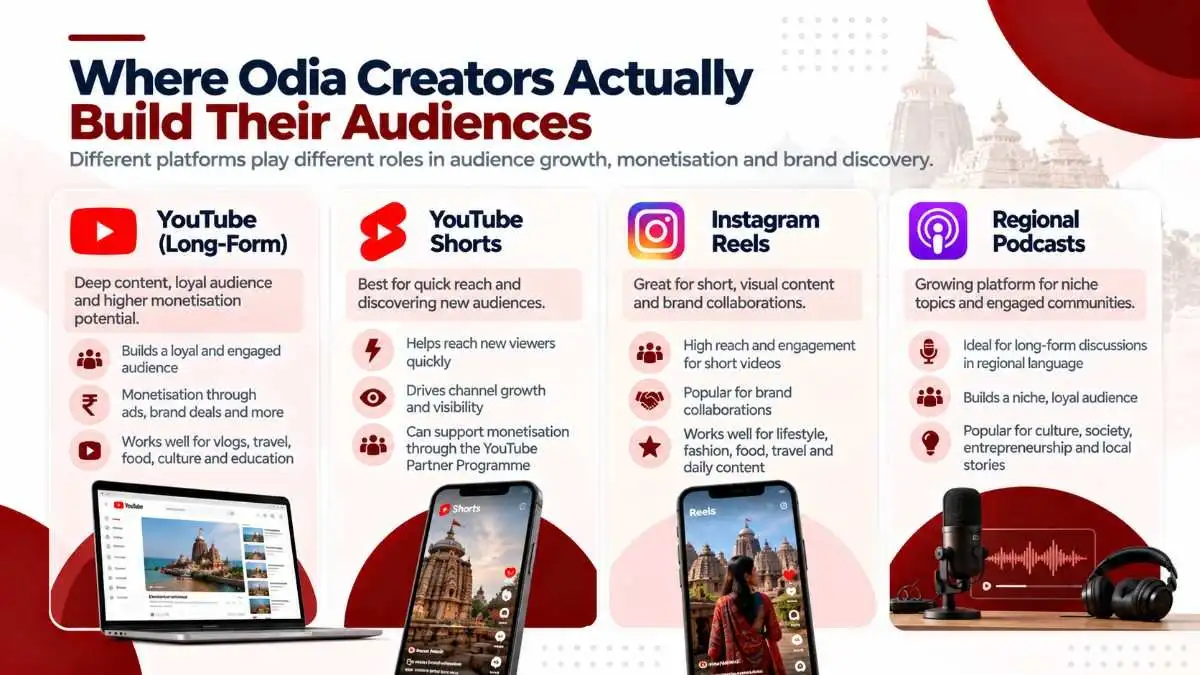
Three platform categories account for almost all real Odia-language creator activity: YouTube, Instagram, and a smaller but growing audio and podcast space. Each has a different role in actually building a sustainable creator business.
| Platform / format | Role in the creator's business | What the real search data shows |
|---|---|---|
| YouTube long-form | Primary ad-revenue generator; builds the deepest audience relationship | "Odia youtube channel" carries 390 monthly searches, though down 64% year over year as viewing habits shift toward Shorts |
| YouTube Shorts | Audience discovery and growth; weak direct ad revenue on its own | Covered in the earnings section below; no standalone Odia-specific search term exists for this yet |
| Instagram Reels | Fastest audience growth; main leverage point for brand deals, not platform payouts | "Odia reels" carries 260 monthly searches |
| Instagram, general creator identity | Where brands actually discover and vet a creator before a deal | "Odia instagram influencer" as a fused phrase has no measurable search volume; "odia influencers" (90/mo) and "odia vlogger" (260/mo) are the real terms people search |
| Regional audio and podcasts | Smaller, newer category; lower competition for an early creator | No standalone search-volume data returned; qualitative trend only, per the original draft's own observation |
One current term worth knowing even though it is not Odia-specific: "UGC creator," which carries 260 monthly searches in India and is rising 24% month over month. A UGC creator is paid to produce content a brand posts from its own account, rather than posting to their own following, and it is a realistic entry point for someone with a small, loyal Odia-language audience who does not yet have the follower count brands look for in a traditional influencer deal.
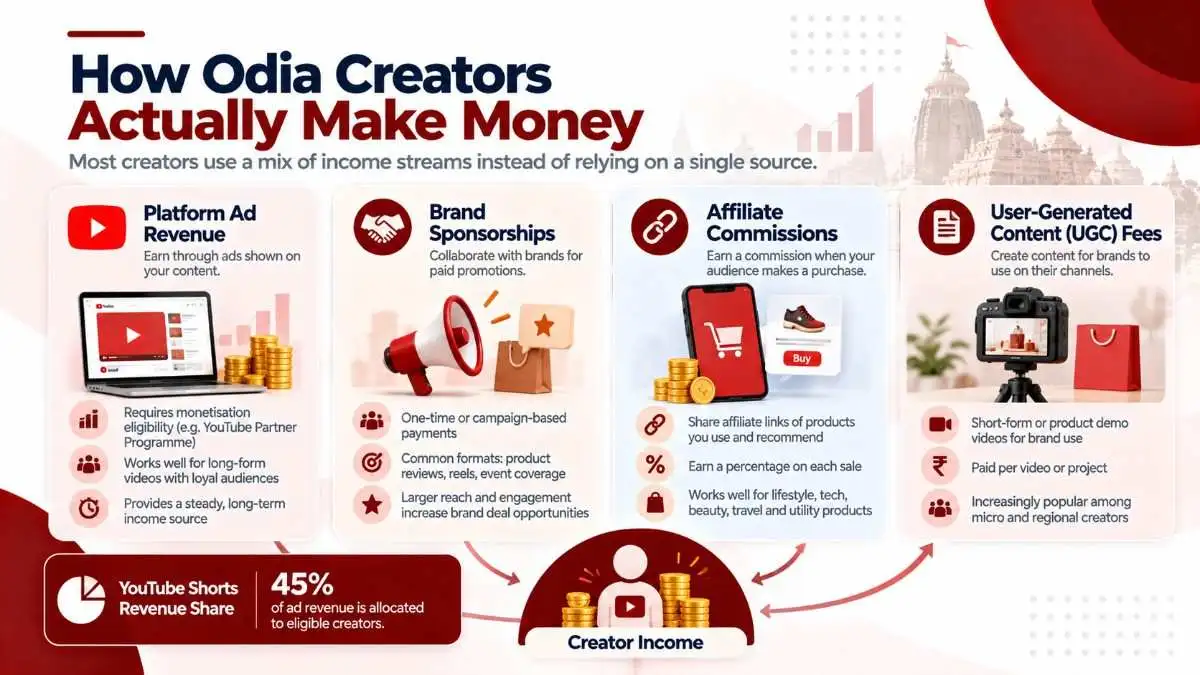
How Odia Creators Actually Make Money
There is no verified, Odisha-specific earnings figure anywhere, and we are not going to invent one. What is verifiable is exactly how each platform's monetization actually works, which matters more than a vague number anyway, since it tells a creator what they need to hit to get paid at all.
| YouTube Partner Program path | Requirement |
|---|---|
| Shorts monetization | 1,000 subscribers and 10 million valid Shorts views in the trailing 90 days |
| Long-form monetization | 1,000 subscribers and 4,000 valid public watch hours in the trailing 12 months |
| Fan funding only, no ads | 500 subscribers plus either 3 million Shorts views in 90 days or 3,000 watch hours in 12 months, with 3 public uploads in the last 90 days |
| Threshold change from 1 February 2027 | Long-form and Shorts paths rise to 8,000 watch hours or 20 million qualified Shorts views; the 1,000-subscriber requirement stays the same |
45% of pool share
Shorts ad revenue is pooled across all eligible Shorts, then split based on views and music usage, and creators keep 45% of their calculated share after that split. Most Shorts earn roughly 0.03 to 0.10 US dollars per 1,000 views as a result, well below long-form YouTube's reported RPM range of 1 to 30 dollars, which is the single biggest reason a Shorts-only strategy struggles to replace a day job on its own.
Beyond platform ad revenue, three other income sources make up most of a working creator's actual income, and all three carry real, searchable demand rather than invented keyword phrases.
Where the real money comes from, beyond ad revenue
- Brand sponsorships and instagram brand deals. The fastest-growing category in this research, up 191% year over year in search interest, and the category where regional creators now have genuine leverage.
- Affiliate marketing. Carries 480 monthly searches nationally; declining in search interest by 46% year over year, which likely reflects more creators already doing it rather than fewer opportunities.
- UGC content fees. Paid per piece of content rather than per view or follower count, making it accessible to a creator who has not yet hit platform monetization thresholds.
Brand Deals and Influencer Marketing: What's Really Happening
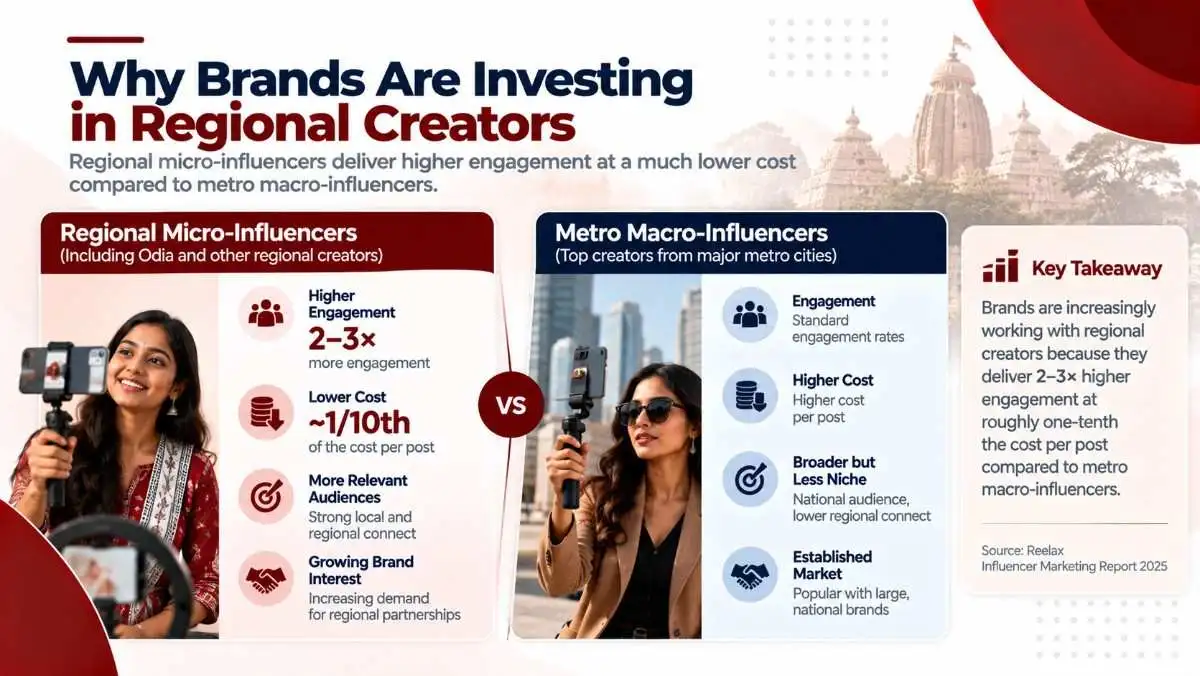
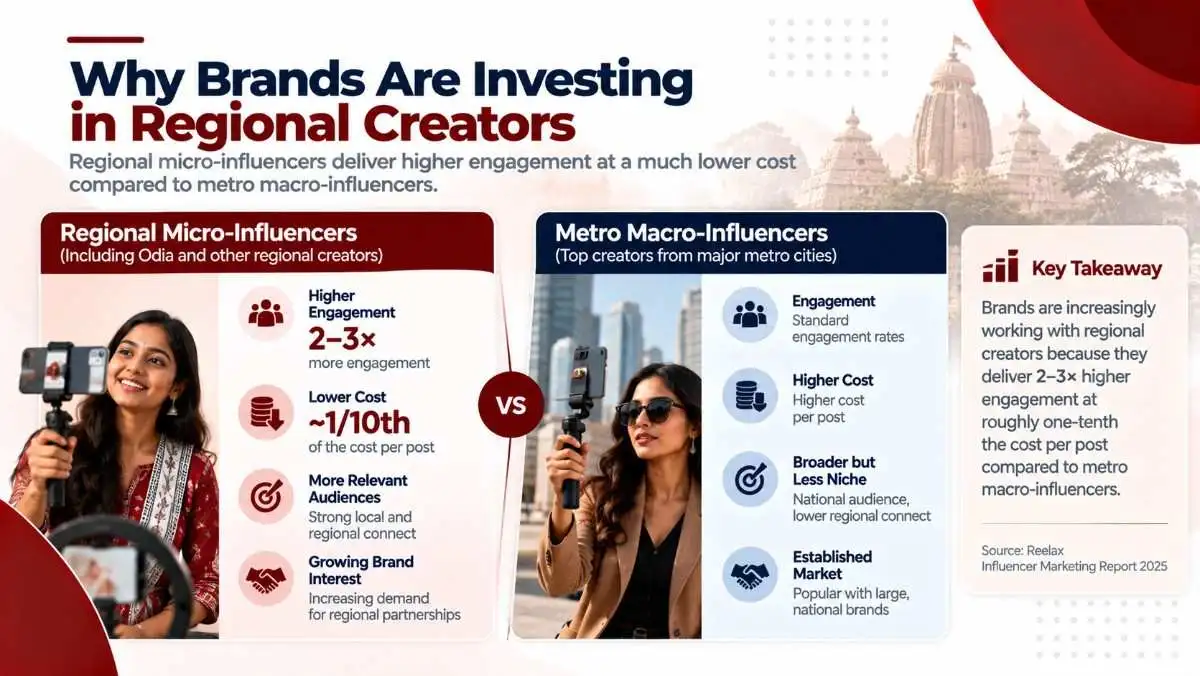
The clearest and most current shift in this entire space is that brands are actively moving budget away from a short list of metro celebrities and toward many smaller, regional creators, and the data on this is unusually specific.
2 to 3 times
Regional micro-influencers are reported to deliver two to three times the engagement rate of metro macro-influencers, at roughly one-tenth the cost per post, which is the economic reason brand budgets are shifting toward them rather than a goodwill gesture toward regional content (Reelax Creator Economy Report H1 2026).
Two years ago, a typical consumer brand put 70 to 80% of its creator budget into a short list of metro macro-influencers. The same report finds that budgets are now spread across many regional creators, often with 10,000 to 2 lakh followers, producing content in languages including Odia, Tamil, Telugu, Marathi, Bengali, and Kannada. Brand searches for creators outside India's top eight metro cities more than doubled year over year, and discovery of Kannada, Marathi, and Odia creators specifically grew faster than Hindi or English creator discovery over the same period.
| Metric | What changed |
|---|---|
| Regional vs. metro creator discovery searches | Regional discovery overtook metro discovery for the first time in March 2026 |
| Brand searches for creators outside the top 8 metros | More than doubled year over year |
| Odia, Kannada, Marathi creator discovery | Growing faster than Hindi or English creator discovery |
| Non-metro creators in paid brand campaigns | Rose from roughly 38,000 to over 4.08 lakh between 2020 and 2025 |
| Average creator-led brand campaign spend | Grew 3.6 times over the same five-year period |
For a brand trying to reach Odisha specifically, this means the right question has shifted from "should we use influencers at all" to "how do we find and vet the right ones," which is exactly the gap an Instagram marketing strategy or an agency built for D2C growth is meant to close.
The Real Challenges Facing Regional Creators
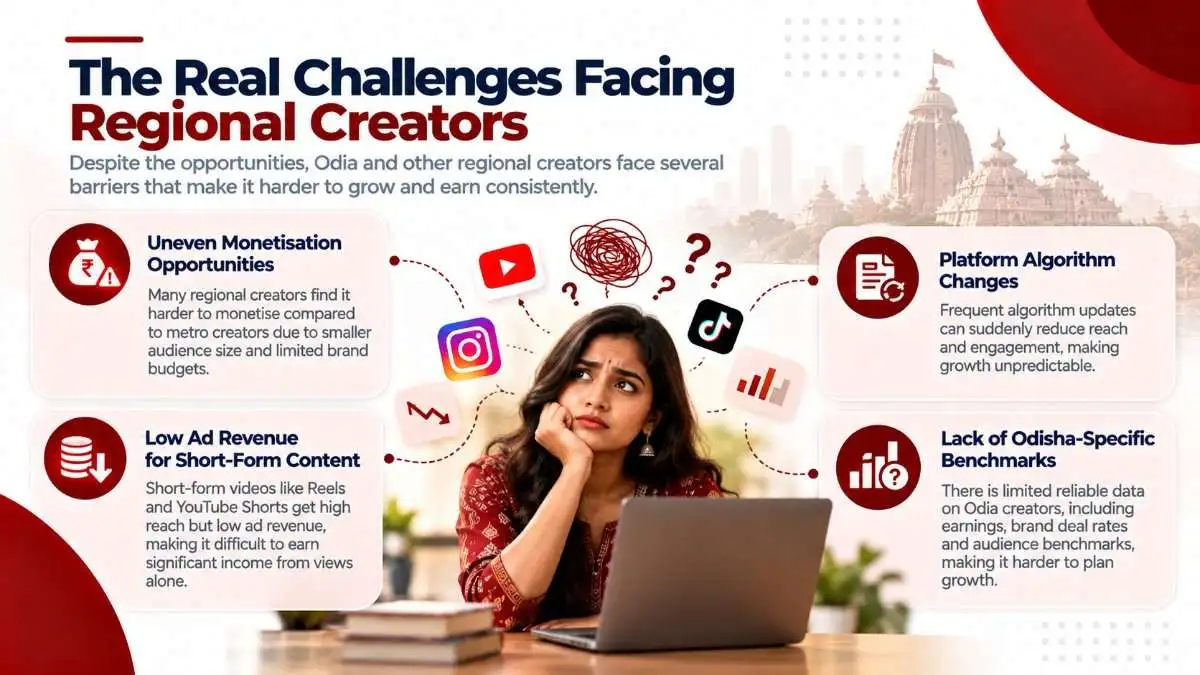
Regional-language creators face a specific set of structural problems that metro, English-language creators mostly do not, and the ISB-Hashfame data makes the biggest one explicit: monetisation remains uneven even as the creator base grows.
What actually slows a regional creator down
- Uneven monetisation. Most creators, even inside a fast-growing base, still complete only one paid brand campaign a year, according to the ISB-Hashfame Report, which means ad revenue and affiliate income carry more weight for regional creators than brand deals do, at least early on.
- Lower baseline ad RPM on Shorts specifically. At 0.03 to 0.10 dollars per 1,000 views, Shorts cannot realistically fund a full-time creator business without a second income stream layered on top.
- Platform and algorithm volatility. Distribution rules change without notice, and the YouTube Partner Program's own thresholds are set to rise again on 1 February 2027, which raises the bar for a creator who has not yet qualified.
- No regional-specific benchmark data. Every published report tracks this at the India level, so an Odia creator or a brand trying to plan a campaign has no reliable local baseline to compare against, only the national pattern.
A Practical Growth Framework for Odia Creators
Given the real data above, a working creator's priorities should follow the actual money, not the keyword someone else decided was important.
In order of what actually moves income
- Hit a monetization threshold on one platform first. Pick either the Shorts path (10 million views in 90 days) or the long-form path (4,000 watch hours in 12 months), since spreading effort across both delays qualifying for either.
- Treat Reels and Shorts as discovery, not income. Their job is building the audience that makes a creator fundable for brand deals and UGC work, not generating meaningful ad revenue on their own.
- Build a media kit before chasing brand deals. Brands discovering creators outside metro cities are actively looking; a creator who can show real engagement numbers and audience data is easier for a brand to say yes to.
- Layer affiliate income underneath everything else. It is the one income stream that does not depend on winning a sponsorship pitch, and it keeps earning between brand deals.
- Consider UGC work as a parallel track. It pays per piece of content rather than per follower count, making it available to a creator who has not yet built a large following.
What the National Reports Miss About Odisha
Every report cited in this article, the YouTube India Impact Report, the Reelax Creator Economy Report, and the ISB-Hashfame Report, tracks India as a whole or groups states into broad regional buckets. None of them isolate Odisha. That is a real, acknowledged gap, not something this article can close with a single audit, since no public dataset currently exists at that granularity.
What we can say, by placing these three reports side by side rather than reading any one of them in isolation, is that Odisha sits at the intersection of two converging trends that all three independently confirm: non-metro creators are growing far faster than metro creators (ISB-Hashfame), and brand budgets are actively following that growth into regional languages including Odia specifically (Reelax). Neither report had a reason to connect those two findings to each other for a reader trying to plan around Odisha; put together, they describe a market that is earlier and less competitive than the national averages suggest, which is itself useful information for a creator or brand deciding whether to invest now or wait.
An honest limitation
This is a synthesis of real, cited national and India-wide data, not a primary Odisha-specific audit. We have been explicit throughout about which numbers are verified and which questions currently have no public answer, rather than filling that gap with an invented statistic, because an unverifiable number is worse than an honest gap.
How Oddtusk Works With Regional Brands and Creators
As a social media company in Bhubaneswar, we sit on both sides of this market: we run paid and organic social for D2C brands that want to reach regional audiences, and we work directly with the kind of creator-discovery and content questions this article covers.
Where we actually help
- Building the Instagram and Reels presence that gives a brand or creator something real to show before chasing a partnership
- Setting up affiliate and UGC content pipelines that generate income without depending on a single sponsorship landing
- Running the research honestly, the way this article does, rather than reporting back invented regional numbers that cannot survive a second look
If you are a brand trying to figure out where regional creator partnerships fit into your marketing, or a creator trying to understand which platform and income stream to prioritize first, talk to our team and we will tell you plainly what the data does and does not support.
Building a brand that needs creator partnerships?
Tell us what you're trying to reach and we'll tell you honestly whether creator marketing, paid social, or both make sense for it.
Talk to Our Team
[ Common questions ]
Frequently Asked Questions
The creator economy is the business of people building an audience online and earning from it directly, through platform payouts, brand deals, and their own products, rather than through a traditional media job. There is no Odisha-specific revenue figure published anywhere, since DataForSEO and every industry report we checked track this only at the India or national level. What we can say with real data is that India's influencer marketing industry crossed roughly 3,600 crore rupees in 2024 and is on track to exceed 5,000 crore in the current financial year, and that regional-language discovery, Odia included, is growing faster than Hindi or English discovery.
Mainly through three channels: YouTube Partner Program ad revenue, brand sponsorships, and affiliate commissions. To join the Partner Program through Shorts, a channel needs 1,000 subscribers and 10 million valid Shorts views in the trailing 90 days; through long-form video, it needs 1,000 subscribers and 4,000 public watch hours in the trailing 12 months. Shorts ad revenue is pooled and split, and creators keep 45% of their share after YouTube's cut and any music-rights split, which is why most Shorts earn roughly 0.03 to 0.10 dollars per 1,000 views, far below long-form RPM of 1 to 30 dollars.
Reels remain the fastest way to build an audience in Odia, since search interest in the term itself has held steady, but direct Reels bonus payouts are no longer the main earning path for most creators. The real money for a Reels-first creator in 2026 comes from brand deals and affiliate links placed on top of that reach, which is also the fastest-growing category we found: instagram brand deals as a search term grew 191% year over year in India.
There is no published, verified earnings figure specific to Odia vloggers, and any exact number quoted online for this is not independently confirmed. What is verifiable is the shape of the opportunity: regional micro-influencers across India, a category Odia vloggers fall into, are reported to deliver two to three times the engagement rate of metro macro-influencers at roughly a tenth of the cost per post, which is why brand budgets are shifting toward them rather than staying concentrated in big-city creators.
A UGC creator is paid by a brand to produce content, typically a short video reviewing or demonstrating a product, that the brand then posts from its own account, rather than from the creator's. An influencer, by contrast, posts from their own account to their own audience. Search interest in ugc creator india has grown 24% month over month, making it one of the more current terms in this space, and it is a realistic entry point for a creator with a small but engaged Odia-language following who does not yet have the follower count brands look for in influencer deals.
Increasingly through dedicated creator-discovery platforms rather than manual searching, and the data shows this shift clearly: brand searches for creators outside India's top eight metro cities more than doubled year over year, and regional discovery searches overtook metro discovery searches for the first time in March 2026. Odia creator discovery specifically was reported to be growing faster than Hindi or English creator discovery over the same period.
It depends on scale. A brand running one or two creator partnerships a quarter can usually manage outreach, contracts, and reporting directly. Once a brand wants to run campaigns across multiple regional languages and track performance consistently, an agency becomes worth the cost, which is reflected in real search demand: influencer marketing agency india carries 1,300 monthly searches in India with a very low keyword difficulty of 4, suggesting brands are actively looking for agency help rather than figuring this out alone. Our D2C growth agency work covers exactly this kind of planning.
Yes, though search interest in affiliate marketing india has declined 46% year over year, which likely reflects more creators already using it rather than people newly researching it. For a regional-language creator, affiliate commissions are usually the most reliable income stream between brand deals, since they do not depend on winning a sponsorship pitch and can run continuously once a creator has built even a modest, loyal following.
Sources
- YouTube and Oxford Economics (2026). YouTube India Impact Report 2025, as reported by MediaNews4U, September 2026.
- Reelax (2026). Creator Economy Report H1 2026, as reported by Deccan Chronicle.
- ISB and Hashfame (2025). Non-metro creators now dominate India's creator economy: ISB-Hashfame report, as reported by UNI India.
- vidIQ (2026). YouTube Shorts Monetization in 2026: Requirements, RPM, and How Much You Get Paid, last updated 28 May 2026.
- Oddtusk, keyword and search-demand research using DataForSEO Labs Google Keyword Data (location: India), October 2026.

About the author
Sanjay Ananda
Founder and CEO, Oddtusk
Sanjay Ananda founded Oddtusk in Bhubaneswar and leads its social media, SEO, AEO, and growth engineering work for D2C brands and businesses across India, the US, and the UK, including the regional creator and influencer marketing research described in this article.
