

Why understanding user intent beats chasing keyword volume in the age of AI-powered search.
Entity-Based SEO: How AI Understands Your Content Context
Date: 04 - 27 - 2026
Time to read: 10 minutes
[ Table of
Content ]
What Is Entity-Based SEO, and Why Has It Replaced Keyword Thinking?
Google no longer reads your content the way a keyword tool does. It reads it the way a researcher would, looking for who you are, what you know, which concepts you cover, and how those concepts connect to each other and to the broader world of established knowledge.
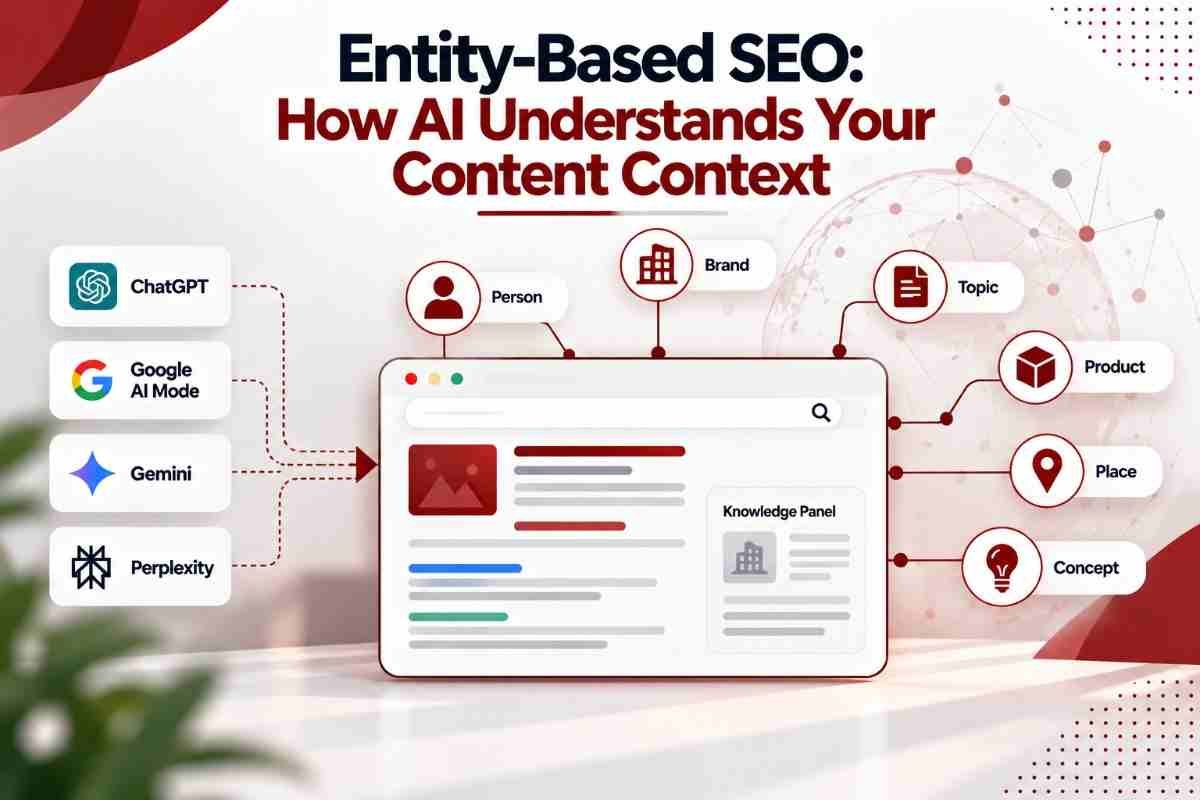
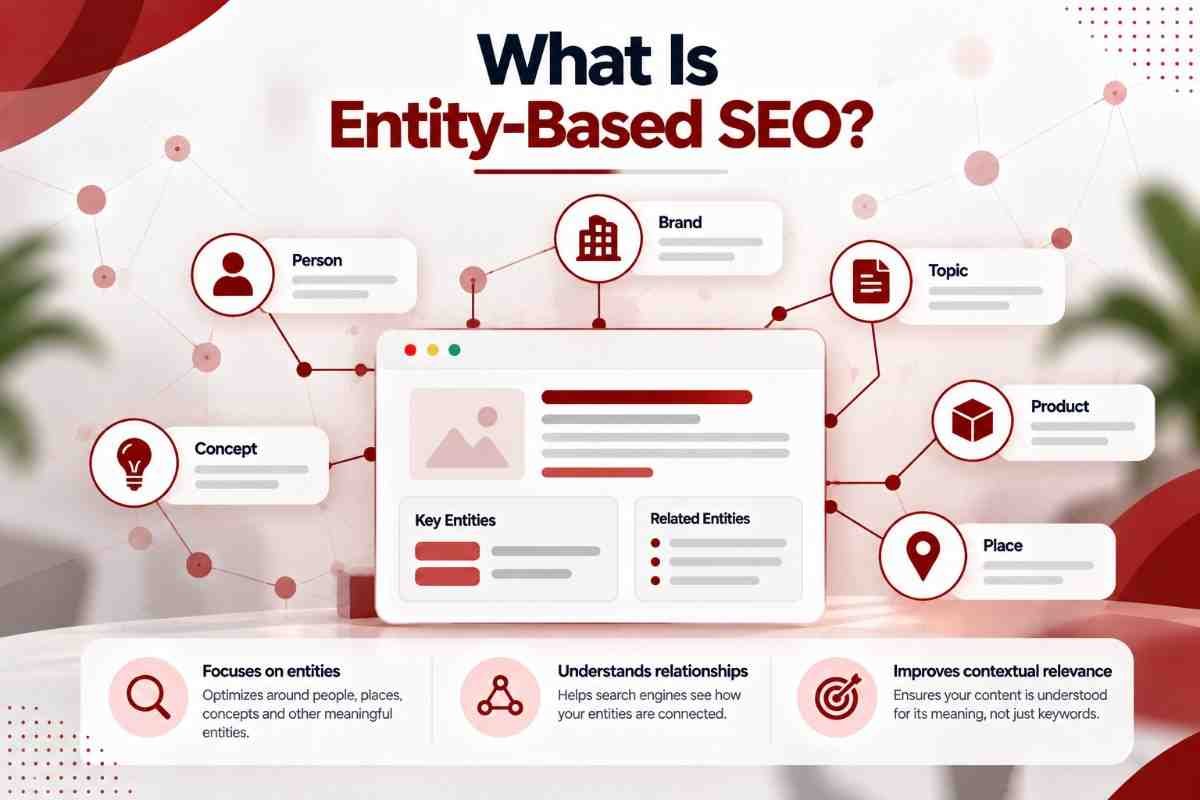
This is the foundation of entity-based SEO: optimizing content around distinct, well-defined concepts, called entities, rather than around isolated keyword phrases. An entity is anything the real world can uniquely identify: a person (Sanjay Ananda), a brand (Oddtusk), a place (Bhubaneswar), a concept (semantic SEO), a product (ChatGPT), or an event (Google I/O 2026). Each entity has attributes, and each entity relates to other entities in ways that form a structured web of knowledge.
For AI-powered search platforms like Google AI Mode, Perplexity, and ChatGPT Search, this entity web is the primary lens through which your content is understood, ranked, and cited. Simple keyword matching is no longer enough. Topical authority, built on rich entity coverage and semantic relationships, is what earns visibility in AI-generated answers.
Key Insight
Entity-based SEO is not a new tactic, it is the structural foundation of how modern AI search
engines understand all content. Every optimization decision you make should align with this reality.
How Google's Knowledge Graph Turns "Strings" into "Things"
Launched in May 2012, Google's Knowledge Graph is a massive semantic database that stores billions of entities and the factual relationships between them. Within seven months of its launch, it had tripled in size. Today it contains billions of facts, and it is the backbone of almost every AI-driven search feature Google has released since.
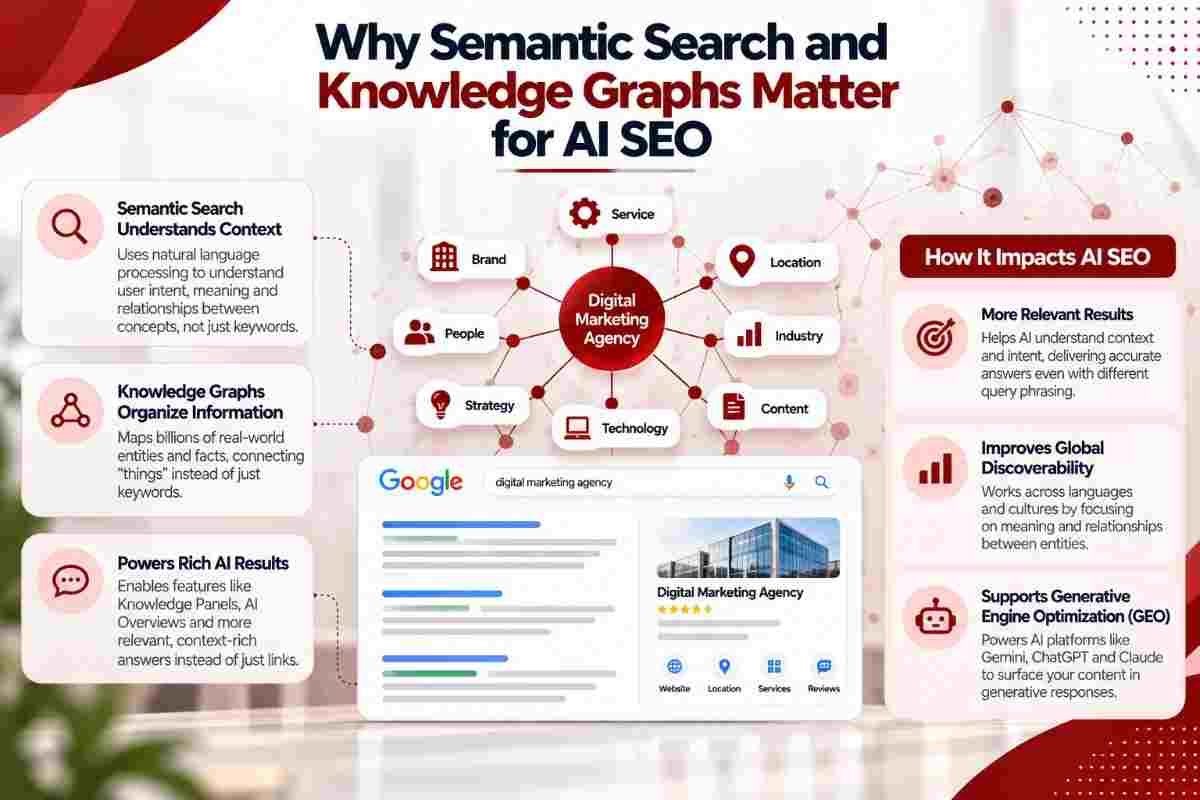
Before the Knowledge Graph, Google matched character strings in queries to character strings on pages. After it, Google shifted from matching strings to understanding things. When you search for "Elon Musk," Google does not scan pages for the string "Elon Musk", it retrieves everything it knows about the entity Elon Musk: his role as CEO of Tesla and SpaceX, his connection to the acquisition of Twitter (now X), his net worth, his companies, his public statements. The results reflect this deep entity understanding, not just keyword co-occurrence.
For SEO, this changes everything. If your brand, content, or expertise is recognized as an entity within Google's Knowledge Graph, connected to related topics, verified by authoritative sources, and consistently represented across the web, your content becomes dramatically easier for AI systems to retrieve, understand, and surface in both traditional results and AI-generated answers.
What Powers the Knowledge Graph
Google's Knowledge Graph draws data from a range of structured and semi-structured sources to build its entity database:
- Wikipedia and Wikidata. The primary sources for entity definitions, attributes, and relationships. Getting a Wikipedia page or Wikidata entry significantly strengthens your brand's entity recognition.
- Schema.org structured data. JSON-LD markup on your website explicitly tells Google what
entities your pages describe and how they connect. The
sameAsproperty links your entities to recognized sources, giving Google the context it needs to verify them. - Google Business Profile (GBP). For local and organizational entities, GBP is a powerful signal. Consistent NAP (Name, Address, Phone) data across GBP and other directories reinforces your entity in the graph.
- Authoritative third-party mentions. References to your brand or content on high-authority, topically relevant websites help Google confirm that your entity is real, established, and trustworthy.
Suggested reading:Schema Markup for
SEO: A Complete Guide to Structured Data
How Semantic Search and AI Models Interpret Your Content
Semantic search is the underlying mechanism that makes entity-based SEO work. Rather than matching keyword strings, semantic search uses advanced NLP models to understand the meaning, intent, and context of both the query and the content.
Google's current AI infrastructure processes content through several overlapping systems:
- BERT (Bidirectional Encoder Representations from Transformers). Launched in 2019, BERT was Google's first major step toward semantic search. It reads words in both directions simultaneously to understand context, "bank" near "river" means something entirely different from "bank" near "loan." BERT processes hundreds of millions of queries daily.
- MUM (Multitask Unified Model). 1,000 times more powerful than BERT, MUM can understand and generate language across 75 languages simultaneously, interpret images and text together, and handle complex, multi-step queries. It's the system that powers Google's ability to understand nuanced, conversational searches.
- Gemini. Google's most advanced multimodal model, integrated into Search, AI Overviews, and the Knowledge Graph itself. Gemini can reason across text, images, video, audio, and structured data, making entity recognition and relationship mapping significantly more sophisticated.
For content creators and SEOs, this means that surface-level keyword optimization is invisible to these systems in the ways that matter most. Content that is entity-rich, contextually coherent, and organized around clear semantic relationships gives AI models far more to work with, and far more reason to retrieve, trust, and surface your pages.
Why Entity-Based SEO Matters More Than Ever in AI-First Search
The shift to AI-powered search is accelerating fast. Google's AI Overviews now appear for an estimated 47% of US searches. Perplexity processed over 500 million queries in early 2026. ChatGPT Search is adding millions of weekly active users. In every one of these systems, entity recognition and knowledge graph alignment determine which content gets cited and which gets ignored entirely.
1. Enhanced Semantic Relevance and Rankings
When you build content around clearly defined entities and their relationships, AI ranking systems can map your content to user intent with far greater accuracy. You rank not just for the exact phrase you targeted, but for the entire cluster of semantically related queries, because the AI understands what your content is about, not just which words it contains. This is how entity-focused content wins long-tail traffic at scale.
2. Knowledge Panels and Rich Results
Structured entity data is the direct driver of Knowledge Panels, Featured Snippets, and AI Overviews. Google surfaces these rich features specifically when it has high entity confidence, when it recognizes your brand or content as a well-defined, well-connected entity within its knowledge graph. Without entity signals, these features are essentially inaccessible, regardless of your keyword rankings.
3. Voice Search Compatibility
Voice queries are conversational, full-sentence, and intent-driven, exactly the type of input that entity-based content is best positioned to answer. When a user asks their assistant "Which SEO agency in Bhubaneswar specialises in semantic SEO?", the answer pulled is from entity-rich content that explicitly defines the brand, location, expertise, and service relationship, not from a page that keyword-stuffed those terms.
4. Topical Authority and E-E-A-T
Google's E-E-A-T framework (Experience, Expertise, Authoritativeness, Trustworthiness) maps almost perfectly onto entity-based SEO. Demonstrating expertise means your content covers topic entities comprehensively. Authoritativeness means your brand entity is cited and referenced by other established entities. Trustworthiness means your entity claims are consistent, verifiable, and backed by structured data. Topical authority mapping built around entity clusters is the most effective way to signal all four E-E-A-T dimensions simultaneously.
5. Future-Proofing Against Algorithm Changes
Keyword trends fluctuate. Algorithm updates shift ranking factors. But entities, real-world concepts and their relationships, remain stable over time. A content strategy built around your brand's entity ecosystem is inherently more durable than one built around ephemeral keyword volumes. When you are recognized as the authoritative entity for your topic area, algorithm changes tend to move you up, not down.
Suggested reading:Why Topical Authority
Matters in AI Search
How to Build an Entity-Based SEO Strategy: 7 Actionable Steps
Moving from keyword-centric to entity-centric SEO is not a single tactic, it is a strategic restructuring of how you create, organize, and signal your content. Here is a practical framework you can implement immediately.
Step 1: Map Your Core Entities and Their Relationships
Start by identifying every entity your brand needs to own: your organization, your products or services, your key people, your locations, and the core topics and concepts you cover. Then map how these entities relate to each other, and to established entities in your industry.
Think of this as building a mini knowledge graph for your brand. Your brand entity connects to your service entities, which connect to industry concept entities (e.g., "semantic SEO" → "knowledge graph" → "structured data" → "schema markup"). Every relationship you map is a semantic signal that AI systems can follow.
Step 2: Implement Schema.org Structured Data Comprehensively
Schema markup is the primary technical tool for communicating entity information to search engines. Use JSON-LD (the format Google recommends) to annotate every key entity on your site. At minimum, implement:
- Organization schema with name, URL, logo, address, founding date, social profiles, and
sameAslinks to Wikipedia, Wikidata, and authoritative directories. - Person schema for key authors and team members, connecting them to your Organization entity.
- BlogPosting / Article schema with
aboutproperties that explicitly name the entities your content covers. - FAQPage schema for question-based sections, directly targeting PAA (People Also Ask) placements.
- HowTo schema for step-by-step content, one of the highest-performing structured data types for AI Overviews.
"about": [
{ "@type": "Thing", "name": "Knowledge Graph", "sameAs": "https://en.wikipedia.org/wiki/Knowledge_graph" },
{ "@type": "Thing", "name": "Semantic Search", "sameAs": "https://en.wikipedia.org/wiki/Semantic_search" }
]
{ "@type": "Thing", "name": "Knowledge Graph", "sameAs": "https://en.wikipedia.org/wiki/Knowledge_graph" },
{ "@type": "Thing", "name": "Semantic Search", "sameAs": "https://en.wikipedia.org/wiki/Semantic_search" }
]
The sameAs property is particularly powerful, it links your content's
entities to verified, authoritative sources, giving Google the context it needs to place your
content within the broader knowledge graph.
Step 3: Build Entity-Anchored Internal Linking
Your internal linking architecture should reflect your entity map. When linking between content pieces, use entity names and related concepts as anchor text, not generic phrases like "click here" or "read more." This signals semantic proximity to crawlers and builds a topical web that mirrors knowledge graph structure.
For example: a pillar page on "Semantic SEO" should link to cluster pages on "Entity-Based SEO," "Knowledge Graph Optimization," "Topical Authority Mapping," and "Intent vs Keywords" using those exact entity-aligned anchor texts. Each link reinforces the topical relationships that AI systems use to understand your content ecosystem.
Step 4: Create a Content Knowledge Graph on Your Website
Design your content architecture as a mini knowledge graph, clusters of entity-rich, contextually linked pages that together cover a topic comprehensively. A well-structured content strategy built around entity clusters does two things simultaneously: it signals topical authority to search engines, and it gives users a complete, interconnected knowledge resource that keeps them engaged.
Pillar pages cover the core entity (e.g., "Semantic SEO"). Cluster pages cover the sub-entities and related concepts (e.g., "Entity-Based SEO," "Topical Authority," "Intent Mapping," "Schema Markup"). Every cluster page links back to the pillar and cross-links to relevant sibling pages, creating the node-and-edge structure that knowledge graphs use.
Step 5: Establish Your Brand Entity Off-Site
Search engines build entity profiles by aggregating signals from across the web, not just from your own site. To strengthen your brand entity in Google's Knowledge Graph:
- Create and maintain a Wikidata entry for your brand with all relevant properties linked to verified sources.
- Keep your Google Business Profile complete, accurate, and active, especially for local entity signals.
- Maintain consistent NAP (Name, Address, Phone) across all major directories: Crunchbase, LinkedIn, AngelList, industry associations.
- Earn brand mentions and backlinks from authoritative, topically relevant sources, each mention strengthens your entity's presence in the knowledge graph.
Step 6: Optimize for Generative Engine Optimization (GEO)
Entity-based SEO and AEO/GEO optimization are deeply intertwined. To be cited in AI-generated answers, your content needs to be entity-rich, structured, and explicitly machine-readable. Practical GEO steps include:
- Create an llms.txt file at your domain root listing your most authoritative pages, this helps AI crawlers understand your content hierarchy.
- Structure content in direct Q&A format for sections targeting PAA and AI Overview placement.
- Add SpeakableSpecification schema to highlight content segments suited for voice assistant responses.
- Keep entity information consistent and verifiable, AI systems cross-reference claims against their training data and real-time sources.
Step 7: Track Entity Visibility in AI Features
Traditional rank tracking measures keyword positions. Entity SEO requires tracking a different set of metrics: Knowledge Panel appearance, AI Overview citations, brand mention frequency in LLM responses, and technical audit completeness for structured data. Monitor your entity visibility in AI features alongside conventional SERP performance, and adapt your entity signals when you see gaps.
Entity SEO in the Age of Generative Search: The GEO Connection
The rise of Generative Engine Optimization (GEO), optimizing content to be surfaced by AI answer engines like Perplexity, ChatGPT Search, and Google's AI Mode, is the natural evolution of entity-based SEO for the AI-first era.
These platforms do not crawl the web and rank pages in the traditional sense. They retrieve information from entities they trust, synthesize answers from multiple sources, and cite the ones that provided the most clearly structured, verifiable, entity-rich content. The content that gets cited is, almost without exception, content that is:
- Rich in entity definition, clearly explaining what entities are and how they relate.
- Structured with schema markup, making entity attributes machine-readable without guesswork.
- Organized in topic clusters, demonstrating comprehensive authority over the entity's knowledge domain.
- Verified by off-site entity signals, brand mentions, directory listings, and consistent NAP data that confirm the entity's real-world existence.
In short: if you build entity-based SEO correctly, GEO readiness is largely a natural outcome. The same signals that help Google understand your content in traditional search are the signals that AI answer engines use to decide whether to trust and cite your content.
Oddtusk Perspective
We have seen clients who built comprehensive entity clusters with proper schema markup gain
Knowledge Panel appearances and AI Overview citations within 60–90 days, without a single link
building campaign. Entity clarity is the lever most brands are still ignoring.
Conclusion: Entity Clarity Is the New Competitive Advantage in AI Search
The shift to entity-based SEO is not a technical trend, it is a fundamental change in how search engines understand the world. Google, Perplexity, ChatGPT Search, and every AI-powered discovery platform that follows them are built on knowledge graphs, entity recognition, and semantic relationships. Content that maps clearly onto this structure earns visibility. Content that does not, regardless of how well it targets keywords, increasingly disappears from the surfaces that matter.
The brands that win in AI-first search are those that invest in becoming recognized entities: consistent, authoritative, well-connected, and structured in ways that machines can read and humans can trust. That means building entity profiles through schema markup, establishing off-site entity presence through directories and authoritative citations, creating topic clusters that demonstrate comprehensive knowledge authority, and optimizing for the AI engines that now influence how half the world's search queries are answered.
Entity-based SEO is also more durable than any keyword strategy. Keyword trends shift with every Google update. Entities, real-world concepts and the relationships between them, remain stable. When your brand is a recognized entity in Google's Knowledge Graph, algorithm changes tend to work in your favour, not against you.
At Oddtusk, our semantic SEO practice is built around entity mapping, knowledge graph alignment, and GEO-ready content architecture. We help brands move from invisible keyword pages to recognized entities that AI systems trust, cite, and surface. Explore our AEO/GEO optimization services or book a strategy call to start building your entity presence today.
[ Common questions ]
Entity-Based SEO FAQs
Entity-based SEO is the practice of optimizing content around distinct, well-defined concepts, called entities, rather than around isolated keyword strings. Entities can be people, brands, places, products, events, or abstract concepts. AI-powered search engines like Google map entities into knowledge graphs and understand how they relate to each other, giving users contextually richer results than simple keyword matching can produce.
Keyword SEO targets specific search phrases to match what users type. Entity-based SEO targets the underlying concepts, the meaning, behind those phrases. A keyword approach targets "best SEO agency"; an entity-based approach ensures your brand is recognized as a distinct, authoritative entity within the "SEO agency" topic cluster. Entity SEO is more durable because entities remain stable even as keyword trends fluctuate.
Google's Knowledge Graph is a semantic database launched in 2012 that stores billions of entities and the factual relationships between them. It powers Knowledge Panels, AI Overviews, Featured Snippets, and rich results. Brands and content recognized within the Knowledge Graph benefit from dramatically increased visibility in these AI-driven features, which now appear for nearly half of all Google searches in markets like the US.
Start by identifying your core entities, brand, products, people, topics, and
locations. Add comprehensive JSON-LD structured data linking your entities to
authoritative sources via sameAs. Build internal links using entity names
as anchor text. Create topic clusters (pillar + cluster pages) that cover your entity
domain comprehensively. Establish your brand entity off-site through Wikipedia,
Wikidata, Google Business Profile, and consistent directory listings.
Schema markup is the primary technical language for communicating entity information
to search engines. Implemented via JSON-LD, it explicitly tells Google what each
element of your page represents (Organization, Person, Product, Article, etc.) and how
those elements relate to each other. The sameAs property is especially
powerful, it connects your entities to verified, authoritative sources like Wikipedia
and Wikidata, helping Google place your content within its Knowledge Graph.
Yes, significantly. Voice queries are conversational, intent-driven, and phrased as full questions, which aligns naturally with entity-aware content. Content that directly answers questions, uses natural language, and includes FAQ and SpeakableSpecification schema is far more likely to be returned as a voice search answer or featured snippet than content optimized purely for keyword density.
Generative Engine Optimization (GEO) is the practice of optimizing content to be cited in AI-generated answers from platforms like Perplexity, ChatGPT Search, and Google AI Mode. It is the natural evolution of entity-based SEO for AI-first search. Content that is entity-rich, structured with schema, and organized into clear knowledge clusters is far more likely to be retrieved and cited in AI answers than content optimized only for traditional keyword rankings.
To build your brand's presence in the Knowledge Graph: create or claim a Wikipedia
page if your brand meets notability criteria; add your brand to Wikidata with verified
properties; maintain consistent NAP across Google Business Profile, Crunchbase,
LinkedIn, and major directories; add Organization schema markup with
sameAs links to all authoritative profiles; and build branded mentions
and backlinks from topically relevant, authoritative sources.
Topic clusters are groups of content pages organized around a core entity (pillar page) and its related sub-entities (cluster pages). In entity-based SEO, this structure mirrors how a knowledge graph organizes information, central nodes connected to related nodes. A well-built topic cluster signals comprehensive topical authority to AI search engines and makes it easier for them to understand and surface your full content ecosystem across related queries.
Semantic search uses NLP models (like Google's BERT, MUM, and Gemini) to understand the meaning, intent, and context of queries and content, not just the keywords. Entity-based SEO aligns your content with how these semantic systems interpret topics. By mapping your content to known entities and their relationships, rather than relying on keyword density, you give AI models far more to work with, which translates to better ranking, higher E-E-A-T recognition, and greater visibility in AI-generated answers.
