

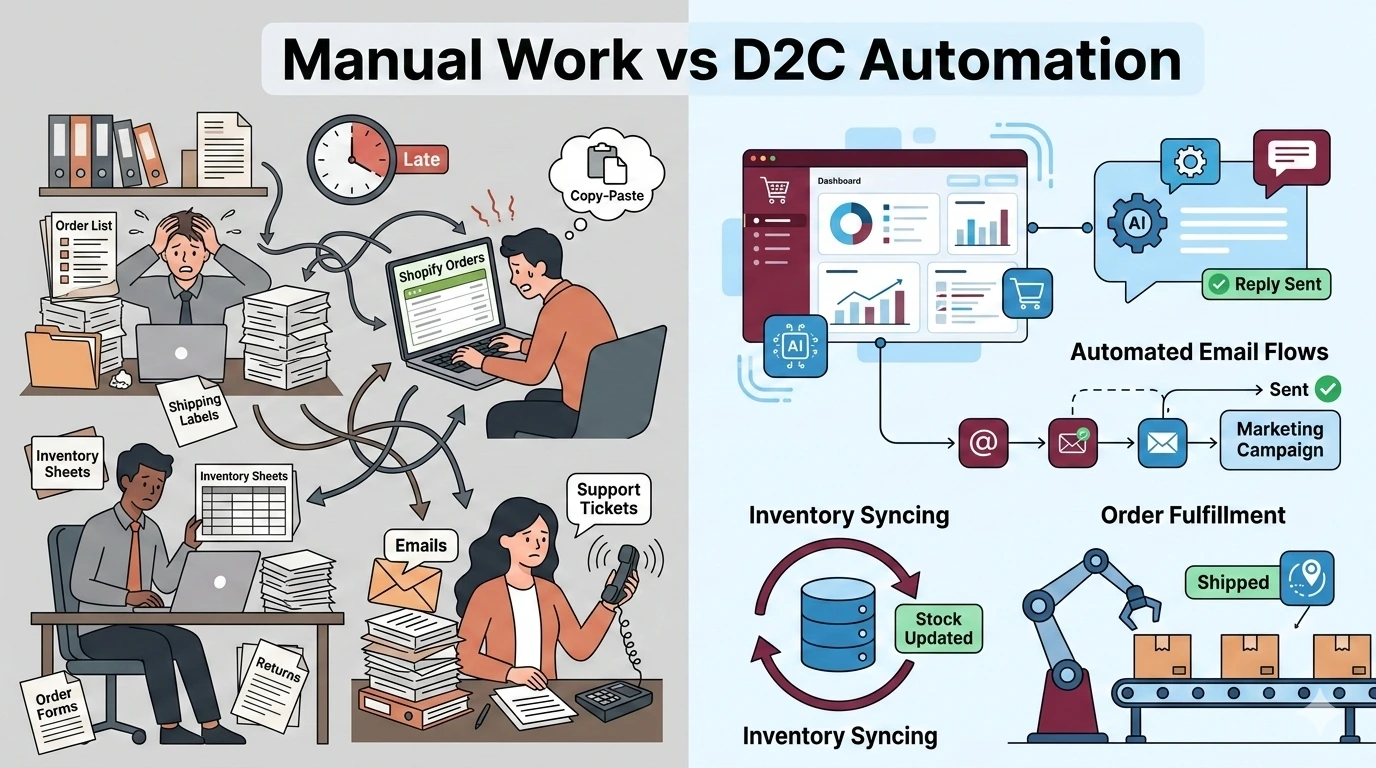
“We’re doing great revenue — but somehow we’re always behind.”
Sound familiar? If you’re running a D2C brand and you have a team that somehow never has enough hours, a customer service inbox that looks like a battlefield, and an ops team copy-pasting orders into spreadsheets at 11 PM — congratulations, you’ve officially outgrown manual processes. The bad news? You probably outgrew them six months ago.
Here’s the cold truth: most D2C brands don’t fail because of bad products. They fail because they scaled their revenue without scaling their operations. The result? Burnout, errors, slow response times, unhappy customers, and a brand that slowly bleeds itself dry from the inside.
In 2026, automation isn’t some futuristic concept reserved for Amazon and Walmart. It’s what gives a 10-person D2C brand the operational muscle of a 100-person company. And the brands winning right now? They figured that out early.
Let’s break down exactly why automation is critical for your brand — backed by data, real examples, and zero corporate fluff.
1. The Hidden Tax of Doing Things Manually
Every manual task your team does is silently invoicing you. The bill just doesn’t show up until it’s too late.
Think about what “manual” actually means in a D2C operation on a busy sale day. Someone is:
1) Exporting orders from Shopify and reformatting them for your 3PL
2) Manually tagging customer segments in your email platform
3) Copy-pasting tracking numbers and sending “your order shipped” emails one at a time
4) Updating inventory counts across three different platforms
5) Replying to the same “where is my order?” question for the 40th time that day
Now multiply that by every sale, every restock, every return, every campaign. That’s not a team — that’s a treadmill.
“The opportunity cost of manual work isn’t just time, it’s the innovation that never happened because your best people were stuck doing repeatable tasks.”
Gartner Research on Intelligent Process Automation, 2023
A study by Salesforce (2024) found that employees spend an average of 5.5 hours per week on tasks that could be automated. For a 10-person team, that’s 55 hours a week — over a full-time employee’s worth of output evaporating into repetitive busywork.
2. Customer Experience Is a Speed Game. Manual Processes Make You Slow.
Customers don’t care if you’re “a small team.” They care if their package arrived.
The modern D2C customer is ruthlessly impatient and they have every right to be. They’ve been trained by Amazon Prime, Zomato 10-minute deliveries, and instant customer support chat. The moment your experience feels slow, dated, or impersonal, they scroll on.
Here’s what the data says about post-purchase expectations in 2025:
1) 90% of customers rate immediate response (under 10 minutes) as “very important” — HubSpot, 2024
2) 69% of shoppers abandon brands after one poor post-purchase experience — Narvar Consumer Report, 2024
3) Brands with automated order tracking see 33% fewer WISMO tickets — Loop Returns, 2023
4) Automated win-back email sequences have an average open rate of 46.5% vs. 22% for batch-and-blast — Klaviyo Benchmark, 2024
When you automate post-purchase flows shipping confirmations, delivery updates, review requests, and return initiations. you’re not cutting corners. You’re delivering a faster, more consistent experience than a manual team ever could.
3. CAC Is Rising. Retention Is Your Only Moat. Automation Enables Both.
Acquiring a new customer costs 5x more than retaining one. In a high-CAC world, automation isn’t optional — it’s your profit lever.
Meta CPMs have risen over 61% since 2021. Google Shopping CPCs are up 19% year-over-year. If you’re relying on paid ads alone and not converting + retaining aggressively, your brand has a leaking bucket problem.
Here’s what automation does for your retention engine:
1) Automated post-purchase sequences — onboard customers into the brand story, educate them on the product, upsell at the right moment
2) Dynamic segmentation — automatically move customers across lifecycle segments based on real purchase behaviour
3) Loyalty trigger automation — reward milestones without any manual tracking
4) Predictive churn flows — identify customers likely to churn and automatically send re-engagement campaigns
5) Subscription reminder & replenishment nudges — trigger reorder reminders based on average product usage cycle
According to Klaviyo’s 2024 Ecommerce Benchmarks, brands with fully automated lifecycle email flows generate 36% more revenue per recipient. Repeat customers represent 27% of customers but drive 43% of revenue.
4. Inventory & Operations: Where Manual Work Gets Expensive Fast
Overselling a product you don’t have. Sitting on dead stock worth lakhs. These aren’t bad luck. they’re what happens without automation.
Inventory management is one of the most painful and costly areas where D2C brands bleed money when operating manually:
1) Overstocking costs D2C brands an average of 25–30% of inventory value in holding costs — Wayfair Supply Chain Study, 2023
2) Stockouts result in an estimated $1.1 trillion in lost global retail sales annually — IHL Group, 2023
3) Brands using automated replenishment algorithms reduce stockouts by up to 40% — McKinsey Operations Practice, 2024
Automation in operations means:
1) Auto-syncing inventory across Shopify, marketplaces, and your 3PL in real-time
2) Automated purchase order triggers when SKUs drop below a threshold
3) Real-time low-stock alerts to pause ad campaigns before you oversell
4) Automated return reconciliation and restocking
5) Dynamic product labelling — automatically marking items as “low stock” to boost urgency
By The Numbers Brands that implement inventory automation see an average 20–30% reduction in carrying costs and up to 50% fewer fulfilment errors within the first 6 months of deployment. (Source: Brightpearl Operational Excellence Report, 2024)
5. Marketing Automation: From Spray-and-Pray to Precision Targeting
Batch-and-blast emails are the marketing equivalent of using a hosepipe to water a single plant. You’re wasting a LOT of water.
The best D2C marketers today aren’t the best copywriters or designers. They’re the best at building systems that deliver the right message, to the right person, at the right moment — without lifting a finger.
What automation unlocks in marketing:
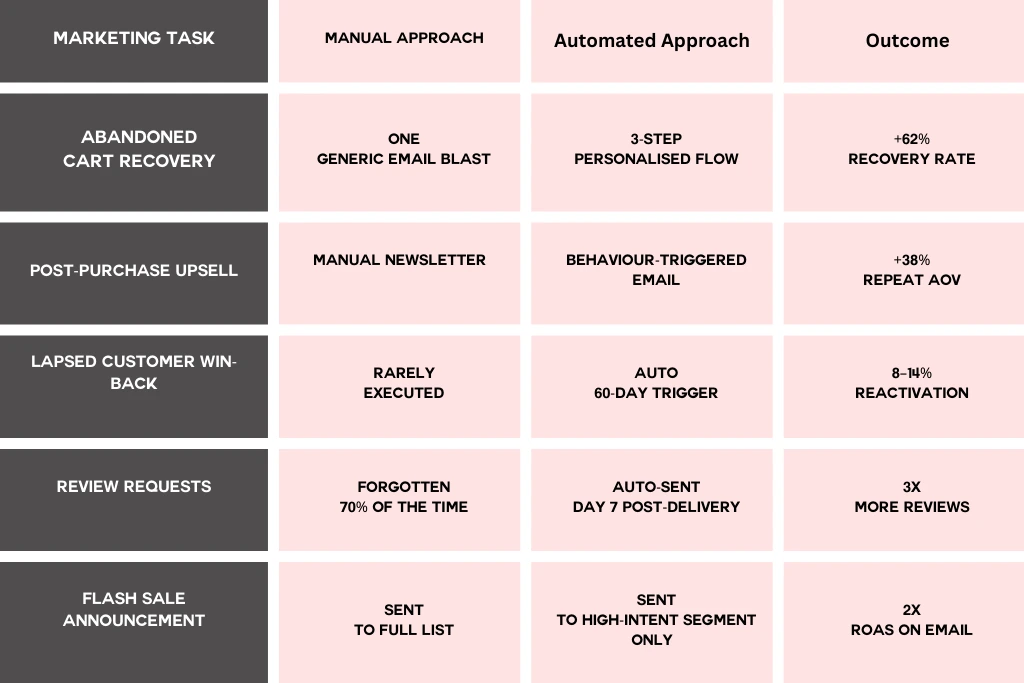
1) Abandoned cart recovery — a 3-step automated series converts 5–15% of abandoners; average recovery of $5.81 per recipient (Klaviyo, 2024)
2) Browse abandonment flows — reach customers who viewed products but didn’t add to cart
3) Cross-sell/upsell triggers — automatically recommend complementary products 7–10 days post-purchase
4) Review & UGC request sequences — automatically ask for reviews at peak satisfaction moments post-delivery
5) SMS automation — high-converting personalised SMS with 98% open rates (Attentive, 2024)
6) Dynamic personalisation — show different banners, subject lines, and offers based on customer behaviour history
6. Your Team Deserves Better Than Being Human APIs
The most expensive thing you can do is pay smart people to do dumb, repetitive work.
Automation is a talent retention strategy. High-performing team members will quit if they spend their days doing data entry, copy-pasting, and responding to the same customer queries on loop. They’ll find somewhere that values their actual skills.
The brands winning at D2C deploy their teams on:
1) Brand strategy and creative direction not export formatting
2) Community building and authentic customer relationships — not WISMO queries
3) Product innovation — not spreadsheet reconciliation
4) Influencer partnerships — not order status updates
“Automation is not about replacing humans. It’s about redirecting human energy toward work that actually requires being human."
Satya Nadella, CEO Microsoft
7. The Brands That Didn’t Automate: A Cautionary Tale
Here’s the pattern we see consistently with D2C brands that plateau or collapse between ₹1–5 Cr/month revenue — the “messy middle”:
1) Founders still manually approving every discount code or refund
2) Support team handling 400+ tickets a day with no categorisation or routing automation
3) Marketing team sending the same email to their entire list because segmentation takes “too long to set up”
4) Finance team manually matching COD remittances against orders every week
5) No real-time inventory visibility — resulting in overselling on sale days
The result? Customer experience degrades as they scale. Reviews drop. Refund rates climb. CAC rises. The founder becomes the bottleneck. The team burns out. Revenue stagnates or falls.
In a 2024 survey of 500 D2C brands by Klaviyo, brands that had not implemented any marketing automation saw average revenue growth of just 9% vs. 34% for brands with full automation stacks. That gap is not a coincidence.
Key Takeaways
- Manual operations are a growth ceiling. Once you hit a certain scale, your team’s bandwidth not your product or marketing becomes the limiting factor. Automation removes that ceiling.
- Speed is a customer experience metric. Automated post-purchase flows and instant support responses aren’t “nice extras”. they’re table stakes for customer retention in 2026.
- CAC will keep rising. Retention is your profitability hedge. Automated lifecycle marketing is the most cost-effective way to increase LTV without spending more on acquisition.
- Inventory automation is a revenue protection tool. Stockouts and overstock both cost you money you can’t easily see. Automated replenishment and sync systems fix this quietly and continuously.
- Automation is a team quality-of-life decision. Brands that automate the repetitive retain better talent and unlock creative capacity that compounds into competitive advantage over time.
- The ROI is measurable and fast. Most automation implementations pay for themselves within 60–90 days. The question isn’t whether you can afford to automate. it’s whether you can afford not to.
- Start small, scale fast. Start with abandoned cart, order notifications, and inventory sync then build from there. The brands that win are the ones that start.
Your 7-Day D2C Automation Audit — Start Here
Day 1–2: Map Your Manual Workflows
List every task your team does manually, more than 3x per week. That’s your automation backlog. Prioritise by time cost and error rate.
Day 2–3: Audit Your Email & SMS Flows
Check if you have: abandoned cart (3-step), post-purchase onboarding, win-back at 60 days, and review request at Day 7. If any are missing, those are your first builds.
Day 3–4: Inventory Sync Check
Is your inventory syncing in real-time across Shopify, marketplaces, and your 3PL? If not, set up auto-sync and low-stock alerts immediately — before your next sale.
Day 4–5: Deploy a Basic Support Automation
Set up FAQ automation and WISMO flow via chatbot or helpdesk rules. This alone can cut ticket volume by 40–60%.
Day 5–6: Segment Your Customer List
Use RFM segmentation (Recency, Frequency, Monetary Value) to auto-tag your customer base. This alone improves email campaign performance by 30–50% in the next send.
Day 6–7: Book a Full Automation Audit
Get an expert to map your entire ops and marketing stack against an automation opportunity framework. Most brands find 8–12 quick wins in the first session alone.
Ready to Run Your Brand on Autopilot?
ODDTUSK helps D2C brands implement automation across marketing, ops, and customer experience. so you can scale without the chaos. Let’s figure out exactly where you’re leaking time and revenue.