

In today’s hyper-connected world, customers don’t think in channels; they think in experiences. One moment they’re searching for something on Google, the next they’re scrolling Instagram, and minutes later jump to YouTube, where they would come across a sponsored ad. And this seamless digital journey has fundamentally transformed the way brands not just show up, but thrive.
In 2025, marketing success transcends isolated tactics or department-specific KPIs. User signals from social platforms are now relevant to search engines. Paid ads are more effective when constructed around keywords derived from SEO. Social media campaigns achieve greater reach when paired with PPC retargeting. These once-separate channels have become interdependent.
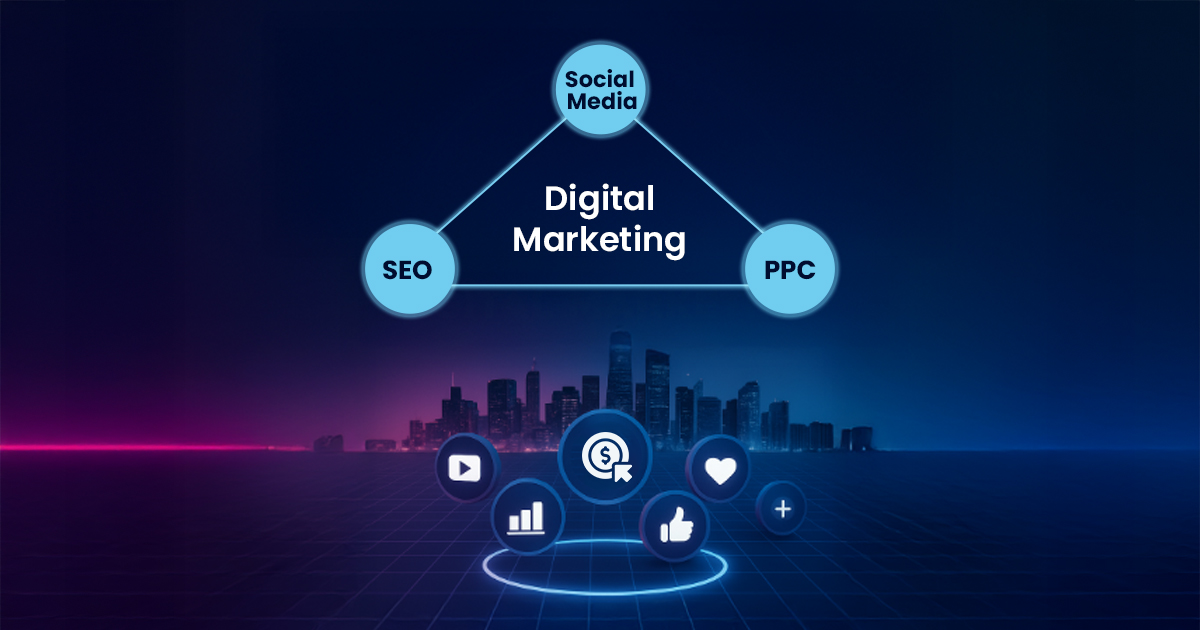
This is precisely the reason why businesses are moving towards the digital marketing triangle, which unifies SEO, PPC, and social media strategy to create a cohesive experience throughout the customer journey.
Strangely enough, the majority of marketing teams still operate in silos. SEO specialists optimize in isolation, paid media managers chase conversions, and social media teams focus on engagements, with no collaboration or communication happening. The result? Missed opportunities, a branding disaster, ROI revived but not up to par, and hence a total approach collapse.
HubSpot states that not only are digitally integrated marketing strategies more efficient, but they also outperform single-funnel approaches by up to 2.3x. Still, a surprisingly low number of companies have actually integrated this practice.
This blog is your roadmap to breaking those silos. We explain why the term integration is far more than a catchphrase, and why it’s the foundation for scalable, data-driven marketing in 2025 and beyond. From exposing the flaws of unorganized and unfocused marketing efforts to constructing an SEO-PPC-social media powerhouse that drives measurable results, we will help maximize the value of your entire marketing ecosystem.
Are you ready to adapt to the future, with integration at the core?
Why Siloed Campaigns Fail in 2025
What happens when you combine SEO, PPC, and social media and work towards different goals, measure disparate KPIs, while following diverging strategies? You end up with siloed campaigns that underperform and underdeliver. In 2025, when businesses integrate marketing channels and the consumer journey is becoming increasingly complex, not only is isolation ineffective, but it’s extremely damaging.
Siloed marketing strategies make it difficult for the audience to easily absorb information. They may see one message on Google, another on Instagram, and something entirely different in an email.
Internally, it also leads to duplicated budget spending, inconsistent branding, and a lack of communication alignment. While the SEO team may be dealing with the top-of-the-funnel, PPC directing all their energy to the bottom-of-the-funnel conversions, the social media is stuck somewhere in between, unsure who they’re speaking to.
A recent Salesforce study states that 79% of customers expect consistent interactions across departments, yet 55% say it generally feels like they’re communicating with separate departments rather than one company. In the end, it just leads to significant missed conversions and diminished brand trust.
In a world where change happens in an instant, one can no longer function in a silo; SEO, PPC, and Social Media have to come together if one expects to grow. The results from integrated marketing enable businesses to surpass expectations and achieve unprecedented levels of performance compared to solo efforts.
The Power of Integration: How SEO, PPC, and Social Feed Each Other
When used together, SEO, PPC, and social media can support and strengthen one another. This isn’t just about more visibility; it’s about creating synergy across the entire customer journey.
A SEO-PPC-social media collaboration enhances integrated marketing campaigns 2025: SEO fuels intent data, PPC gives testing insights, and social provides engagement, leading to faster, smarter, and more cost-effective marketing.
Here’s how the channels fuel each other:
- SEO → Helps PPC and Social
With high-quality content and keyword research, social media posts, and ad copy can have greater value and relevance
- PPC → Supports SEO and Social
Paid ads can reveal what messaging resonates best with the audience quickly. This helps to improve social media interaction and blog content
- Social Media → Boosts SEO and PPC
Social shares help increase web traffic and brand searches, which in turn may improve rankings and reduce ad costs.
- Shared Audiences → Better Targeting
You can use data from one platform to retarget users on another, increasing chances of conversion.
- Unified Messaging → Builds Trust
When all channels communicate the same message, your brand feels more reliable and consistent to customers.
Simply put, you need to stop viewing them as SEO vs PPC vs social media; not as separate tools, and instead see them as a single, intertwined force within your digital ecosystem.
Building the 2025 Digital Marketing Triangle: Step-by-Step Strategy
Building an integrated digital marketing triangle requires more than syncing tools, it demands structured coordination across teams, timelines, and touchpoints. Here’s a clear, step-by-step process to guide you:
- Set Shared Goals: Ensure all teams are working collaboratively toward the same goal—be it generating new leads, sales, or website traffic.
- Define the Role of Each Channel:
- SEO brings in people looking for information.
- Social media helps you stay connected and build trust.
- PPC drives quick results and conversions.
- Create Synergy Across Tools: Integrate your analytics tools, ad accounts, and CRM so you can evaluate the performance of all channels together.
- Create One Content Plan: Rather than ideating content for each channel separately, create one comprehensive content calendar for SEO, social media, and advertising.
- Repurpose Content: Transform blog posts into LinkedIn articles or Instagram stories. Improve website content with successful ad headlines.
- Share Learnings: Encourage cross-channel collaboration by organizing regular meetings where teams share what’s working.
- Adaptive Strategy: Track results and try new things. Over time, you’ll learn what combination of content and platform works best for your audience.
The goal isn’t to blend everything into one campaign, but to ensure every touchpoint reflects one united front. When your organic content inspires your ads, your ads fuel engagement, and your social presence reinforces search intent, you’re no longer running isolated efforts; you’re building momentum.
Tools and Tactics to Integrate SEO, PPC, and Social in 2025 - Bullet Points
With these tools and strategies, you can build a high-performing integrated digital strategy and maximize your digital marketing ROI.
- Google Analytics 4 + BigQuery: Consolidate all paid, organic, and social data to unlock full-funnel marketing tracking insights.
- Surfer SEO + Google Ads Keyword Planner: Integrate paid and organic insights to construct a singular targeting approach.
- Meta Ads Manager + UTM Links: Assess the performance of social ads on your website.
- HubSpot CRM or Zoho CRM: Track the customer’s first touchpoint to conversion for seamless tracking with CRM-enabled workflows.
- Zapier + Make (Integromat): Lead nurturing and task handoffs between streams can be automated, such as syncing form fills from PPC landing pages to email drip campaigns.
- ChatGPT + Jasper: AI content workflows make it easy to maintain message uniformity throughout various social channels, ad copy, and landing pages.
- Canva + Figma: Ensure consistent branding across posts and ads, so every touchpoint reinforces your brand identity.
- Slack + Notion/Asana: Bring social, paid, and SEO teams together into one space where they can collaboratively create campaign calendars, approve creative assets, and work on projects.
Choose tools that not only work well individually but also play well together; tools that can sync data, track customer journeys across channels, and simplify collaboration across teams. Then, as your strategy develops, adjust your tech stack accordingly.
When tools enable clear communication, everything else falls into place with ease.
Common Mistakes and How to Avoid Them
Even the best teams with the finest tools may encounter issues when attempting integration. Here’s what to watch out for—and how to fix it.
- Operating in Silos
What happens: Teams don’t share goals or data. SEO is working for blog traffic, while PPC is chasing leads, no sync.
Fix: Implement a centralized marketing dashboard, shared KPIs, and metrics that work across functions.
- Duplicating Audiences
What happens: Reaching the same user on Google, Facebook, and LinkedIn causes ad fatigue and burns the budget.
Fix: Use shared audience lists and retarget across platforms, not within the same one.
- Inconsistent Messaging
What happens: Facebook “Free Demo” post doesn’t match with the “Limited Time Trial” ad. Confused users tend to leave.
Fix: Sync creative across all touchpoints during campaign planning. Create brand voice guidelines.
- No Feedback Loops
What happens: PPC discovers a high-converting headline, but SEO never sees it. A missed opportunity.
Fix: Run weekly strategy syncs where data is reviewed holistically
- Measuring ROI in Silos
What happens: You can’t prove what worked because each team reports success differently.
Fix: Set attribution frameworks that span multiple channels, allowing visibility on all parts of the funnel.
Overcoming these hurdles requires discipline, but in the long run, it doesn’t just improve performance; it cultivates a robust and flexible marketing engine that’s ready for whatever the future brings.
Final Thoughts: The Future is Integrated
2025 is all about marketing channel alignment. The brands that grow the fastest are those that treat SEO, PPC, and social media not as separate tasks, but as connected parts of one big picture.
When you align your channels, teams, and tools, you’re not just improving performance—you’re building a smarter, more connected brand.
It doesn’t require a complete overhaul.
Begin with the basics: align your goals, share your content calendar, and engage in clear communication. From here, you can create a robust marketing triangle that guides your audience from awareness to action.
Need help putting it all together?
Oddtusk is where unifying strategiс marketing meets digital excellence. We build strategies that are integrated, data-driven, and designed for maximum impact. Whether you’re just getting started or scaling your growth, our team helps you connect the dots between content, paid campaigns, and social media, so your marketing finally works as one.
Are you ready to transform 2025 into a year of unified marketing and smarter growth for your brand?
Let Oddtusk help you build your personalized digital marketing triangle —- one that achieves your marketing vision.
The time is now to unify your marketing. The sooner you begin, the faster you grow.