

Google just rolled out its third core update of 2025. And if you’re still treating core updates like technical incidents to recover from, you’re already behind.
The December 2025 Core Update isn’t a punishment cycle. It’s another step in Google’s quiet transition from ranking pages to evaluating relevance in context continuously, not periodically.
Key Takeaways
1) Core updates are continuous, not events: Rankings now change through ongoing reassessment, not sudden update cycles. Improvements can surface anytime.
2) Losses aren’t penalties, they’re relative shifts: Visibility drops often happen because better or newer content enters the ecosystem, not because your page is wrong.
3) Authority beats tactics: Long-term visibility comes from credibility, topical depth, and real-world trust not from chasing core update fixes.
Core Updates Are No Longer Events
Let’s start with what actually happened.
Google began rolling out the December 2025 Core Update on December 11, with a rollout window of up to three weeks. That part is standard.
What’s not standard is the timing. Just two days earlier, Google updated its core updates documentation to make something explicit:
You don’t need to wait for a major core update to see ranking improvements.
Smaller, ongoing core changes happen all the time.
That single clarification matters more than the update itself.
Because it confirms what many SEOs have felt for months: there is no longer a clean before and after moment in search.
The Era of Continuous Reassessment
For years, core updates acted like checkpoints.
You improved content → You waited → You hoped the next update rewarded you
That mental model is now obsolete.
Google is telling us plainly that ranking systems are being adjusted continuously, with large updates acting more like visibility accelerators than reset buttons.
If your site improves, it doesn’t sit in a queue anymore. It can move between updates.
That changes how we should interpret volatility.
Why Rankings Move Even When You Did Nothing Wrong
Google repeats this line every core update cycle: Pages that lose visibility don’t necessarily have problems.
Most SEOs hear that and think it’s deflection.
It’s not.
What Google is really saying is this: Your content is being re-evaluated relative to everything else available, not against a fixed checklist.
In a web increasingly flooded with:
1) AI-generated content
2) Rewritten summaries
3) Lookalike topical pages
Relevance is no longer static.
If ten new, better answers enter the ecosystem, your page can slide even if nothing on your site changed. Core updates now reflect relative usefulness, not absolute quality.
The Pattern From 2025 So Far
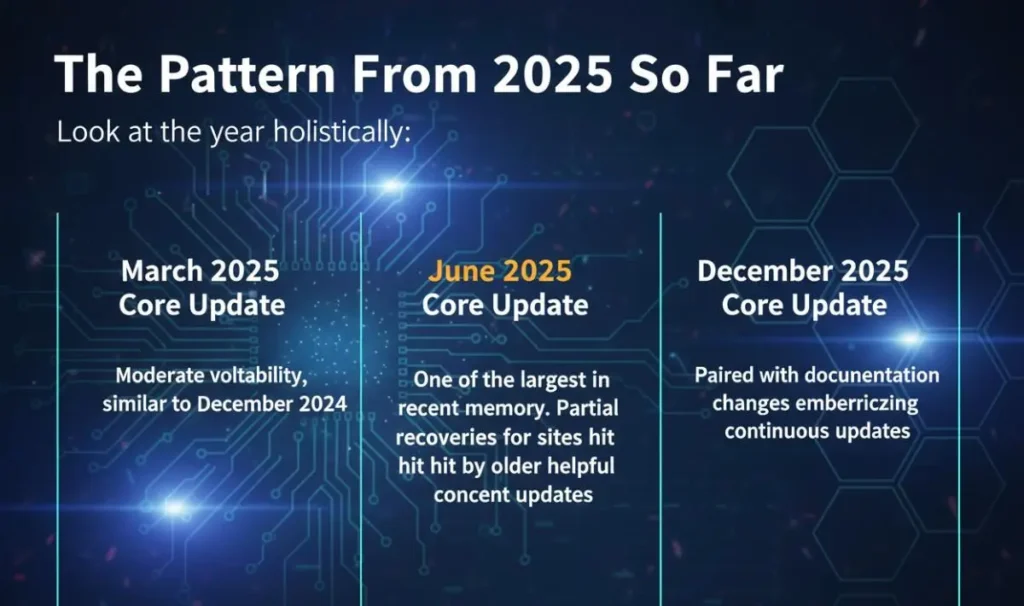
Look at the year holistically:
1) March 2025 Core Update: Moderate volatility, similar to December 2024
2) June 2025 Core Update: One of the largest in recent memory. Partial recoveries for sites hit by older helpful content updates
3) December 2025 Core Update: Paired with documentation changes emphasizing continuous updates
This isn’t random.
It’s a signal that Google is:
– De-emphasizing one-off helpful content corrections
– Moving toward ongoing quality reassessment
– Letting improvements surface faster, without waiting for named updates
This Core Update Isn’t About SEO Tactics
If your first reaction to a core update is:
“What did Google change?”
“What should I fix?”
You’re asking the wrong questions.
Core updates don’t reward tactics. They reward alignment.
Alignment between:
User intent and content depth
Brand authority and topical coverage
Real-world credibility and on-page claims
This is why some sites recover without doing anything dramatic and others keep chasing fixes that never land.
Building topical authority through structured content clusters has become more important than ever in this continuously updating environment.
Where This Intersects With AI Search & GEO
Core updates don’t exist in isolation anymore.
They now operate alongside:
1) AI Overviews
2) Conversational search
3) Long, specific, intent-heavy queries
Google is evaluating content the way an AI would:
Is this clear? → Is it trustworthy? → Is it the best answer right now?
That’s why visibility is increasingly influenced by:
Brand mentions
Consistent expertise
Real-world validation
This update reinforces a shift from ranking optimization to credibility optimization, the foundation of GEO (Generative Engine Optimization).
What To Do During The December Rollout (And What Not To)
Do this:
Monitor trends, not daily swings
Segment changes by intent (informational vs commercial)
Document dates relative to the rollout window
Look for patterns across sections, not single URLs
Don’t do this:
Rewrite content mid-rollout
Panic-delete pages
Assume losses mean penalties
Chase core update fixes
If rankings move, observe first. Core updates reward measured improvements, not reactive ones.
The Real Takeaway
The December 2025 Core Update isn’t a disruption.
It’s confirmation.
Confirmation that:
1) Search is always updating
2) Improvements don’t need permission anymore
3) Authority compounds over time
4) And relevance is judged in context, not isolation
Core updates are no longer storms to survive.
They’re mirrors.
They reflect how well your site holds up against everything else competing for attention at that moment.
A Practitioner’s Lens On The December Core Update
“What stands out to me about this update isn’t the rollout itself, it’s the documentation change that came just before it,” says Sanjay Ananda Behera (LinkedIn), Co-Founder of Oddtusk.
Google is clearly telling us that improvements don’t live on a schedule anymore. If you’re building genuinely helpful, well-structured content ecosystems, visibility can improve without waiting for a named update.
He adds that many sites misinterpret ranking drops as penalties, when in reality they’re seeing relative reassessment:
In competitive spaces, you’re not competing against your past self, you’re competing against everything else that entered the index more recently. That’s why authority, structure, and clarity matter more than chasing core update fixes.
Final Thought
If your SEO strategy still revolves around:
Waiting for updates → Recovering from updates → Fixing for updates
You’re playing defense in a system that rewards consistency, clarity and credibility.
The key is demonstrating expertise, experience, authoritativeness and trustworthiness in ways that both users and AI systems can recognize and value.
The winners of 2026 won’t be the fastest reactors. They’ll be the brands that don’t need to react at all.
FAQs - December 2025 Core Update
Q1: What is the Google December 2025 core update?
It’s a broad algorithm adjustment that began rolling out on December 11, 2025, designed to continuously evaluate content relevance rather than periodic reassessment. This update reflects Google’s shift to ongoing quality evaluation.
Q2: When did the December 2025 core update begin?
The rollout started on December 11, 2025, and is expected to take up to three weeks to fully complete across all search results globally.
Q3: Why did my rankings drop if I didn’t change anything?
Ranking drops aren’t penalties they reflect relative reassessment. Your content is being compared against new, potentially better answers that recently entered the index. It’s about competitive positioning, not site quality issues.
Q4: What makes this update different from previous ones?
This is the first update following Google’s documentation change emphasizing continuous ranking adjustments. It marks the shift from periodic checkpoint updates to ongoing relevance evaluation in real-time.
Q5: Should I rewrite content during the rollout?
No. Avoid reactive changes mid-rollout. Monitor trends instead of daily swings, document patterns across content sections, and implement strategic improvements only after the rollout stabilizes.
Q6: How long does the December 2025 update volatility last?
Volatility typically persists throughout the 3-week rollout period and sometimes longer as Google refines ranking signals and reassesses content across competitive verticals.
Q7: Is this update a penalty for my website?
No. Core updates aren’t penalties. Google explicitly states that pages losing visibility don’t necessarily have problems they’re being re-evaluated against the current competitive landscape and improved quality standards.
Q8: How does this update relate to AI Overviews?
Core updates now work alongside AI Overviews and conversational search. Google evaluates content clarity, trustworthiness and real-time relevance factors critical for both traditional search and generative engine optimization (GEO).
Q9: What should I focus on instead of quick fixes?
Focus on building topical authority through structured content clusters, strengthening E-E-A-T signals, and demonstrating consistent expertise. Authority compounds over time reactive fixes don’t work anymore.
Q10: What were the key Google updates in 2025?
Three major updates occurred: March 2025 (moderate volatility), June 2025 (one of the largest ever with partial recoveries), and December 2025 (emphasizing continuous evaluation). Each showed Google’s progression toward ongoing quality reassessment.