
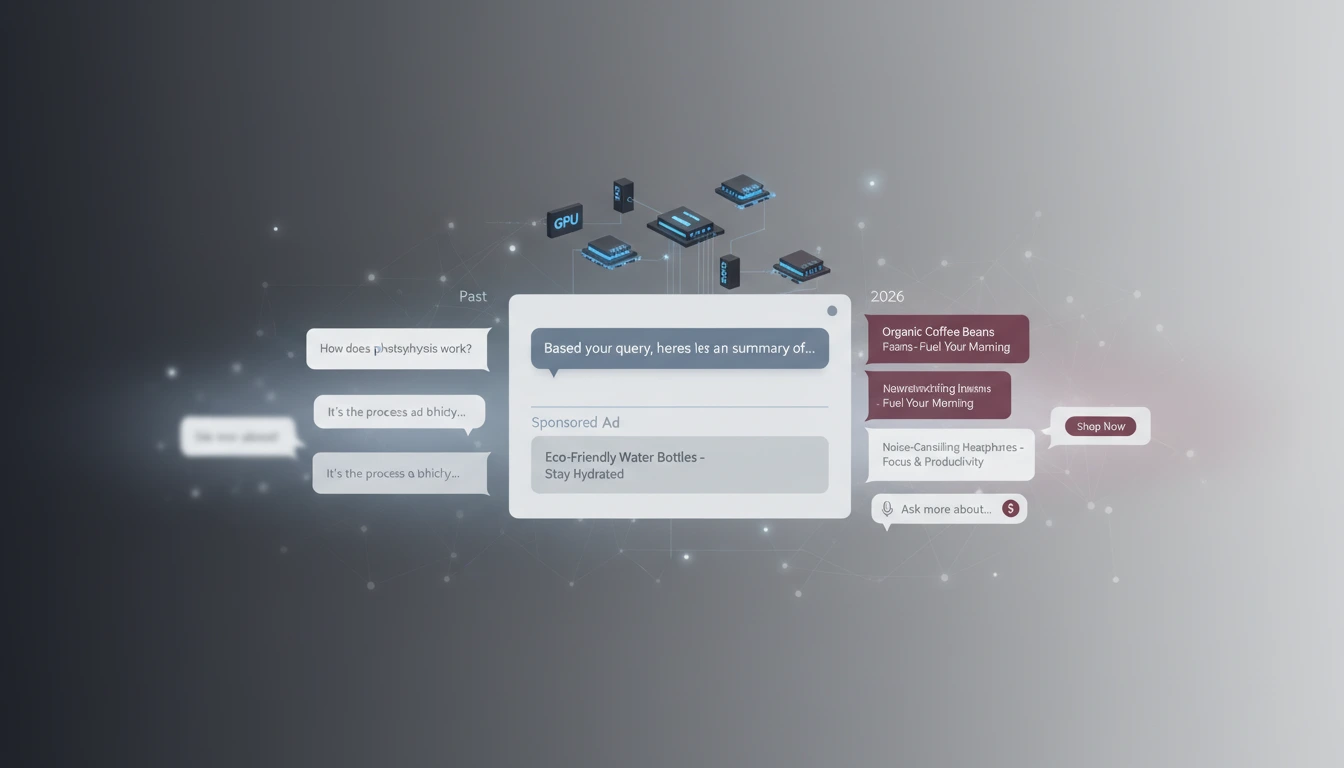
Throughout the years, the potential of an ad-free, “pure” AI assistant has been the main attraction for millions of enthusiastic tech users. Yet, with the move towards early 2026, the huge expense of running massive computing facilities has led to a historic turning point. OpenAI advertising is no longer a whisper, it is a world that is fundamentally changing human interaction with the most popular chatbot.
This change is a moment of change in the development of generative AI.
As OpenAI strives to fulfill its mission of making AGI available to everyone while also dealing with the huge costs of training the model, the release of sponsored content is the chosen path. For the typical user, the era of “free lunch” high-end AI is changing into a regular digital media model.
It is necessary for everyone who depends on these tools for productivity, creative work, or information gathering to understand the details of OpenAI advertising.
The Strategic Shift: Why OpenAI is Embracing Advertising
The root of the decision for OpenAI introducing ads to ChatGPT is ultimately the basic and unavoidable fact that keeping a model like GPT-5.2 running for 800 million weekly active users is ridiculously costly. At the beginning of 2026, various sources suggested that the firm’s infrastructure expenses alone might top billions of dollars every year. To keep the edge and push forward with innovation, the company had to come up with a source of revenue that was not dependent on the roughly 5% of users paying for premium subscription plans only.
OpenAI introducing ads to ChatGPT means, in a way, that the company is “democratizing” the use of its most advanced models. They are not hiding the best features behind a $20 or $200 paywall but rather using a sponsored model to cover some of the costs. This is the same pattern as when the internet was just beginning, and free access was exchanged for attention. Yet, since AI is conversational and very personal, the risk level for this OpenAI advertising strategy is way higher than what it used to be for search engines or social media.
Understanding these shifts is crucial for businesses leveraging AI tools. Our digital marketing services help navigate these evolving platforms effectively.
Navigating the Tiers: What the ChatGPT Ads Free Tier Looks Like
Those who are on the ChatGPT ads free tier are going to experience the change the most quickly. A logged-in adult user in the U.S. will soon see a new feature added to their interface. These ads differ from those annoying pop-ups of the early 2000s since they are intended to be “contextual”. So, if you request a dinner recipe that is keto-friendly, at the bottom of the response, you might find a “Sponsored Suggestion” for a meal kit delivery service or a particular kitchen appliance.
ChatGPT ads free tier allows the main experience to be stable while also allowing brands to obtain value. However, we should also mention that these ads are visually distinct from the AI’s original response. OpenAI has expressed its intention to preserve “answer independence, ” which means that a company cannot pay to have the AI recommend their product in the text of the response. This difference is very crucial for keeping the users’ trust when AI is turning into the main source of truth for most people.
For businesses looking to leverage AI-powered platforms, our paid media advertising services can help you navigate these new advertising opportunities.
The New Middle Ground: OpenAI Advertising Strategy and the "Go" Plan
One intriguing aspect of the larger OpenAI marketing campaign is unveiling an intermediate subscription level named the “ChatGPT Go” plan.
This plan, which will be around $8 per month, exists as a compromise to those buyers who crave a few more sophisticated features from the free version, like more messages and better, generated images but aren’t quite ready to pay the Plus tier price.
What’s more, the “Go” package is also supported as well.
Such a stratified OpenAI marketing campaign opens the door for the company to get hold of a segment of “price, sensitive” consumers. At the same time, it clearly lays out a hierarchy of value:
1) Free Tier: Access to the essentials coupled with ads.
2) Go Tier ($8): Improved functionality along with ads.
3) Plus/Pro/Enterprise: Premium, with no ads, highest privacy, and best performance.
The operating principle behind this is that the user at the lower price level is still partially funding the huge GPU setups that keep OpenAI’s data center lights on.
Privacy in the Age of AI Ads: ChatGPT Ads User Data Privacy
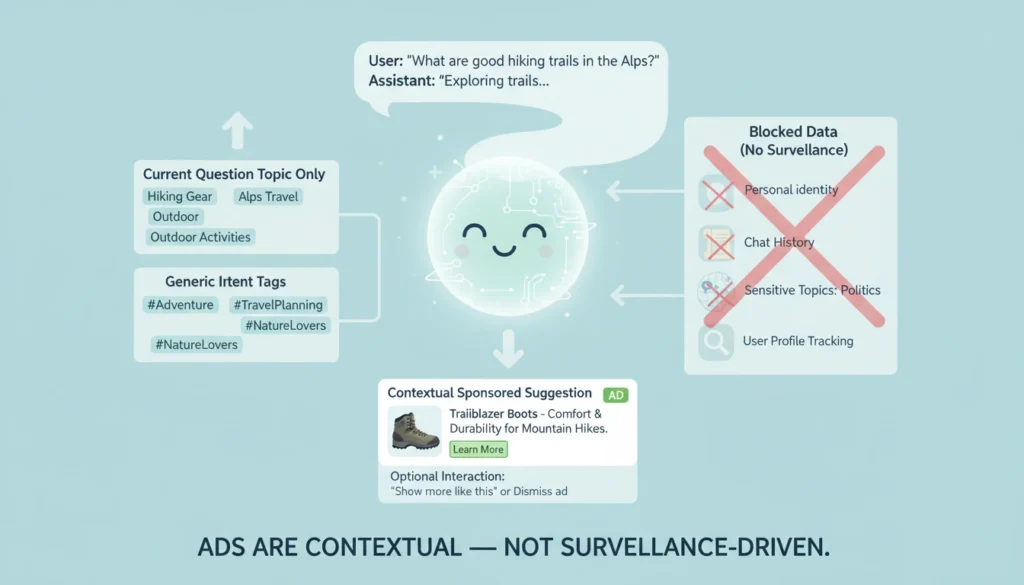
The greatest worry of most consumers is not the presence of ads, but rather ChatGPT ads user data privacy. Since individuals use ChatGPT for a variety of purposes, like coding or getting personal advice, the notion of using that data for targeting is a touchy issue. OpenAI has responded by saying that they do not “sell” user data to advertisers. Instead, they use the immediate context of the conversation to display the relevant ad.
To secure ChatGPT ads user data privacy, the company has put several guardrails in place:
Privacy Protections:
1) No Ads for Minors: Accounts detected to be under 18 will not get to see advertisements.
2) Sensitive Topic Exclusions: Ads are prevented from appearing next to discussions on health, mental health, or politics.
3) Opt Out Controls: Users can turn off ad personalization in their settings, though they will still be shown generic ads.
4) Anonymized Intent: To advertisers, it is only visible that the user is interested in “hiking gear”, but they do not see who the user is or their entire chat history.
The issue of protecting ChatGPT ads user data privacy can be considered as the main challenge facing OpenAI in 2026. If the “creepy” factor of hyper-personalized ads gets too high, customers may move away to the rivals offering an ad-free experience. Our consumer behavior analysis services help businesses understand these privacy considerations.
The Future of Conversational Commerce
With the evolution of OpenAI advertising, the transition is heading towards a scenario of “Conversational Commerce”. These new units are interactive, in contrast to a traditional Google ad.
Just picture finding a smartphone ad and you can ask, “Does this phone have a 5x optical zoom?” and getting an immediate answer from the brand’s AI assistant.
This change changes the ad from a nuisance to a helpful tool. If the advertising industry manages it properly, it could lead to the digital marketing sector’s complete transformation. However, OpenAI still has to provide evidence that these features don’t lower the quality of the user experience.
The OpenAI advertising strategy is aimed at making advertisements appear like a helpful “next step” rather than a commercial interruption.
Key Takeaways
Contextual Integration: Ads will be displayed at the bottom of the screen, with a clear label of “Sponsored, ” and will reflect the topic of the ongoing conversation.
1) Tiered Access: ChatGPT ads free tier, and the $8 “Go” tier will feature ads, whereas Plus and Pro users will continue to be without ads.
2) Answer Independence: OpenAI commits that OpenAI advertising will not influence the actual content or accuracy of the AI’s organic responses.
3) Privacy Protections: In order to keep ChatGPT ads user data privacy, OpenAI avoids using sensitive topics (health/politics) and does not allow ads for users below 18 years of age.
4) Sustainability: The decision to switch to OpenAI advertising comes from the necessity to financially support the trillion-dollar infrastructure required for AGI development.
5) User Control: Ad personalization can be turned off, so even though you will see ads, they are not based on a long-term profile of your behavior.
Conclusion: What Really Matters to AI
The addition of ads to ChatGPT is a clear signal that the “experimentation” phase of AI is over and that the “industrialization” phase has begun. Some users might be annoyed at ads appearing in their apps, but it is a price worth paying for the continuation of free, fast and powerful AI. Throughout 2026, as we explore this new territory, being knowledgeable about the use of your data and the differences between the service levels will assist you in harnessing these tools to their full capacity.
At Oddtusk, we understand that tech companies constantly updating their products is a reality you must face if you want to stay ahead in the digital age. In a way, OpenAI advertising is breaking the line between utility and commerce just like the music industry did when the digital era began. Still, our purpose is to help you stay focused on the real “intent” amidst the noise. Whether you are getting used to the ads in the ChatGPT free tier or you are looking for ways to double your digital productivity, Oddtusk continues to be your beacon of light in the ever-more-complicated AI environment.
Artificial intelligence in the future will not only depend on the models we create, but also on how we choose to sustain them—and Oddtusk is here to get you ready for every twist and turn of the road.
Explore our comprehensive digital marketing services, marketing automation solutions, and eCommerce services to stay ahead in this evolving landscape. Contact us to adapt your marketing strategy for the AI-powered future.
FAQs: OpenAI introducing ads to ChatGPT
Q1:What does it mean that OpenAI is introducing ads to ChatGPT?
It means OpenAI will display clearly labeled, contextual ads alongside responses to help fund AI infrastructure while keeping ChatGPT accessible for free users.
Q2:Will ChatGPT free tier show ads in 2026?
Yes, the ChatGPT free tier will show contextual ads, typically displayed separately from the AI’s main response.
Q3: How does ChatGPT ads user data privacy work?
Ads are based on real-time conversation context, not personal identity, and sensitive topics and minors are excluded from ad targeting.
Q4:What is the ChatGPT Go plan?
ChatGPT Go is a lower-cost subscription tier offering more usage and features than free, while still displaying ads.
Q5: Can advertisers influence ChatGPT answers?
No, OpenAI states that ads do not affect or alter the AI’s organic responses or recommendations.
Q6: How will AI advertising impact digital marketing?
AI advertising shifts marketing toward intent-based, conversational experiences, prioritizing structured data, relevance, and AI comprehension over clicks alone.