

Growing an online store from a small boutique to a high-volume enterprise is rarely a straight line. It is a series of compounding technical challenges. Many brands stall not because of weak demand, but because their internal systems simply cannot handle the weight of more orders.
The solution is a scalable ecommerce tech stack built to grow alongside your revenue. By automating the friction points across inventory sync, customer support, and shipping logistics, your team is freed up to focus on brand strategy instead of manual data entry.
By 2026, competitive advantage belongs to the brands whose systems communicate fastest and most reliably. This article explores the crucial ecommerce automation and integration techniques that smooth out operations, reduce human error, and unlock sustained growth.
Foundation of a Scalable Ecommerce Tech Stack
A high-performance ecommerce tech stack is the engine room of your digital business. It is a collection of software solutions that together handle everything from the front-end user interface to back-end fulfillment.
In the early days, a basic store platform may be sufficient. But as you scale, the gap between your storefront and your warehouse or accounting software becomes a serious bottleneck.
The solution is a modular approach. Rather than relying on one all-in-one tool that does everything poorly, top-performing brands invest in “best of breed” integrations.
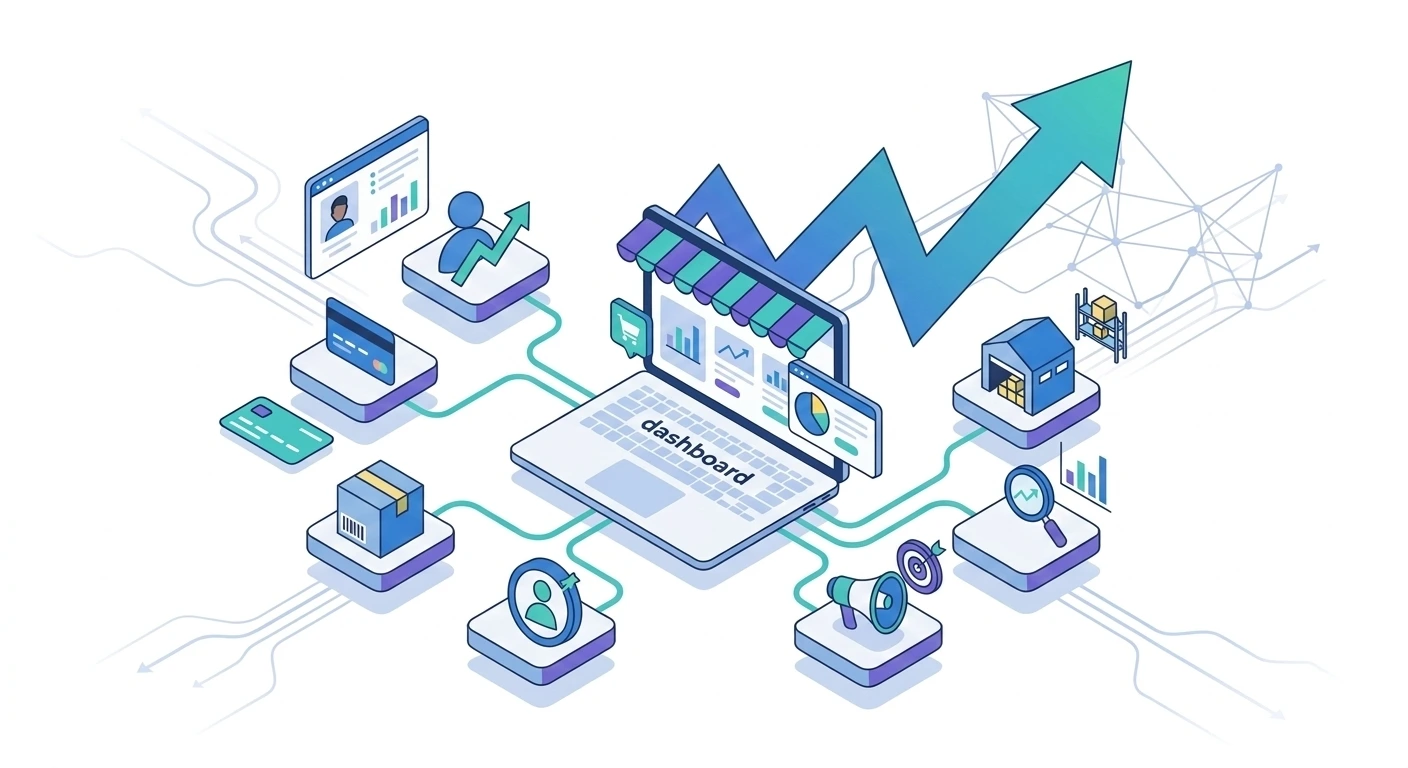
These tools communicate via APIs, so when a customer places an order, your inventory updates instantly across Amazon, Flipkart, and your own website simultaneously. This interconnected architecture is what makes a modern ecommerce web development strategy truly resilient. Learn how we approach this at Oddtusk in our guide on building scalable ecommerce websites.
1) Centralized Data: A single source of truth for all customer and order information across every platform.
2) Reduced Latency: Fast communication between apps translates directly into a better customer experience.
3) Flexibility: Swap out one tool for a better one without disrupting the rest of your system.
4) Data Security: Sensitive customer information stays protected across all integrated platforms.
Leveraging Ecommerce Automation Tools for Operational Efficiency
Automation is no longer optional. It is a survival strategy. Ecommerce automation software puts key business functions on autopilot. Tasks like sending “order out for delivery” notifications or updating stock levels after a flash sale no longer require human intervention. The result is a business that can handle far greater volume without a proportional increase in headcount.
The real power of ecommerce automation tools lies in their conditional logic. For example, if an order is flagged as potential fraud, the system automatically halts dispatch and alerts the security team.
xIf a VIP customer crosses a spending threshold, the system triggers a personalized thank-you gift with zero manual effort. Explore how workflow automation can be configured for your specific business rules.
Key Areas for Automation:
1) Inventory Management: Coordinating stock level adjustments in more than one warehouse and sales channel.
2) Marketing Workflows: Dispatching reminders like “abandoned cart” and product recommendations that are personalized.
3) Customer Service: Employing AI-based chatbots for routine questions regarding tracking.
4) Order Processing: Identifying the closest fulfillment facility to the customer for dispatching the order so that the delivery period is shortened.
Integrating Your Marketing and Retention Engine
Your ecommerce tech stack must include a robust layer for marketing and customer relationship management (CRM). Acquiring a new customer costs five times more than retaining an existing one. Scalable integrations let you segment your audience based on live purchase behavior, ensuring every marketing rupee is spent on the right person at the right time.
When your marketing automation tools are tightly connected to your sales data, you can move beyond “batch and blast” email campaigns. Instead, launch hyper-targeted SMS or email campaigns built on real behavior. Pair this with lead nurturing workflows to build customer loyalty at scale. For D2C brands specifically, our D2C marketing predictions for 2026 outline exactly where retention strategy is heading.
Managing Global Operations with Multi-Channel Integrations
For an Indian brand eyeing global markets, or a global brand entering India, the complexity of taxes, currencies, and local shipping can be overwhelming. A scalable ecommerce tech stack must handle localization independently. It should work seamlessly with local payment gateways like UPI while also supporting global providers like PayPal and Stripe.
Multi-channel selling is the new normal. Your ecommerce automation tools should let you manage listings across all marketplaces from a single dashboard. The moment a product sells out on your store, it should immediately reflect as “out of stock” on every other platform.
This prevents overselling, protects your seller ratings, and delivers a consistent brand experience everywhere your customers find you. See how our ecommerce marketing services are built around multi-channel performance.
The Role of Data Analytics in Scaling
You cannot grow your business without a proper measurement system. A business intelligence (BI) or analytics tool is a vital part of your ecommerce technology stack.
If your data is siloed, you are basically making gut-feeling decisions. If you have your data integrated, you make decisions based on real facts and figures.
With integrated analytics, you can track in real time not only the “Customer Lifetime Value” (CLV) but also the “Customer Acquisition Cost” (CAC). Automating your ecommerce through tools is an excellent way to generate weekly performance reports that show profit, driving products, and products that only take up space in your warehouse.
Understanding is very helpful for you to make significant tactical changes during rapid growth phases.
Key Takeaways
- Modular Architecture: Select the best of breed tools for your ecommerce tech stack and let them talk to each other through APIs for maximum flexibility.
- Save Time & Effort: Enable ecommerce automation tools to take care of inventory management, order routing, and even basic customer service.
- Data Synchronization: Make sure all your sales channels (Website, Amazon, Social Media) show the same inventory and pricing data at the same time.
- Retention First: Connect your CRM and marketing tools to leverage purchase data for creating highly personalized customer journeys.
- Scalability Over Convenience: Go for enterprise-grade integrations capable of handling high traffic events like festive sales without crashing the system.
- Insight, Driven Growth: Use combined analytics to monitor CLV and CAC, thus making well-informed decisions on how to direct your budget.
Conclusion: Scaling with Strategic Intent and Oddtusk
Scaling a digital business is about more than brand popularity. It is about whether your technical infrastructure can match your ambitions. Sticking to manual operations is an invitation to burnout and profit leakage. Investing in a modular ecommerce tech stack ensures your business can pivot quickly, stay productive, and face whatever market challenges emerge.
At Oddtusk, we focus on the “how” of ecommerce scaling. A beautiful storefront counts for little if the back-end integrations are not seamless. As a technical excellence-focused partner, we help brands build and refine their ecommerce tech stacks to meet the demands of a fast-moving market. Every ecommerce automation tool we recommend is chosen on the basis of ROI and performance. Explore our full ecommerce web development services and understand the real cost of building a scalable ecommerce website in 2026.
Oddtusk is not just a web design company. We are a digital ecosystem builder that turns the growing pains of scaling brands into growth achievements.
Are you ready to turn your Shopify store into a powerhouse of sales? Could I, perhaps, perform a performance audit of your current store, or assist you in drafting a project scope for your new build?