


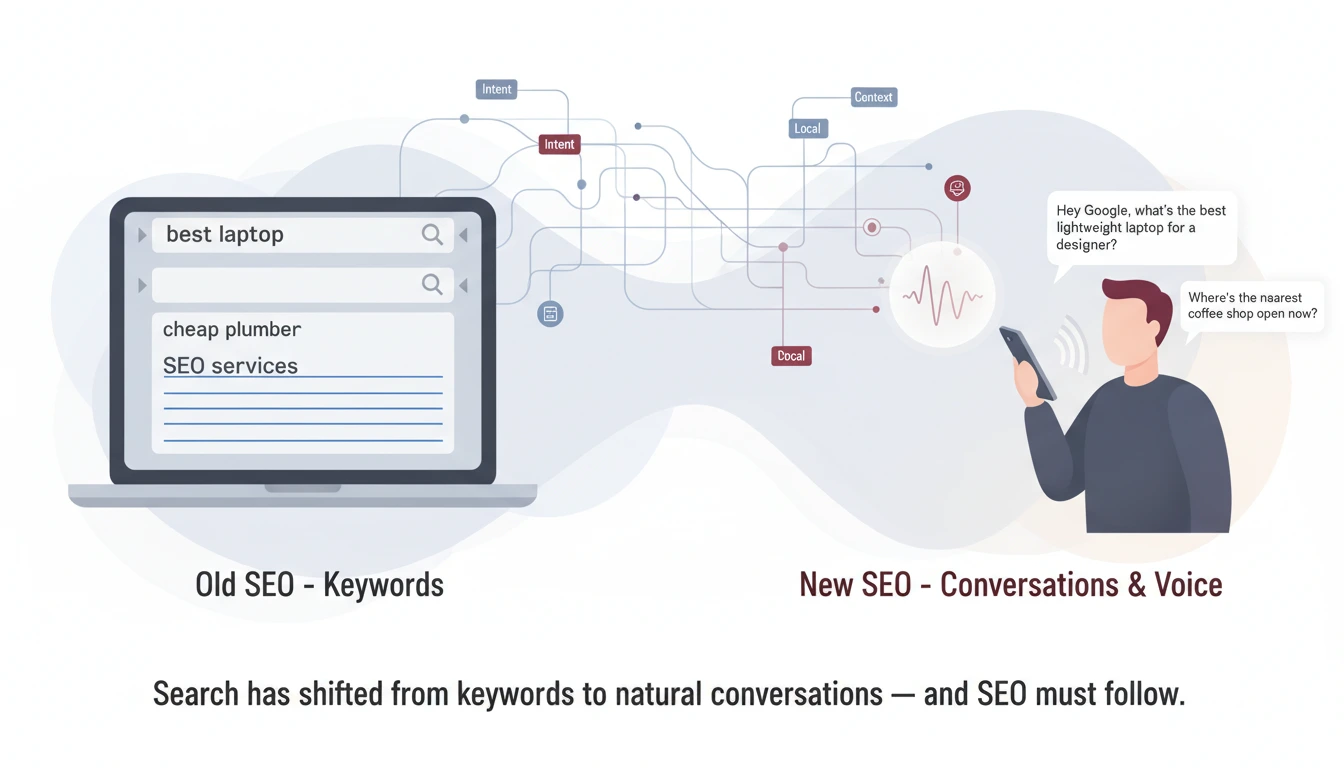
The digital landscape has transitioned from “typing” to “talking.” By the time we reach 2026, the typical search bar isn’t the only door to information anymore. A massive number of users have started depending on virtual assistants like Alexa, Siri, and Google Assistant to get their queries answered. Such a change has resulted in the emergence of the voice search SEO era as the main engine of online visibility. Therefore, for a business to keep its edge, it has to radically change from merely matching keywords to perfecting conversational search SEO.
Knowing this shift thoroughly is a must for any brand that wants to be digitally successful over time. Speaking is very different from typing, as it involves longer sentences and therefore people tend to ask more direct questions. Furthermore, they not only want their questions to be instantly answered, but also preferably by an answer that sounds human and accurate. Content that is still very ‘machine-like’ in the style of the year 2015 is basically nonexistent when it comes to voice, activated searches in 2026. Let this playbook serve as your compass to synchronizing your tactics with the way people naturally talk nowadays.
The Core Shift: Why Conversational Search SEO Matters
In the early internet days, SEO was focused on “fragments.” For example, the users would simply enter the words like “best laptop 2026.” However, nowadays, a voice query would be more like “Hey Google, what is the best lightweight laptop for a graphic designer on a budget?” This trend towards natural language is what conversational search SEO is all about. It is a big challenge for search engines to figure out not only the intention but also the context and the subtle differences in human speech.
By 2026, more than 60% of the daily searches are predicted to be voice searches. This is why conversational search SEO is no longer just a “nice, to, have” feature, rather it is the basis of modern search engine algorithms. Search engines are now giving more weight to the pages that are able to provide clear, straightforward answers to complex questions. If your content can perfectly match a user’s spoken issue with your textual answer, you will be ranked first in the AI, generated “voice” response.
Professional SEO services now incorporate voice search optimization as a standard practice.
Mastering Voice Search SEO: 3 Practical Strategies
To really take over voice search SEO, you have to change the way you organize your content. It’s true that classic long, form articles still hold their value, however, they have to be “voice, ready.”
This means concentrating on long, tail, question, based keywords that sound like the way people talk at home, in their cars, or when they are walking around.
- Get Ready For The ‘Featured Snippet’
Most voice assistants obtain their answers from the ‘Position Zero’ or Featured Snippet on a search page. If you want to be the answer chosen for voice search SEO, you should:
1) Make H2 and H3 titles that look like real questions
2) Write a short, clear, 40-60 word answer right after the title
3) Use bullet points for step-by-step instructions
Our content strategy services help structure content for featured snippet optimization.
- Concentrate On Local Intent
A large number of voice queries are related to location. Examples of such queries are: ‘Where is the nearest plumber?’ or ‘Find a coffee shop open now’. To be successful at voice search SEO, you must have a strong Google Business Profile and local schema markup. If your local data is not structured properly, voice assistants will not be able to ‘read’ your business to the user.
Professional local SEO services ensure your business is optimized for voice search queries. Industry-specific solutions include:
2) Dental SEO
3) Law Firm SEO
- Use FAQ Schema
FAQ sections are a treasure for voice search SEO. When you use FAQ Schema markup, you essentially inform search engines that these are the questions you are answering. This facilitates AI models in parsing your content and citing you as the trusted source in a conversational exchange.
Answer Engine Optimization (AEO): The Next Frontier
When we dig deeper into 2026, a big trend is Answer Engine Optimization (AEO). Whereas conversational search SEO is about the manner of the search, AEO concentrates on the way the result is given. AI engines like ChatGPT, Perplexity, and Google’s AI Mode not only display links; they provide summarized answers.
If you want your business to prosper, it is crucial for your brand to be recognized as an “entity” and not just a website. Search engines give more credit to your brand when they find consistent brand information on different parts of the web. This trust is what enables your proficiency to be an integral part of the AI’s decision, making. A shift from a keyword, first to an entity, first strategy is the pinnacle of conversational search SEO capability.
Strategic digital marketing services help build this entity recognition across platforms.
Technical Foundations for Voice Success
No matter how well written your site is, it won’t be able to compensate for a slow loading time. Since a large number of voice searches are done on mobile phones through cellular networks, it is imperative that the website be really fast. A webpage that takes five seconds to open will be unlikely to get top ranking in voice search SEO.
1) Mobile-First Design: Make sure your website is fully responsive.
2) Core Web Vitals: Focus on Largest Contentful Paint (LCP) to make your site load fast.
3) Structured Data: Employ Schema.org to unambiguously describe your products, services, and location.
Key Takeaways
- Natural Language Wins: Speak the language of your customers. Rephrase your content into complete sentences in a friendly style to help conversational search SEO.
- Speed is Essential: Running great voice search SEO on mobile devices requires pages that not only are mobile, friendly but also load very quickly.
- Structure for AI: Implement FAQ schema and use question, based headings so AI assistants can easily pick the content up for reading aloud.
- Local is Critical: Make sure your local SEO is well, tuned since lots of voice queries imply “near me” searches.
- Focus on Intent: Don’t just rely on single keywords. Try to figure out the reason behind the query and offer the best possible answer.
- Stay Entity, Focused: Maintaining consistent brand data across all platforms is key to becoming a trusted source for AI answer engines.
Conclusion: Adapting to an AI-First World
The transition from keywords to conversations is a definite sign of the internet becoming more human. Adopting voice search SEO goes beyond working on rankings; it focuses on delivering a better user experience. When you make your content correspond to the way people naturally speak, you gain their trust and establish yourself as an authority. By moving towards conversational search, SEO allows your business to be a visible, helpful partner in the user’s everyday journey.
Oddtusk acknowledges how challenging it might be to understand AI-powered search. We want to make it simple for you. If you want to check your current content for voice search SEO or create a new, AI-friendly digital brand, Oddtusk is the place for the strategic know-how that positions you at the forefront. We don’t just look at keywords; we look at the “intent” which is the main driver of your growth. In a situation where search is like a talk, Oddtusk will be your helping hand in making your brand say the right words at the right moment.
Explore our complete suite of digital marketing services, eCommerce solutions, and marketing automation to optimize for voice search. Contact us to make your brand voice-search ready.