
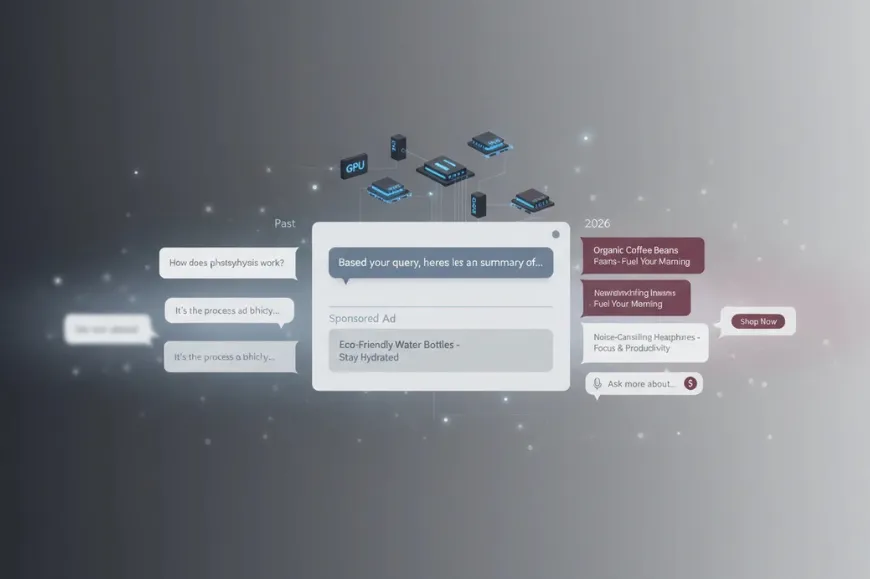
How ChatGPT ads work, user data privacy, the Go plan, and what conversational commerce means for brands.
OpenAI Launches ChatGPT Atlas Browser for Mac Users
Date: 04 - 19 - 2026
Time to read: 9 minutes
[ Table of Content ]
The Biggest Shift Since Google - And It's Not an Algorithm Update
The biggest shift in digital behaviour since Google has arrived - and it's not another algorithm update. OpenAI's ChatGPT Atlas turns the browser into a thinking partner, blending search, conversation, and action in real time. As Atlas expands beyond macOS, it signals a new era where visibility won't depend on rankings, but on credibility, structure, and semantic authority - the foundation of what's now being called Generative Engine Optimisation (GEO).
10% of the world's adults now live inside ChatGPT. With Atlas, AI is no longer a tab - it's the browser itself. ChatGPT now commands 800 million weekly users and processes over 2.5 billion daily prompts. For the first time since Google's rise, user behaviour itself is being rewritten. We're moving from searching to asking, from browsing to conversing, and from rankings to trust.
The Beginning of the AI-Native Web
For the first time since Google reshaped how we find information, the way humans access the web itself is being rewritten. OpenAI describes Atlas as "the browser with ChatGPT built in." That sounds simple until you realise what it really means: Atlas doesn't just display the web. It interprets it. It merges search, chat, and action into one continuous experience where users don't just browse the internet - they converse with it.
Announced in a livestream led by CEO Sam Altman and Ben Goodger - a key figure behind both Chrome and Firefox - Atlas arrives first on macOS, available today to Free, Plus, Pro, and Go users worldwide. Versions for Windows, iOS, and Android will follow soon. But this isn't just another browser release. It's OpenAI's first step toward turning ChatGPT into an operating system.
Suggested article:OpenAI
Introducing Ads to ChatGPT: What It Means for Users in 2026
Unified Search Meets Generative Understanding
Opening a new tab in Atlas doesn't show a blank page or a search bar. It creates a starting point where you can ask a question or enter a URL, and receive answers, links, videos, and news all in one screen. No more toggling between ChatGPT and Google. No more switching tabs to compare.
Generative results and traditional links now coexist in the same view, effectively merging browsing and reasoning into one behaviour. This is not just convenience - it's a new mode of cognition online.
Sidebar Intelligence
Atlas introduces a ChatGPT sidebar that follows you across the web. It can summarise an article, analyse data, compare products, or rewrite a paragraph without leaving the page. Highlight any text in an email or document, and ChatGPT offers instant context or a rewrite through Cursor Chat - inline, in real time.
This is not "AI assistance." This is integrated intelligence, blurring the line between content consumption and content creation.
Agent Mode: The Web Starts to Act
Then there's Agent Mode, still in preview but already rewriting what "automation" means. ChatGPT can now open tabs, click through sites, and complete tasks with your approval. Researching a product? Booking an appointment? Comparing options? Purchasing products? The agent can do it while you watch.
OpenAI admits it's still learning - it may make mistakes on complex workflows - but the trajectory is clear: we are entering the era of AI agency inside the browser.
Memory: The Browser That Remembers
Browser Memories are where Atlas quietly becomes transformative. It remembers the context from the sites you visit and retrieves that context when relevant - continuing your research, recalling comparisons, or rebuilding to-do lists.
These memories are fully user-controlled. You can view, edit, archive, or delete them at any time - even block ChatGPT from seeing specific sites. It's not tracking. It's a continuous cognitive layer between you and the internet.
Privacy by Design, Not as a Policy
OpenAI's privacy model for Atlas is radical in one way: it puts control back in the user's hands.
- By default, browsing data isn't used for model training.
- You can opt in to include web browsing data if you wish.
- You can pause the agent on sensitive sites.
- You can clear individual pages or entire histories.
Agent Mode itself is sandboxed - it can't run code, download files, or touch local storage. In a world sceptical of AI surveillance, Atlas introduces consent as architecture.
Suggested article:
href="/insights/ai-search/ai-visibility-mentions-not-metadata/">The New PR Playbook: Why
Mentions, Not Metadata, Decide AI Visibility
GEO: The New Discipline of Discovery
Generative Engine Optimisation isn't SEO with a facelift. It's a brand strategy for a world where AI decides what to recommend. Visibility inside Atlas and other generative engines won't depend on keyword density or backlinks - it will depend on:
- Proof - credible citations, reviews, and third-party mentions
- Structure - clean schema, accessible metadata, machine-readable credibility
- Authority - expertise signals that LLMs can interpret, not just humans
Atlas is the first environment to make that ecosystem real. It rewards semantic authority and brand evidence, not "topical authority fluff."
The browser as an operating system. The bigger story? Atlas is OpenAI's first step toward an AI-native OS. The roadmap confirms it: multi-profile support and developer tools are coming, websites will soon be able to use ARIA tags to help agents interpret their content, and memory and task persistence will extend across devices. In other words, OpenAI is quietly turning ChatGPT into the internet's nervous system.
What Marketers Should Take From This
If Chrome built the search economy, Atlas is building the credibility economy. Your visibility in this world won't come from chasing impressions. It will come from being the most trustworthy, structured, and referenced answer in the generative layer.
Your task as a brand:
- Be easy for AI to recommend.
- Be verifiable through third-party evidence.
- Be distinct enough for memory to recognise and recall.
This isn't about traffic - it's about being chosen by the model. Our href="/digital-marketing/seo/">SEO services and href="/digital-marketing/content-marketing/">content marketing solutions are built for exactly this new credibility-first paradigm.
When the Browser Starts Thinking, Will It Think of You?
OpenAI didn't just launch a browser. It launched a new interface for human knowledge. ChatGPT Atlas collapses the gap between question and action, between curiosity and completion. It's not the next browser war - it's the start of an AI-native web, where context, continuity, and credibility rule.
The future won't belong to those who write the most content. It'll belong to those who are easiest for AI to remember, recommend, and trust.
At Oddtusk, we help brands become the answer AI remembers - through semantic authority, structured credibility, and GEO-ready content architecture. Explore our href="/digital-marketing/">digital marketing services, href="/digital-marketing/seo/">SEO solutions, and href="/digital-marketing/content-marketing/">content marketing services built for the AI-native web. Ready to be the brand Atlas remembers? Let's build your GEO strategy together.
