
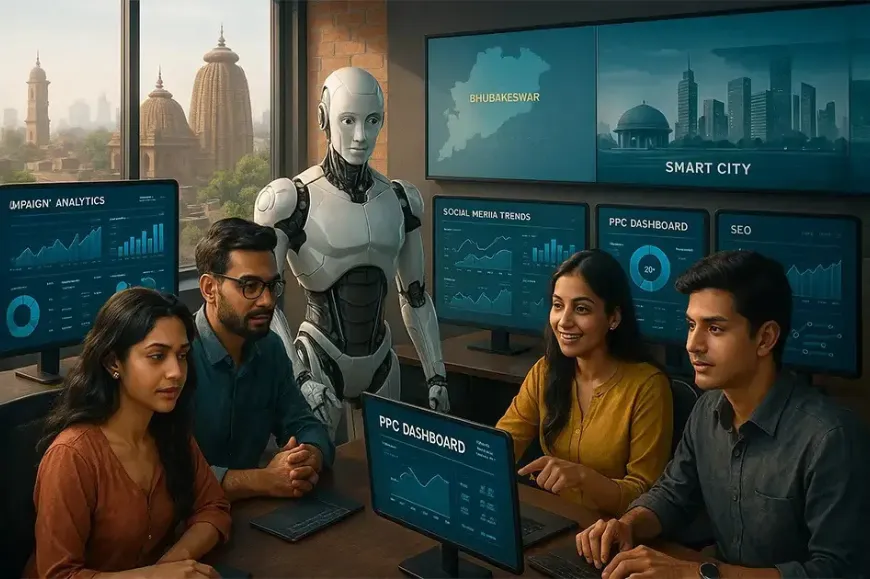
From data analysis to ad optimization, see how AI-powered workflows are reshaping digital agencies.
Will AI Replace Digital Marketers in 2026?
VERIFY - Article likely already answers its title question. Check first paragraph.
Date: 04 - 23 - 2026
Time to read: 7 minutes
[ Table of Content ]
Can AI Actually Replace Digital Marketers?
"Will AI steal my job?" It is the question echoing across every design studio, Slack group, and caffeine-driven brainstorming session in 2025. The speed at which automation is being incorporated into design, from generating logos to creating social media visuals with a single command, is remarkable. Yet, before we mourn the end of creative thinking, perhaps we should ask a more thought-provoking question: Will AI replace creativity, or merely redefine it?
While AI has certainly changed how things are done, it is unlikely to replace the human touch, intuition, and originality that define true creativity. Creativity isn't just about making things look good. It's about making things feel real. And that is something no prompt can replicate.
Let us decode the key aspects of the AI-powered creative world, its impact on your workflow, and why collaboration rather than competition is the way forward for graphic designers and brand builders alike.
How AI Is Reshaping Human Creativity
Every new technology has sparked the same fear: Will it kill creativity? Throughout history, from the printing press to Photoshop, every innovation has been met with scepticism. The present use of AI falls precisely in line with this pattern. It is simply the newest addition to the array of technologies that have reshaped the way we work. However, unlike previous tools, AI isn't here to replace. It's here to extend human creativity.
Just as the camera did not kill painting, and digital did not kill hand lettering, AI will not kill creativity. At its core, AI assists, augments, and enhances the creative process. With its capabilities, designers can brainstorm at a faster pace, create mood boards more efficiently, and automate repetitive tasks, leaving more time for high-level creative thinking.
According to a report from Gitnux, graphic designers using AI tools have seen project turnaround times cut by up to 35%. However, AI will never possess the cultural insights, emotional intelligence, or profound brand understanding that only a human mind can bring to the table.
Suggested article:What AI Is
Doing Right Now in Digital Agencies
What AI Can (and Can't) Do in Design: Superpowers with Limits
AI can generate a dozen Instagram posts in 30 seconds. But can it read the room during a pitch or translate a brand's personality into pixels? Not quite. Knowing when to leverage AI's strengths and when to acknowledge its limits is key to wielding it strategically. AI generates creative-looking outputs, but it does not truly create in the human sense:
- AI utilises patterns and data, not emotion, context, or intuition
- It cannot originate an idea, only remix, reframe, or repackage existing material
- It does not understand branding goals or the cultural nuance that makes a campaign resonate
Where AI Wins: Speed, Scale, and Repetition
- Generate multiple design variations in minutes, ideal for A/B testing across campaigns
- Optimise designs for specific platforms, ensuring content looks perfect across different screen sizes
- Automate repetitive tasks like resizing images, background removal, and generating basic layouts
- Analyse user preferences to generate data-driven design decisions backed by real engagement signals
Where It Falls Short: Strategy, Emotion, and Taste
- Interpreting nuanced cultural contexts or emotional undertones essential for brand building
- Understanding brand storytelling, the key skill for creating memorable, human-centred campaigns
- Making subjective aesthetic decisions, taste, intuition, and emotional resonance are qualities AI lacks
Human designers bring strategic thinking (Who is this for? Why does this matter?), conceptual storytelling (not just visuals, but narratives), and aesthetic judgement (knowing what feels right, even if it is not technically correct). AI can accelerate the process, but it will always depend on human creativity for concept development, storytelling, and brand identity.
The New Role of Graphic Designers in 2025
Graphic design in 2025 looks very different. Designers have evolved from solely focusing on aesthetic appeal to becoming multi-skilled, tech-savvy professionals who seamlessly merge creativity with technology. The modern designer's skillset now includes:
- Prompt engineering as a creative skill, guiding AI tools toward meaningful, brand-aligned outputs
- Hybrid tools fluency, Figma combined with ChatGPT and Runway is the new baseline creative stack
- Critical thinking to interpret and adapt AI outputs, knowing what to keep, refine, or discard
- Brand storytelling that no bot can replicate, the human thread connecting strategy to visual identity
With 90% of creatives agreeing that AI has improved the quality of visual communication (Canva Visual Economy Report, 2024), the bar for design excellence is only rising, along with expectations from clients and audiences alike. As the line between technology and artistry blurs, graphic designers will move from creators to curators, directing AI to achieve optimal outcomes, then refining those results through their own artistic expertise.
How Brand Builders Can Use AI to Their Advantage
Branding goes beyond logos and colour schemes. It is about establishing a genuine connection with your audience. AI has revolutionised the way marketers and brand developers work, helping test narratives, visualise customer journeys, and adapt identity systems in real time. Our content marketing services combine AI efficiency with human brand intelligence to deliver campaigns that truly connect. Here is how AI helps brand builders:
- Fast creation of content variations. Test different images, headlines, and CTAs rapidly, enhancing campaign optimisation without months of iteration.
- Personalised content at scale. AI analyses customer behaviour, demographic data, and interests to streamline and tailor marketing efforts across large audiences.
- Visual analysis. AI identifies what images and videos work best for your audience based on real engagement data, not assumptions.
- Predictive analytics. Anticipating trends and market demand allows brands to stay ahead of the curve rather than reacting after the moment has passed.
According to HubSpot's 2025 State of AI Marketing Report, 48% of marketers are already using AI art tools to create images for marketing content. But no AI knows your brand like you do. It does not participate in your brainstorming sessions. It does not study your audience. It does not have its own opinions. Brand identity will always be human-driven, even the most polished AI output still needs editing, refining, and above all, meaning.
Will AI Replace Creative Jobs? A Reality Check
The increasing use of AI in creative fields has sparked legitimate concerns about job security. Will machines take over the roles of designers, marketers, and other creative professionals? The answer is no. AI will enhance, not replace, the roles of creative professionals. Here is why:
- Creative technologists are in high demand. Businesses are actively seeking professionals who understand both design and AI tools, a hybrid skill set that commands a premium.
- AI does not replace human intuition. It cannot sense emotions, understand culture deeply, or interpret human stories with the nuance that makes creative work meaningful.
- Human oversight is crucial. Curating, refining, and directing AI-generated content requires experienced creative judgement at every stage.
Gitnux notes that by 2025, up to 40% of graphic design tasks could be automated or significantly transformed by AI. But AI might take your tasks. It will not take your thinking. The creatives who thrive will not be the ones who fight AI, but the ones who learn to lead it.
Suggested article:Will
AI Replace Digital Marketers Or Make Agencies Smarter?
The Future Is Co-Creation, Not Competition
The future of creativity is not about competing with AI. It is about co-creating with it. AI serves as an enhancer of creativity, not a substitute. As AI advances, it will take on the more laborious tasks, freeing creative experts to focus on high-level ideation, strategy, and the storytelling that drives brand success.
A 2025 creator survey by Bread & Circuses revealed that nearly 75% of professionals use AI for less than 25% of their workflow, relying on it for ideation, drafts, and automation, but reserving final decisions and refinements for themselves. What this means in practice:
- Hybrid workflows. Incorporate AI tools to enhance creative output while retaining control over important decisions and brand direction.
- AI as your co-pilot. Use AI for ideation and initial execution, then enhance and elevate the results with your own creative vision.
- Collaboration over competition. Brands that succeed will be those that foster genuine collaboration between human creativity and machine capability.
AI is your intern, your assistant, your sketchpad, not your replacement. The future is not about choosing sides. It is about building better together. This same principle applies to how AI is reshaping digital marketing at every level, from content strategy to campaign execution.
Conclusion: Reframe the Question, Reclaim Your Power
Forget "Will AI replace creativity?" Instead, ask: "What can I do that AI never will?" Because the answer is quite a lot. Your intuition, your taste, your cultural understanding - those are irreplaceable. While AI can mimic, it cannot originate. It can scale, but it cannot surprise. And in a world that values authenticity with each passing day, surprise reigns supreme.
Graphic designers, strategists, and brand builders - now is your time to shine. Equip yourself with new-age skills and tools, but do not lose that unique human touch that has set you apart from the beginning.
At Oddtusk, we know what it takes to build authentic, high-impact brand stories in the age of algorithms. Whether you are a brand looking to stand out or a designer ready to collaborate smarter, we bring the perfect mix of human strategy and tech-savviness to every pixel. We embrace AI-powered tools while elevating the creative minds behind them. Explore our content marketing services and digital marketing solutions built for the AI era. Want to stay creatively relevant in 2025 and beyond? Let us guide you into the age of AI-enhanced design.
