
The companion piece on what a single website project costs, once you've decided who to build it with.
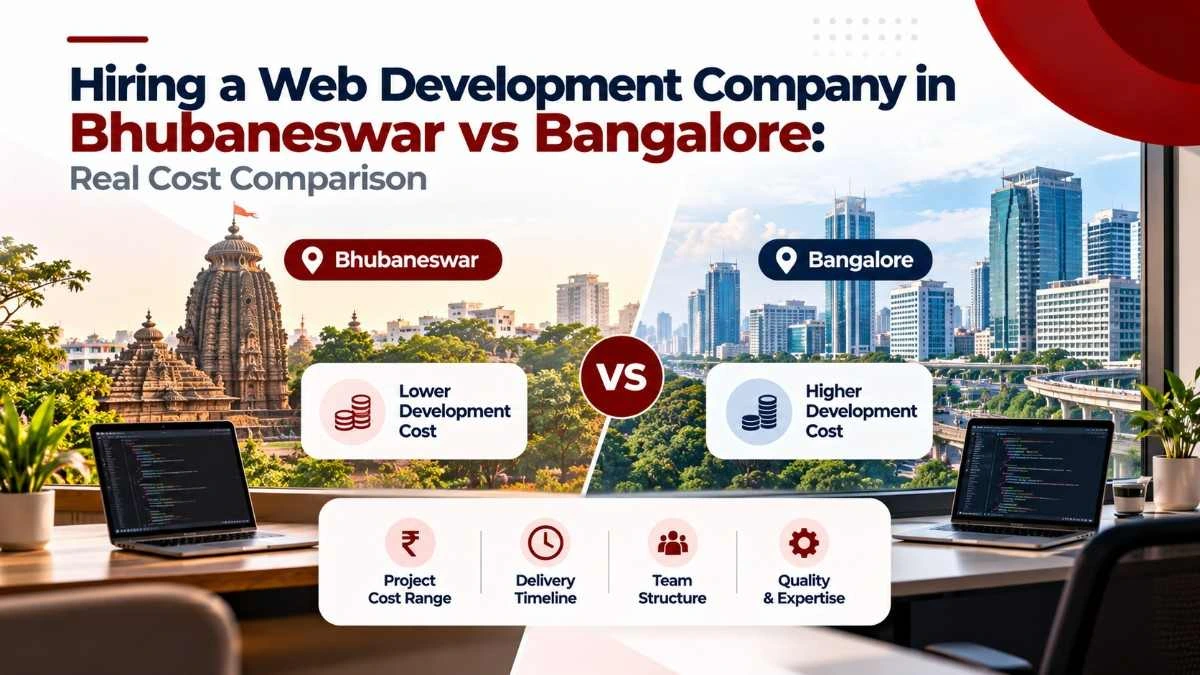
Hiring a Web Development Company in Bhubaneswar vs Bangalore: Real Cost Comparison [2026]
Date: 19 - 10 - 2026
Time to read: 16 minutes
Key Takeaways
- Hiring a web development company in Bhubaneswar instead of Bangalore typically saves 30 to 50 percent on comparable project and retainer pricing, with the gap narrowing only at the most specialized senior work.
- The savings aren't just salary arbitrage. Lower office overhead, lower staff attrition, and a less competitive hiring market reduce a Bhubaneswar agency's cost structure, and that shows up in the invoice.
- Team augmentation, hiring full-time developers from a Bhubaneswar company to extend your existing team, is the engagement model most companies land on, not project outsourcing or direct relocation.
- Bangalore agencies carry hidden costs a simple quote comparison misses: developer churn mid-project, account manager turnover, and real estate overhead passed through to clients.
- Bhubaneswar's delivery capability is already validated. Several major MNCs run large IT centres in the city, drawing from the same graduate pipeline a Bhubaneswar development company hires from.
- The right evaluation criteria for a development company are the same regardless of city: portfolio, billing transparency, named project leads, and references, which matter more than where the office sits.
[ Table of Content ]
Most companies researching "Bhubaneswar vs Bangalore for software development" are really asking the wrong unit of comparison. The real decision a company makes is not which city has cheaper individual developers to poach. It is which development company to sign a contract with, one that owns delivery, carries the project management overhead, and is accountable when something breaks after launch.
That distinction changes the entire cost conversation. A company isn't comparing one engineer's CTC against another's. It is comparing two vendor cost structures: office overhead, attrition risk, project management layers, billing models, and what happens if the relationship needs to scale or end. This guide breaks that comparison down the way a procurement or founder decision actually gets made.
A note from our founder
Nearly every prospective client who asks us about Bhubaneswar vs Bangalore is actually trying to decide between two agencies, not two cities. The city is a proxy for cost structure. Once you unpack what actually drives that structure, the decision gets easier to make on paper instead of on vibes.
Sanjay Ananda, Founder and CEO, OddtuskWhy This Has to Be a Company Decision, Not an Individual One
Comparing Bhubaneswar and Bangalore at the level of individual developer salaries answers the wrong question for a company that is hiring a vendor, not an employee. When you engage a development company, you are not buying one person's time. You are buying that company's delivery process, its project management, its quality assurance, its account continuity, and its accountability if the work needs to be redone.
Three shifts have made this a live procurement question in 2026 rather than a theoretical one. Remote-first delivery has normalized hiring a development company outside your own city or country. Bangalore agency rates have kept climbing, driven by the same salary inflation and real estate costs that push up individual developer pay there. And Bhubaneswar's vendor landscape has matured. The city now has development companies, not just freelancers, with the project management layer, QA processes, and account structure that a company contracting out real work actually needs.
What changes when you compare companies instead of individuals
- Overhead gets priced in. A vendor's office cost, bench time, and management layer are part of what you pay for, not separate from the developer's salary.
- Accountability shifts to the company. If a developer leaves mid-project, a real development company absorbs the handoff cost and keeps delivering; an individual hire leaves you starting over.
- Billing model matters as much as the number. Fixed-price, time-and-materials, and dedicated-team retainers carry different risk profiles regardless of which city the vendor sits in.
The Real Cost Gap by Engagement Model
The cost difference between a Bhubaneswar development company and a Bangalore one shows up differently depending on how you structure the engagement. The table below breaks down the three models most companies actually use.
| Engagement model | What it means | Typical Bhubaneswar vs Bangalore gap* |
|---|---|---|
| Fixed-price project | A scoped website, web app, or platform build billed as one quoted figure | A Bhubaneswar quote typically comes in noticeably lower for the same written scope, for standard CMS, ecommerce, and web-app work |
| Team augmentation (dedicated developers) | Full-time developers from the vendor company working inside your existing team and tools | Monthly per-developer retainer from a Bhubaneswar company usually runs well below a comparable Bangalore agency's rate card |
| Time-and-materials / hourly | Billed per hour against a scope of work, common for ongoing maintenance and smaller features | Bhubaneswar hourly rates are generally lower both in INR for domestic clients and in USD for international clients |
*Ranges reflect Oddtusk's own quote comparisons against Bangalore agencies pitching the same briefs across 2025 and 2026. No published industry index exists, since no independent benchmark tracks agency-to-agency pricing at this level of detail.
The gap is widest at the standard end of the work: CMS sites, ecommerce storefronts, internal tools, API integrations, QA, and maintenance. That's where Bhubaneswar's talent pipeline is deepest relative to its cost base. It narrows for the most specialized senior engineering, where Bangalore's much larger pool of niche specialists still commands a premium that a smaller city can't fully match.
What You Actually Get for the Price
A lower quote only matters if the delivery underneath it is comparable. Here is where a Bhubaneswar development company matches a Bangalore one, and where it typically doesn't.
| Capability | Bhubaneswar companies | Bangalore companies |
|---|---|---|
| Full-stack web and ecommerce development | Comparable skill depth for common stacks (Java, Python, React, Node.js) | Comparable skill depth, at a higher price point |
| QA, API, and backend work | Strong, validated by years of major MNC delivery centres drawing from the same local graduate pool | Strong, with a larger pool to draw from |
| Mobile development (Android and iOS) | Available, good quality for standard apps | Available, broader bench for complex native work |
| Enterprise architecture, deep AI/ML research | Available, but a thinner bench; fewer specialists per company | Deeper bench; this is where Bangalore's size advantage is real |
| Product management with Series B+ startup experience | Less common | More common, given Bangalore's startup density |
For the large majority of company briefs, websites, ecommerce platforms, internal tools, SaaS features, and integrations, the capability gap is small enough that price decides the comparison. Bangalore's size genuinely buys you something Bhubaneswar can't match yet only for the thin slice of work needing a large bench of one specific, hard-to-staff specialism.
The Hidden Costs Bangalore Agencies Add
A quote-to-quote comparison between a Bhubaneswar and a Bangalore development company misses several costs that only show up once the engagement is underway.
Developer and account manager churn
Attrition in India's IT sector has been a persistent industry issue for years.[1] Bangalore's dense, highly competitive job market gives individual developers and account managers more frequent reasons to move for a counter-offer. When a vendor's staff member on your project leaves mid-engagement, you absorb the handoff cost, a new person ramping up on your codebase and context, even though your contract is with the company, not the individual.
- Mid-project handoff cost. Documentation gaps, re-explaining requirements, and a ramp-up period before the replacement developer is as fast as the one who left.
- Account manager turnover. A new point of contact means re-establishing context on your business, your priorities, and your communication style.
- Lower churn in a Bhubaneswar vendor team. A smaller, less saturated job market means fewer competing offers pulling staff away from your project mid-stream.
Office and real estate overhead passed through
Commercial real estate in Bangalore carries a well-documented premium over Tier-2 cities. A development company's office cost is baked into its billing rate, whether or not that's stated explicitly in the quote. A Bhubaneswar company with lower rent and operating costs has more room to price competitively without cutting into delivery quality.
Recruitment friction reflected in your rate card
A Bangalore agency competing for talent in a crowded market pays more to recruit and retain senior engineers. That cost structure shows up in client billing rates over time, not just in one-off hiring events. A Bhubaneswar company recruiting in a less saturated market has lower acquisition cost per hire, which is reflected in steadier, lower rate cards.
Odisha's IT Services Capability: What a Bhubaneswar Company Can Deliver
The capability question behind this comparison is simple: has Bhubaneswar built enough of an IT services base for a company to trust a vendor there with real client work? The answer is yes. It didn't happen overnight.
STPI Bhubaneswar
The Software Technology Parks of India has run a dedicated STPI centre in Bhubaneswar for years, supporting software exporters in the city with infrastructure and export facilitation, the same institutional backbone that supports IT services clusters in other Tier-1 and Tier-2 cities across India.[2]
Large, risk-averse multinational IT companies have run delivery centres in Bhubaneswar for years. They hire from the same KIIT University, IIT Bhubaneswar, and NIT Rourkela graduate pipeline that smaller Bhubaneswar development companies draw from. Those MNCs would not have built lasting delivery capacity in the city if the underlying talent couldn't support real client work at scale.
What a Bhubaneswar development company reliably delivers
- Full-stack web development on common enterprise stacks
- Ecommerce builds and QA (Shopify, WooCommerce, Magento, custom)
- Backend, API, and integration work
- Mobile development for standard Android and iOS apps
- React and Vue front-end work
- Team augmentation for companies that want to extend an existing team rather than outsource whole
Where you'll find a thinner bench: deep AI/ML research roles, large pools of product managers with Series B+ startup experience, and senior architects specialized in niche enterprise platforms. These are real gaps, not marketing spin. A company with that exact need should weigh a Bangalore or metro vendor for that specific slice of work, even while using a Bhubaneswar company for everything else.
Team Augmentation vs Full Outsourcing: Which Model Fits Your Company
Most companies that run this comparison end up choosing team augmentation over either full project outsourcing or trying to relocate hiring entirely. It's worth understanding why that model wins so often.
Team augmentation means a Bhubaneswar development company supplies full-time developers who work inside your existing team, your tools, your sprint process, and your codebase. It is not the same as taking an entire project in-house as a sealed black box. Companies tend to reach for this model when they already have a tech team in a metro or overseas and need to scale capacity without a proportional headcount cost increase. It also appeals to companies that want to keep IP and institutional knowledge in-house rather than handing it to an agency's own process.
It is operationally simple to run. Remote collaboration tooling has matured enough that daily standups, sprint planning, and code review work the same whether your augmented developer sits in Bhubaneswar or down the hall. Bhubaneswar's time zone, 5:30 GMT, overlaps comfortably with both Indian metro business hours and the US East Coast working day. That matters for companies managing a distributed team across time zones.
Why team augmentation beats full outsourcing for most companies
- IP and continuity stay with you. Your codebase, documentation, and institutional knowledge live in your systems, not the vendor's.
- Lower switching cost. If the engagement ends, you keep the work product and simply stop renewing the augmented seats.
- Price point without losing control. You get Bhubaneswar's cost advantage without ceding project ownership the way a full outsourcing contract would.
Full project outsourcing still has a place, usually for a company with no internal technical team at all, or a well-defined, bounded project that can genuinely be handed off end to end. For that model, a Bhubaneswar agency's lower rate card for CMS, ecommerce, QA, API, and maintenance work tends to match client needs closely. That's exactly the category of work most outsourced projects fall into.
The 12-Month Engagement Comparison
A single quote comparison understates the real gap. Run the comparison across a 12-month engagement for a team of five mid-level developers, and the picture gets clearer.
| Factor over 12 months | Bangalore development company | Bhubaneswar development company |
|---|---|---|
| Base retainer / rate card | Higher, reflecting the city's cost base | Lower, for comparable scope and skill level |
| Attrition risk during the engagement | Higher, given denser competing-offer activity | Lower, though not zero |
| Recruitment and replacement friction | Higher, in a more competitive hiring market | Lower, with less bidding-war pressure at the offer stage |
| Office and real estate overhead passed through | Higher | Lower |
| Delivery quality for standard CMS, ecommerce, QA, and API work | Comparable | Comparable |
For the standard engagement model that most companies actually run, team augmentation or fixed-price work on web and ecommerce builds, Bhubaneswar wins on total cost. It doesn't concede meaningfully on delivery quality to get there. The comparison tightens only when the brief genuinely needs a deep bench of one specialized, hard-to-staff skill.
Vendor Continuity: The Long-Term Argument
Choosing a development company is also a continuity bet, not just a cost bet. A vendor relationship that survives staff turnover, retains institutional knowledge of your systems, and doesn't need to be re-onboarded every year compounds in value the longer it runs.
Why this compounds
Every month a vendor's team continues on your account, they accumulate undocumented context about your codebase, your edge cases, and your priorities that a replacement team has to rebuild from scratch. A lower-churn vendor keeps that knowledge intact, which makes Year 2 of the relationship faster and cheaper than Year 1, where a high-churn vendor resets some of that value every time a key person leaves.
A Bhubaneswar company operates in a less saturated, less competitive hiring market. That gives it structurally lower staff churn pressure than a Bangalore agency competing in one of India's tightest tech labor markets. That advantage is not guaranteed for any individual vendor, but it is a real structural tailwind worth weighing alongside price.
How to Evaluate a Development Company, Wherever It's Based
City is a proxy for cost structure, not a substitute for due diligence. These questions decide whether a specific company, Bhubaneswar or Bangalore, is actually worth hiring.
- Can they show a portfolio of comparable past projects, not just a generic capability deck?
- Is the billing model (fixed-price, time-and-materials, or dedicated-team retainer) stated clearly, with what's included and excluded?
- Is there a named project lead and an escalation path if something goes wrong?
- Will they provide at least one reference from a client outside their home city or country?
- Do they subcontract any part of delivery, and if so, is that disclosed upfront?
- What is their actual staff retention on long-running accounts, not just their marketing claim about it?
- Who owns the code, infrastructure access, and IP at the end of the engagement?
- What does their handoff process look like if a team member on your account leaves?
A company that answers these clearly, whichever city it operates from, is a lower-risk hire. A cheaper number with a vague answer on any of the above is not.
Keep reading
Already decided to build in Bhubaneswar?
Our website design cost in Bhubaneswar guide breaks down what a single project actually costs once you've picked a vendor. Our SEO cost in Bhubaneswar pricing guide covers what comes after launch.
Conclusion
Hiring a web development company in Bhubaneswar instead of Bangalore is not a compromise companies make to save money at the cost of quality. For the large majority of company briefs, websites, ecommerce platforms, internal tools, and team augmentation, it is a structurally lower-cost decision that doesn't sacrifice delivery quality. The underlying cost drivers, office overhead, attrition, and hiring-market competition, genuinely differ between the two cities.
- The comparison that matters is company vs company, not developer vs developer.
- Bhubaneswar wins on total cost of engagement for standard web, ecommerce, and team augmentation work.
- Bangalore still has an edge for the thinnest slice of work: deep AI/ML specialists and large product-management benches.
- Evaluate any vendor, in either city, on portfolio, billing transparency, named leads, and references, not location alone.
At Oddtusk, we build web and ecommerce platforms for companies across India, the US, and the UK as a managed company engagement, not a single freelance hire. Every engagement comes with a named project lead, transparent billing, and the same accountability you'd expect from a vendor in any city. If you're comparing a Bangalore quote against a Bhubaneswar one, talk to our team and we'll walk you through where the numbers actually come from.
How Oddtusk Approaches This as a Vendor
Oddtusk is a Bhubaneswar-based development and growth company, and we scope every engagement the way this article recommends evaluating any vendor.
- Named project lead, not a rotating pool. Every engagement has an accountable lead for delivery and escalation.
- Transparent billing model. Fixed-price, time-and-materials, or dedicated-team retainer, stated clearly before work starts.
- Team augmentation support. We've run this model for companies that already have a tech team and need to extend capacity without ceding IP.
- References on request. Including clients outside Odisha, since that's the fair comparison against any Bangalore agency you're evaluating.
- Lower cost structure, same delivery bar. Our Bhubaneswar overhead is lower; our QA and delivery process isn't scaled down to match.
If you're weighing a Bangalore agency's quote against a Bhubaneswar alternative, reach out. We'll tell you plainly where a lower number is a genuine efficiency and where it's scope quietly removed.
Comparing a Bangalore quote against Bhubaneswar?
Send us both and we'll tell you honestly what's comparable, what's missing, and what the real gap is. No strings attached.
Get a Free Quote Review
[ Common questions ]
Frequently Asked Questions
Yes, for most standard engagement types. A Bhubaneswar development company typically quotes 30 to 50 percent lower than a comparable Bangalore agency for the same project scope. The main reasons are lower office overhead, lower salary floors, and less competitive bidding for talent. The gap narrows for highly specialized senior work such as enterprise architecture or deep AI/ML engineering, where Bangalore's deeper talent pool still commands a premium.
For fixed-price website and web application projects, Bhubaneswar agencies typically quote noticeably lower than Bangalore agencies for an equivalent scope. For ongoing team augmentation, a Bhubaneswar agency's monthly per-developer retainer usually runs meaningfully below Bangalore's too. These are directional ranges based on Oddtusk's own quote comparisons across 2025 and 2026 projects, not a published citywide index, since no independent benchmark tracks agency-to-agency pricing at this granularity.
For standard full-stack web development, CMS and ecommerce builds, QA, and API work, quality is comparable. Bhubaneswar's talent pipeline from KIIT University, IIT Bhubaneswar, and NIT Rourkela has been validated for years by the large IT delivery centres that several major MNCs run in the city. The gap reappears at the most specialized end, deep AI/ML research or enterprise platform architecture, where Bangalore's larger talent pool still has an edge.
Team augmentation means a Bhubaneswar-based company supplies full-time developers who work as an extension of your existing team, under your processes and tools. It is not the same as taking the whole project in-house as a black box. Most Bhubaneswar development companies, including Oddtusk, support this model because it is simple to run, with standard remote collaboration tools and a 5:30 GMT time zone that overlaps well with both Indian metros and US East Coast working hours.
Bangalore agencies carry higher real estate and office overhead that gets priced into client invoices. They also carry higher developer attrition, which leads to mid-project handoffs and re-onboarding costs, and a more competitive hiring market that drives up account manager and senior engineer replacement costs. A Bhubaneswar development company generally has lower overhead, lower staff churn, and a less congested hiring market, which keeps total engagement cost lower even when base quotes look similar.
For enterprise web platforms, ecommerce at scale, and multi-system integrations, yes, since the underlying engineering skill sets (Java, Python, React, Node.js, cloud) are comparable to Bangalore. Companies should still lean toward a Bangalore or metro agency for projects needing a large bench of niche specialists in a single hard-to-staff area, such as a dedicated enterprise AI research team. A smaller Bhubaneswar talent pool is less likely to offer that depth.
Ask for a portfolio of comparable past projects, a clear breakdown of fixed-price versus time-and-materials billing, and named points of contact for project management and escalation. Also ask for references from at least one client outside Odisha. A company that is vague about who actually writes the code, subcontracts without disclosure, or has no escalation process is a bigger risk than its location.
Yes. Oddtusk is a Bhubaneswar-based company that delivers web and ecommerce development, SEO, and performance marketing as managed engagements, with a named project lead and team rather than a single freelance hire. Companies evaluating Bhubaneswar as an alternative to Bangalore can use this article's questions to evaluate Oddtusk the same way they'd evaluate any other vendor.
Sources
- Analytics India Magazine (2025). Attrition Rate In Indian IT Industry Is At An All-Time High. Why?
- Software Technology Parks of India. About STPI Bhubaneswar.
- Oddtusk project records and quote comparisons against Bangalore-based agencies, 2025 and 2026 engagements.

About the author
Sanjay Ananda
Founder and CEO, Oddtusk
Sanjay Ananda founded Oddtusk in Bhubaneswar. He leads its website design, SEO, AEO, and growth engineering work for businesses across India, the US, and the UK, including the team-augmentation and project-based development engagements described in this article.
