

A practical framework for evaluating digital marketing agencies in Bhubaneswar based on results, not promises.
How Much Does SEO Cost in Bhubaneswar? A Complete Pricing Guide for 2026
Date: 09 - 03 - 2026
Time to read: 22 minutes

[ Table of Content ]
Why Is There No Reliable SEO Pricing Guide for Bhubaneswar?
Search for "SEO cost in Bhubaneswar" right now. Every result on the first page is an agency promoting its own packages. Basic, Standard, Premium. Silver, Gold, Platinum. The naming changes but the structure is the same: pick a box, pay the price, get a fixed list of deliverables.
The problem is that none of these packages know anything about your business. A dental clinic and a funded SaaS startup have nothing in common when it comes to SEO, but a package-based agency might slot both into the same "Standard" tier because the monthly fee fits their budget. Not one result on that first page is an independent guide that helps you understand what you actually need versus what someone is trying to sell you.
That gap is the reason this guide exists.
Bhubaneswar's SEO market is growing fast. The city has a booming startup scene, a strong IT corridor, and thousands of small businesses going digital for the first time. Many of these business owners know they need SEO but have no frame of reference for what it should cost. They see SEO service charges that vary wildly from one provider to the next with no clear way to tell which one offers real value.
This guide gives you that frame of reference. We will walk through how the package-based market works, what each tier typically includes, why packages often fail business owners, and what a requirements-first approach looks like instead. The goal is to help you evaluate any SEO proposal on substance, not just price.
One thing to keep in mind before we start: SEO services in India attract 18% GST on top of the quoted price. Always confirm whether a quote includes or excludes GST before signing anything.
How Much Does SEO Cost in Bhubaneswar?
There is no single answer because the cost depends entirely on what your business needs. But most SEO agencies in Bhubaneswar do not start by understanding your needs. They start by showing you a menu. Here is how the typical package-based market is structured.
| Provider Tier | What You Typically Get | Best For |
|---|---|---|
| Budget freelancer or solo specialist | Basic on-page fixes, limited keyword targeting, minimal reporting | Very small businesses with a narrow local focus |
| Small agency (2 to 5 person team) | Local SEO, Google Business Profile, basic content, monthly reports | Single-location businesses in Bhubaneswar |
| Mid-tier agency with structured packages | On-page + off-page SEO, regular content, link building, analytics | Growing SMEs targeting regional keywords |
| Full-service digital agency | Comprehensive strategy, content production, advanced link building, CRO | Brands targeting national or multi-city keywords |
| Enterprise-grade agency | Multi-subdomain architecture, programmatic SEO, dedicated cross-functional team | Large corporations, funded startups at scale |
Notice the pattern. Every tier is defined by the provider, not by your business. A budget freelancer offers a fixed set of tasks. A full-service agency offers a bigger fixed set. Neither starts by asking what your actual business goals are, what keywords matter in your market, or what competitive landscape you face.
The rest of this guide breaks down what drives the real cost of SEO, why most packages miss the mark, and how to tell the difference between a provider selling a box and one building a plan around your business.
What Should Your Business Spend on SEO in Bhubaneswar?
This is where the package model breaks down most clearly. A single-location restaurant and a funded startup targeting national keywords have completely different SEO needs. Putting them both in a "Standard" package means one overpays for things it does not need and the other gets too little to move the needle. Here is what each business type actually requires and what drives the cost.
Local Small Business (Single Location)
Scope: Basic local SEO
This covers businesses like dental clinics, salons, local retailers, and professional service offices. Your agency should target 5 to 10 keywords, optimize your Google Business Profile, build local citations, handle basic on-page SEO, and send you a monthly report. Content creation is minimal, usually 1 to 2 pages per month. Expect to see results in the Local Pack within 3 to 6 months. This is the lowest cost tier for SEO in Bhubaneswar.
Restaurant or Hospitality
Scope: Google Business Profile + local visibility
Restaurants have a simpler SEO scope. The primary focus is Google Business Profile optimization, review management, local citations, and menu or photo optimization. Content needs are minimal. You should see Local Pack visibility within 2 to 4 months. If you are a single-location restaurant in Bhubaneswar, this is often enough to drive consistent footfall from search. The narrower scope means this is one of the most affordable SEO engagements.
Healthcare Clinic
Scope: YMYL-compliant local SEO + medical content
Healthcare SEO costs more than general local SEO because medical content falls under Google's YMYL (Your Money or Your Life) guidelines. Content must be accurate, well-sourced, and ideally reviewed by a medical professional. Expect 10 to 20 target keywords, Google Business Profile optimization, citation building, and 1 to 2 medical articles per month. Results take 4 to 8 months.
Real Estate
Scope: Location pages + lead generation + schema
Real estate SEO in Bhubaneswar is competitive. You need location-based landing pages for each project, lead generation optimization, schema markup for property listings, and 2 to 3 new project pages per month. The keyword count typically falls between 20 and 40. Results take 4 to 8 months, but the cost per lead from organic search is usually far lower than what you pay for portal listings or Google Ads. The higher content volume and technical requirements push this into the mid-tier pricing bracket.
Education and Coaching
Scope: Course page optimization + content marketing
Bhubaneswar's education market is competitive, with coaching institutes, schools, and ed-tech platforms all fighting for the same queries. Expect to target 15 to 30 keywords, invest in course page optimization, local SEO, content marketing, and student review management. Plan for 2 to 3 articles per month and 4 to 6 months to see traction. The competitive landscape means you need mid-tier investment at minimum.
Growing SME or Regional Brand
Scope: Full on-page + off-page + content + link building
Multi-location businesses and regional service providers need a broader approach. This means 20 to 50 keywords, on-page and off-page SEO, content creation (2 to 4 pieces per month), quality link building, and quarterly technical audits. Results take 4 to 8 months. The scope puts this firmly in the upper-mid tier of SEO investment.
Funded Startup
Scope: Topic clusters + aggressive content + national link building
Startups in growth mode need topic cluster strategies, 6 to 10 content pieces per month, advanced link building, conversion rate optimization, and weekly reporting. You are targeting 50 to 100+ keywords and competing at a national level. Expect results in 6 to 12 months. This is premium-tier SEO and the investment should only make sense when your customer lifetime value justifies it.
D2C and E-commerce
Scope: Product pages + category SEO + Google Shopping + schema
E-commerce SEO involves product page optimization, category SEO, Google Shopping integration, image optimization, and schema markup. The keyword count is higher (50 to 250+), and you need ongoing product content plus 2 to 4 blog posts per month. Results show up within 4 to 8 months for most product categories. The sheer volume of pages to optimize makes e-commerce one of the more expensive SEO engagements.
Enterprise
Scope: Multi-subdomain architecture + programmatic SEO + dedicated team
Large corporations, banks, insurance companies, and major portals need multi-subdomain architecture, programmatic SEO, a dedicated cross-functional team, and revenue attribution models. Enterprise SEO is the highest investment tier with 12+ month timelines. Most Bhubaneswar businesses do not need this level. Enterprise clients typically hire metro-based or international agencies.
How Do SEO Agencies Charge for Their Services?
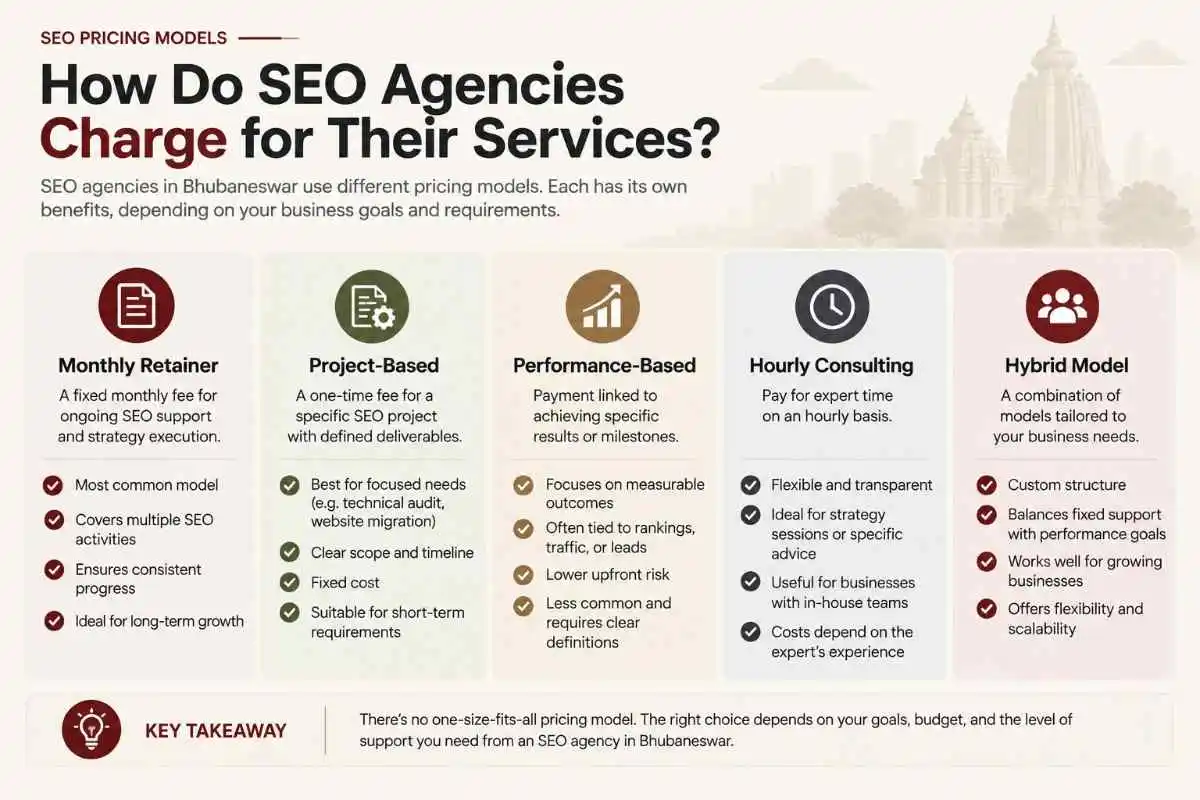
Beyond the provider tier, you also need to understand how agencies structure their pricing. Most agencies in Bhubaneswar default to the monthly retainer model with pre-built packages. But there are other models, and understanding them helps you spot whether a provider is selling a box or actually scoping work around your needs.
Monthly Retainer
This is the most common model in India. You pay a fixed amount each month for ongoing SEO work. The agency handles keyword research, on-page optimization, content, link building, technical fixes, and reporting on a continuous basis. Contracts typically run 6 to 12 months because SEO needs that time to produce results. The benefit is predictable budgeting and compounding returns. The downside is the long-term commitment. Monthly retainers span the widest price range of any model because they cover everything from basic local SEO to enterprise-level campaigns.
Project-Based
This model works for one-time jobs like a technical SEO audit, a website migration, or a site-wide content overhaul. The scope is clear, the deliverables are fixed, and there is no ongoing commitment. Project fees vary dramatically based on the size and complexity of the site. A basic audit for a 20-page site is a fraction of what a full migration for a 5,000-page e-commerce store costs. The risk is that without ongoing optimization, the results from a one-time project can decline over time.
Hourly Consulting
The SEO consultant cost model works best for strategy sessions, training, or ad-hoc problem solving. Senior consultants charge significantly more than junior ones. This model is less common in India than in Western markets, but it can work well when you need expert advice without committing to a full retainer. The total cost is unpredictable, and execution is not included.
Freelancer
India has a large freelance SEO market. The typical SEO freelancer cost is lower than an agency because overheads are minimal. You get direct communication and flexibility. The trade-off is a single point of failure, limited capacity, and potentially fewer enterprise-grade tools. Quality varies widely, so check their portfolio and references carefully.
Performance-Based
In this model, you pay a lower base fee and a bonus when the agency hits specific targets. Sounds attractive, but be careful. Legitimate performance-based models tie bonuses to leads or revenue. Risky ones tie them to rankings. Any agency that guarantees first-page rankings is either using tactics that will hurt your site long-term or making a promise they cannot keep. Google itself has said that no one can guarantee a #1 ranking.
In-House Hire
Hiring a full-time SEO professional gives you dedicated attention and deep business understanding. But the total cost of salary plus enterprise tool subscriptions plus training often exceeds what you would pay a mid-tier agency retainer, especially in the first year when the learning curve is steepest. This makes sense only for companies with large, ongoing SEO needs where the volume of work justifies a dedicated hire.
What Do SEO Packages Typically Include?
If you are comparing SEO packages from agencies in Bhubaneswar, this is what each tier generally looks like. The table below reflects how most package-based providers structure their offerings.
| Deliverable | Basic Tier | Standard Tier | Premium Tier |
|---|---|---|---|
| Website Audit | Basic technical audit | Comprehensive audit | Advanced audit + competitor analysis |
| Keyword Research | 5 to 10 keywords | 20 to 50 keywords | 50 to 100 keywords |
| On-Page SEO | Title tags, meta descriptions (5 to 10 pages) | Full on-page optimization (20 to 50 pages) | Complete optimization + content overhaul (50 to 100 pages) |
| Content Creation | None or 1 blog per month | 2 to 4 articles per month | 6 to 10 content pieces per month |
| Link Building | Basic directory submissions | 5 to 10 quality backlinks per month | 10 to 20 high-authority links per month |
| Technical SEO | Basic fixes (robots.txt, sitemap) | Speed optimization, basic schema | Advanced schema, Core Web Vitals, crawl optimization |
| Local SEO | Google Business Profile setup | GBP optimization + 15 citations | GBP + 25 citations + review strategy |
| Reporting | Monthly basic report | Bi-weekly reporting + dashboard | Weekly reporting + insights + strategy calls |
| Analytics Setup | Basic GA4 setup | GA4 + goal tracking + GTM | Advanced GA4 + custom events + attribution |
| Content Strategy | Not included | Basic editorial calendar | Topic cluster strategy + content briefs |
The table looks neat. The problem is that it treats every business the same way at each tier. A healthcare clinic and a restaurant both land in "Basic" if their budget is similar, but their SEO needs could not be more different. The clinic needs YMYL-compliant medical content. The restaurant needs Google Business Profile and review management. A generic package gives both the same 5 to 10 keywords and one blog per month.
Content creation and link building are the two biggest cost drivers in SEO. A well-researched, 1,500-word article takes real writing time. Quality link building requires manual outreach to authoritative sites. These costs add up quickly, which is why packages that include both content and links cost significantly more than basic optimization packages. If a package promises content creation and link building at a very low monthly fee, ask how many pieces they produce and where the links come from. The math rarely works out at rock-bottom prices.
A better approach is to start with your business requirements and build the deliverable list from there. What keywords matter for your business? How competitive are they? What content do you need to produce to rank? How many and what quality of links does your domain need? The answers to these questions should determine the scope, and the scope should determine the cost. Not the other way around.
Cheap SEO vs Quality SEO: What You Need to Know
This is where the package model creates the most damage. When everything is sold as a box with a label, business owners naturally compare boxes on price. A "Basic" package from Agency A looks similar to a "Basic" package from Agency B, so the cheaper one wins. But the labels hide enormous differences in what you actually get, what risks you take, and what happens to your website over time.
What Cheap SEO Looks Like
Bottom-tier packages typically involve automated keyword research with no competitive analysis, spun or AI-generated content that nobody edited, directory submissions passed off as "link building," automated reports full of vanity metrics, and no real strategy. The agency runs a checklist of tasks instead of building a plan around your business goals.
The worst part: some cheap SEO providers use black hat techniques like private blog networks, link farms, and keyword stuffing. These can produce short-term ranking spikes. But when Google catches on, and it usually does, your site can get hit with a manual penalty. Recovering from a Google penalty takes months and costs far more than the original SEO engagement.
What Quality SEO Looks Like
A quality provider gives you a custom strategy document based on your business goals, original content written by someone who understands your industry, manual outreach for backlinks from relevant, authoritative sites, comprehensive reporting that tracks traffic, leads, and revenue (not just rankings), a dedicated account manager with regular calls, and enterprise tools like Ahrefs or Semrush. Those tool subscriptions alone cost a meaningful amount each month. Quality agencies absorb this cost rather than passing cheap alternatives to you.
Red Flags in SEO Proposals
- Guaranteed first-page rankings or #1 position promises
- Cannot name the specific keywords they will target
- Cannot show case studies of results lasting 12+ months
- Promises 100+ backlinks per month at a suspiciously low fee
- No strategy document or discovery call before starting
- Reporting only shows rankings, not traffic, leads, or revenue
- Cannot explain what Core Web Vitals are or why they matter
- One-size-fits-all approach with no questions about your business
Think about it this way. A cheap SEO package that leads to a Google penalty costs you far more than a quality package that builds sustainable organic traffic. The cheapest option is rarely the least expensive one in the long run.
How Do You Know If Your SEO Spend Is Working?
The real question is not what the SEO optimization cost is. It is what return that cost generates. Here is a framework to measure that for any business size.
Customer Acquisition Cost (CAC)
Divide your total SEO spend by the number of customers you acquired through organic search. After 6 months of consistent work, SEO typically delivers 30 to 60% lower CAC compared to paid channels like Google Ads. Track this monthly. If your SEO CAC keeps dropping while your paid CAC stays flat or rises, your SEO investment is working.
Organic Traffic Value
Take your monthly organic traffic and multiply it by the average cost per click you would pay for those same keywords through Google Ads. If you rank for a keyword with a moderate CPC and get hundreds of clicks per month from it, the traffic value from that one keyword alone can match or exceed your entire monthly SEO spend. After 12 months of quality SEO, your effective cost per click from organic search drops dramatically compared to paid ads.
Cost Per Lead (CPL)
Divide your monthly SEO spend by the number of leads generated from organic traffic (form submissions, calls, purchases). SEO CPL is typically 40 to 70% lower than PPC CPL after the ramp-up period. Track this monthly to show improving efficiency over time.
Break-Even Timeline
This is the month when your cumulative organic revenue exceeds your cumulative SEO investment. For basic SEO targeting local keywords, break-even typically happens at 6 to 12 months. For competitive national keywords, plan for 12 to 18 months. Set this expectation upfront so you are not surprised by the investment timeline.
SEO vs PPC: A Practical Comparison
SEO and PPC are not competitors. They serve different purposes at different stages. PPC gives you immediate visibility but stops the moment you stop paying. SEO takes longer to build but compounds over time. After 12 months, your organic traffic keeps coming even if you reduce your SEO budget. That compounding effect is why SEO delivers better long-term value per rupee spent.
The smart approach for most Bhubaneswar businesses: use PPC for immediate leads while you build organic traffic through SEO. As organic takes hold, gradually shift budget from paid to organic. This way, you never have a gap in lead generation.
Local SEO vs National SEO: Pricing Differences
This distinction matters a lot for Bhubaneswar businesses because it directly affects how much you need to spend.
Local SEO
Local SEO targets customers in your city or region. If you run a dental clinic, a restaurant, or a law firm in Bhubaneswar, this is what you need. The focus is on Google Business Profile optimization, local citations, review management, and ranking in the Local Pack (the map results at the top of Google). You are targeting 5 to 25 keywords, all combining your service with your location. Local link building costs less because the sources are local directories, local news sites, and local business associations.
The biggest advantage: results come faster. Bhubaneswar's SEO competition is lower than metros like Delhi, Mumbai, or Bangalore. You can expect Local Pack visibility within 2 to 4 months for most local keywords. Local SEO sits at the lower end of the pricing spectrum because the scope is narrower.
National SEO
National SEO targets customers across India without geographic restrictions. If you run an e-commerce store, a SaaS product, or a service that can be delivered remotely, you need national SEO. The keyword count is higher (50 to 250+), the content volume is greater (4 to 10+ pieces per month), and the link building is more expensive because you need links from nationally recognized sites. National SEO typically costs 2 to 3 times more than local for the same quality level, and results take 6 to 12+ months.
Which Do You Need?
Most single-location businesses in Bhubaneswar need local SEO. If your customers need to physically visit your location or you serve only the Bhubaneswar area, start with local. You can always expand to national later. Some businesses need both. A Bhubaneswar-based coaching institute that also offers online courses would need local SEO for physical admissions and national SEO for online course visibility.
Is SEO in Bhubaneswar Cheaper Than in Delhi or Bangalore?
How does Bhubaneswar's SEO market compare to national averages? The short answer: entry-level packages start lower, but the picture is more complex than "Bhubaneswar is cheaper."
| Tier | Metro Cities (Delhi, Mumbai, Bangalore) | Bhubaneswar (Tier-2) |
|---|---|---|
| Freelancer | Wide range, often at metro-level rates | Lower entry point due to lower cost of living |
| Small Agency | Higher overheads push prices up | Lower overheads allow more competitive entry pricing |
| Mid-Tier Agency | Broad selection of agencies at this tier | Growing number of agencies, fewer options than metros |
| Premium Agency | Well-established agencies with national client bases | Very few options at this tier locally |
| Enterprise | Multiple options across all metros | Typically served by metro or international agencies |
Bhubaneswar is a Tier-2 city with lower operating costs than metros. This means entry-level SEO tends to start at a lower price point. But lower prices do not automatically mean the same quality at a discount. Some lower-priced providers simply offer a narrower scope of work. Always compare deliverables, not just monthly fees.
Very few Bhubaneswar agencies publish their rates openly, so the local pricing landscape is harder to benchmark than in metros with dozens of published rate cards. The limited data makes it even more important to evaluate each provider on scope, tools, and track record rather than trying to compare prices across cities.
For premium and enterprise-level SEO, Bhubaneswar has limited options. Businesses needing high-end, full-service SEO often work with agencies in Delhi, Bangalore, or Mumbai, or with national firms that serve clients remotely.
How Does Indian SEO Pricing Compare to the US or UK?
For context, here is how Indian SEO pricing compares to Western markets.
Indian SEO pricing runs 60 to 70% lower than Western equivalents for comparable scope. Monthly retainers, hourly consulting rates, content writing, and link building all follow this pattern. The gap exists because labour costs and operational overheads in India are significantly lower than in the US, UK, or Australia.
Content writing costs are 60 to 80% lower. Link building per link follows a similar discount. This makes India one of the most cost-effective markets for SEO services globally, which is why many international businesses outsource SEO work to Indian agencies.
One factor that compresses margins for Indian agencies: the tools are priced globally. Ahrefs, Semrush, and Screaming Frog cost the same in USD whether you are in Bhubaneswar or Boston. This is partly why very cheap Indian SEO providers skip enterprise tools entirely, which directly affects the quality of keyword research, competitor analysis, and backlink monitoring they can deliver.
What Should You Look for in an SEO Proposal?
You have the pricing context. Now you need to know what to look for when an SEO agency in Bhubaneswar sends you a proposal. Here is what separates a good SEO company in Bhubaneswar from one that is just selling boxes.
What a Good SEO Proposal Should Include
- A discovery call or audit before they quote a price
- Clear scope of work with specific deliverables listed
- Target keyword list with search volume and difficulty data
- Competitive analysis showing where you stand right now
- Content plan with topics, frequency, and word counts
- Link building strategy with types of links and sources
- Reporting schedule with specific metrics they will track
- Timeline with realistic milestones (not "page 1 in 30 days")
- Clear contract terms including scope, duration, and exit clauses
- Case studies or references from businesses similar to yours
Questions to Ask Before Signing
Ask the agency these questions and pay attention to how they answer. A good agency will answer all of these without hesitation.
What specific keywords will you target, and why? If they cannot answer this, they have not done their homework. Good agencies start with research, not generic keyword lists.
What tools do you use for research, tracking, and reporting? If they cannot name specific tools, they are likely using only free alternatives, which limits the depth of their analysis.
How do you build backlinks? Listen carefully. "We submit to directories" is very different from "We do manual outreach to industry publications and local news sites." The link building approach is often the biggest quality differentiator between agencies.
Can you show results for a business similar to mine? Ask for specific case studies with traffic, lead, or revenue data. Rankings alone are not enough. A site can rank for 100 keywords that nobody searches for.
What happens if I want to cancel? Understand the contract length, notice period, and what you keep if you leave. Will you retain access to content created, analytics data, and search console access?
Who will actually do the work on my account? Find out if the person you are talking to is the same person who will manage your SEO. Large agencies sometimes send senior people to pitch and hand the work to junior staff.
SEO Packages vs Requirements-First: Which Model Actually Works?
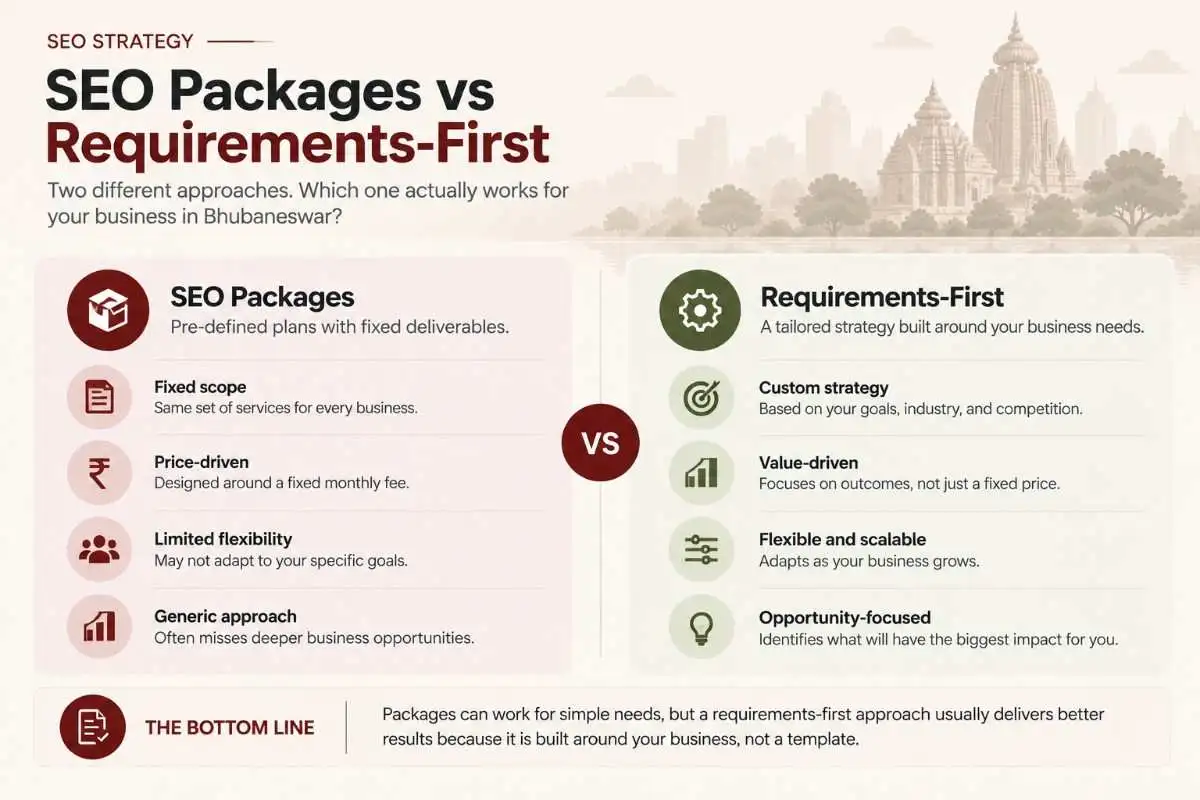
This is the most important section in this guide. Everything above, the pricing tiers, the package inclusions, the cheap vs quality breakdown, describes how the market works today. This section explains why that model fails most business owners and what the alternative looks like.
How the Package Model Works
Most SEO agencies build three to five packages. They give each one a name like Basic, Standard, Premium. They assign a fixed monthly price, a fixed keyword count, a fixed number of blog posts, and a fixed number of backlinks. They publish this on their website. When a potential client reaches out, the agency points them to the pricing page and asks them to pick a plan.
The problem is that this process skips the most important step: understanding what the business actually needs. A dental clinic in Bhubaneswar competing for 5 local keywords faces a completely different SEO challenge than a D2C fashion brand competing nationally for 200+ keywords. Putting both of them into a "Standard" package because they picked the same price point means at least one of them is getting the wrong strategy. Usually both are.
Where Packages Break Down
Packages assume every business at the same budget level needs the same deliverables. That assumption is wrong in three specific ways.
Wrong keyword strategy. A package that promises "20 keywords" does not account for whether those keywords have commercial intent, what the competition looks like for each one, or whether ranking for them will actually bring paying customers. A restaurant does not need 20 keywords. It needs 5 to 8 high-intent local phrases and a fully optimized Google Business Profile. An e-commerce store might need 200 keywords organized by product category, each with purchase intent mapping. The package gives both of them the same number.
Wrong content volume. A local service business might need 2 well-researched location pages and monthly blog posts. A SaaS company might need a full topical authority build across 50+ articles. The "4 articles per month" in a standard package is too many for the first business and far too few for the second.
Wrong link building approach. A Bhubaneswar-only business needs local citations, local directory listings, and links from Odisha-based publications. A national brand needs links from industry publications and high-authority domains. The "10 backlinks per month" line item in a package tells you nothing about whether those links will move the needle for your specific competitive landscape.
The One-Minute Test
Here is the simplest way to tell if an agency is selling packages or building around your needs. If they show you a pricing page and ask you to pick a plan before they have looked at your website, your keywords, or your competitive landscape, they are selling packages. If they insist on a discovery call, run an initial audit, and then come back with a custom scope built around your specific business goals, they are working requirements-first.
How the Requirements-First Model Works
A requirements-first provider does not have a pricing page. The engagement starts with a business audit: what you sell, who your customers are, what your unit economics look like, and what growth targets you are working toward. Then comes a competitive keyword analysis to understand where you stand in your market and where the gaps are. Only after that does the provider recommend a scope, a timeline, and an investment level.
This means every client gets a different deliverable list. The clinic gets a Local Pack strategy. The e-commerce brand gets a content velocity and product page optimization plan. The funded startup gets a technical SEO overhaul paired with aggressive link building. Nothing is standardized because no two businesses face the same competitive reality.
This takes more upfront effort from the agency. A discovery call, a preliminary audit, and a custom proposal require real work before any money changes hands. That is exactly why most agencies skip it and sell packages instead. It is easier to build a pricing page than to build a custom scope for every inquiry.
Signs You Are Talking to a Package Seller vs a Requirements-First Provider
- Package seller: Shows you their pricing page in the first interaction
- Requirements-first: Asks about your business goals before discussing price
- Package seller: Offers fixed keyword counts that are the same for every client at that tier
- Requirements-first: Recommends keywords based on your competitive landscape and commercial intent
- Package seller: Promises a fixed number of backlinks per month regardless of your niche
- Requirements-first: Builds the link strategy around what it will take to outrank your specific competitors
- Package seller: Can onboard you the same week because no research is needed
- Requirements-first: Needs 1 to 2 weeks for discovery and scoping before starting
- Package seller: Sends the same proposal template to every lead
- Requirements-first: Sends a proposal you could not forward to another business because it only applies to yours
Why This Matters for Your Budget
The irony of the package model is that it often costs you more in the long run. When you buy a package that does not match your actual needs, you spend 6 to 12 months paying for deliverables that do not move your metrics. Then you switch agencies and start over. A requirements-first engagement might look like a bigger commitment upfront because the scoping takes longer, but the work that follows is built to produce results for your specific situation. You stop paying for things you do not need and start investing in the things that will actually grow your organic traffic and revenue.
What Is the Right SEO Investment for Your Bhubaneswar Business?
Here is the bottom line. SEO is not a commodity you buy off a shelf. It is a service that should be built around your business goals, your competitive landscape, and your unit economics. The package model is popular because it is easy to sell, not because it is effective.
If you run a local small business in Bhubaneswar, your SEO scope should focus on local visibility, Google Business Profile, and a handful of high-intent keywords. You should see Local Pack visibility within 3 to 4 months and a meaningful increase in organic inquiries within 6 months.
If you are a growing SME or a business targeting regional or national keywords, your scope needs content production, quality link building, and ongoing optimization. Commit for at least 6 months to give the campaign time to compound.
If you are a funded startup or a mid-to-large e-commerce business, you need serious content velocity, advanced link building, and technical depth. The scope should be tied to revenue targets, not to a package label.
Whatever your situation, focus on three things. First, work with a provider who asks about your business goals before quoting a price. If they show you a pricing page before they have seen your website, walk away. Second, make sure the SEO proposal includes specific deliverables built around your needs, not a generic checklist. Third, track your results monthly using the ROI metrics we covered, and hold your provider accountable for business outcomes, not just rankings.
Bhubaneswar's digital marketing market is maturing fast. The businesses that invest in the right SEO strategy now, while competition is still relatively low, will build an organic traffic advantage that compounds for years. Finding the best SEO company in Bhubaneswar is not about who offers the most keywords per package. It is about who understands your business well enough to build the right scope. The ones that keep buying the cheapest package will keep starting over.
If you want to know what SEO should actually look like for your specific business, start a conversation with us. We will run a preliminary assessment of your market, your keywords, and your competition, and tell you exactly what scope makes sense. No packages. No pricing pages. Just a plan built around your business.
[ Common questions ]
SEO Pricing FAQs
The cost depends entirely on your business type and scope, which is why no honest answer starts with a number. A local small business targeting 5 to 10 keywords needs a different scope than a growing SME targeting 50+ keywords. Most agencies will show you a package menu instead of asking what you actually need. The better approach is to find a provider who scopes the engagement around your business goals first and quotes a price second. All SEO services in India are subject to 18% GST on top of the quoted price.
The price difference comes down to scope and quality. Bottom-tier SEO packages typically use automated tools, skip original content creation, and rely on low-quality link building that can trigger Google penalties. Quality SEO includes custom strategy, original content, manual outreach for backlinks, regular reporting, and dedicated account management. The enterprise tool subscriptions that quality agencies use add a meaningful fixed cost that cheap providers simply skip.
Freelancers work well for narrow projects or specific tasks like technical audits. They cost less than agencies because their overheads are minimal. Agencies bring a team with diverse skills, enterprise tools, and structured processes but charge more for the added capacity. Choose a freelancer if your scope is limited and you can manage the relationship closely. Choose an agency if you need ongoing, multi-channel SEO with regular reporting.
For local SEO targeting Bhubaneswar-specific keywords, you can expect to see movement in Google's Local Pack within 2 to 4 months. For broader organic rankings targeting national keywords, plan for 6 to 12 months of consistent work. Bhubaneswar's lower competition compared to metros like Delhi or Bangalore means results often come faster here, but SEO is still a medium-term investment.
Yes. SEO services fall under digital marketing services in India, which attract 18% GST. This means your actual invoice will be 18% higher than the quoted price. Always confirm whether a quote includes or excludes GST before signing a contract. Most agencies quote prices exclusive of GST.
Entry-level SEO in Bhubaneswar tends to start at a lower price point than metros because operating costs are lower in Tier-2 cities. However, the sample size of Bhubaneswar agencies with published pricing is small, and lower prices do not always mean equal quality. What matters more than geography is the actual scope of work, who does it, and whether the provider builds the engagement around your business needs rather than selling a generic package.
