

How complete topic coverage directly affects your site's authority signals in both traditional and AI-powered search.
How to Do a Content Gap Analysis for SEO: A Step-by-Step Guide
Date: 07 - 06 - 2026
Time to read: 11 minutes
[ Table of
Content ]
What Is Content Gap Analysis in SEO?
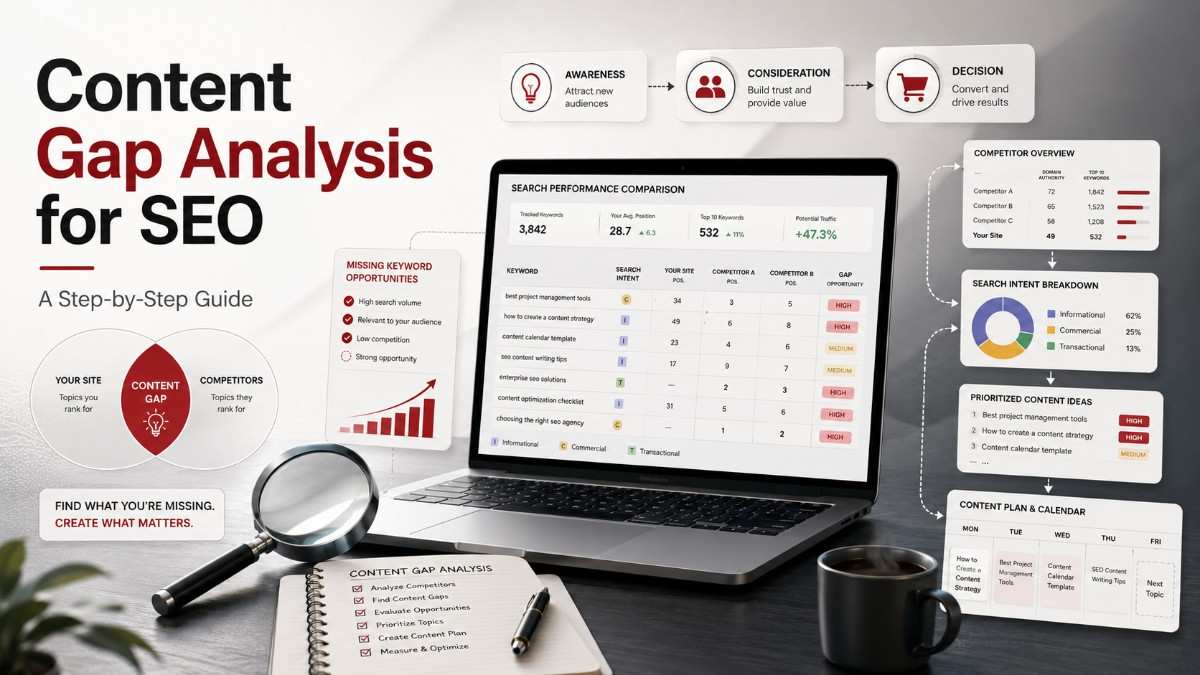
Content gap analysis is the process of finding the keywords and topics your target audience is searching for, that your competitors are already ranking for, and that your website does not yet cover. The "gap" is the space between what your audience wants to know and what your site currently answers.
A content gap analysis works by comparing your site's keyword footprint against two or three competitors in the same search space. The keywords those competitors rank for in positions 1 to 10, where your site has no ranking page at all, are your priority gaps. These are the queries you are losing by default.
This is different from a keyword research exercise. Keyword research finds search volume. A content gap analysis finds what is specifically working for your competitors and missing from your site, so your content strategy starts from evidence rather than guesswork.
Why Content Gap Analysis Matters for Your SEO Strategy
It surfaces buying-intent keywords you would not find otherwise
When you run a gap analysis against competitors, you frequently find commercial and transactional keywords they rank for that your own keyword research never surfaced. These are often mid-funnel queries like "best [product type] for [specific use case]" or "[brand A] vs [brand B]" that signal a buyer who is close to a decision.
Identifying these keywords early lets you build pages that intercept traffic at the point where it is most likely to convert, rather than producing more content for awareness-stage queries that may never lead to a sale.
It reveals where your competitors are weak
A content gap analysis does not only show you what you are missing. It also shows you where competitors rank with thin, poorly structured, or outdated pages. When you find a keyword where the top-ranking page is a 600-word post from 2020 with no examples and no schema markup, you have a real opportunity to take that position with a substantially better page.
It builds topical authority
Google evaluates how completely a site covers a subject area, not just how good individual pages are. A site that answers every meaningful question about a topic, at the right depth, earns greater topical authority than a site with a few strong pages and large gaps elsewhere. A content gap analysis maps the full question landscape for your topic, so you can build coverage deliberately.
It gives your content team a prioritised, evidence-based work queue
Without a gap analysis, content planning often defaults to brainstorming or chasing high-volume keywords that are too competitive to win. A gap analysis replaces that with a ranked list of opportunities tied to real traffic data.
Suggested reading:Why Topical Authority
Matters More Than Ever for AI Search
Tools for Content Gap Analysis
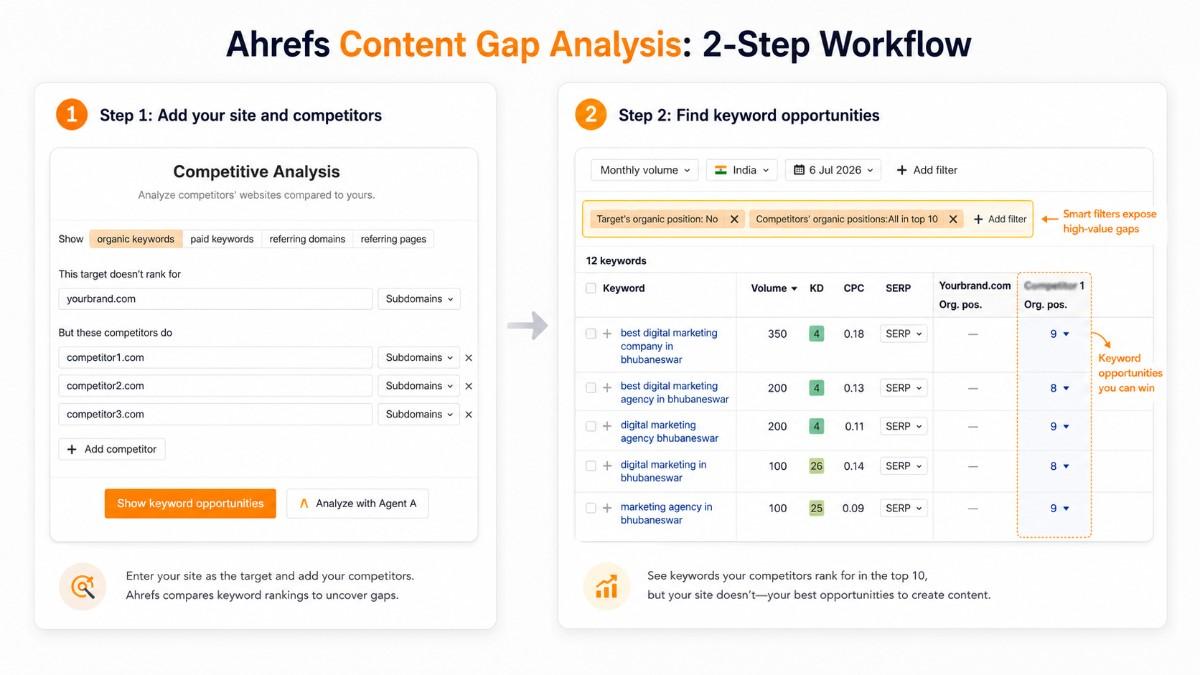
Ahrefs is the most widely used tool for this task. Use the Content Gap feature under Site Explorer to enter your domain and two to four competitor domains. Set the filter to show keywords where at least two competitors rank in the top 10 but your site does not rank at all. Export that list and sort by keyword difficulty to find the most accessible gaps first.
Semrush has a Keyword Gap tool that works on the same logic. It also surfaces keyword overlap visually with a Venn diagram, which is useful for presenting findings to clients or stakeholders who are less familiar with raw keyword data.
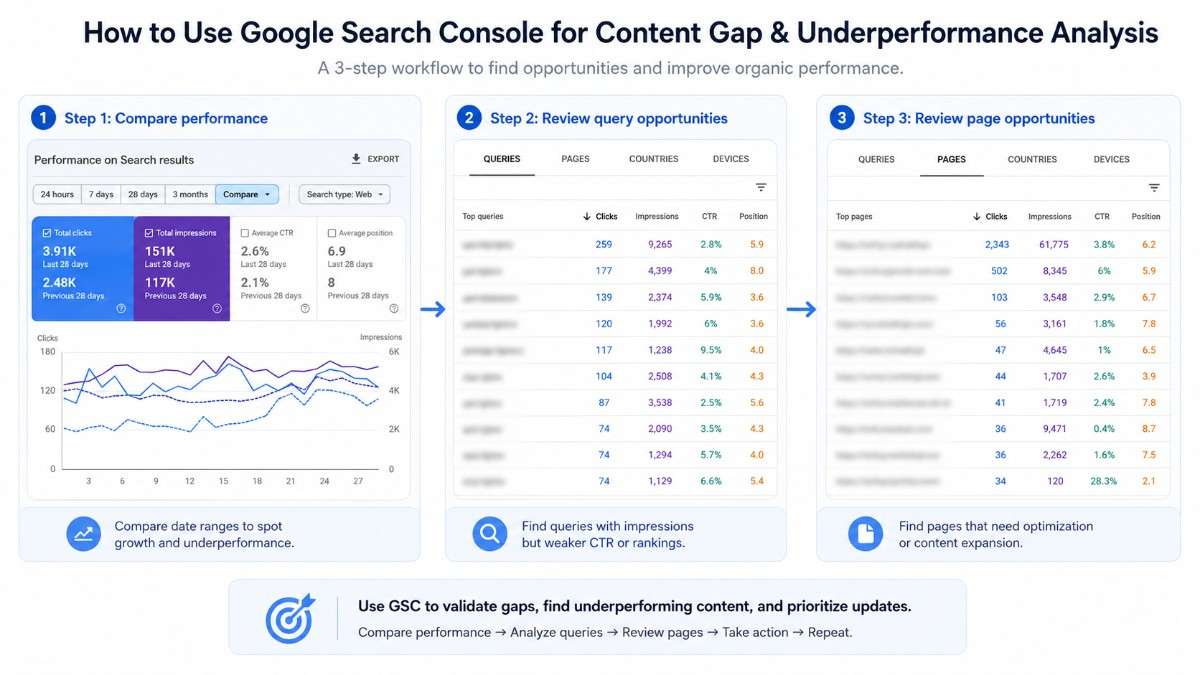
Google Search Console cannot run a gap analysis on its own because it only shows data for your own site. Use it after you have run Ahrefs or Semrush to cross-check: if a keyword appears in your gap list but GSC shows you already have some impressions for it, that signals a page exists but is underperforming rather than completely absent.
Each tool has a different data set and refresh frequency. Ahrefs tends to have the largest keyword index. Semrush tends to have stronger local and regional data for certain markets. For most content gap work, either tool gives you enough to build a solid action plan.
How to Run a Content Gap Analysis: Step by Step
Step 1: Find your real search competitors
Your search competitors are not always your business competitors. A search competitor is any website that ranks in the top 10 for the keywords you want. A software company might find that a tutorial blog, a Wikipedia article, or a tools review site consistently outranks it for its most important terms.
To find search competitors, enter your domain into Ahrefs Site Explorer, open the Organic Competitors report, and sort by Common Keywords. The sites with the most keywords in common with yours are your real search competitors. Pick two to four of them for the gap analysis.
Step 2: Pull the keyword gap list
In Ahrefs, go to Site Explorer, select Content Gap, and enter your competitors' domains. Set the filter to "at least 2 of the below targets rank in top 10." Export the results. You will typically get a list of hundreds to thousands of keywords depending on your niche.
Step 3: Classify by search intent
Work through the list and classify each keyword by what the user actually wants to find. The four intent types are informational (the user wants to learn something), commercial investigation (the user is comparing options), transactional (the user wants to buy or hire), and navigational (the user is looking for a specific site or page).
Intent classification matters because the format of content that ranks for each type is different. A blog post ranks for informational queries. A comparison page ranks for commercial investigation queries. A service or product page ranks for transactional queries. Building the wrong format for a keyword will not get you to page one, even if the content is thorough.
Step 4: Score by difficulty and business value
Not every gap is worth closing. Score each keyword on two dimensions: keyword difficulty (use the KD score from Ahrefs or Semrush as a starting point) and business value (how likely is a visitor searching this to become a customer?). Prioritise keywords where difficulty is low to medium and business value is direct. These are the gaps that give you the best return on the effort of creating a new page.
Step 5: Map gaps to existing pages or plan new ones
Some gaps can be closed by expanding an existing underperforming page rather than creating a new one. Check whether you already have a page touching the topic. If yes, update and expand it. If no, add the keyword to your new content backlog with the intent type, target format, and recommended word count from the top-ranking competitor pages.
Suggested reading:Entity-Based SEO: How AI Uses
Content Context
The Quality Gap: When You Have the Content but Still Do Not Rank
Finding that a keyword gap exists is one type of problem. A quality gap is a different problem: you have a page for the topic, but the page is not good enough to rank. Both show up in a gap analysis, and both need a different fix.
A quality gap usually appears as a keyword where your page sits in positions 11 to 30 while competitors hold the top three spots. The content exists; it just does not match what Google is rewarding for that query.
How to identify and close a quality gap
Read the top five ranking pages for the keyword in question. Note the format they use (guides, lists, comparison tables, case studies), the depth of each section, the types of examples included, and whether they use original data or only repeat conventional wisdom. Then read your own page against the same criteria.
The areas where your page is consistently thinner or shallower are the quality gaps. Address them by adding concrete examples, expanding the sections that are under-covered, updating any statistics that have gone stale, and restructuring the page so the most useful information is easier to navigate.
Adding author credentials, citing external sources, and including a real case study or worked example also improve the page's standing on Google's quality criteria. This is what E-E-A-T optimization looks like in practice: real expertise made visible on the page, not just claimed in a bio.
How to Map Content Gaps to the Buyer's Journey
A thorough gap analysis will show that most sites under-invest in early-stage content. Pages that sell or service exist; pages that educate and build trust before the sale do not. This creates a leaky funnel where potential customers encounter the brand only at the decision stage, without enough context to feel confident.
Awareness stage gaps: These are "what is," "how to," and "why does" queries. A user at this stage is trying to understand a problem, not find a solution yet. They need educational content that defines terms, explains mechanisms, and frames the problem clearly. If your site has no pages targeting these queries, you are invisible to a large portion of your potential audience.
Consideration stage gaps: These are comparison, review, and "best option for" queries. A user here is evaluating solutions. They need content that honestly compares options, explains trade-offs, and helps them apply a framework to their specific situation. Case studies, comparison guides, and detailed how-to content serve this stage well.
Decision stage gaps: These are hire, buy, and "near me" queries, along with highly specific product or service queries. A user at this stage needs proof that you are the right choice: client results, credentials, transparent pricing, and a clear path to starting. If these pages are weak or missing, you lose customers at the last step.
Build content for all three stages. Closing gaps at only one stage leaves money on the table. A well-designed internal linking structure connects these stages so authority flows from your educational content through to your commercial pages.
Common Mistakes in Content Gap Analysis
Targeting keywords with no connection to your revenue
High search volume is not a reason by itself to create a page. Before adding a keyword to your plan, ask directly: if 100 people who searched this term visited your site, how many would realistically become customers or referral sources? If the honest answer is close to zero, the keyword does not belong in a commercial content plan.
Ignoring keyword cannibalization
Keyword cannibalization happens when two or more pages on your site target the same search query. Google has to choose which one to show, often picks the weaker one, and the result is that neither page performs as well as a single consolidated page would. Before creating a new page for a gap keyword, check whether you already have a page that touches the same topic. If you do, decide whether to consolidate or differentiate clearly.
Targeting high-difficulty keywords on a young domain
A site with low domain authority and few backlinks will not displace a well-established competitor on a high-difficulty keyword regardless of content quality. Use keyword difficulty scores to set realistic expectations. Build authority in lower-competition areas first, earn links and engagement signals, and then work toward more competitive terms. A technical SEO audit should confirm that your site's foundation is solid before you start competing for harder terms.
Running the analysis once and treating it as complete
Search demand changes. Competitors create new pages. New questions emerge in your market. A content gap analysis should be a recurring task, run at minimum once per quarter, not a one-time project.
Suggested reading:What Is Answer Engine
Optimization?
How Oddtusk Runs Content Gap Analysis for Clients
Oddtusk is an SEO and ecommerce growth agency based in Bhubaneswar, India. We work with D2C brands, ecommerce retailers, and B2B service companies to build content strategies grounded in real search data rather than assumptions.
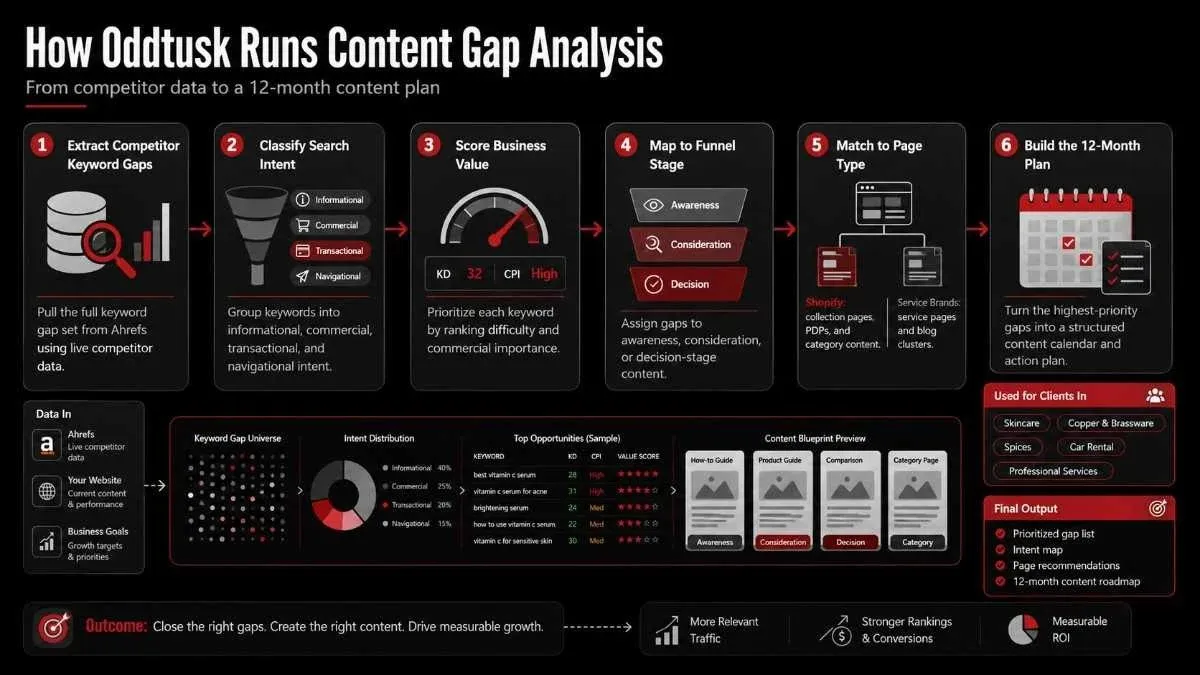
Our content gap process starts with extracting the full keyword gap set from Ahrefs using live competitor data for each client's specific market. We classify every keyword by intent, score it against the client's commercial model, and map it to the correct funnel stage. For clients on Shopify, we connect collection page and PDP keyword gaps directly to their product catalog through our ecommerce SEO process. For service businesses, we map gaps to service pages and blog content in a tiered topical structure.
Every gap page we plan comes with a content brief that specifies the target entity, required sub-entities, search intent, format, internal links, and entity SEO targets. This is how we make sure each page contributes to the site's overall semantic SEO structure instead of existing in isolation.
We have run this process for clients in skincare, copper and brassware, spices, car rental, and professional services. In each case, the gap analysis became the foundation for the 12-month content plan, not a standalone report that sat unused.
If you want a content gap analysis done for your site with a clear action plan attached, contact Oddtusk directly.
Key Takeaways
- Start from competitor data: Use content gap analysis to build your content plan from what is actually working in search, not from internal brainstorming.
- Classify every gap by intent: Match each keyword to the correct content format. The wrong format will not rank regardless of quality.
- Score before you build: Not every gap is worth closing. Prioritise by keyword difficulty against business value.
- Close all funnel stages: Cover awareness, consideration, and decision stage gaps together. Our content strategy service is built around this principle.
- Check for quality gaps too: Sometimes the page exists but needs E-E-A-T improvements rather than a new page build.
- Run it quarterly: A content gap analysis is a recurring process, not a one-time report. Markets change and competitors publish new content constantly.
- Build for AI citation: Structure your gap pages with clear definitions, FAQ schema, and step-by-step formatting so they qualify for AI Overviews. Our AEO/GEO optimization process covers this end to end.
[ Common questions ]
Content Gap Analysis FAQs
A content gap analysis is a research process that identifies the keywords, topics, and content formats your competitors rank for in search results that your site does not yet cover. It works by comparing your site's keyword footprint against two to four competitors and isolating the queries where they appear in the top 10 but your site has no ranking page. The output is a prioritised list of content opportunities backed by real search data, not assumptions.
A keyword gap analysis shows you which specific search terms competitors rank for that you do not. A content gap analysis is broader: it includes keyword gaps but also examines whether you are missing entire topic areas, funnel stages, or content formats that your audience needs. A keyword gap analysis is one input into a content gap analysis, not the same thing. You can complete a keyword gap analysis in an hour; a proper content gap analysis also factors in search intent, format, topical authority structure, and the quality of competing pages.
You need at minimum three types of tools. First, a competitive keyword gap tool: Ahrefs Content Gap or Semrush Keyword Gap both work well. Second, Google Search Console for your own site's first-party data, so you can identify pages that exist but are underperforming rather than completely absent. Third, a crawl tool such as Screaming Frog for most sites, or SiteBulb for larger ones, to audit what pages you actually have before you start finding gaps. No single platform covers everything.
A basic analysis covering one domain against two to three competitors takes three to four hours for an experienced SEO. A thorough analysis that classifies by intent, maps to funnel stage, checks for cannibalization, and produces a content brief for each priority gap typically takes one to two full working days depending on the size of the keyword list.
Run a full analysis once per quarter. Between full analyses, do a lighter monthly check focused on new pages competitors have published and any notable shifts in your top SERP positions. If you operate in a fast-moving category like software, finance, or health, move the full audit to every two months.
Score each gap keyword on two dimensions: keyword difficulty and direct business value. Prioritise keywords where difficulty is low to medium and business value is direct. Move quick wins to the front of the queue: these are gaps where you have an existing page in positions 11 to 20 that can be improved to capture a People Also Ask result or a featured snippet.
AI tools can accelerate the research phase but cannot replace the full process. They are useful for clustering large keyword lists by topic and drafting outlines for gap pages. What AI cannot do well is make strategic decisions about which gaps align with your business model, whether a gap is worth the competitive effort, or whether a new page would cannibalize an existing one. Use AI to move faster inside a structured process. It should not replace having one.
Two to four competitors is the practical range. Fewer than two gives you a narrow picture. More than four produces a keyword list so large that prioritising it becomes its own problem. Pick two competitors whose business model and audience match yours, plus one that consistently outranks you on your core terms.
Sort by priority score. For the top 20 keywords, decide whether each needs a new page or an expansion of an existing one. Assign a content type based on search intent. Add the top ten to your active content calendar with a clear content brief: target keyword, intent, format, target length, and the internal links the page needs.
Yes, when you choose your gaps deliberately. Large sites frequently have thin or outdated pages on mid-tail and long-tail keywords because they build for volume rather than depth. A smaller site that produces a genuinely thorough, well-structured page for a specific mid-tail query will often outrank a large site whose page is a brief, generic overview.
Search your target queries directly and note which pages Google cites in AI Overviews. If competitors are being cited and you are not, the gap is a citation gap, not just a ranking gap. AI Overviews favour pages with clear definitions, structured steps, FAQ sections, and proper schema. Our AEO/GEO optimization service is built around closing these citation gaps.
