Topical map service with page briefs, link mesh and redirect maps
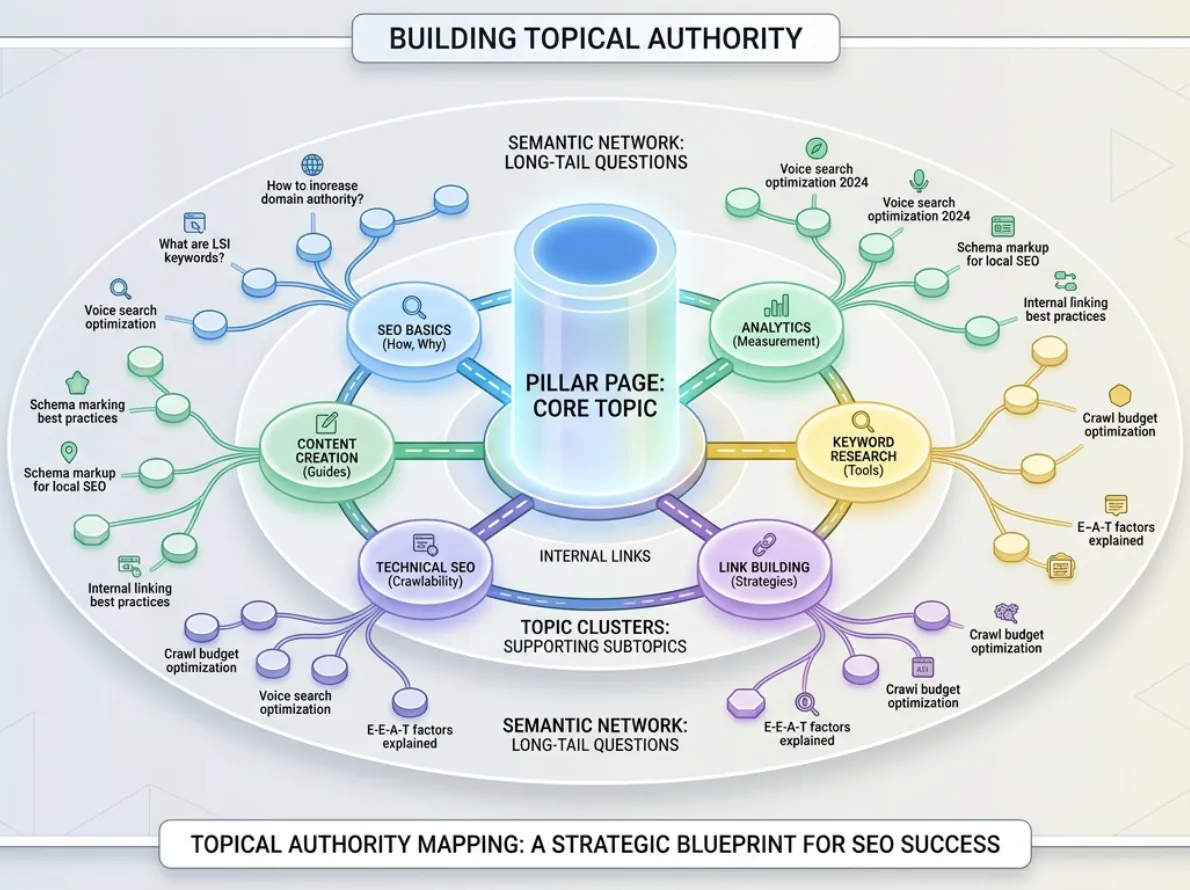
A topical map is a plan of content clusters that fully covers a subject area to establish domain expertise. The topical map service at Oddtusk is built on entity relationships and semantic gap analysis. Each topical map covers 50 to 277 canonical pages, with content briefs per page, an internal link mesh and 301 redirect maps. This work is one part of a complete 2026 SEO services strategy.
A topical map fixes pages that rank once and then drop, which happens when keyword targeting has no site architecture behind it. When a topical map sets the structure before content, rankings compound over time.
- Full site structure (50 to 277 pages)
- Macro and micro cluster map
- Content brief per page
- Internal link mesh with anchor text
- 301 redirect map
- Schema directives per page
- Meta titles and descriptions
- 6-month content calendar
A topical map prevents site problems before a single page is written

A topical map stops pages from spreading authority thin. Without one, blogs compete with service pages, local pages suppress national rankings, and deep-buried pages receive almost no PageRank. The topical map fixes these problems before content production, so every future page has a defined role and intent within a connected semantic entity network. A topical map lets semantic SEO compound over time. The map feeds directly into our E-E-A-T optimization and AEO and GEO strategy for AI search visibility. Brands also running technical SEO audits see the topical map turn into rankings fastest.
A topical map sets the structure before content
A topical map defines your namespace structure, cluster hierarchy, and page depth before anything is written. In a topical map, every page path encodes a topical signal and every folder represents exactly one entity type. That structure lets search engines understand your site's expertise before a single piece of content is published. See how this connects to our technical SEO audit process.
A topical map with a brief for every page
Every page in the topical map comes with a complete content brief covering primary entity, EAV attributes, lexical field terms, H2 and H3 sequence, query journey mapping, information gain angle, internal links, schema type, and meta tags, so writers can start work without guessing.
How a topical map fixes cannibalization
The topical map identifies every case where your own pages compete for the same query and resolves it through consolidation, 301 redirects, or intent differentiation. The redirect map is delivered alongside the topical map so nothing is left ambiguous during implementation. Cannibalization fixes in a topical map are part of our broader technical SEO audit for existing sites.
A topical map readies pages for AI search
Every page in a topical map is positioned for both traditional search rankings and AI citation eligibility. Schema directives, structured answer formatting, and entity completeness signals are built into every brief so your content is ready for Google AI Overviews, ChatGPT, and Perplexity from day one.
A complete topical map is a plan every team can follow

The largest topical map we have built covers 277 canonical pages across 7 content clusters, 4 service namespaces, a geo hub, and full blog architecture, built for Oddtusk.com using our semantic SEO methodology.
From the initial site audit and briefing call, a complete topical map takes 2 weeks to deliver, documented and ready for your development and content teams.
Every topical map includes a 6-month content publishing calendar that sequences pages in the right order: pillar pages before cluster pages, redirects before new content, to maximize topical authority build-up.
How a topical map gets built
Central entity definition
Query semantics analysis
Cluster building
URL architecture design
Content brief per URL
Link mesh and redirect map
Topical map questions from Indian brands
A topical authority map, or topical map, is a complete blueprint of your website's content structure. It defines every URL you need to build or optimize, how those pages group into semantic clusters, how they link to each other, and what each page needs to cover to rank. It is the strategic foundation that all SEO execution is built on.
The topical map from Oddtusk is a complete XLSX with full URL architecture covering 50 to 277 canonical pages, content brief per URL with EAV coverage, internal link mesh with exact anchor text, 301 redirect map, schema directives, optimized meta tags, and a 6-month publishing calendar.
Keyword research identifies individual search terms. Topical mapping builds the structural architecture that determines how those terms are covered, on which pages, in what hierarchy, and how those pages connect through an internal link mesh to build topic authority. Keyword research tells you what to target. Topical mapping tells you how to build a site that wins entire topic areas. The full approach is explained in our semantic SEO service.
Topical maps range from 50 pages for focused niche brands to 277 pages for multi-service agencies. The RideEZ topical map contained 193 URLs across 7 content clusters. Every topical map is scoped to the pages your site actually needs. For ecommerce brands, category and local SEO clusters are typically scoped separately.
Both. The topical map covers all existing pages with a clear status: EXPAND, MIGRATE, FIX, or KEEP, and all new pages to build from scratch. The 301 redirect map handles all consolidation and URL migration decisions so cannibalization is fully resolved before content work begins. This feeds into the technical SEO audit we run as part of every engagement.
A complete topical map arrives within 2 weeks of the initial site audit and briefing call. The timeline covers entity research, query semantics analysis, cluster building, URL architecture design, content brief writing, internal link mesh, and 301 redirect mapping. See our full SEO services hub for what comes next.

14+ years in SEO and digital marketing. Post Graduate in Data Science and Business Analytics, The University of Texas at Austin.