
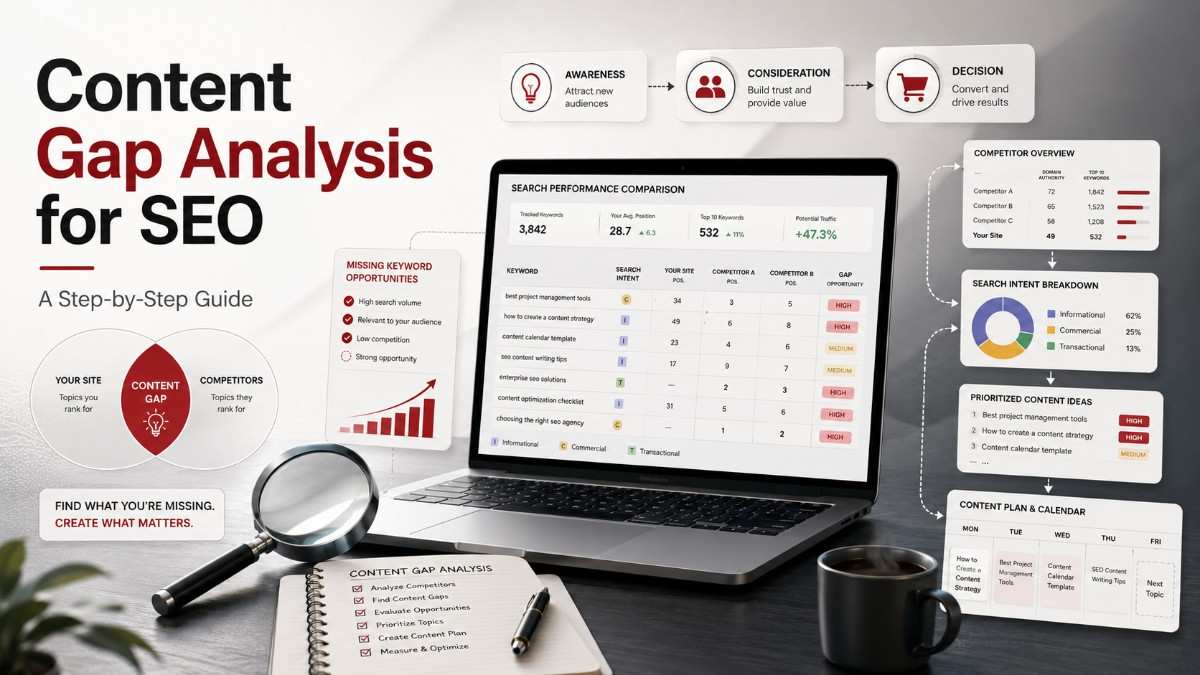
Find the keywords your competitors rank for that your site is missing, and build an evidence-based content plan to close them.
Topical Authority SEO: How to Build It and Why It Matters
Date: 07 - 27 - 2026
Time to read: 10 minutes
[ Table of Content ]
Publishing dozens of unrelated blog articles is one of the fastest routes to organic invisibility. Yet most brands continue to produce isolated, keyword-chasing content without understanding how modern search engines actually evaluate expertise. If you want durable search rankings, building topical authority is the single highest-leverage investment available to you right now.
The brands outperforming their competitors in organic search are not the ones with the biggest backlink profiles. They are the ones that have claimed ownership of an entire topic - covering every meaningful question their audience asks, organised in a structure that search engines can read as authoritative.
This guide covers what topical authority is, why fragmented content undermines it, and a concrete process for building it from scratch - whether you are starting a new site or restructuring an existing one.
What Is Topical Authority in Modern Search?
Topical authority is a measure of how completely your website covers all meaningful subtopics within a defined subject area. Traditional search models weighted keyword matches and backlink counts heavily. AI-powered algorithms evaluate something deeper: whether your site is the most comprehensive, reliable source on a topic as a whole - not just whether a single page contains the right words.
When Google's systems crawl your site and find that you have thorough, well-organised content covering every angle of a subject - from foundational definitions through to advanced implementation - they recognise your domain as an authority on that subject. This recognition carries across your entire content cluster, meaning new pages you publish on the topic index faster and rank more competitively from launch, even before they accumulate their own link signals.
From keyword matching to topic mastery
The practical shift this creates for your content strategy is significant. Rather than researching which individual keyword has the highest search volume, you map the full landscape of questions your audience has on a subject and build systematic coverage of all of them. This entity-based approach changes how search crawlers perceive your entire site - not just individual pages.
The specific advantages that come from strong topical authority include:
- Full niche coverage: Answering every meaningful question in your area means no competitor can draw your audience away by covering a subtopic you left blank.
- Entity recognition: Search engines connect your domain to the relevant entities and concepts in the Knowledge Graph, expanding the range of queries for which you are considered a relevant source.
- Accelerated indexing: Once Google recognises your site as authoritative on a topic, new content on that topic is crawled and indexed faster - often within hours rather than days.
- Algorithm protection: Sites with genuine topical authority are far more resilient to core algorithm updates than sites built on isolated keyword pages, because the authority signals are structural, not superficial.
Suggested reading:How to Do a Content Gap Analysis for SEO: A Step-by-Step Guide
Why Fragmented Content Strategies Fail
Creating isolated articles targeting trending keywords is not just an inefficient content strategy - it actively works against you. When your pages do not connect to each other and do not collectively demonstrate command of a subject, search engines have no basis for elevating your domain as an authoritative source. They see scattered information, not expertise.
The specific ways fragmented content damages rankings
Absence of contextual depth. Publishing standalone blog posts makes it difficult for search engines to determine your area of expertise. Without a clear topical structure, your site reads as a general-purpose information repository rather than a specialist authority. This limits how broadly your pages rank across related queries.
Keyword cannibalization risk. When you publish multiple pages targeting similar keywords without a clear hierarchy, your own pages compete against each other in the same search results. Search engines split their attention between the competing pages, and neither one performs as well as a properly organised, consolidated page would. Auditing for cannibalization before building clusters prevents this from compounding over time.
High user exit rates. Visitors who arrive on a thin or incomplete page that does not fully answer their question leave immediately to look for a better source - often a competitor. This sends negative engagement signals back to the algorithm and reinforces the perception that your site is not the authoritative destination for the topic.
Vulnerability to algorithm updates. Google's core updates consistently target thin, disconnected content. Sites built on isolated keyword articles tend to see significant ranking drops after major algorithm changes. Sites built on deep topical clusters tend to hold or improve, because the quality signals the updates reward were already present.
The Three Greatest Advantages of Topical Depth
Prioritising depth over quantity creates compounding advantages that keyword-based content strategies cannot replicate. These are not incremental improvements - they change the fundamental economics of your organic channel.
New content ranks faster
On a site with established topical authority, a new article on the relevant topic can reach the top 10 within days. On a site without that foundation, the same article may take months to gain traction - if it ever does. The difference is that Google already trusts the authoritative domain to produce reliable content on the subject and prioritises its new pages accordingly. Each piece of content you add to a cluster accelerates the performance of every other piece in it.
Less dependence on external backlinks
High-depth topical clusters regularly outrank pages from high-authority domains that lack contextual depth. This is one of the most consistent patterns we see in client work: a focused site with comprehensive coverage of a narrow topic defeating a major publication whose page on the same topic is a 500-word overview from four years ago. Backlinks still matter for very competitive head terms, but topical authority is the more decisive factor across the long-tail and mid-tail queries that drive the majority of real search traffic.
Stronger E-E-A-T signals throughout
Google's Search Quality Rater Guidelines ask evaluators to assess whether a site demonstrates genuine Experience, Expertise, Authoritativeness, and Trustworthiness on its subject. A site with deep topical clusters - where every meaningful question is answered with specifics, clear authorship, and cited sources - satisfies these criteria systematically, not just on individual pages. Our E-E-A-T optimization work always starts with cluster architecture, because it is the most efficient way to raise the quality signal across an entire site at once.
How to Build Topical Authority: A Step-by-Step Blueprint
Building topical authority is a deliberate process, not a content production sprint. The steps below describe how we approach it for clients, adapted for teams implementing it independently.
Step 1: Map your topic, subtopics, and all semantic questions
Start by defining the core topic you want to own and the outer boundaries of what falls within it. Then map every subtopic, question, and angle your audience might search - from the most basic "what is" queries through to advanced implementation and troubleshooting questions. This full question landscape is the raw material for your content plan.
The fastest way to identify gaps in this map is a content gap analysis run against two or three competitors who currently rank well across the topic. The queries they appear for that your site does not cover are the first gaps to prioritise.
Step 2: Build a hub-and-spoke content architecture
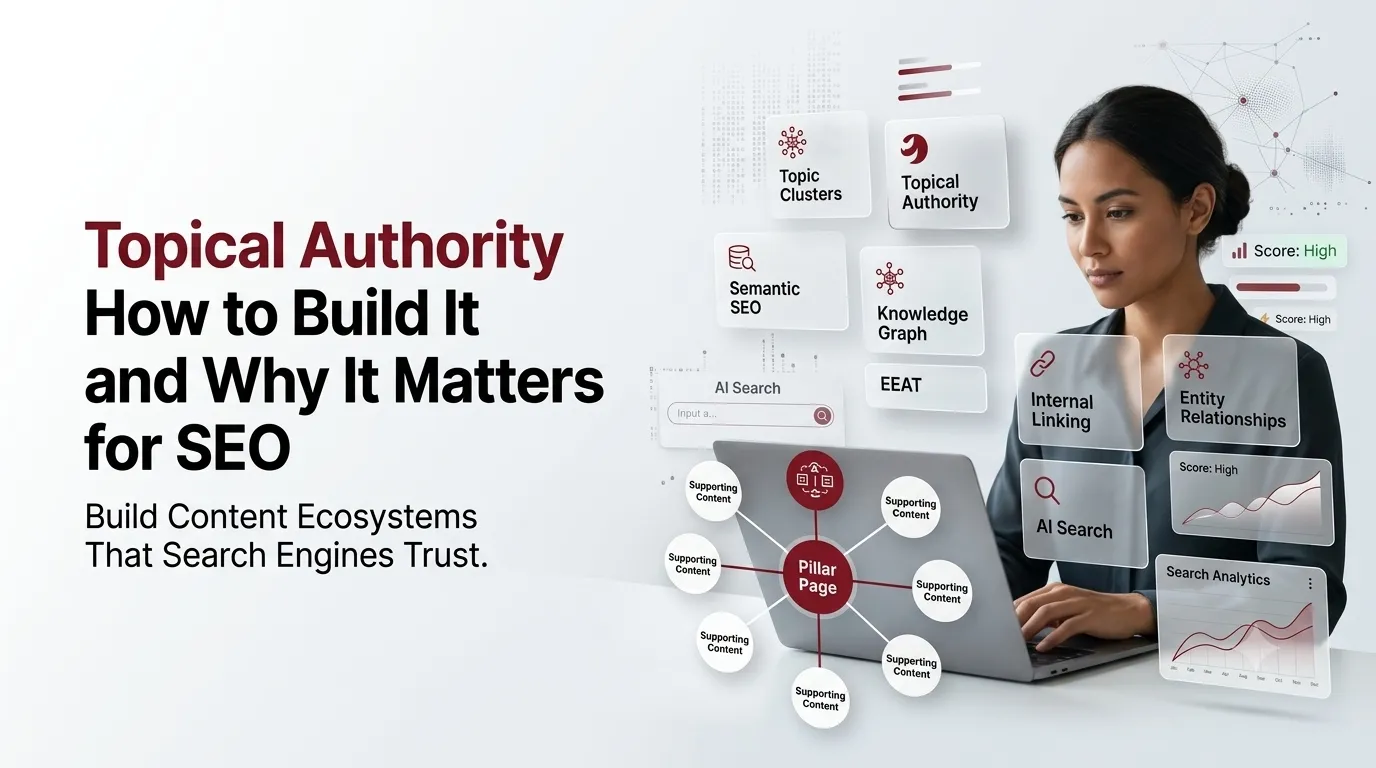
The hub-and-spoke model is the most effective structure for communicating topical authority to search engines. A central pillar page covers the broad topic comprehensively - providing enough depth to stand alone but leaving room for cluster pages to go deeper on each subtopic. Each cluster page (a spoke) covers one specific subtopic in full, linking back to the pillar as the canonical authority on the broader subject.
The pillar page should answer the core query for the topic and introduce every major subtopic, with clear links to the cluster pages where each subtopic is covered in full detail. Think of it as the table of contents for your entire topic ecosystem, not just a summary article.
Our dedicated topical authority mapping service is built around this exact process - identifying the full cluster architecture before a single word is written.
Step 3: Deploy contextual internal linking throughout
Internal links are the mechanism that converts your content architecture into measurable ranking performance. Every cluster page should link back to the pillar. Related cluster pages should link to each other where the connection is genuinely useful to a reader. The anchor text for each link should describe the destination page's topic specifically - not generic phrases like "click here" or "learn more."
A deliberate internal linking strategy does three things simultaneously: it passes authority from established pages to newer ones within the cluster, it shows Google the topical relationships between your pages, and it keeps visitors within your site by giving them a clear path to the next relevant question they are likely to have.
Step 4: Cover every search intent within the topic
A complete topical cluster addresses all four intent types across its pages: informational (what is, how does, why), commercial investigation (best options, comparisons, reviews), transactional (hire, buy, get started), and navigational (specific brand or product lookups). If your cluster only covers informational queries, you are present at the awareness stage and invisible at every other stage of the decision journey.
Match the content format to each intent type: blog posts and guides for informational queries, comparison tables and case studies for commercial investigation, service or product pages for transactional queries. The wrong format will not rank even if the content is thorough, because the page structure does not match what Google knows users expect for that query type.
Step 5: Refresh and expand clusters on a regular cadence
A cluster built once and left alone starts losing authority as competitors publish fresher content and new subtopics emerge within the space. Run a full cluster audit at least quarterly: check every page for outdated statistics, deprecated recommendations, and newly emerged questions the original cluster did not address. Add new cluster pages for subtopics that have grown in search demand since the cluster was built. Consolidate any thin pages that are no longer serving a distinct purpose.
Pages sitting in positions 11 to 30 are often the highest-value targets for quick improvement: a targeted expansion - a new section, a worked example, or a structured FAQ block - can move them into the top 10 without requiring a full rebuild.
Topic Cluster Architecture vs. Isolated Blogging
The difference between an organised topic cluster and a conventional keyword blog is not just aesthetic — it is structural. The two approaches send fundamentally different signals to search engines and produce fundamentally different long-term results.
| Feature | Traditional Isolated Blogging | Strategic Topic Cluster Architecture |
|---|---|---|
| Primary goal | Target individual high-volume keywords | Master an entire topic ecosystem |
| Internal linking | Random or automated | Intentional hub-and-spoke connections |
| Search engine perception | Surface-level information provider | Recognised industry authority |
| Traffic resilience | Vulnerable to algorithm updates | Stable, compounding organic growth |
| New content speed | Slow — each page starts from zero | Fast — cluster authority lifts new pages immediately |
| Backlink dependency | High — each page competes independently | Lower — depth compensates for link equity gaps |
Topic cluster architecture converts your blog from a news feed into a knowledge asset. Every piece of content you add strengthens the authority of every other piece already in the cluster, rather than existing in isolation.
Suggested reading:Intent vs Keywords: How Semantic SEO Changes the Game
Topical Authority and Entity SEO: The Connection That Compounds
Entity SEO and topical authority work together in a way that makes each more effective. When your content cluster correctly maps the entities within your topic - the key concepts, named people, products, organisations, and their relationships - Google can connect your domain to those entities in the Knowledge Graph. This entity recognition expands the set of queries your cluster can rank for beyond those you explicitly targeted.
Practically, entity optimisation inside a topic cluster means defining every core concept clearly when it first appears, explaining the relationships between concepts explicitly rather than assuming the reader will connect them, and using schema markup to signal entity types to search engine crawlers. A well-structured pillar page naturally does most of this - it defines the main entity, introduces the key sub-entities, and organises their relationships in a way a language model can parse.
The combination of deep topic coverage and correct entity mapping is what allows semantic SEO to deliver results that keyword optimisation alone cannot: ranking across hundreds of related queries simultaneously, appearing in AI Overviews, and being cited by language models as a trusted source on the topic.
How Topical Authority Strengthens E-E-A-T Across Your Site
Google's E-E-A-T framework - Experience, Expertise, Authoritativeness, and Trustworthiness - is not evaluated page by page in isolation. It is assessed at the domain level and influenced by the overall quality and coverage of your content. A well-built topic cluster is the most efficient way to improve E-E-A-T signals across an entire site.
Expertise signals come from the depth and accuracy of each page. Authoritativeness signals come from the breadth of coverage - a site that answers every meaningful question on a topic is inherently more authoritative than one with a few articles. Trustworthiness signals come from consistency: citations, named authors with verifiable credentials, accurate information maintained over time, and a clear publishing standard applied across the cluster.
When you run a technical SEO audit alongside cluster development, you also address the structural signals that underpin trustworthiness: correct canonicals, working internal links, fast page load times, and proper indexation. The content work and technical work reinforce each other; neither alone is as effective as both together.
For sites in health, finance, legal, or other YMYL (Your Money or Your Life) categories, E-E-A-T is especially critical - Google holds these topics to a higher standard because the consequences of inaccurate information are more serious. In these niches, topical authority built on well-sourced, expertly authored content is not optional; it is the baseline requirement for ranking at all.
Suggested reading:Ranking Is Not Enough: How AI Overlooks Traditional SEO
Key Takeaways
- Depth before breadth: Cover a subject fully before expanding into adjacent topics. A complete cluster on one subject outperforms partial coverage of five subjects every time.
- Use hub-and-spoke architecture: Organise every major topic into a pillar page and supporting cluster pages. The structure itself is a ranking signal. Our topical authority mapping service designs this architecture before any content is written.
- Make internal links deliberate: Every link between cluster pages should use descriptive anchor text and serve a genuine reader purpose. Random or automated linking does not build the topical signals you need.
- Address all intent types: Cover informational, commercial investigation, and transactional queries within each cluster. Missing any stage leaves part of the decision journey open to a competitor.
- Audit for cannibalization first: Before adding new pages, make sure you are not already competing against yourself for the same queries on different pages.
- Refresh clusters quarterly: Static clusters lose authority over time. New subtopics emerge, statistics go stale, and competitors publish fresher content. A quarterly refresh schedule maintains the depth signal.
- Connect entity mapping to cluster planning: Use entity SEO and schema markup inside every cluster to expand the range of queries your pages can match beyond their exact keyword targets.
- Topical authority compounds: Unlike keyword targeting, which requires constant new effort to maintain rankings, topical authority compounds - each new page in a mature cluster gets a lift from the authority already established by the pages around it.
[ Common questions ]
Topical Authority FAQs
Topical authority is a measure of how comprehensively a website covers all meaningful subtopics within a defined subject area. Search engines use it to determine which sites deserve to rank at the top for an entire category of queries, rather than evaluating each page in isolation. A site with high topical authority on a subject ranks faster for new content on that subject, needs fewer external backlinks to compete, and maintains rankings more stably through algorithm updates.
Domain authority is a third-party metric approximating overall link equity based on external backlinks. Topical authority is a content-based signal measuring how completely a site covers a specific subject area. A site with modest domain authority can outrank a high-authority domain on a topic if its content coverage of that topic is substantially deeper. This is where smaller, focused sites most often beat large generalist publications.
A topic cluster is a group of interconnected pages that collectively cover all meaningful sub-questions within a broad topic. It consists of a pillar page covering the topic at a high level and multiple cluster pages each addressing a specific subtopic in depth, with contextual internal links connecting them. The cluster model builds topical authority by demonstrating comprehensive coverage to search engines, passing link equity across the cluster, and keeping visitors within your site by answering every follow-on question they might have.
The right number depends on how many meaningful questions exist within your topic, not on an arbitrary target. Map every question your audience asks from awareness through to purchase decision, then build a page for each question that has meaningful search demand. A well-defined niche topic might need 15 to 25 cluster pages. A broad subject may sustain hundreds of pages across sub-clusters. Depth on each page matters more than hitting a page count.
The hub-and-spoke model is a content architecture where a central pillar page (the hub) covers a broad topic comprehensively and links to multiple supporting pages (the spokes) that each address one specific subtopic in greater depth. Every spoke page links back to the hub, and related spokes link to each other where relevant. This architecture concentrates topical authority signals in the hub and gives users a clear navigation path through the subject.
Internal links are the connective tissue of a topic cluster. They show search engines how your pages relate to each other, pass authority from stronger pages to newer ones within the cluster, and signal the hierarchy of your content. Contextual anchor text - the clickable words used for the link - carries especially strong signals because it tells search engines what the destination page is about. Deliberate internal linking is how topical authority built through content gets converted into measurable ranking performance.
Not entirely, but it significantly reduces your dependence on external backlinks. Sites with strong topical authority regularly outrank higher-authority domains on specific queries because the depth and interconnectedness of their content sends stronger relevance signals than link count alone. For very competitive head terms, backlinks still matter. But for the long-tail and mid-tail queries that drive the majority of real search traffic, topical authority is often the more decisive factor.
Choose topics directly connected to your commercial offering that you can cover more completely than any competitor. Ask two questions: does ranking for the full set of subtopics in this area generate real business value? And is there a realistic path to better coverage than the sites currently dominating the space? A content gap analysis run against your main search competitors will show you exactly which subtopics they own that you do not yet cover - that becomes your topical authority roadmap.
Keyword cannibalization occurs when two or more pages on your site target the same search query. Search engines have to choose which page to show and often pick the weaker one, leaving neither page performing as well as a single consolidated page would. In the context of topical authority, cannibalization signals fragmented, disorganized coverage - the opposite of what a topic cluster architecture is designed to demonstrate. A technical SEO audit should identify and resolve all cannibalisation issues before cluster building begins.
E-E-A-T directly strengthens with topical authority: comprehensive cluster coverage signals Expertise and Authoritativeness, while consistent accuracy and clear sourcing across the cluster build Trustworthiness. Google's Search Quality Raters look for completeness, factual accuracy, clear sourcing, and identifiable authorship - all of which a well-built topic cluster naturally demonstrates. Our E-E-A-T optimization process always starts with cluster architecture for this reason.
Run a full cluster refresh at least quarterly. Check each page for outdated statistics, deprecated recommendations, and newly emerged subtopics. Between full refreshes, monitor cluster pages in Google Search Console for positions in the 11-to-30 range - these are the best candidates for a targeted content expansion that can move them into the top 10. Clusters that go without maintenance for more than six months start to lose authority as competitors publish fresher, more complete content.
Yes. AI Overviews and other generative search surfaces draw from sources that demonstrate comprehensive, well-organised expertise on a subject. A site with deep topical authority is more likely to be cited across multiple queries in the same subject area, because the AI system has encountered its content in many relevant contexts and treats it as a reliable source. Schema markup, FAQ sections, and clear entity definitions inside cluster pages further increase citation likelihood. Our AEO/GEO optimization service builds on the topical authority foundation to maximise citation rates in generated answers.
