
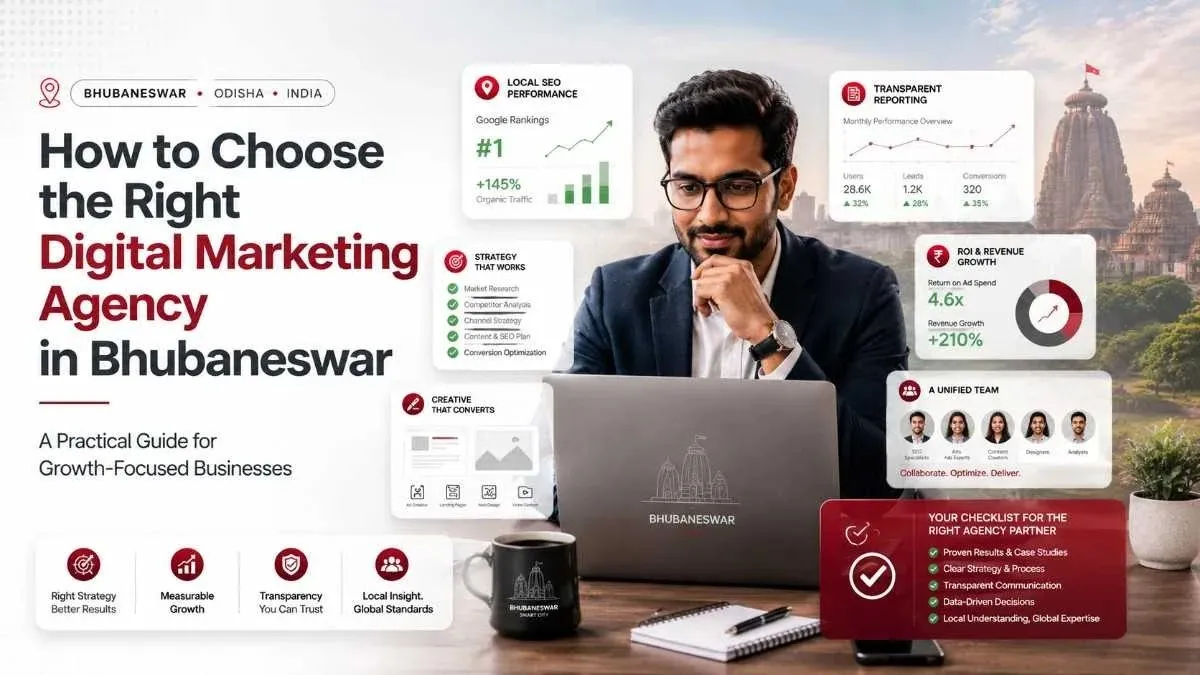
A practical guide to choosing a digital marketing agency in Bhubaneswar: local SEO skill, transparent reporting, cultural fit, and unified strategy.
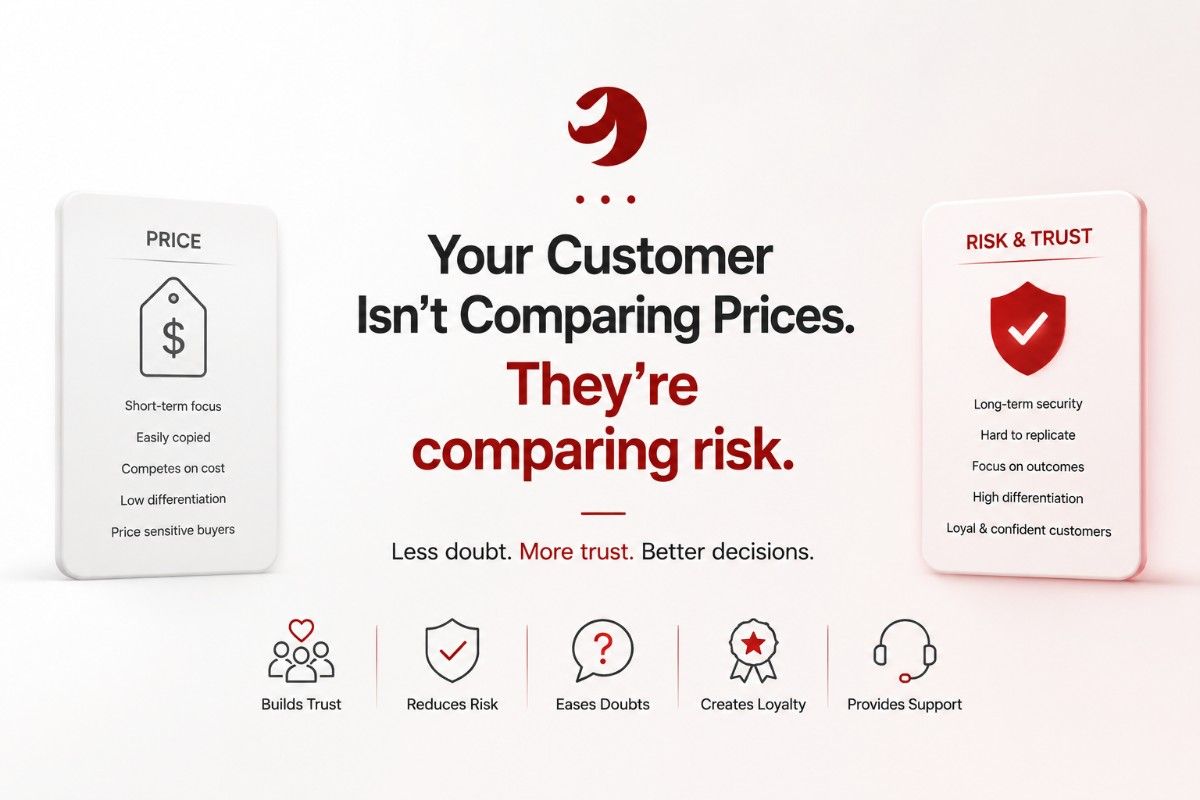
Your Customer Isn't Comparing Prices. They're Comparing Risk.
Date: 07 - 13 - 2026
Time to read: 12 minutes
[ Table of
Content ]
Your Customer Isn't Comparing Prices. They're Comparing Risk.
Marketers, at some point during the annual reviews, usually have come across such a statement: Customers are very price-sensitive. The statement sounds appealing because it transfers the responsibility of poor conversion rates from positioning to general market conditions, but is basically incorrect.
After all, it wouldn't have been possible for Apple to account for over 80% of world mobile profits if it were only a pricing issue. People wouldn't stand in a queue for months to buy the latest iPhone. Besides, no one would pay 500 for cafe coffee that can be brewed at home for less than $30. Luxury skincare products would not be a multi-billion-dollar business.
The price is rarely the real point of conflict that causes a transaction to get stuck. It is the risk that one faces at every turn. From the smallest purchase to a software deal of 5 crore, one of your decisions boils down to taking on and avoiding possible risk.
For instance, in the absence of clear reasons to the contrary, the customer or B2B buyer is basically running an internal risk-reward calculus that goes like this: Which is the safest decision I can make here? Brands that sustainably create loyalty are those that have learned this lesson — it is not the cutting of prices that keeps customers coming back; it is the elimination of all doubts, the systematic destruction of uncertainties, piece by piece.
Every Purchase Is a Risk Calculation
Customers are not just after products or a list of features; instead, they go for the assurance that a new product will solve their problem without any side effects. Harvard Business Review states that as many as 90% of B2B purchasing decisions are mostly influenced by selling the clients on the idea of not making an expensive mistake rather than enhancing the utility of the product.
So, B2B marketing should be geared towards assuaging the customer's anxiety and reassuring them that it is the right decision to go ahead. A potential customer, when they reach your website, is already weighing four different types of unseen risks.
Financial Risk ("Am I wasting my money?"). The potential buyer is worried about having thrown their money into the air. Will this course really enable me to be promoted at my work? Shall these shoes endure the monsoon season? Will this tool be able to show us the return on investment?
Performance Risk ("What can you guarantee from this?"). The customer does not trust your claims about the product. Does this marketing agency genuinely promise more leads or just give you statistics with no meaning?
Social Risk ("What will people make out of my choice?"). Being humans with a tribe mentality and status-seeking characteristics, this risk factor makes a difference. Fashion, automobiles, smartphones, and even expensive B2B software products fall victim to this risk as the choice becomes a public display.
Emotional Risk ("Shall I have a change of mind on my purchase?"). This is the major conversion killer without a sound. That is fear of buyer's remorse. In a way to cope with these fears, a potential loss is weighted much greater at the neural level compared to a possible gain (which the psychologists have labelled as loss aversion).
Level of Friction: The bigger the purchase, the risk perception seems to double. Yet it helps to know that risk perception is not always tied to how much something costs; actually, it depends on how bad a situation we would face if the product did not work properly.
Suggested article:Post-Purchase Paralysis: Why Buyers Regret and How to Prevent It
Why Cheap Isn't Always Convincing
What drives consumers to buy a product is not always just wanting to get the lowest price. If it were, brands like Rolex, Mercedes-Benz, or high-end SaaS platforms like Salesforce would disappear quickly. On the contrary, these companies are doing very well.
The secret of premium prices has something to do with the psychology of the buyer: a low price usually means that the product is somehow uncertain. When a company sells its product at a price that is much less than the average price on the market, a customer feels that they are putting themselves at risk.
- They think that the low price tag corresponds to something worse or less good in many aspects.
- That the customer support service might be unreliable, outsourced, or maybe even non-existent.
- That there will be a high chance that the product will break or cease working properly at some point.
In fact, there are cases when by raising the prices of your products smartly, you might be able to sell even more. Displaying a high price tag is an indirect way of saying "trust us," as it tells the brain that this brand has put a lot of effort into quality control, top-notch engineering, and solid customer service infrastructure.
Trust Is the New Currency
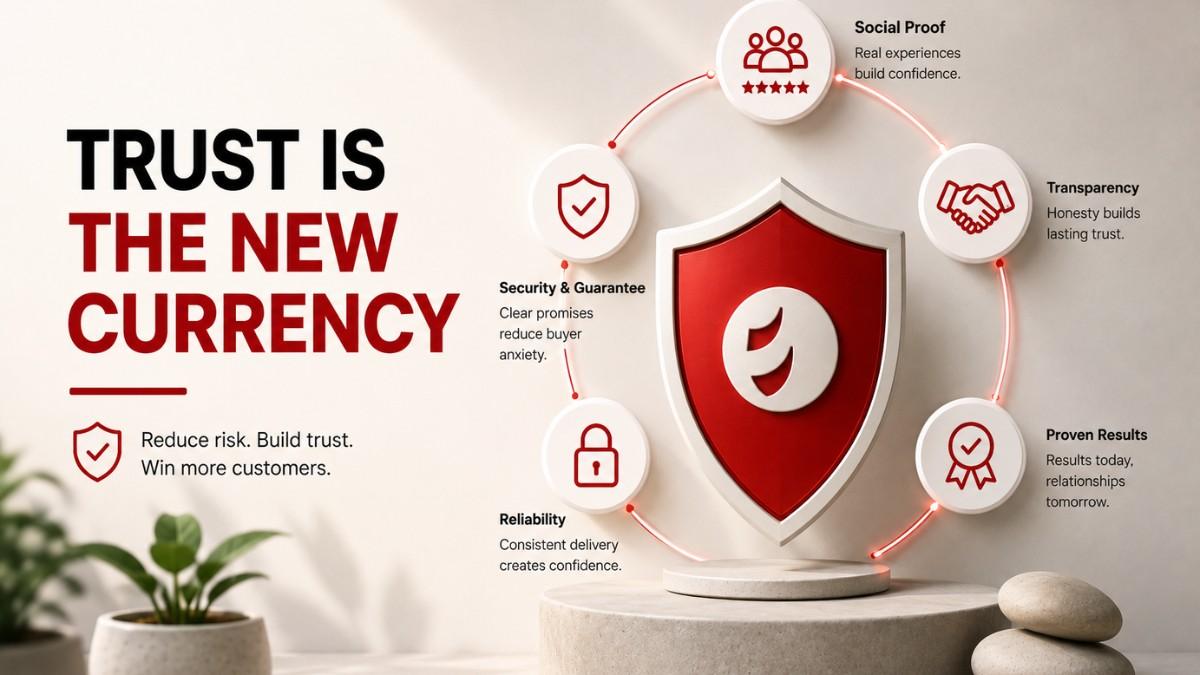
The marketing strategy was once competing only by making the most features, offering local discounts, and specifying product characteristics technically. In a market overloaded with products where generative AI can recreate features in a matter of a night, companies do not compete by the product only. They compete based on the perception of who is the least risky to do business with.
To win the modern buyer, companies need to provide trust signals visibly throughout their digital footprints that will lead to the disarming of suspicion proactively.
Verified Social Proof: Independent third-party reviews, genuine user-generated content (UGC) that has not been edited, and comprehensive case studies with the names of real companies and concrete metrics.
Founder Visibility: Showing the human side of the company, like introducing your team, to demonstrate real accountability.
Structural Guarantees: Bold and clear money-back guarantees, straightforward pricing levels with no hidden fees, and quick customer support response channels.
Professional Branding: Neat website design, perfect mobile typography, and uniform visual elements that indicate that the company is solid, well-funded, and has a long operating plan.
Marketing Should Reduce Anxiety, Not Just Increase Awareness
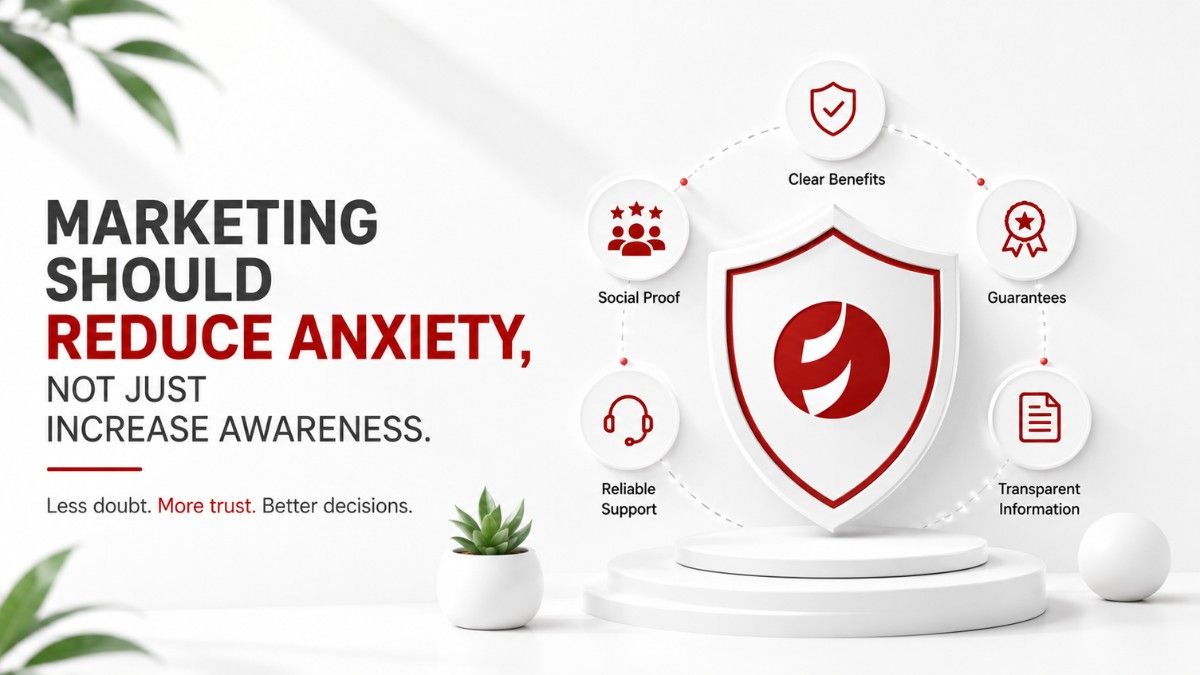
Nowadays, most of the advertising campaigns mainly aim to grab attention, bring in a lot of new audience at the beginning of the sales funnel, and just increase brand recognition on the surface level. Even so, the most earning campaigns are the ones that purposefully work on minimizing the consumer's reluctance.
We have to change the way we think about marketing functions in the company:
- Landing pages must be designed to confront and resolve even the consumer's unspoken fears, which is exactly what a well-executed conversion rate optimization strategy addresses.
- Case studies should be created that lead to the breakdown of technical scepticism step by step.
- An FAQ is where you should remove, very clearly, the structural doubts of the customers.
- Automated email marketing has to be a tool for building and strengthening trust over time.
Lowering the anxiety of customers on purpose is a way to increase the rate of conversions, even if you don't lower your prices.
Suggested article:How to Choose the Right Digital Marketing Agency in Bhubaneswar
Customers Don't Buy When They're Convinced. They Buy When They're Comfortable.
People don't get up in the morning thinking they must find the cheapest item on the market. Most of them get up with the idea of spending their money in the safest way, of not wasting their limited time, maintaining a good professional reputation, and keeping their personal emotions in control.
The companies that grow in a sustainable way, constantly throughout the years, are not the ones bragging the loudest in the advertising auctions or trench-cutting their prices. They are the brands that, without even making a noise, step by step, eliminate every logical reason a buyer might have to hesitate. In today's super commoditized market, reducing your perceived risk is probably one of the most powerful, defensible competitive advantages that a business can develop.
How Oddtusk Helps Brands Become the "Safe Choice"
At Oddtusk, we challenge the notion of world-class marketing being about flashy tricks to convince sceptical people to buy. Instead, we believe that it's about providing so much transparency and structural confidence that going with your brand seems like the only logical next step. We develop and implement data-driven digital strategies that hit the consumer risk factors that were investigated in this guide.
- Brand Positioning: First, we develop compelling, benefit-oriented messages that cut through consumer confusion and communicate your key value proposition with total clarity.
- Website Experience: We create really fast, very easy-to-use, and highly professional websites that users feel less and less hesitant about starting from the very first click.
- SEO & Content Strategy: Besides making your brand easy to find online, we help you establish credibility and gain authority soon through content that is both very educational and trust-building.
- Performance Marketing: Putting client campaigns at our focus, we target audiences with high intent rather than mere superficial metrics to keep the quality of your acquisitions high.
- Conversion Rate Optimization (CRO): We make use of a systematic approach to pinpoint those micro-moments in your customer journey that, by causing friction, lead to the abandonment of carts.
- Social Proof Strategy: Presenting structures for your customer testimonials, reviews, and case studies in the most trust-building formats, we maximise the immediate credibility that your real customer stories bring.
- Integrated Brand Experience: We work on every online interaction, from paid ads to landing pages and follow-up emails, giving your brand a consistent and very trustworthy identity across all our services.
The next time your digital conversion rate starts to decrease, don't give in to the temptation of saying, "Should we launch a discount code?" Instead, focus on a question that will be much more rewarding: "At which point exactly along this journey is our customer feeling uncertain?" Because, in a contemporary economy, it is not the cheapest brands that regularly get the nod, but rather those who make the act of buying seem completely safe.
If you're ready to find out where your funnel is losing trust, get in touch with us.
Key Takeaways
- Risk Over Price: Understand that the majority of buyers are assessing personal and financial risk, not just hunting for the lowest price.
- The Four Risks: It is always a good idea to check your marketing funnels for addressing financial, performance, social, and emotional fears.
- The Price-Quality Heuristic: Refrain from offering unnecessary, highly discounted prices, as a low price often communicates low product quality to consumers.
- Optimize the Trust Equation: Thoroughly increase your proof, clarity, and consistency and, at the same time, in a very conscious way, lower structural uncertainty.
- Escape the Discount Trap: Do not rely on price reductions to solve a poor conversion rate problem, as this tactic will eventually jeopardize brand equity and net margins.
- Lead with Empathy: Move away from marketing with the single purpose of raising awareness towards reducing buyer anxiety, which is still a very effective way of marketing.
[ Common questions ]
Customer Risk vs Price FAQs
Customers compare risk instead of price because a purchase decision is really a bet on whether a product will work as promised. Price is easy to evaluate, but the bigger, unspoken question is "what happens if this goes wrong?" Buyers subconsciously run a risk-reward calculation before checking the cost, which is why even well-priced offers can fail to convert if trust is missing.
The four types are financial risk (wasting money), performance risk (the product not living up to claims), social risk (how the purchase will be judged by others), and emotional risk (regretting the decision later, also known as buyer's remorse). Addressing all four in your marketing, not just price, is what reduces hesitation.
No. A price set noticeably below the market average often signals hidden risk rather than value, making buyers assume the product, service, or support behind it is weaker. Many brands, including premium SaaS platforms, sell more by pricing confidently and investing that trust into quality signals instead of discounts.
Loss aversion is a psychological principle showing that people feel the pain of a potential loss roughly twice as strongly as the pleasure of an equivalent gain. In marketing, this means the fear of making a bad purchase decision outweighs the appeal of a good deal, so campaigns that reduce perceived loss convert better than campaigns that only highlight savings.
A business reduces perceived risk through visible trust signals such as verified reviews, real case studies, transparent pricing, clear guarantees, and a professional, fast-loading website. These signals work together to answer a buyer's unspoken objections before they have to ask.
Yes, in most cases. Discounts can win a one-time sale but often lower perceived quality and squeeze margins over time. Systematically removing doubt through conversion rate optimization, clearer messaging, and stronger social proof tends to build repeat customers and protect brand equity better than price cuts alone.
In B2B marketing, risk perception is often the deciding factor because a wrong purchase can cost a buyer their credibility internally, not just their company's budget. Research shows a majority of B2B decisions hinge on avoiding an expensive mistake rather than maximizing product features, which is why detailed case studies and guarantees matter so much in B2B sales cycles.
