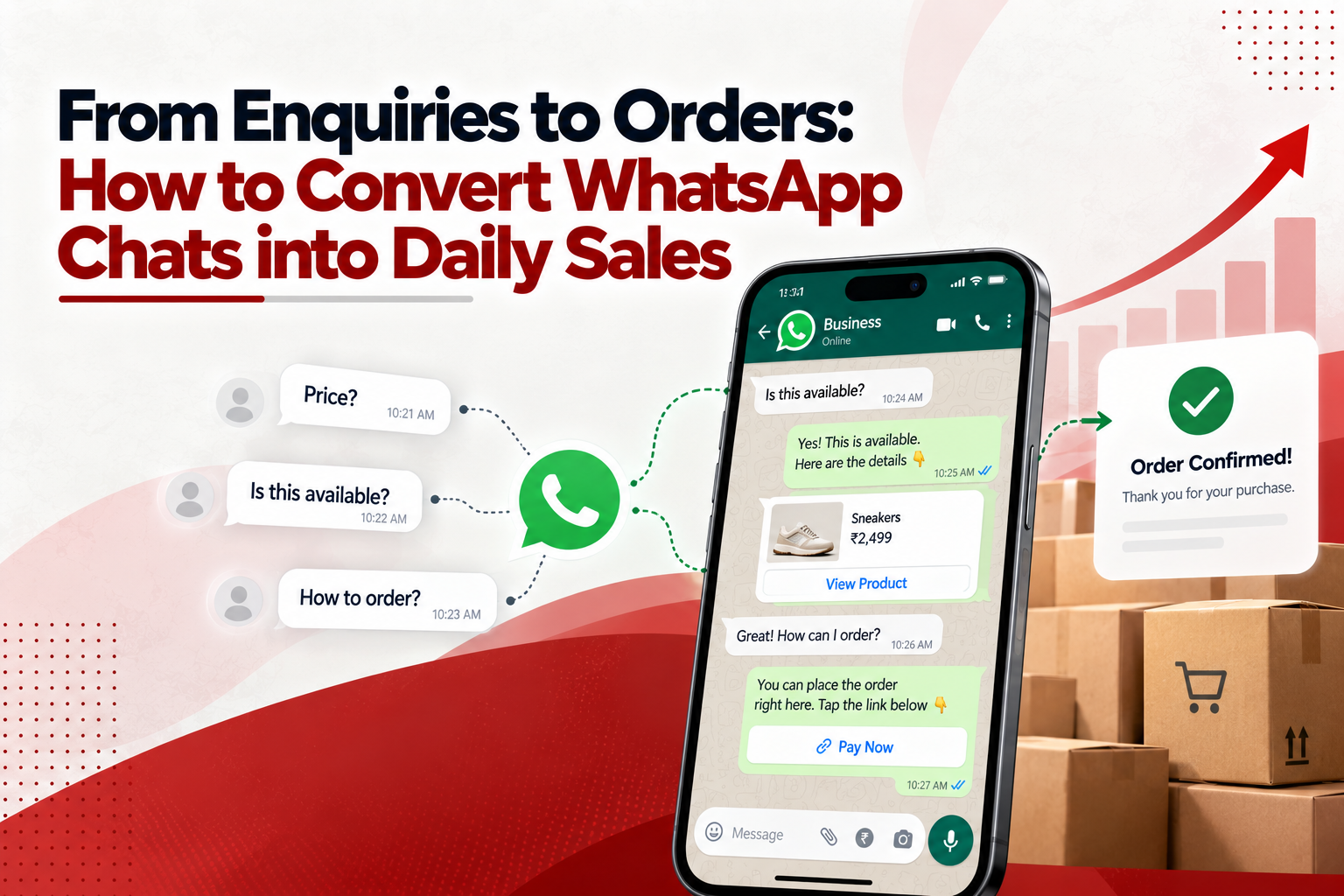
The companion piece on turning WhatsApp conversations that are already happening into a repeatable sales flow.
WhatsApp Automation for Business: How Bhubaneswar Companies Can Fix Slow Lead Response Time
Date: 13 - 10 - 2026
Time to read: 16 minutes
Key Takeaways
- Firms that contact a web lead within one hour are nearly 7 times more likely to qualify it than firms that wait longer (Oldroyd, McElheran and Elkington, Harvard Business Review, 2011).[1]
- The odds of qualifying a lead called within 5 minutes versus 30 minutes drop by a factor of 21 (Oldroyd, MIT Sloan and InsideSales.com, 2007).[2]
- In a 2017 survey of 433 B2B companies, only 7 percent responded to a new lead within 5 minutes, and 55 percent had not responded after 5 business days (Drift, 2017).[3]
- WhatsApp messages have a 98 to 99 percent open rate, compared to 20 to 21 percent for email (Infobip, WhatsApp Statistics 2026).[4]
- WhatsApp automation does not replace a salesperson; it guarantees the first reply happens in minutes instead of hours.
- CRM integration is what turns WhatsApp automation from a messaging tool into a system that shows which follow-up sequence actually converts.
[ Table of Content ]
A lead that does not get a reply within five minutes is already looking elsewhere. That is not an opinion. Research going back to a 2007 MIT Sloan and InsideSales.com study, repeated in a 2011 Harvard Business Review study of 2,241 companies, found that firms calling a web lead within an hour were nearly 7 times more likely to qualify it than firms that waited longer, and that the odds of qualifying a lead called within 5 minutes versus 30 minutes drop by a factor of 21.[1][2]
A decade later, the problem has not gone away. A 2017 Drift survey of 433 B2B companies found that only 7 percent responded to a new lead within 5 minutes, and 55 percent still had not responded after 5 business days.[3] This article looks at what that delay actually costs a Bhubaneswar business, and where WhatsApp automation fits as a fix.
A note from our founder
We built our first WhatsApp automation flow because we were losing our own leads this way, not because a client asked for it. The version in this article is the same one we now run for clients like Gardenia Whispers. It works because it is simple enough to actually get used every day.
Sanjay Ananda, Founder and CEO, OddtuskWhat Is WhatsApp Automation for Business?
WhatsApp automation for business is a set of pre-built rules and messages that respond to an inquiry, ask qualifying questions, and send scheduled follow-ups without a person typing each one. It runs through the free WhatsApp Business App for basic features, or through a paid WhatsApp Business Platform connection for multi-step flows and CRM syncing. Most WhatsApp automation tools on the market cover some version of this same core flow; the difference between providers is usually how well the qualification and follow-up steps integrate with a CRM.
Definition
WhatsApp Business Platform (sometimes called the WhatsApp Business API) is the paid, developer-level connection to WhatsApp that lets a business send automated, templated, and CRM-synced messages at scale. It is a separate product from the free WhatsApp Business App, which covers basic greeting messages, away messages, and quick replies but not multi-step automation or CRM integration.[5]
A basic WhatsApp automation setup for a local business typically does four things:
- Confirms receipt of an inquiry within seconds and tells the person when a human will follow up
- Asks a short set of qualifying questions, such as the service needed, the timeline, and the location
- Sends a scheduled follow-up if the lead goes quiet, commonly at 24 hours, 3 days, and 7 days
- Keeps responding after business hours, so a 9pm inquiry gets an acknowledgement instead of silence
Why Lead Response Time Decides Whether You Keep a Lead
Lead response time, the gap between an inquiry arriving and a business replying to it, is the single factor the published research ties most directly to whether a lead converts. Customer response time research outside WhatsApp specifically shows the same pattern across call centers, web chat, and email, so this is not a WhatsApp-only effect; it is a speed-of-contact effect that WhatsApp automation happens to be well suited to fixing. The table below summarizes the two most-cited studies on this.
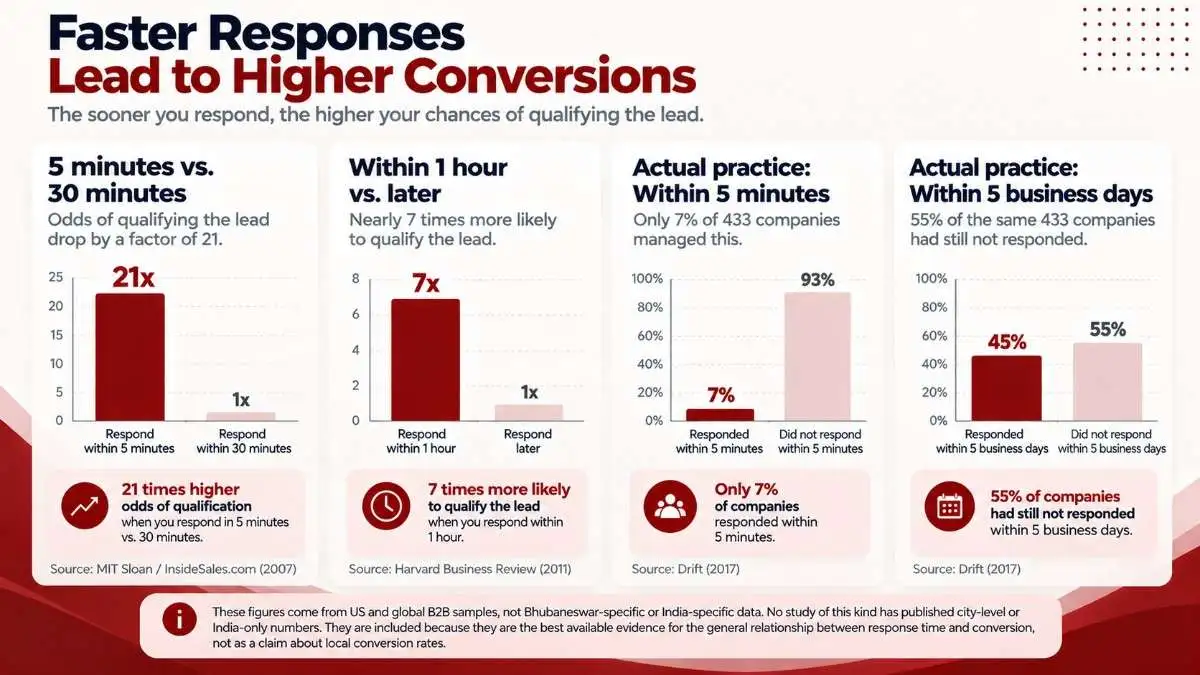
| Response window compared | Effect on qualification odds | Source |
|---|---|---|
| 5 minutes vs. 30 minutes | Odds of qualifying the lead drop by a factor of 21 | MIT Sloan / InsideSales.com, 2007[2] |
| Within 1 hour vs. later | Nearly 7 times more likely to qualify the lead | Harvard Business Review, 2011[1] |
| Within 5 minutes (actual practice) | Only 7% of 433 companies surveyed managed this | Drift, 2017[3] |
| Within 5 business days (actual practice) | 55% of the same 433 companies had still not responded | Drift, 2017[3] |
These figures come from US and global B2B samples, not Bhubaneswar-specific or India-specific data; no study of this kind has published city-level or India-only numbers. They are included because they are the best available evidence for the general relationship between response time and conversion, not as a claim about local conversion rates.
The Four Ways Businesses Leak Leads Without Noticing
Lead leakage is a genuine inquiry that never converts because nobody followed up in time, not because the person was uninterested. It is invisible by default because most businesses only count the leads that did convert, never the ones that quietly disappeared.
- The unanswered after-hours inquiry. A message arrives at 9pm with no automated acknowledgement; by morning the person has already looked elsewhere.
- The forgotten form submission. A web form lands in an inbox the owner checks twice a day; by the time a reply goes out, the lead has gone cold.
- The missing follow-up. A person responds once, then goes quiet, and the business reads silence as a no instead of as a prompt to ask again.
- The abandoned inquiry. A customer gets a partial answer on WhatsApp, has a follow-up question, and never gets around to asking it.
How a WhatsApp Automation Setup Actually Works
A working WhatsApp automation setup follows the same four-step sequence regardless of industry. Each step removes one specific point where a manual process usually breaks down.
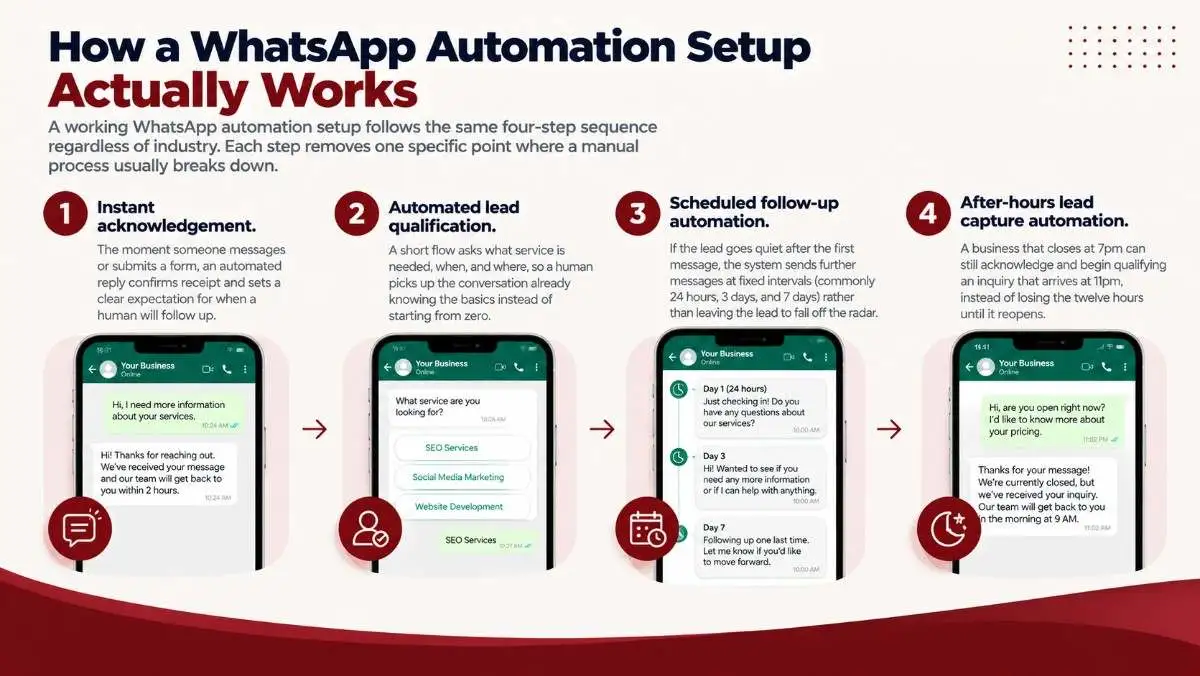
- Instant acknowledgement. The moment someone messages or submits a form, an automated reply confirms receipt and sets a clear expectation for when a human will follow up.
- Automated lead qualification. A short flow asks what service is needed, when, and where, so a human picks up the conversation already knowing the basics instead of starting from zero.
- Scheduled follow-up automation. If the lead goes quiet after the first message, the system sends further messages at fixed intervals (commonly 24 hours, 3 days, and 7 days) rather than leaving the lead to fall off the radar.
- After-hours lead capture automation. A business that closes at 7pm can still acknowledge and begin qualifying an inquiry that arrives at 11pm, instead of losing the twelve hours until it reopens.
What a Faster Response Time Is Worth: A Worked Example
The math below is a worked, illustrative example using round numbers, not an audited client result. It shows the kind of swing a faster, consistent follow-up cadence can produce once response time stops being left to chance.
| Variable | Before (inconsistent follow-up) | After (consistent 5 to 7 touch sequence) |
|---|---|---|
| Monthly inquiries | 40 | 40 (unchanged) |
| Conversion rate | 15% | 22% |
| Conversions per month | 6 | ~9 (rounded) |
| Revenue at Rs. 15,000 per conversion | Rs. 90,000 | Rs. 1,32,000 (approx. 3 additional conversions) |
The change in this example is not more marketing spend or more inquiries. It is the same 40 inquiries, with a follow-up cadence applied consistently instead of ad hoc, which is why the lead conversion rate moves even though nothing else about the business changed.
Why WhatsApp Outperforms Email for Follow-Up Here
WhatsApp automation works as a follow-up channel because the message actually gets opened. WhatsApp messages have a 98 to 99 percent open rate, compared to 20 to 21 percent for email.[4] A follow-up sitting in an inbox competes with dozens of other emails; one on WhatsApp is read.
| Channel | Typical open rate | Best fit for |
|---|---|---|
| 98% to 99% | Instant acknowledgement, short qualifying questions, time-sensitive follow-up | |
| 20% to 21% | Long-form content, documentation, formal B2B or corporate communication |
This does not make email automation obsolete. For business-to-business or corporate client services, email still carries the formal documentation a deal often needs. The combination that works best uses WhatsApp for instant engagement and short-term follow-up, and email for the longer, formal communication WhatsApp is not built for.
CRM Integration: Turning Messages Into a Conversion System
WhatsApp automation without a CRM integration is still just a messaging tool. A CRM (Customer Relationship Management system) is what records who made each inquiry, when, what they asked about, and what stage they are at, so the automation can act on that history instead of starting blind.
What proper CRM integration adds
- Every lead is captured with contact details, source, and first point of interest
- Every automated message is logged, giving a full communication history per lead
- Different follow-up sequences can run for different lead types, based on how they respond
- A salesperson sees the full conversation before joining it, so they never repeat a question the lead already answered
- Conversion data is tracked per sequence, showing which follow-up pattern actually works
Which Businesses Cannot Afford to Wait
Lead leakage does the most damage in categories where a customer has other, equally fast options and will simply book with whichever business replies first.
- Clinics and healthcare practices, where a patient books the first available appointment slot they can find
- Coaching institutes and tutoring centers, where admission-season inquiries convert or drop to zero within a short window
- Real estate agents, where a popular listing draws several simultaneous inquiries and the fastest responder usually gets the viewing
- Event services such as photographers, caterers, and decorators, where a customer is typically comparing several vendors at once
- Salons, spas, and wellness services, where booking decisions tend to be made on impulse and a delayed reply often means a lost customer
Keep reading
Already getting WhatsApp inquiries but not converting them?
Our companion piece covers the sales side of the same channel. Read: From Enquiries to Orders, How to Convert WhatsApp Chats into Daily Sales. If you are automating other parts of your operations too, our D2C automation strategy guide and D2C marketing automation guide cover the logistics and catalog side.
Conclusion
WhatsApp automation is not a sophisticated technology investment. It is an operational fix for a problem that is well documented, costly, and almost entirely invisible to the business losing money from it. The research is consistent: faster response time converts more leads, and WhatsApp gets read when email does not.
- Lead response time is the strongest documented factor in whether an inquiry converts.
- Lead leakage is invisible unless a business specifically measures it, since most owners only track the leads that did convert.
- WhatsApp automation does not replace a salesperson; it guarantees the first reply happens in minutes.
- CRM integration is what turns that automation into a system you can actually improve over time.
- The businesses with the most to lose are the ones where a customer has equally fast alternatives: clinics, coaching institutes, real estate, event services, and salons.
At Oddtusk, we build WhatsApp automation and CRM integration for businesses across Bhubaneswar and the rest of India, along with the lead nurturing sequences that keep a lead warm after the first reply. If slow response time is costing you leads you never even knew you lost, talk to us.
How Oddtusk Helps You Set This Up
Oddtusk builds the WhatsApp automation and CRM integration described in this article for businesses across Bhubaneswar and the rest of India, scoped to your actual inquiry volume and sales process rather than sold as a generic off-the-shelf template.
- WhatsApp Business Platform setup. We connect your business to a WhatsApp Business Platform provider (a BSP) and configure the instant-acknowledgement message so every inquiry gets a reply within seconds, not hours.
- Qualification flow design. We write the short question sequence (service, timeline, location, or whatever fits your sales process) so a human picks up each conversation already knowing the basics.
- Follow-up cadence setup. We build the 24 hour, 3 day, and 7 day (or whatever interval fits your sales cycle) sequence so a quiet lead gets a second, third, and fourth touch instead of being left on read.
- CRM integration. We connect WhatsApp conversations to your CRM as tagged lead records, so every follow-up sequence becomes something you can actually measure and improve, not just a messaging tool.
- Ongoing optimization. Once it is live, we track which follow-up sequences convert and adjust the flow, rather than treating the initial setup as a one-time project.
The WhatsApp automation and lead nurturing service pages cover the specifics of what each engagement includes. If you want a second pair of eyes on your current setup before committing to anything, reach out.
Not sure how many leads you are actually losing?
We will walk through your current response times and follow-up setup and tell you plainly where the gaps are. No strings attached.
Get a Free Response-Time Review
[ Common questions ]
Frequently Asked Questions
WhatsApp automation is a set of pre-built rules and messages, usually run through the WhatsApp Business App or WhatsApp Business Platform, that reply to an inquiry, ask qualifying questions, and send follow-up messages without a person typing each one. It does not replace a salesperson. It makes sure the first reply happens in minutes instead of hours.
The free WhatsApp Business App has built-in greeting messages, away messages, and quick replies that cover basic acknowledgement. For qualifying questions, scheduled follow-up sequences, and CRM syncing, most businesses move to a WhatsApp Business Platform provider (a BSP) rather than building this from scratch.
The basic WhatsApp Business App automation features, greeting messages, away messages, and quick replies, are free. Multi-step qualification flows, scheduled follow-up sequences, and CRM integration require a paid WhatsApp Business Platform connection, which is usually billed per conversation.
Yes, when it follows WhatsApp's own rules: business-initiated messages outside a 24 hour customer service window must use a pre-approved template, and marketing-style messages need the recipient's opt-in. This is general information, not legal advice; check current WhatsApp Business Platform policy and India's data protection rules before sending bulk or marketing messages.
You can start with the free WhatsApp Business App's greeting message, away message, and quick replies for basic acknowledgement. To add qualifying questions, scheduled follow-up sequences, and CRM syncing, you connect a WhatsApp Business Platform provider (a BSP) and build the conversation flow on top of it, which is the setup described in this article.
Not in the way this article describes. Bulk or marketing-style WhatsApp sends require the recipient's prior opt-in and a pre-approved message template, and they are a different use case from the inquiry response and follow-up automation covered here. Sending to people who have not opted in risks WhatsApp restricting the business number.
Lead leakage is a genuine inquiry that never converts because nobody followed up in time, not because the person was uninterested. Most businesses cannot see it because they only track the leads that did convert; the warning sign is a conversion rate that looks fine on paper despite unanswered WhatsApp messages or forms with no recorded reply time.
An automated flow asks a short set of qualifying questions, such as the service needed, the timeline, and the location, before a person joins the conversation. The human touch stays intact because a person still closes the sale; automation only handles the repetitive first exchange that used to cause the delay.
Most WhatsApp Business Platform providers offer a direct integration or webhook that pushes each conversation into a CRM as a lead record, tagged with its source and stage. Without that connection, WhatsApp automation is just a messaging tool; with it, every follow-up sequence becomes something you can measure and improve.
Automated lead nurturing is a scheduled sequence of follow-up messages, commonly sent at 24 hours, 3 days, and 7 days, aimed at a lead who has gone quiet. Email still has a place for long-form content, documentation, and formal business communication; WhatsApp is better suited to the short, time-sensitive follow-up that actually gets read.
The right choice depends on your inquiry volume, how much qualification logic you need, and whether CRM syncing matters to you, which makes "best overall" the wrong question to ask. A proper tool-by-tool comparison is outside the scope of this article; this one explains the lead-response mechanics and worked example that apply regardless of which WhatsApp Business Platform provider you pick.
The free WhatsApp Business App covers greeting messages, away messages, and quick replies, which handles basic acknowledgement at no cost. Multi-step qualification flows, scheduled follow-up sequences, and CRM syncing are not available on the free app and require a paid WhatsApp Business Platform connection, usually billed per conversation.
A conversion rate calculated only from leads that replied back hides every inquiry that got no timely response and went quiet, which never shows up as a lost lead because it was never counted in the first place. Tracking response time and follow-up completion per inquiry, not just the final conversion number, is what surfaces this gap.
Sources
- Oldroyd, J., McElheran, K., and Elkington, D. (2011). The Short Life of Online Sales Leads. Harvard Business Review.
- Oldroyd, J. (2007). Lead Response Management Study. MIT Sloan and InsideSales.com. Figures as widely reported in subsequent industry research, including this compilation of lead response time studies.
- Drift (2017). The 2017 Drift Lead Response Survey.
- Infobip (2026). WhatsApp Statistics 2026: Market Analysis and Global Usage Data.
- Meta. WhatsApp Business Platform, official product page.
- Oddtusk, DataForSEO Labs keyword data (India) and Ahrefs Google Search Console connector for oddtusk.com, snapshot October 2026.

About the author
Sanjay Ananda
Founder and CEO, Oddtusk
Sanjay Ananda founded Oddtusk in Bhubaneswar and leads its SEO, AEO, and growth engineering work for ecommerce and D2C brands across India, the US, and the UK. He builds and runs the WhatsApp automation and CRM integration systems described in this article for Oddtusk's own clients, including Gardenia Whispers, the D2C spice brand he also operates.
