

Learn how to evaluate expertise, portfolio, integrations, and post-launch support when hiring a Shopify development company.
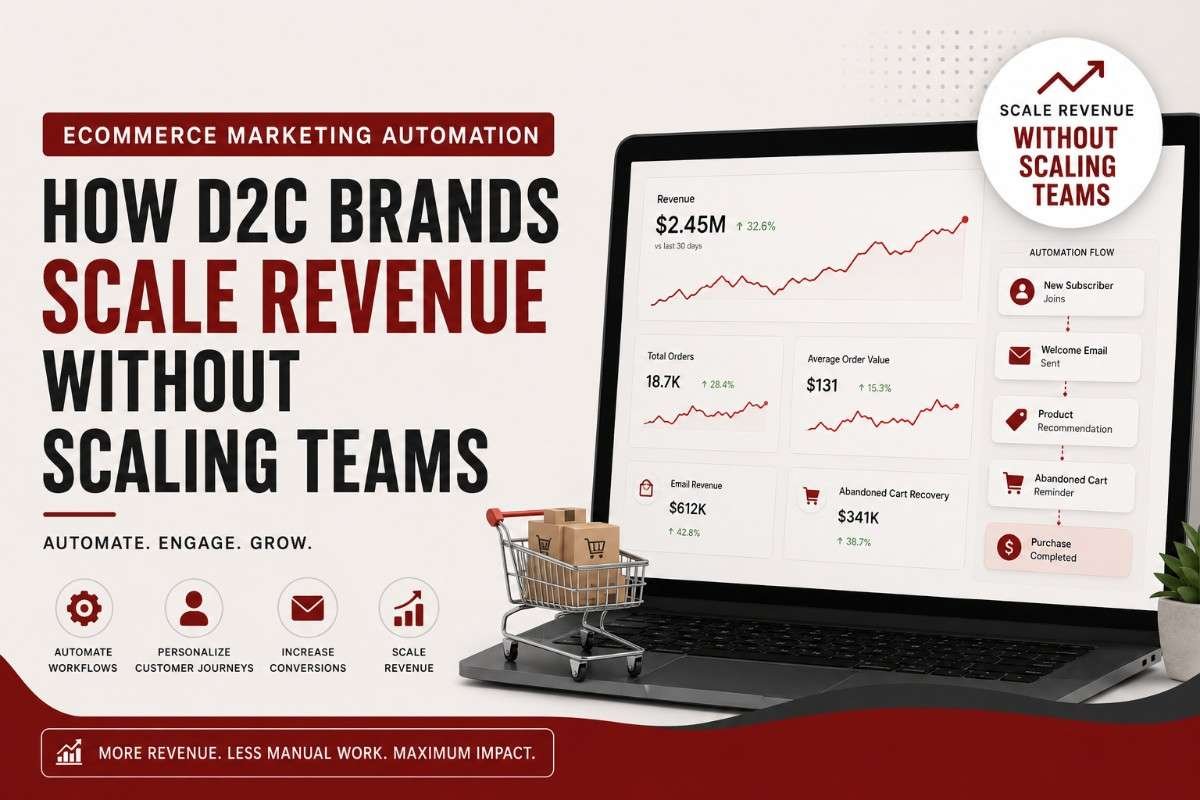
D2C Marketing Automation Scaling Brands Without Scaling Teams Without Scaling Teams
Date: 08 - 25 - 2026
Time to read: 18 minutes
[ Table of
Content ]
Automated emails make up just 2% of the volume most ecommerce brands send, yet they drive 37% of all email revenue. That single stat explains why the fastest-growing direct-to-consumer brands are pulling ahead without ballooning their headcounts. They're building systems that sell while the team sleeps.
This is the complete guide to ecommerce marketing automation for D2C brands: the workflows, channels, and playbooks that let lean teams operate like departments ten times their size.
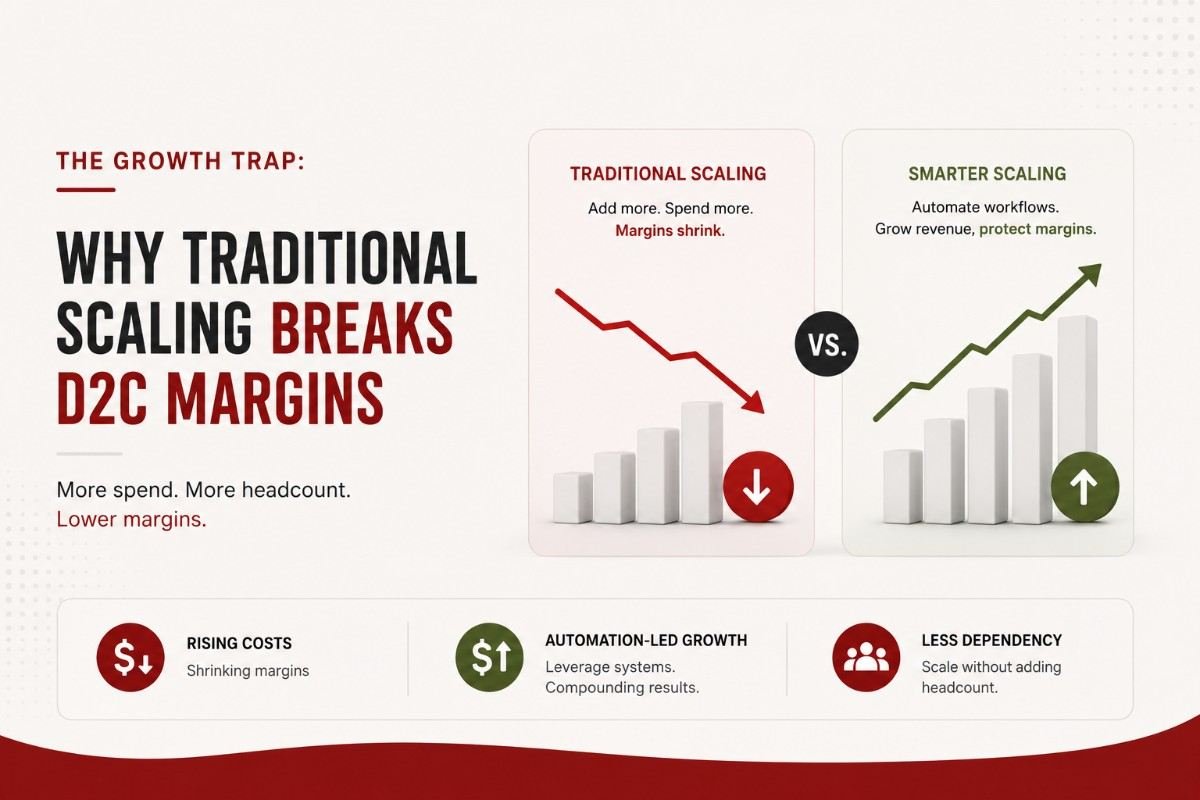
The Growth Trap: Why Traditional Scaling Breaks D2C Margins
Every direct-to-consumer brand hits the same wall. Revenue climbs, so the founder hires more people to keep up. Another email marketer, a retention specialist, a campaign coordinator. Then margins start shrinking because payroll scales linearly while revenue growth doesn't.
The numbers tell the story. Companies with mature marketing automation strategies see 32% higher revenue growth than those stuck in manual mode, according to recent industry benchmarks. Meanwhile, 79% of top-performing companies have used automation for two or more years. They solved the scaling problem before it became a crisis.
The issue isn't that teams are bad at their jobs. It's that human effort doesn't compound the way automated systems do. Three problems keep showing up:
The efficiency gap. Manually building campaigns, exporting segments, and scheduling sends across email, SMS, and ads eats hours that could go toward strategy. Marketing automation tools for ecommerce eliminate this drag entirely. A workflow built once runs thousands of times.
The margin squeeze. Each revenue milestone demands more hires under the traditional model. Ecommerce marketing automation software flips that equation: the technology handles execution while your team handles thinking.
The consistency risk. A human operator will occasionally miss the abandoned cart follow-up, forget the VIP segment update, or send the wrong variant to the wrong list. Automated workflows don't have off days.
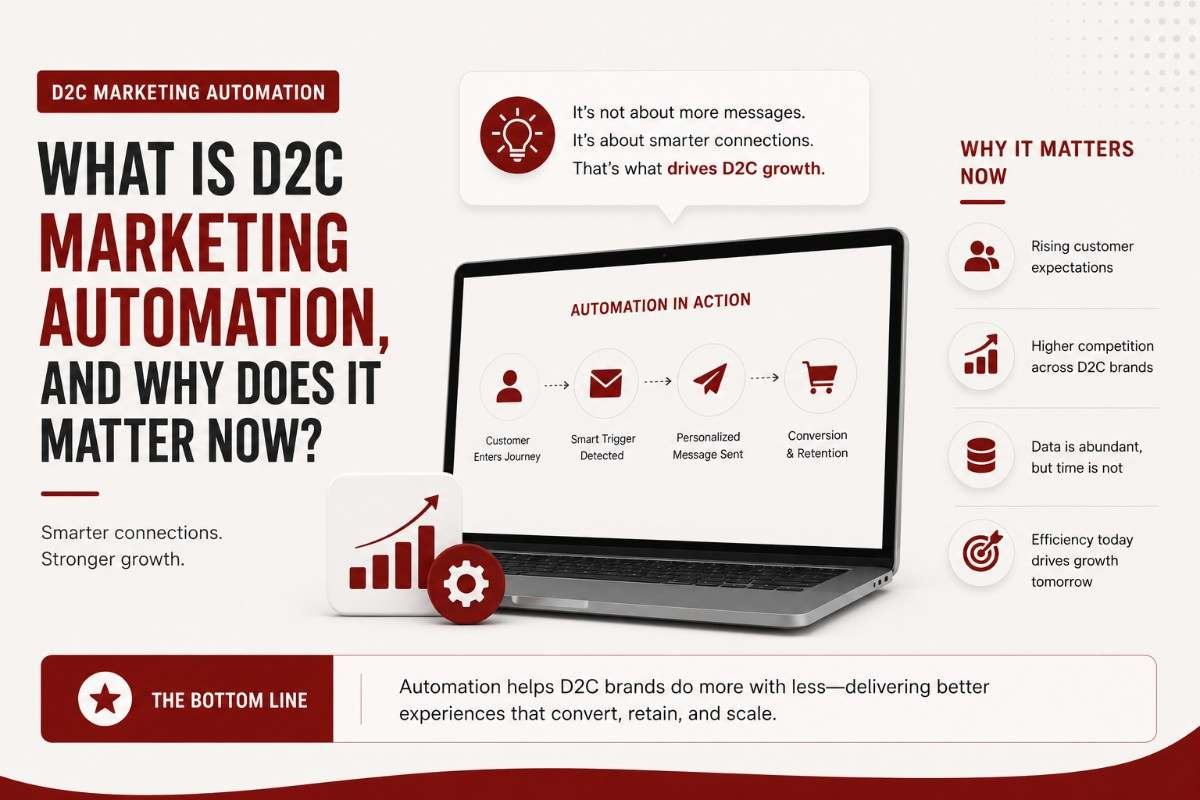
What Is D2C Marketing Automation, and Why Does It Matter Now?
At its core, ecommerce marketing automation is the use of software to trigger, personalize, and manage marketing actions across channels based on customer behavior, without manual intervention for each message. For direct-to-consumer brands specifically, it means turning your Shopify or WooCommerce store into a self-operating revenue engine where every customer interaction triggers the right next step.
Why does this matter more in 2026 than it did five years ago? Because the market has caught up. The global marketing automation market hit $6.65 billion in 2024 and is projected to reach $15.58 billion by 2030. That growth reflects a simple reality: the brands that didn't automate got outrun by the ones that did. Today, 76% of businesses use some form of marketing automation, and that number is climbing toward 90%.
For D2C founders asking "how to scale a D2C brand" without burning through runway, automation is no longer optional. It's the operating system your business runs on.
Suggested article:How
to Choose the Best Shopify Development Company for Your Store
Core Pillars of an Ecommerce Marketing Automation Strategy
Building a real direct-to-consumer marketing strategy around automation means covering every stage of the customer journey, not just slapping a welcome email on your signup form. Here are the pillars that actually move revenue.
Behavior-Driven Email Flows
Email remains the highest-ROI channel in ecommerce, generating between $36 and $40 for every dollar spent. But that ROI lives almost entirely in automated flows, not batch campaigns. Automated emails achieve a 42.1% open rate compared to 26.6% for scheduled campaigns, and they generate $2.87 per email sent versus just $0.18 for regular campaigns.
The ecommerce email marketing automation flows that matter most:
Welcome sequences. A new subscriber's first 48 hours represent your highest-engagement window. An automated welcome series that introduces the brand, highlights bestsellers, and offers a first-purchase incentive converts at dramatically higher rates than a single welcome email. Welcome flows average a 54.3% open rate globally.
Cart and browse abandonment. With a 70.2% average cart abandonment rate across ecommerce, this is where automation pays for itself fastest. A multi-step abandonment sequence that fires within minutes, starting with email and escalating to SMS, recovers revenue that would otherwise vanish. Sending three abandoned cart emails generates 69% more orders than sending just one. The best abandoned cart emails hit a 50.5% open rate, and one in every two people who click through completes their purchase.
Post-purchase nurture. The sale isn't the finish line. It's the starting point for lifetime value. Automated post-purchase flows (shipping confirmations at a 62.47% open rate, unboxing guides, usage tips, and timed replenishment reminders) turn one-time buyers into repeat customers without anyone on your team lifting a finger.
Birthday and milestone emails. These feel personal but run entirely on autopilot, and the results are staggering: birthday message flows drive an average order value of $744.37, roughly four times the typical AOV.
Multi-Channel SMS and Messaging Workflows
SMS open rates dwarf email, with most texts read within three minutes of delivery. Integrating SMS into your ecommerce marketing automation workflows creates a second revenue channel that complements email rather than competing with it.
VIP early access. Text your highest-LTV customers exclusive early-access links before a sale goes public. This direct-to-consumer marketing channel creates urgency and rewards loyalty simultaneously. No team member needs to pull a segment or hit send.
Transactional updates. Automated order confirmation and shipping updates via SMS reduce "where is my order?" support tickets by up to 30%. Every avoided ticket is time your team gets back.
Conversational commerce. Two-way SMS workflows that help customers choose the right size, variant, or bundle act like a 24/7 sales associate. The replies are automated; the revenue is real.
Dynamic Customer Segmentation
Static lists decay fast. Dynamic segmentation, where customers automatically move between segments based on real-time behavior, is what separates amateur automation from a real ecommerce marketing automation platform.
RFM scoring on autopilot. Recency, frequency, and monetary value scoring should update continuously, not quarterly in a spreadsheet. When a customer's RFM profile shifts, their messaging shifts with it, automatically pushing high-value buyers into VIP flows and lapsing customers into win-back sequences.
Predictive churn detection. The best marketing automation tools for ecommerce flag at-risk customers before they're gone. When engagement drops below a threshold (no opens in 60 days, no purchases in 90) a win-back sequence fires automatically. The alternative is discovering churn three months after the fact in a quarterly report.
Predictive LTV targeting. Advanced ecommerce marketing automation platforms can identify high-potential customers early based on first-purchase behavior and browsing patterns. Those signals feed directly into ad platforms, automatically adjusting bids and budgets to acquire more customers who look like your best ones.
Advanced Playbooks for Rapid D2C Scaling
The basics (welcome flows, cart recovery, post-purchase) are table stakes. Brands that pull ahead build layered automation playbooks that extract maximum lifetime value from every customer relationship. This is where a thoughtful d2c marketing strategy separates from a generic one.
Cross-Sell Recommendation Engine
Instead of blasting your entire list with the same product feature, map purchase combinations from your order data. When a customer buys Product A, the system automatically serves complementary Product B through a post-checkout email or SMS, timed to arrive when they're most likely to buy again. This is direct-to-consumer digital marketing at its most precise: one customer, one recommendation, zero manual work.
Subscription Retention Automation
For brands with recurring revenue, the billing cycle is a churn risk. Automated workflows that fire three to five days before renewal, offering a pause option, a flavor swap, or a loyalty discount, reduce involuntary and voluntary churn without anyone on your team monitoring renewal dates.
VIP Loyalty Progression
Define purchase thresholds that automatically tag customers into loyalty tiers. When a customer crosses a spend milestone, they're immediately enrolled in a VIP flow with early access, exclusive products, or free shipping. No manual tagging, no spreadsheet tracking. The experience feels premium; the operations cost is zero.
Automated Social Proof Collection
Reviews and user-generated content fuel conversion, but manually requesting and distributing them is a full-time job. Automation handles the entire cycle:
A review request email triggers automatically 10 days after delivery confirmation. Photo and video reviews get syndicated to product pages and dynamic ad creatives without manual placement. Customers who leave verified reviews instantly receive a discount code or loyalty points as a thank-you, all without human intervention.
Suggested article:Post-Purchase
Paralysis: Why Your Customers Buy Once and Never Come Back
How to Automate D2C Marketing: Choosing the Right Platform
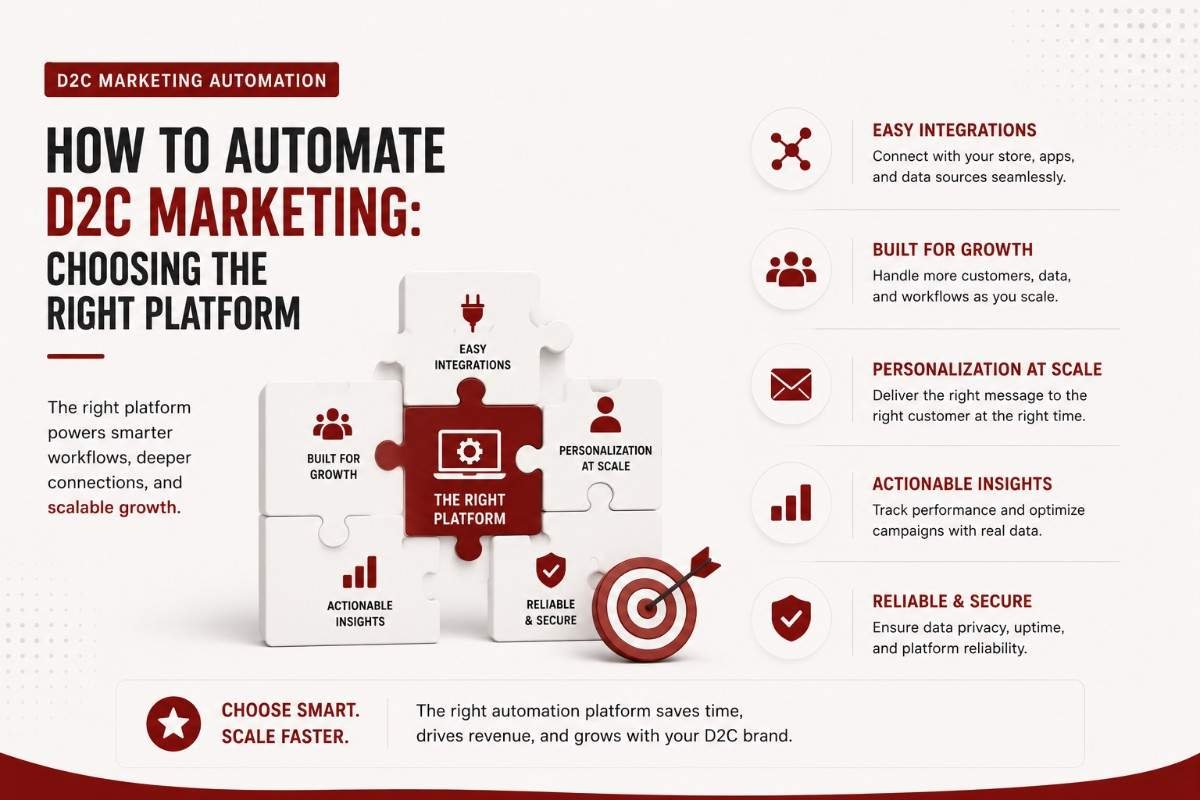
Not every ecommerce marketing automation platform is built for D2C. The best marketing automation for ecommerce brands, particularly those doing $1M to $50M in revenue, shares a few non-negotiable traits:
Native ecommerce integration. The platform should plug directly into your store (Shopify, WooCommerce, BigCommerce) and pull real-time purchase, browse, and cart data without custom development.
Cross-channel orchestration. Email-only tools aren't enough. Your ecommerce marketing automation software needs to coordinate email, SMS, push notifications, and on-site experiences from a single workflow builder.
Revenue attribution. Every flow should report revenue generated, not just opens and clicks. If you can't see that your cart abandonment sequence recovered $47,000 last month, you can't optimize it.
Dynamic segmentation engine. Look for platforms where segments update in real time based on behavior, not static lists you have to rebuild manually.
The best ecommerce marketing automation tools on the market right now (Klaviyo, Omnisend, Drip, and ActiveCampaign) all offer these capabilities at different price points. The right choice depends on your catalog size, channel mix, and technical team.
Measuring ROI Without Overhauling Your Team
The whole point of ecommerce marketing automation is doing more with less. Here's how to measure whether it's working, and these are the metrics your ecommerce marketing automation workflows should report automatically through dashboard integrations.
Abandoned cart recovery rate. This is your most direct measure of automation ROI. Industry leaders recover 5 to 15% of abandoned carts through automated sequences. With a 70% abandonment rate and an average order value of $100, even a 10% recovery rate on 10,000 monthly abandoned carts means $100,000 in revenue that required zero human effort.
Customer lifetime value growth. Track LTV cohort over cohort. Effective post-purchase, cross-sell, and win-back automation should push LTV up 20 to 40% within six months of deployment. If it's flat, your retention workflows need tuning.
Revenue per automated message. At $2.87 per automated email versus $0.18 per campaign email, the gap is 16x. Monitor this metric monthly. It tells you whether your flows are getting smarter or going stale.
Fixed overhead ratio. The metric that matters most for a d2c growth strategy: are you growing revenue while keeping headcount and payroll stable? If your revenue doubled and your marketing team stayed at three people, automation is doing its job.
Time saved per campaign. Marketing automation saves an average of 2.3 hours per campaign and 6+ hours weekly on routine tasks. Track this qualitatively with your team. The hours they get back should be going toward creative strategy and brand building, not operational busywork.
Why Marketing Automation Is Important in Ecommerce: The Compounding Effect
The real power of ecommerce marketing automation isn't any single workflow. It's the compounding effect of dozens of workflows running simultaneously. While your welcome series converts new subscribers, your cart recovery sequence saves abandoned orders, your post-purchase flow builds loyalty, your win-back campaign reactivates lapsed buyers, and your review automation generates social proof that lifts conversion rates site-wide.
Each workflow makes every other workflow more effective. Better reviews lift product page conversion rates, which means more purchases, which means more post-purchase flows firing, which means more reviews. This flywheel doesn't require additional headcount to spin faster. It requires better data, better triggers, and better copy.
Companies that invest in mature automation see a 544% ROI over three years ($5.44 returned for every dollar spent) and 76% generate positive ROI within the first year. Those returns compound because the systems keep running and improving while the team stays lean.
Conclusion
The D2C landscape in 2026 looks nothing like it did five years ago. Customer acquisition costs have climbed sharply since Apple's privacy changes reshaped digital advertising. Legacy retailers now run their own direct channels, compressing the advantage that digitally native brands once held. And the brands that tried to grow by simply adding headcount for every new revenue milestone learned the hard way that overhead scales faster than profit.
The brands that are winning through all of this share one trait: they built their marketing operations on automated systems, not manual labor. They invested in ecommerce marketing automation early, letting behavior-driven email flows, multi-channel messaging, dynamic segmentation, and retention playbooks compound over time. Their three-person marketing teams now outperform departments of fifteen because every workflow they built once keeps generating revenue without ongoing effort.
The playbook is clear. Start with the three highest-impact flows: welcome, cart abandonment, and post-purchase. Choose one ecommerce marketing automation platform and commit to it. Build flows that trigger on behavior, not on a calendar. Layer in advanced playbooks (cross-sell engines, subscription retention, VIP progression, automated social proof) as your foundation matures. Measure what matters: recovered revenue, lifetime value growth, and fixed overhead ratio.
Scaling a direct-to-consumer brand doesn't require scaling your team. It requires building the right systems and letting compound returns do what compound returns do.
The question isn't whether to automate. It's how much revenue you're leaving on the table every day you don't.
At Oddtusk, we build ecommerce marketing automation systems engineered for high-growth D2C brands. From behavioral email flows and dynamic segmentation to SMS orchestration and retention playbooks, we design the infrastructure that turns your store into a compounding revenue engine, without adding headcount. Whether you're launching your first automated flows or upgrading a patchwork setup, our team builds fast, stable, and revenue-ready systems. Ready to scale smarter? Let's start the conversation.
[ Common questions ]
Ecommerce Marketing Automation FAQs
Direct-to-consumer (D2C) marketing is when a brand sells and markets its products directly to end customers, bypassing wholesalers, distributors, and traditional retail. This model gives brands full control over their customer relationships, data, and messaging, which is exactly what makes marketing automation so powerful in a D2C context. Unlike wholesale or marketplace selling, D2C lets you own the entire customer journey from first click to repeat purchase, and automation is what makes that ownership profitable at scale.
D2C marketing automation refers to using software platforms to automate repetitive marketing tasks across the direct-to-consumer customer journey, from first-touch acquisition emails to post-purchase retention flows and loyalty programs. It encompasses email, SMS, push notifications, dynamic segmentation, and behavioral triggers, all running without manual intervention. Think of it as the operating layer between your store platform (Shopify, WooCommerce) and your customer: every action a shopper takes triggers a relevant, personalized response without anyone on your team pressing send.
This is one of the most common pain points we hear from D2C founders. One Shopify merchant described email marketing as "the hardest part" of running their store, harder than inventory or shipping. The fix is shifting from campaign-first to flow-first thinking. Instead of manually building a new email for every occasion, set up evergreen automated flows (welcome, cart abandonment, post-purchase, win-back, VIP) that run year-round. Then layer in a handful of seasonal campaigns on top. Most brands find that 70 to 80% of their email revenue comes from flows they built once and rarely touch, freeing up dozens of hours every month.
This is the D2C profitability crisis in a nutshell. After Apple's App Tracking Transparency changes, the targeted digital advertising that once let D2C brands scale cheaply became far more expensive. Automation helps in two ways. First, it maximizes the value of every customer you already acquired (through retention flows, cross-sells, and replenishment sequences), which reduces your dependence on paid acquisition. Second, predictive LTV targeting feeds your best-customer data back into ad platforms so you spend less to acquire buyers who actually stick around. Brands like Casper and Allbirds showed what happens when acquisition costs outrun retention. Automation is how you avoid that trap.
Start with the three highest-ROI workflows: a welcome email series, a cart abandonment sequence (email + SMS), and a post-purchase nurture flow. Choose an ecommerce marketing automation platform with native Shopify or WooCommerce integration, set up dynamic segments based on purchase behavior, and layer in additional flows (win-back, VIP, cross-sell) as you see results from the foundational ones. Most scaling brands run 15 to 25 active automated workflows with a marketing team of two to four people. The key is resisting the urge to build everything at once. Get three flows live, measure their impact for 30 days, then add the next layer.
A 70% cart abandonment rate is actually the industry average, so you're not alone. But "average" still means massive revenue left on the table. Automation won't fix the reasons customers abandon (high shipping costs, forced account creation, slow delivery estimates), but it will recover a meaningful percentage of those who left. A well-built multi-step abandonment sequence (email within 30 minutes, follow-up email at 24 hours, SMS at 48 hours) recovers 5 to 15% of abandoned carts for most stores. Sending three cart emails generates 69% more orders than sending one. Pair that with checkout optimization (guest checkout, transparent shipping costs, trust badges) and you're attacking the problem from both sides.
Tool fatigue is real. Merchants on Reddit and Shopify forums constantly ask "Klaviyo vs Omnisend vs Mailchimp" and the thread goes in circles. Here's a shortcut: if you're a Shopify store doing under $5M in annual revenue, Klaviyo or Omnisend will handle 95% of what you need. Pick one based on whether you need deeper SMS capabilities (Omnisend) or more advanced segmentation and predictive analytics (Klaviyo). Don't spend three months comparison-shopping. Pick one, build your first three flows, and optimize from there. The best ecommerce marketing automation software is the one you actually use, not the one with the longest feature list.
Because manual execution doesn't scale. A human can manage a few hundred customer interactions per day; an automation platform handles millions. With 70% of carts being abandoned, email generating $36 to $40 per dollar spent, and automated messages outperforming campaigns by 16x on revenue per send, the math is clear: automation is the only way to capture the full revenue potential of your traffic without proportionally scaling your team. And with customer acquisition costs rising across every paid channel, the brands that retain and reactivate existing customers through automation are the ones that stay profitable.
The traditional model (more revenue means more hires) is exactly what crushes D2C margins. Brands that scaled to $80K in monthly revenue and still couldn't pay the founder illustrate the problem. The leverage play is building systems that run without proportional labor. That means ecommerce marketing automation for your messaging, dynamic segmentation to replace manual list management, automated review collection to replace a UGC coordinator, and dashboard integrations to replace manual reporting. Every role you can replace with a workflow is margin you keep. The goal isn't zero employees. It's ensuring each new hire amplifies strategy instead of handling tasks software should own.
