Consumer Behaviour Analysis India
Most consumer behaviour frameworks were built for Western markets where credit card is default, WhatsApp is not a discovery channel, and festival purchase spikes do not exist. Indian buyer behaviour: COD preference on first purchase, WhatsApp-influenced discovery, festival cycle concentration, mobile-first browsing with higher-ticket desktop purchase, is a different system that needs to be researched on its own terms. Every analysis connects to our CRO programme and retention marketing services.
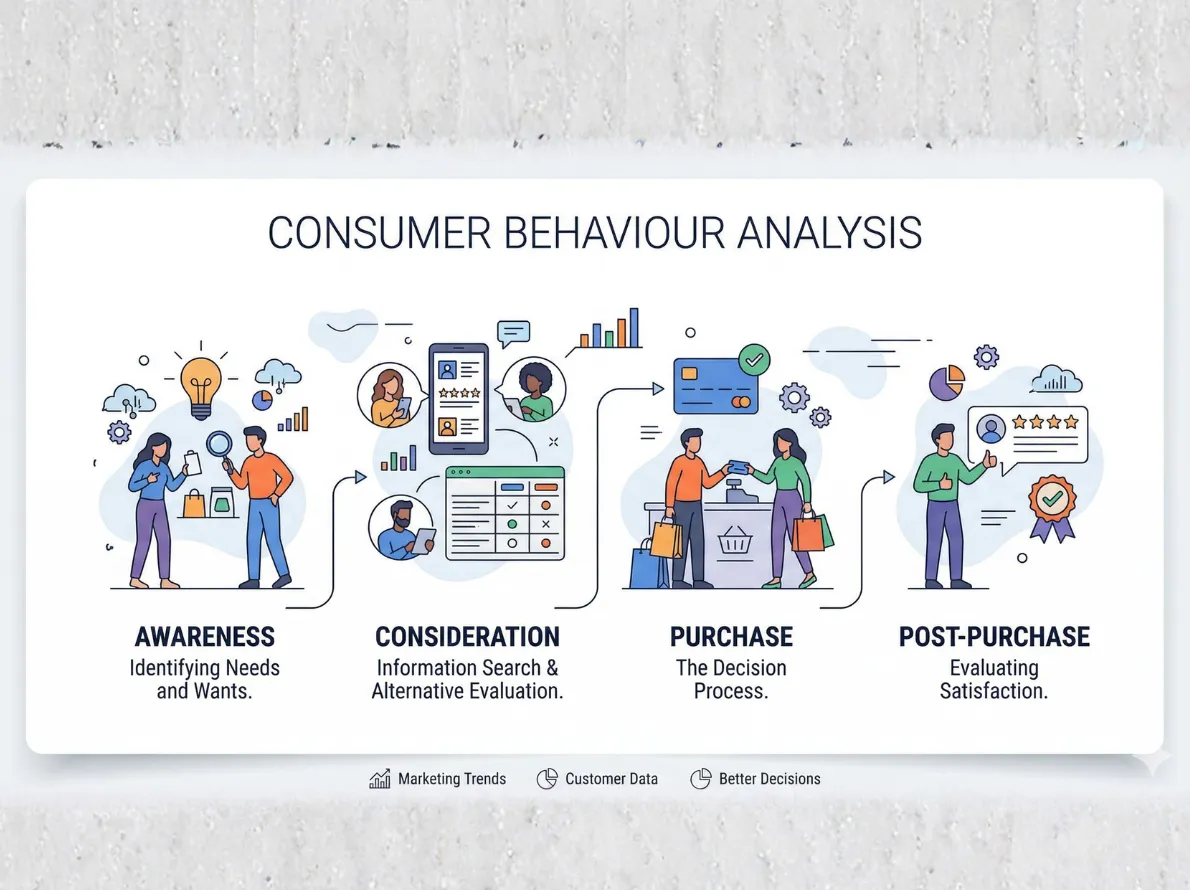
- GA4 cohort analysis (30, 60, 90 days)
- Purchase path analysis
- RFM segmentation
- Session recording review (mobile-filtered)
- Heatmap analysis
- Customer survey (buyers and non-buyers)
- Social listening (Instagram, Reddit, Quora)
- Festival purchase cycle mapping
- COD-to-prepaid conversion journey
- WhatsApp discovery proportion
- Buyer persona documentation
- CRO and retention strategy recommendations
Global tools miss Indian patterns like festival spikes, WhatsApp discovery, COD-to-prepaid transitions, and mobile-to-desktop journeys for high-ticket item purchases.
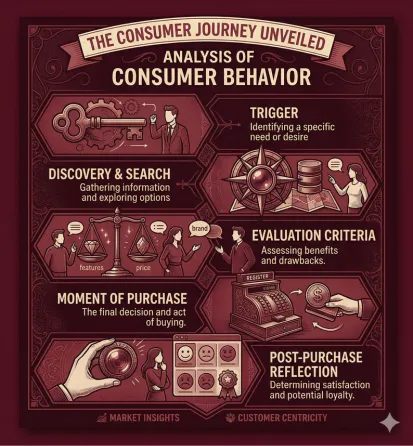
Standard analytics tools overlook unique Indian behaviours like festival purchase concentration and WhatsApp-driven discovery. Since a major revenue share comes during Diwali or Eid, brands often mismanage these distinct customer cohorts by using generic retention strategies. Similarly, WhatsApp's massive role in product discovery is often misattributed as direct traffic in GA4, causing brands to underinvest in social channels. Oddtusk identifies these hidden patterns through localised cohort data, surveys, and RFM segmentation, providing the intelligence needed to optimise CRO and retention programmes specifically for the Indian market.
GA4 cohort analysis and purchase path
GA4 cohort analysis tracks customer behaviour over 90 days, revealing retention and revenue trends. For Indian brands, comparing festival versus off-season cohorts exposes critical differences in purchase patterns. Path analysis further identifies influential pages, mapping the actual consideration journey Indian buyers take beyond simple product-to-checkout routes shown in default reports.
Session recordings, surveys, and social listening
Microsoft Clarity sessions reveal mobile checkout friction, specifically regarding COD and UPI. Surveys capture motivations and hidden WhatsApp discovery that GA4 misattributes. Social listening on Instagram and Reddit uncovers organic buyer concerns, revealing a true hierarchy of consumer needs that standard surveys often miss when brands are watching. These insights feed directly into our CRO hypothesis development.
RFM segmentation and Indian buyer pattern mapping
RFM segmentation classifies customers by Recency, Frequency, and Value to tailor communication for loyal, at-risk, or dormant tiers. We integrate India-specific mapping, identifying the COD-to-prepaid trust milestone and distinguishing seasonal festival shoppers from year-round buyers to optimise unique retention strategies.
Buyer personas and Cialdini influence mapping
Research outputs are synthesised into behavioural buyer personas detailing purchase paths, discovery channels, and trust barriers. We apply Cialdini's principles with Indian weighting: prioritising social proof like WhatsApp and YouTube reviews over brand prestige. Scarcity and authority are calibrated for local credibility, ensuring marketing resonates with actual psychological triggers that drive D2C conversion.
GA4 misses crucial Indian patterns: massive WhatsApp discovery, 40% festival revenue, and the COD trust milestone.

GA4 cohorts reveal what customers do. Session recordings reveal where they hesitate. Surveys reveal what they say about why. Social listening reveals what they say organically. India-specific patterns: festival cycles, WhatsApp discovery, COD journey, emerge from the synthesis of all four.
Surveys typically reveal that 15 to 35 percent of buyers found the product through a WhatsApp recommendation before visiting the site. GA4 attributes these sessions to direct traffic. Brands that miss this underinvest in WhatsApp automation and referral programmes.
Social proof carries higher weight in India: WhatsApp group recommendations, visible review volume, and YouTube creator endorsements outweigh independent judgement in most D2C categories. Scarcity works when credible and fails when obviously synthetic: Indian buyers have developed scepticism about perpetual countdown timers.
Quantitative data audit, qualitative research, India pattern mapping, buyer persona documentation
Quantitative data audit: GA4 cohorts, purchase path, RFM
Qualitative research: session recordings, surveys, social listening
India-specific pattern mapping
Buyer persona documentation and strategic recommendations
Everything you need to know about consumer behaviour analysis for Indian brands.
Consumer behaviour analysis produces four categories of output for Indian brands. First, quantitative behaviour data from GA4 cohort analysis, purchase path reports, and RFM segmentation. Second, qualitative behaviour data from session recordings, customer surveys, and social listening. Third, Indian behaviour pattern intelligence covering festival cycle purchase concentration, COD-to-prepaid journeys, WhatsApp discovery attribution, and mobile-to-desktop purchase patterns. Fourth, buyer persona documentation translating the research into actionable profiles that inform CRO, content strategy, paid media targeting, and retention programme structure.
Indian consumer behaviour differs from Western behaviour in patterns consequential for marketing strategy. Festival purchase concentration creates demand spikes not spread across the year as in Western markets. WhatsApp plays a product discovery and recommendation role with no Western equivalent: 15 to 35 percent of buyers in high-share-of-voice categories find products through WhatsApp before visiting the brand's site. The COD-to-prepaid conversion journey is unique to India. Mobile-first browsing is more pronounced in India than any other large ecommerce market. Price sensitivity is higher, making value framing more consequential to the purchase decision.
GA4 cohort analysis groups users by acquisition date or channel and tracks their behaviour over 30, 60, and 90 days: revealing which cohorts have the highest retention rate, revenue per user, and second-purchase probability. For Indian ecommerce brands, cohort analysis by acquisition period is particularly revealing: customers acquired during Diwali may behave very differently from off-season customers across retention rate, AOV, return rate, and second-purchase category. A brand that does not analyse cohorts by acquisition period will design its retention programme for average customer behaviour and miss that 40 percent of its customer base was acquired in a six-week festival window. See our GA4 setup service.
RFM stands for Recency, Frequency, and Monetary value: classifying customers by how recently they purchased, how often, and how much they spend. RFM divides the customer base into behavioural tiers: high-value loyal customers receive VIP treatment and early product access; at-risk customers with a recent lapse receive win-back campaigns; one-time buyers receive nurture sequences addressing the second-purchase trigger; dormant customers receive reactivation campaigns. RFM is the foundation of a retention programme: without it, brands send the same communication to loyal and lapsed customers, which is inefficient and produces lower response rates than segment-specific messaging. See our retention marketing service.
Social listening captures unsolicited buyer opinions across Instagram, YouTube comment sections, Reddit, Quora, and product review platforms: conversations that happen without any brand-initiated prompt. For Indian brands, social listening surfaces specific concerns and comparisons that buyers mention organically but rarely express in surveys where they might sense the brand is reading the responses. A wellness brand might discover through social listening that a significant proportion of category buyers are concerned about ingredients they cannot pronounce: a concern that never appears in post-purchase surveys because buyers concerned enough simply did not purchase. Social listening identifies barrier-level concerns that inform both CRO hypothesis development and product communication strategy.
Cialdini's six principles operate in Indian consumer psychology with different relative weightings. Social proof is among the highest-weighted principles for Indian buyers: WhatsApp group recommendations, visible review volume, and YouTube creator reviews carry more weight than independent judgement in most D2C categories. Scarcity works when credible (festival sale countdowns, genuine limited stock) and fails when obviously synthetic. Authority works through specific, relevant credentials rather than general brand prestige. Oddtusk maps these principle weightings per category and per persona based on the qualitative research findings.
Consumer behaviour analysis makes CRO hypotheses evidence-based rather than assumption-based. A CRO hypothesis from session recording alone produces a generic fix. Combined with consumer behaviour data: buyers in this category have a high first-purchase COD rate and a specific concern about return policy, it produces a targeted hypothesis: moving the return policy summary above the payment options will reduce hesitation for first-time buyers. For retention, behaviour analysis identifies the RFM tiers most at risk of churn and the specific product or message that historically converts a second purchase. See our CRO service and retention marketing service.
WhatsApp is a product discovery channel in India for which GA4 provides no attribution data. A buyer who finds a product in a WhatsApp group and then buys is recorded in GA4 as direct or organic search traffic: the WhatsApp discovery is invisible. Customer surveys that specifically ask about WhatsApp discovery reveal that 15 to 35 percent of buyers in high-share-of-voice D2C categories found the product through WhatsApp before ever visiting the site. Brands that do not measure this will underinvest in WhatsApp automation and referral programmes, and overinvest in the paid channels that GA4 falsely credits for those conversions.