


Building a digital storefront in 2026 goes far beyond simply launching a website. It requires strategic technology choices that will shape your revenue potential, business scalability, and brand reputation. The ecommerce website cost 2026 depends primarily on your business model, required functionalities, and growth readiness rather than superficial design elements. Companies expanding their online presence must understand ecommerce development pricing, create realistic budgets, and recognize the true cost of building an ecommerce site to avoid compromising their future growth trajectory.
Why Understanding E-commerce Website Cost in 2026 Matters
Grasping the e-commerce website cost 2026 enables businesses to optimize spending while meeting launch deadlines. Today’s consumers demand fast, secure, and personalized online transactions. Insufficient budget allocation for your e-commerce store often leads to costly rebuilds within months, multiplying expenses and operational complexity.
Why 2026 demands attention:
- Digital competition has intensified dramatically
- Consumer expectations continue evolving
- Scalability determines survival, not just expansion
- Strategic ecommerce development cost planning protects ROI
Key Factors That Define the Cost to Build an E-commerce Site
The cost of creating an eCommerce site varies with various technical and strategic factors. There isn’t a single number that can be applied to every business. What ultimately determines the price is the level of complexity and how future-ready your store needs to be.
Platform Selection
Platform choice significantly impacts e-commerce development pricing. Hosted platforms offer rapid deployment, while open-source or custom solutions provide maximum flexibility. Your platform selection determines scalability potential, security infrastructure, and ongoing maintenance requirements all factors affecting the e-commerce website cost in 2026. Whether you choose Shopify design development, WooCommerce development, Magento development, or BigCommerce development, each platform brings distinct cost implications.
Design & User Experience
Design transcends aesthetics in 2026. User experience directly influences conversion rates. Conversion-focused interfaces, mobile optimization, and accessibility require substantial planning and execution, impacting your total eCommerce budget while reducing future redesign expenses. Professional graphic design and strategic content marketing play crucial roles in creating compelling user experiences.
Feature & Functionality Scope
Advanced capabilities like intelligent search, dynamic filtering, multi-currency transactions, and automation increase the cost of building an e-commerce site. Each feature adds development time, testing phases, and long-term maintenance obligations.
Total costs of an ecommerce website
The complete investment for launching and operating an online store starts around $29 monthly. Actual costs vary based on customization depth, premium design choices, and platform fees.
Breakdown of e-commerce website expenses:
- Domain registration – $10–$30 annually for your store’s web address
- Web hosting – $5–$250 monthly for reliable website hosting
- SSL certificate – $0–$200 for securing customer data
Ecommerce platform:
- Hosted platforms: $5–$300 monthly depending on feature sets
- Open-source platforms: Free downloads with additional customization costs
Website design and development:
- Pre-built themes: $0–$200
- Custom ecommerce web development: $2,000–$20,000+ based on complexity
Additional investments:
- Digital marketing and advertising – Variable based on strategy
- SEO services including ecommerce SEO – Essential for visibility
- Website maintenance and technical support – Depends on service level requirements
E-commerce Budget Breakdown by Business Type
Different businesses will have varied e-commerce budgets depending on the stage of their growth. Knowing this will help you not to overbuild or underbuild your store.
Startups & Small Businesses
Emerging businesses typically prioritize essential features. Their building cost of an eCommerce site focuses on MVP functionality, accelerated timelines, and simplified architecture while maintaining scalability options. Local SEO services often prove valuable for startups targeting specific geographic markets.
- Growing Brands
Expanding brands require adaptable systems. Their e-commerce development costs encompass performance optimization, conversion-focused design, and marketing integrations supporting inventory expansion. Implementing marketing automation and conversion rate optimization becomes increasingly important at this stage.
Enterprise Ecommerce
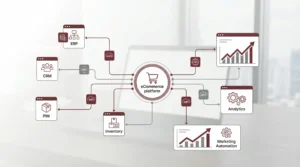
Enterprise organizations demand comprehensive frameworks. Their cost of an e-commerce website in 2026 reflects robust security protocols, regulatory compliance, advanced scalability, and system integrations built for sustained operations. Enterprise solutions often integrate CRM systems and sophisticated workflow automation.
Ongoing Costs Businesses Often Overlook
Many businesses inaccurately determine the cost of an ecommerce website in 2026 by solely considering the expenses related to the launch. Investments that follow the launch quietly figure out the real ecommerce budget and thus influence the stability, security, performance, and long-term sustainability of the ecommerce store.
Hosting and infrastructure scaling
With the increase in traffic, servers have to scale smoothly in order to maintain speed, uptime, and stability without causing any inconvenience to customer experience or sales momentum.
Security monitoring and updates
Security patches are performed continuously, vulnerability monitoring and threat prevention are necessary activities for customer data protection and in avoiding expensive breaches.
Platform upgrades and maintenance
It is through regular updates that compatibility is maintained, features are improved, and operations run smoothly, thus preventing the buildup of technical debt from using outdated systems.
Performance optimization
Continuous speed improvements, database tuning, and front-end changes are some of the ways that conversions, SEO performance, and user experience can be maintained.
If one decides to overlook these, then the real cost of building an e-commerce site will increase later; at times, they will have to bear the cost of expensive fixes instead of planned improvements.
How Features and Integrations Impact E-commerce Budget
Features enhance functionality but increase costs without strategic planning. Every integration creates ripple effects across development timelines, testing requirements, and ongoing support, ultimately affecting e-commerce development pricing.
Budget-impacting features typically include:
- Payment gateway integrations
- ERP and CRM connections
- Inventory automation systems
- Analytics and tracking platforms
- Email marketing integrations
- Social media advertising tools
Strategic feature planning ensures optimal resource allocation and prevents budget overruns.
Scalability Planning and Long-Term Cost Efficiency
By planning for scalability, you can cut down on repeated development cycles. A store that is scalable can adjust without a complete overhaul, thus reducing the total ecommerce website cost 2026 over time.
Scalability planning reduces repetitive development cycles. Scalable stores adapt without complete overhauls, decreasing total ecommerce website cost 2026 over time.
Scalable architecture addresses:
- Campaign-driven traffic surges
- Product catalog expansion
- New market penetration
- Seasonal demand fluctuations
- Paid media advertising scalability
This approach prevents inflating cost of building an ecommerce site through reactive rebuilds.
Common Mistakes That Inflate Ecommerce Website Cost
Experienced teams consistently observe recurring errors. These mistakes increase ecommerce development expenses without performance improvements.
Most common pitfalls:
- Neglecting scalability during platform selection
- Skipping UX and CRO research phases
- Adding features without development team consultation
- Delaying performance testing until post-launch
- Inadequate ecommerce marketing services planning
- Underestimating ecommerce PPC services requirements
Avoiding these errors stabilizes your ecommerce budget significantly.
How Businesses Should Plan E-commerce Development Pricing for 2026
Smart planning makes the cost of an e-commerce website in 2026 both predictable and efficient. The business must put clarity as its main focus even before the development starts.
Effective planning encompasses:
- Clear business objectives
- Feature prioritization frameworks
- Phased development methodology
- Budget allocation for continuous optimization
- Integration of content strategy
- Comprehensive campaign strategy
This reduces unnecessary expenses in your cost to build e-commerce site.
Key Takeaways
- Cost of an ecommerce website 2026 will mainly be determined by the strategy and how big the project will be.
- The price of e-commerce development is largely influenced by the level of intricacy and the number of features.
- A practical online store budget should also consider the expenses that will be incurred after the launch.
- Intelligent budgeting will lower the actual cost to build ecommerce site.
- Expandable projects keep the initial investment low while the rest of the money can be saved later.
Conclusion: Building Smart, Scalable Ecommerce in 2026
The cost of an e-commerce website in 2026 is not a matter of simply selecting the lowest-priced alternative. Rather, it is about making knowledgeable decisions that maintain a good balance between the effectiveness, scalability, and expansion of the business. Companies that comprehend the costs of e-commerce development, create a feasible e-commerce budget, and make a wise investment lessen the chances of carrying risk and technical debt for a long time. At Oddtusk, brands are led through scalable e-commerce builds that emphasize ROI, performance, and being prepared for the future instead of temporary solutions.