Predictive SEO Services
Most SEO is reactive. Content is published after topics trend, seasonal pages go live when demand has already peaked, and keyword targeting is based on what people searched last month rather than what they will search next quarter. Predictive SEO inverts this. Oddtusk maps emerging search demand, forecasts seasonal query patterns, identifies topics before they peak, and builds the content and ranking foundation that puts your brand in position before your competitors have even noticed the opportunity.
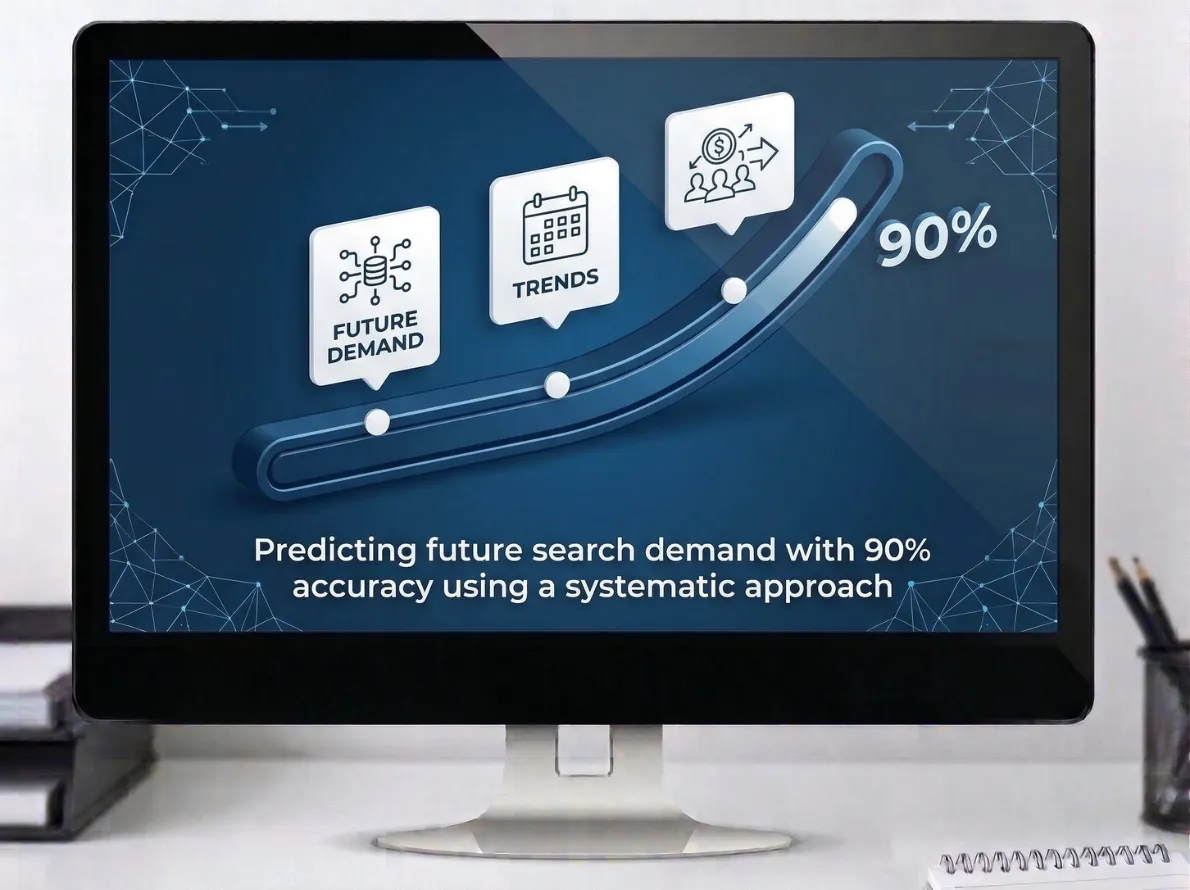
The brands that rank when demand peaks published their content before demand arrived. Timing is a competitive advantage.

New content takes time to rank. A page published the week a topic trends rarely earns a competitive ranking before the search volume peaks and subsides. Predictive SEO works by identifying those topics 3 to 6 months early, building the content and authority foundations while competition is low, and arriving at peak demand already ranked. Oddtusk applies Google Trends analysis, seasonal pattern modelling, industry signal monitoring, and competitive gap forecasting to give your content calendar a forward-looking edge.
Search Trend Forecasting
We analyse Google Trends data, rising query patterns in GSC, social media search behaviour signals, and industry publication topic velocity to identify search demand that is growing before it reaches mainstream keyword tool visibility. Topics with accelerating search interest but low current competition are the highest-value predictive SEO targets because they combine early positioning opportunity with incoming traffic volume.
Seasonal Demand Mapping
Most industries have predictable seasonal search cycles. We map 24 to 36 months of historical search volume data for every relevant query cluster to identify peak demand windows, pre-peak research phases, and post-peak tail periods. This defines a precise content publication schedule when to publish each piece to allow sufficient ranking time before peak demand and when to refresh or re-promote existing content in the weeks before seasonal volume spikes.
Emerging Query Identification
New product categories, regulatory changes, cultural shifts, and technology developments all generate emerging query sets before mainstream tools register significant volume. We monitor industry publications, regulatory announcements, platform changelogs, and competitor content velocity to identify query clusters that are forming around new concepts. These pages, built and ranked early, capture traffic that did not exist when the strategy was planned.
Predictive Content Calendar
Trend forecasting and seasonal demand data are translated into a 6 to 12 month forward-looking content calendar. Each piece is scheduled with its target publication date calculated backwards from the predicted demand peak, accounting for the expected time to rank and the content depth required. The calendar integrates evergreen content, seasonal refreshes, emerging topic coverage, and competitive gap content into a single prioritised production schedule.
Intent Shift Monitoring
Search intent is not static. As categories mature, buyer intent shifts from informational to commercial. As regulations change, compliance query intent emerges. As products evolve, comparison and alternative queries grow. We monitor GSC impression and CTR trends, SERP feature changes, and ranking competitor content shifts to detect intent signals changing in your category before they fully register in keyword volume data, adjusting content strategy to match the evolving intent landscape.
First-Mover Content Positioning
First-mover ranking advantage in SEO is real and measurable. Pages that rank first for an emerging query accumulate engagement signals, backlinks, and entity authority that make them progressively harder to displace. We identify and brief first-mover content opportunities before competitive content density reaches the point where ranking requires significant authority. Early publication at low competition translates directly into defensible positions that hold through peak demand cycles.
Predictive SEO Outcomes Across Brands and Publishers We Have Positioned Ahead of Demand.

Brands publishing seasonal content 90 to 120 days before peak demand capture four times more organic traffic at peak than brands publishing the same content in the weeks immediately before or during the demand spike.
Pages establishing first-mover positions on emerging queries while competition is low retain those rankings through peak demand in 65 to 75 percent of cases, as engagement signals and authority accumulated early create a compounding defensive advantage over later entrants.
Content targeting low-competition early-stage queries requires significantly less depth to rank than content entering competitive markets after demand peaks. Predictive SEO reduces total content investment per ranking position by 40 to 60 percent.
From Demand Forecasting to First-Mover Rankings
Search Demand Baseline Analysis
Trend Signal Identification
Publication Timing Modelling
Predictive Content Brief Production
Content Production & Early Ranking
Performance Review & Next Cycle Planning
Straight answers to the questions that matter.
Standard SEO targets existing search demand optimising for queries that already have measurable volume. Predictive SEO targets search demand that is about to grow identifying seasonal patterns before their cycle, emerging topics before they peak, and rising query clusters before competitors have noticed them. The difference is timing. Standard SEO is competitive at established demand. Predictive SEO is competitive at the point where barriers to ranking are lowest and the opportunity to hold position through peak demand is greatest.
For most industries, seasonal content published 90 to 120 days before the peak demand window has sufficient indexation time to rank competitively. Content in highly competitive categories may need 150 to 180 days. Content targeting low-competition queries can rank in 30 to 60 days. The correct lead time depends on your domain authority, the topic competitiveness, the content depth required, and the steepness of the demand curve. We calculate the specific lead time for each piece based on your site's ranking velocity data.
We use Google Trends for seasonal demand curve modelling, GSC impression and click data for your domain's existing query velocity, Ahrefs for keyword difficulty and search volume trend lines, industry publication topic velocity monitoring, competitor content publishing patterns, regulatory and platform announcement monitoring, and social media search interest signals. No single source is sufficient. We combine multiple signals to identify trends with high confidence before they register in standard keyword tool volume data.
Yes. Seasonal demand patterns are the clearest application of predictive SEO, but emerging topic identification and intent shift monitoring apply equally to industries with flat demand cycles. In non-seasonal categories, predictive SEO focuses on identifying emerging query clusters from regulatory changes, technology shifts, and category evolution, and positioning content on those queries before competitive content density makes ranking significantly harder. Every industry has topics that are about to grow even when nothing follows a calendar cycle.
Forecasting is probabilistic, not guaranteed. We build monitoring checkpoints into every predictive content brief so ranking progress and actual demand signals can be reviewed before peak. If a trend develops more slowly than forecast, the content remains live and ranks for existing lower-volume queries while the demand builds. If the trend does not develop, the content serves the existing base query volume and can be pivoted toward an adjacent growing topic with minimal rework. No page produced for a predictive brief is wasted even if the forecast does not fully materialise.
Existing seasonal pages are reviewed for content depth, keyword coverage, and ranking history before the approach is decided. Pages that ranked well in previous cycles are refreshed 60 to 90 days before the next peak with updated content, current data, and internal link reinforcement. Pages that ranked poorly despite previous optimisation receive a deeper content and authority review to identify the specific gap preventing competitive rankings. We prioritise refreshing proven assets over producing new pages for the same seasonal queries.
Predictive SEO typically requires the same or less content production for equivalent ranking outcomes because each piece targets lower-competition opportunities. The difference is planning horizon, not volume. Content needs to be briefed and produced 3 to 6 months earlier than in a reactive programme, which requires more forward planning but not necessarily more total production. The efficiency gain comes from producing content when ranking is achievable at lower competition rather than producing more content to compete at higher competition.
Industries with strong seasonal demand patterns including travel, retail, finance, education, and events benefit most from seasonal demand mapping. Industries undergoing regulatory change including healthcare, fintech, and legal benefit most from emerging query identification. Industries with fast-evolving technology landscapes including SaaS, consumer electronics, and media benefit most from intent shift monitoring. The combination of all three approaches provides the strongest predictive advantage and applies across virtually every industry with meaningful organic search presence.
The predictive content calendar sits within the broader topical authority map and content strategy. Evergreen content covers stable perennial topics. Predictive content covers seasonal cycles and emerging opportunities. Both are planned together in the same production schedule so the total content output addresses the full demand landscape consistent baseline traffic from evergreen content and traffic spikes at seasonal and emerging demand peaks from predictive content. The two reinforce each other through the internal linking architecture connecting them.
Predictive SEO performance is measured at three points. Pre-peak: ranking position and impression velocity at 30 and 60 day checkpoints before the demand peak. At peak: total organic traffic, ranking positions, and conversion outcomes during the peak demand window versus the previous cycle. Post-peak: ranking retention after the demand subsides and year-over-year traffic improvement for recurring seasonal topics. Forecast accuracy is reviewed against actual outcomes after each cycle to improve modelling precision for subsequent planning periods.