
How the shift to AI-generated answers and zero-click search changes what it means for your brand to be visible online.
GSC Now Tracks Social Media Under Platform Properties
Date: 07 - 27 - 2026
Time to read: 11 minutes
[ Table of Content ]
For over two decades, the SEO team and the social media team operated in separate rooms with separate tools and separate metrics that rarely spoke to each other. SEO lived in Google Search Console - keywords, impressions, click-through rates, ranking positions. Social lived in native platform dashboards - likes, reach, saves, watch time. When an Instagram Reel or YouTube Short happened to appear on page one of Google, nobody could measure what search query put it there. It was a happy accident, not a data point.
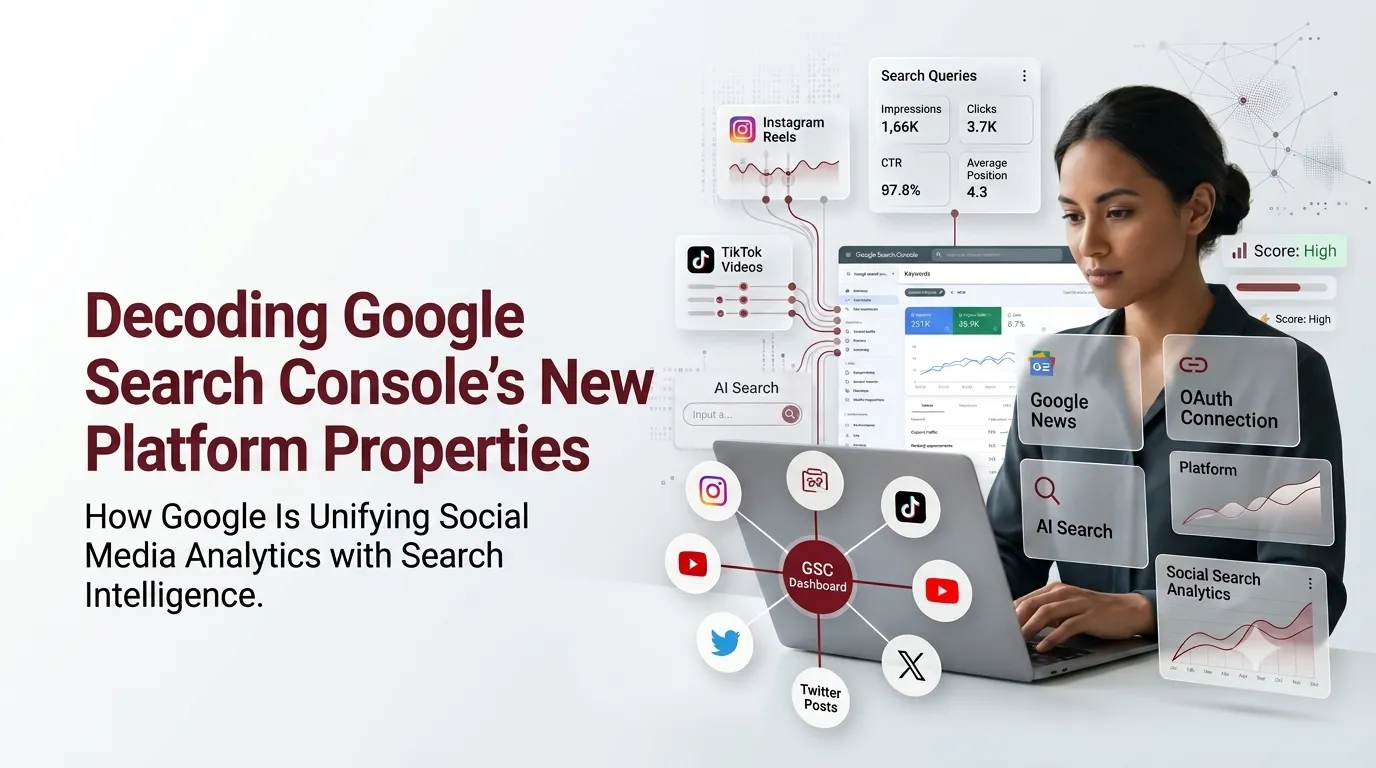
On July 7, 2026, that wall came down. Google launched Platform Properties in Google Search Console globally, and for the first time in the history of web search, brands and creators can link their Instagram, TikTok, X, and YouTube profiles directly to Search Console - no website required - and see exactly which Google search queries are surfacing their social content.
This is not a minor feature update. It is a structural shift in how organic search data is measured, and it has immediate implications for every brand that produces social content and cares about organic reach.
What Changed on July 7, 2026 — and Why It Matters Now
Before Platform Properties, Google Search Console was a tool for web properties only. When someone searched "how to layer skincare serums" and clicked through to your website article, GSC recorded the query, the impression, the click, and the position. When the same person searched the same query and clicked your Instagram Reel in the Google video carousel, that data disappeared entirely. You knew you got a view; you had no idea it came from a Google search for that specific term.
Platform Properties close that measurement gap. Traditional domain properties still manage your website, subdomains, and online store through DNS verification. Platform Properties sit alongside them as a separate property type, authenticated through OAuth, tracking your social content's organic search performance across Google Search, Google Discover, and Google News.
The commercial implications are immediate. Your TikTok videos, Instagram Reels, X threads, and YouTube Shorts may already be ranking for high-intent commercial queries that your SEO team has no visibility into. Platform Properties makes that invisible traffic visible - and therefore actionable.
Suggested reading:What AI Visibility Means for Brands in 2026
What Are GSC Platform Properties?
Platform Properties are a new property type within Google Search Console that extends search performance measurement beyond your website to your social media profiles. Where a traditional domain property requires DNS verification to prove website ownership, a Platform Property requires only OAuth authorisation - logging into the social account you want to connect takes under two minutes.
Once connected, the property works on the same reporting logic as a web property: Google surfaces the search queries that generated impressions for your social content, the number of clicks those queries produced, the resulting CTR, and the average ranking position your social content held on the relevant Google surfaces.
The key distinction is the scope. A web property measures your website pages. A Platform Property measures your social content - individual posts, videos, Reels, Shorts, threads - as they appear in Google Search results, Discover feeds, and Google News. They are separate properties in your GSC account, with separate data, and they can run in parallel without any conflict.
The Four Platforms Supported at Launch
Google's initial rollout covers four platforms, each with a defined scope of what content within the platform is tracked.
- Instagram: Profile pages, Feed posts, Reels, and Stories that Google has indexed and is surfacing in search or Discover.
- TikTok: Creator profile pages and individual public video posts.
- X (formerly Twitter): Profile pages, individual tweets, and long thread posts.
- YouTube: Full channel pages, long-form videos, YouTube Shorts, and playlists.
Facebook and LinkedIn are not included in the initial rollout, which is a notable absence given their scale. Google's documentation explicitly references additional partner integrations in later phases, suggesting the platform list will expand. For now, if your brand's social presence is concentrated on Facebook or LinkedIn, you will need to rely on referral data in GA4 and platform-native analytics for Google-referred traffic attribution.
What Metrics You Actually Get
After OAuth connection, Google processes an initial data backlog - allow 24 to 72 hours before the Performance Report begins populating. Once live, Platform Properties surface three reporting dimensions.
The Performance Report - social edition
This is the core report and the one with the most strategic value. It shows the precise Google search queries that generated visibility for your social content across three Google surfaces: Search, Discover, and Google News. For each query you see:
- Impressions: How many times your TikTok video, Instagram Reel, or YouTube Short appeared in a Google result for that query.
- Clicks: How many times a Google user clicked your social content from that result.
- CTR: The click-through rate for your social content on that query, comparable to your web pages' CTR in the standard Performance Report.
- Average Position: Where your social content ranks on that query relative to other results - including both web pages and other social content from competitors.
The Insights Overview
A higher-level summary report that aggregates trends across your connected social profiles. It highlights your best-performing content formats (short-form video versus long-form, Reels versus Feed posts), growth rate over time, and demographic breakdowns by country and device. Useful for quarterly reviews and reporting to stakeholders who need the picture at a channel level rather than a query level.
Click-Based Milestones
Automated alerts that fire when your social content crosses click thresholds via Google organic traffic within a rolling 28-day window. These function as early-warning signals for content that is gaining Google traction - useful for identifying videos or posts worth doubling down on with additional promotion or a dedicated landing page before the momentum peaks.
Suggested reading:Ranking Is Not Enough: How AI Overlooks Traditional SEO
How to Connect a Platform Property in Google Search Console
The setup process is deliberately simple and takes under two minutes per platform.
- Log into Google Search Console with the Google account that manages your brand's GSC access.
- Click Add property in the left-hand property selector.
- Select Platform property as the property type (distinct from URL prefix or Domain).
- Choose your platform from the available options and click through to OAuth authorisation.
- Log into the social media account you want to connect and grant Search Console read access.
- The property will appear in your GSC dashboard. Wait 24 to 72 hours for the initial data processing before the Performance Report becomes active.
You can connect multiple platforms simultaneously, each as a separate property. If your brand runs multiple Instagram accounts (for example, a main brand account and a regional account), each will need its own Platform Property connection.
Three Real-World Scenarios That Change Commercial Strategy
The practical impact of Platform Properties is best understood through the type of decisions it enables - decisions that were previously impossible because the underlying data did not exist.
Scenario A: The skincare brand discovers hidden commercial intent
A D2C skincare brand posts a 30-second TikTok explaining how to layer niacinamide and BHA serums. On TikTok's native dashboard, the video performs adequately: 25,000 native views, reasonable completion rate, a few hundred saves.
Platform Properties tells a different story. The video generated 45,000 Google Search impressions and 3,800 clicks on queries like "can I use niacinamide with BHA serum morning or night" - a phrase with strong commercial intent that signals a buyer close to a product decision. The brand's website had no page targeting this query. That gap is now a concrete brief for a landing page that intercepts the same Google traffic and gives it somewhere to convert.
This is the core value of the tool: converting what looked like organic social performance into evidence-based content strategy and ecommerce conversion opportunities.
Scenario B: The B2B SaaS firm and the evergreen X thread
A B2B SaaS company publishes an educational thread on X explaining how to audit cloud security compliance. The thread gets strong engagement in the first 48 hours, then fades from the platform's feed as newer content takes over.
Platform Properties shows that the thread continues to receive 1,200 clicks per week through Google Search, driven by enterprise IT directors searching operational queries months after the original post. Rather than leaving it to age passively, the team pins the thread, refreshes its resource links, and repurposes the full outline into a gated PDF lead magnet targeting the same search queries. An asset that would have been archived becomes a durable traffic and lead generation source.
Scenario C: The YouTube Shorts versus long-form split
A technology review publication posts both a 10-minute long-form review and a 60-second YouTube Short about the same laptop model. Their expectation is that the long-form video will dominate on depth queries and the Short will capture casual interest.
Platform Properties surfaces a more nuanced picture. The long-form video ranks well for broad queries like "Laptop X review." But the Short outranks it on specific long-tail queries like "does Laptop X thermal throttle when editing 4K videos" - exactly the kind of decision-critical questions that a buyer near purchase is asking. The publication restructures its content workflow: Shorts are now planned specifically to address the long-tail, high-intent queries that keyword research and Platform Properties data identify together.
What Platform Properties Does NOT Track
The distinction between Platform Properties data and native platform analytics is important to understand clearly, both to set internal expectations and to avoid misinterpreting reports.
| Metric or Dimension | GSC Platform Properties | Native Platform Analytics |
|---|---|---|
| Search queries from Google | ✅ Fully tracked | ❌ Not provided |
| Google Discover impressions | ✅ Fully tracked | ❌ Blended into "External" |
| In-app feed views (FYP, IG Feed) | ❌ Not tracked | ✅ Fully tracked |
| Watch time and audience retention | ❌ Not tracked | ✅ Fully tracked |
| Likes, comments, shares, saves | ❌ Not tracked | ✅ Fully tracked |
| Paid ad traffic performance | ❌ Not tracked | ✅ Fully tracked |
The clearest mental model: Search Console tells you how Google users find your social content. Native platform analytics tell you what those users do once they get there. Both are necessary; neither replaces the other. The value of Platform Properties is specifically in the query-level data that native platforms have never provided - the specific words people typed into Google before your Reel or video appeared in their results.
Why Google Built This — and What It Signals About Search's Direction
Google Search in 2026 looks fundamentally different from what it was five years ago. The traditional ten blue links have been displaced across many query types by video carousels, Perspectives panels, short-form video feeds, social profile blocks, and AI-generated answer summaries. Social and video content is not supplementing organic search results - it is competing directly with web pages for the same positions.
This shift is supported by patterns in user behaviour that Google's own data captures. A substantial portion of younger users now start searches on TikTok or Instagram rather than Google. Search result pages that include video or social carousels generate meaningfully higher aggregate CTR than text-only results. Google Discover surfaces billions of impressions monthly, with short-form video among the fastest-growing content types in the feed.
By integrating social into Search Console, Google accomplishes two things simultaneously. It gives creators and brands a reason to keep producing quality content that Google can index - the data incentive to treat Google discoverability as a deliberate goal rather than an incidental outcome. And it begins positioning Search Console as the unified measurement layer for all organic Google traffic, regardless of where that content lives.
For brands with an AEO and GEO optimization strategy, this also has relevance: the social content that AI Overviews and generative search features are pulling into answers is now measurable in the same tool that tracks your web page citations. The full organic footprint - website and social together - becomes visible in one place.
How Oddtusk Is Already Using Platform Properties for Clients
At Oddtusk, we have run SEO, content engineering, and performance marketing as a unified system rather than separate channels. Platform Properties fits directly into that approach - it is the measurement infrastructure that makes social content a first-class input to content strategy and keyword research, rather than a parallel track that reports to a different team.
We integrated Platform Properties the day it launched, without waiting for industry commentary to catch up. Here is the four-stage framework we use to convert the data into commercial outcomes for clients.
Stage 1 - Map: unified multi-platform audit
We connect a client's website domain property alongside their Instagram, TikTok, YouTube, and X Platform Properties into a consolidated Search Console view. This gives us the client's complete organic search footprint - what Google is ranking across every surface they produce content on - rather than just the slice represented by their website. For most clients, this reveals significant Google search activity from their social content that was previously unmeasured and untouched.
Stage 2 - Analyze: query gap extraction
We pull the full query set from Platform Properties and cross-reference it against the client's existing website keyword coverage. Queries generating social impressions that are not addressed anywhere on the website are immediate content briefs. Queries where the social content is ranking above the website's own page for the same term flag a structural issue - the website page needs improvement, or the social content's metadata needs optimisation to drive traffic to the right destination. This is a form of content gap analysis that did not exist as a data-backed exercise before July 7.
Stage 3 - Optimize: social SERP metadata
Armed with the actual queries driving Google impressions, we update video titles, descriptions, and captions to reinforce the high-intent terms that GSC has confirmed are working. This is not keyword stuffing - it is intent alignment. If Google is already choosing to rank a Reel for "niacinamide and BHA layering order," the Reel's description should make that intent explicit and support it with the right entity context. The same principle that governs semantic SEO on web pages applies here.
Stage 4 - Scale: bridge pathways
When Platform Properties reveals social assets driving substantial Google search traffic, we build low-friction conversion points - landing pages, lead magnets, or email opt-ins - targeted at the exact queries generating that traffic. The goal is to convert a Google user who found a client's Reel or video in search results into a trackable lead or subscriber, rather than an unattributed view. This closes the loop between organic search reach and measurable commercial outcome in a way that was structurally impossible before Platform Properties existed.
Key Takeaways
- Platform Properties launched globally on July 7, 2026 and allows Instagram, TikTok, X, and YouTube profiles to be connected to Google Search Console via OAuth - no website or DNS verification required.
- The Performance Report is the core value: For the first time, you can see exactly which Google search queries are surfacing your social content, how many impressions and clicks those queries generate, and what position your social content holds in Google results.
- GSC data and native analytics are complementary, not competing: Search Console tells you how Google users find your social content; platform-native analytics (TikTok Studio, Instagram Insights, YouTube Studio) tell you what those users do once they arrive.
- Query data is a content brief: High-intent queries surfacing your social content but absent from your website are immediate, evidence-backed briefs for new landing pages, blog posts, or service pages. Our content gap analysis process now incorporates Platform Properties data as a standard input.
- Social metadata deserves the same intent alignment as web page titles: Video titles, descriptions, and captions should reflect the specific search queries GSC confirms are driving Google impressions for your content.
- Bridge pathways convert search traffic from social content: Build conversion points - landing pages, lead magnets - that match the intent of the Google queries driving traffic to your social content, so that reach translates into measurable commercial outcomes.
- Facebook and LinkedIn are not yet supported: If your brand's social presence is primarily on those platforms, continue relying on GA4 referral data and native analytics for Google-referred traffic attribution until Google announces additional integrations.
- Connect all relevant accounts now: Earlier connection means a longer historical data window. Platform Properties data does not backfill beyond the connection date, so delay in connecting means delay in having enough data to act on.
[ Common questions ]
GSC Platform Properties FAQs
Platform Properties are a feature launched by Google on July 7, 2026 that allows brands and creators to connect their social media profiles — Instagram, TikTok, X, and YouTube — to Google Search Console as standalone properties. Unlike traditional domain properties that require DNS verification, Platform Properties are authenticated via OAuth and track how your social content performs in Google Search, Discover, and Google News: which queries surface it, how many impressions it generates, how many clicks it receives, and its average ranking position.
At launch, the four supported platforms are Instagram (profile pages, Feed posts, Reels, and Stories), TikTok (creator profiles and individual public videos), X formerly Twitter (profile pages, individual tweets, and thread posts), and YouTube (channel pages, long-form videos, YouTube Shorts, and playlists). Facebook and LinkedIn are not included in the initial rollout. Google's documentation indicates additional platform integrations are planned for subsequent phases.
No. Platform Properties do not require a website, domain verification code, or DNS record. You authenticate using OAuth by logging into the social media account you want to connect. This means creators and brands without a traditional web presence can access Google Search data for their social content directly through Search Console for the first time.
Platform Properties surface three reporting areas. The Performance Report shows search queries that generated impressions and clicks for your social content across Google Search, Discover, and News — including impressions, clicks, CTR, and average ranking position. The Insights Overview provides high-level trend data on best-performing formats, growth rate, and geographic and device breakdowns. Click-Based Milestones deliver alerts when social content crosses click thresholds in a rolling 28-day window.
Platform Properties only track how Google users find your social content through Google Search, Discover, and News. They do not track in-app feed performance such as TikTok For You Page views or Instagram Feed impressions, watch time, audience retention, likes, comments, shares, saves, or paid ad performance. For those metrics you still need each platform's native analytics - TikTok Studio, Instagram Insights, YouTube Studio, or X Analytics.
Native platform analytics show you what happens after someone finds your content inside the app — views, retention, engagement, and follower growth. Platform Properties show you how Google users find your social content from outside the app — the specific search queries they typed, the Google surface they found it on, and the resulting click behaviour. The two data sets are complementary: native analytics tell you how content performs once found; GSC tells you what search demand drove Google users to it.
Google's search results have moved well beyond traditional blue links. Video carousels, Perspectives panels, short-form video feeds, and social profile blocks now appear across many result pages. Social and video content is already indexed and ranked by Google - Platform Properties gives creators the data to see how that content is performing in search. It also incentivises creators to continue producing content that Google can index, reinforcing the quality of Google's own results.
Go to Google Search Console, click 'Add property', and select 'Platform property' as the property type. Choose your platform and authorise access using OAuth by logging into the relevant social account. The process takes under two minutes. After connection, allow 24 to 72 hours for the initial data processing before your Performance Report begins showing search query data.
Yes - this is one of its most valuable applications. When GSC shows that a TikTok video or Instagram Reel is generating thousands of Google impressions for a high-intent commercial query, that query is validated by real search demand. If your website has no page targeting it, you have a concrete, data-backed brief for a new landing page or blog post. Platform Properties converts your social content performance into a content gap signal for your website SEO strategy.
Use the search queries from your Performance Report to guide metadata optimisation. Update video titles and descriptions to naturally reflect the high-intent phrases already generating Google impressions for your content. For YouTube, ensure captions and chapter titles match the long-tail queries GSC surfaces. For Instagram and TikTok, the first line of the caption carries the most weight for Google indexing. Apply the same intent-matching discipline you would use for a web page title tag and meta description.
A bridge pathway is a low-friction conversion point that captures Google users who arrive at your social content through search. Because Platform Properties reveals the exact queries driving that traffic, you can build landing pages, lead magnets, or email opt-ins directly relevant to those queries. This converts a Google search visit to a social asset into a trackable lead rather than an unattributed view - closing the loop between organic search reach and measurable commercial outcome.
Connecting Platform Properties does not directly change how Google ranks your social content - it is a measurement tool, not a ranking intervention. However, the data it surfaces allows you to make changes that do affect ranking: optimising video metadata to align with confirmed queries, producing more content on topics where social posts demonstrate strong Google demand, and building engagement signals that correlate with sustained search visibility. The data is the lever; your actions on it determine the outcome.
