
73% of Odisha students want to learn AI tools but only 12% use them. Discover the careers being transformed by AI and how to close the gap.
How LLMs Handle Ambiguity, Sarcasm and Context in Text
Date: 10 - 05 - 2026
Time to read: 7 minutes

Subscribe to our newsletter
[ Related Posts ]
Read article
Read article

How AI is changing what appears in local search results and what businesses can do to stay visible in an AI-personalized world.
Let's Talk
Ready to build content that AI can understand, cite, and recommend? We can help.
Get in touch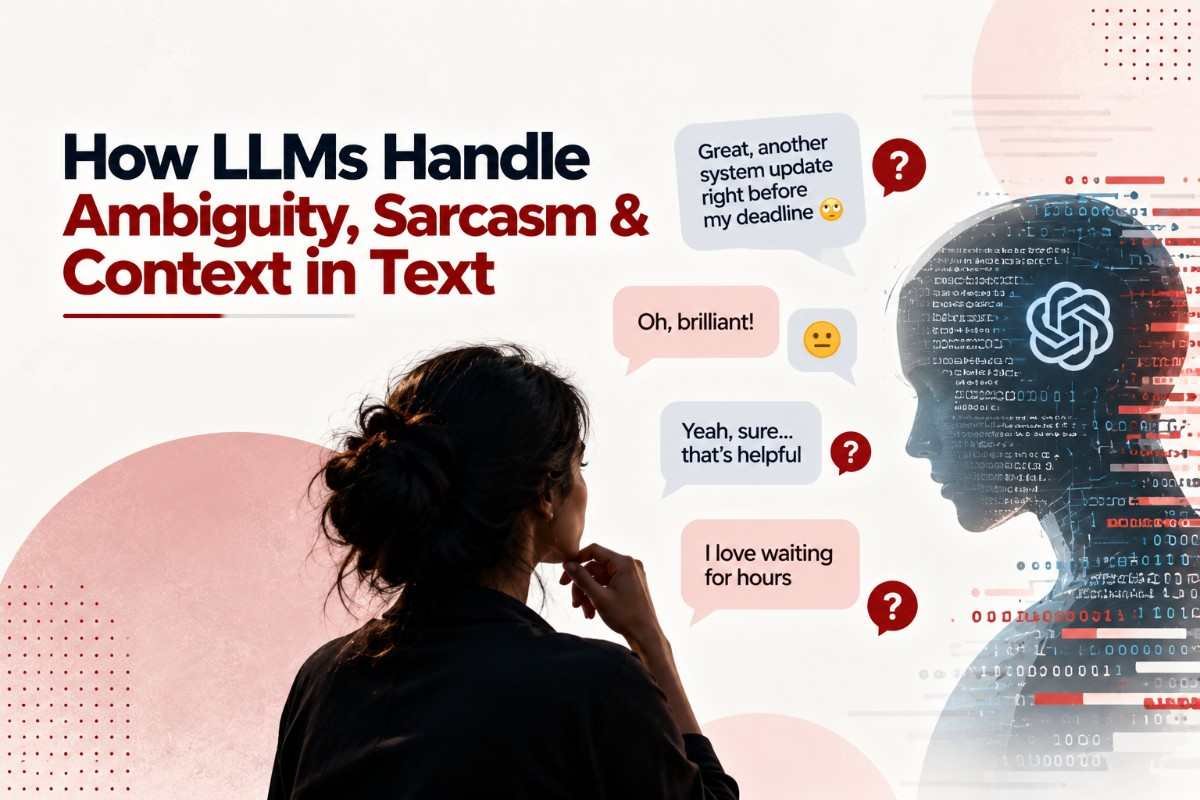
[ Table of Content ]
Have you ever sent a sarcastic text message and watched the recipient take it completely literally? If humans, socially tuned over millions of years of evolution, still misread subtext, consider how difficult that same challenge is for artificial intelligence. Large Language Models have transformed how we interact with technology. But underneath their fluent prose, these systems are working through the complicated and non-linear nature of human speech using mathematics rather than lived experience.
Exploring how LLMs handle ambiguity is more than a technical question. It is where the future of genuinely human-feeling AI communication lives. A customer service bot that reads "Oh, brilliant!" as a compliment when the customer is furious. A model that misses a subtle metaphor in a legal brief. The gap between a word's literal meaning and its intended meaning is exactly where today's models both shine and fail.
Here we take a closer look at the inner workings of AI language understanding and why LLM text interpretation remains one of the most fascinating and consequential problems in modern computer science. As AI skills are transforming careers across every sector, understanding where AI language comprehension succeeds and where it breaks down matters for anyone building with or communicating through these systems.
Suggested reading:How AI and Digital Skills Will Shape Careers in Odisha
The Mechanics of Context: How AI Reads Between the Lines
We cannot think of AI as reading text the way humans do. A model has no gut feeling for a sentence. It depends on highly complex mathematical architectures. At the heart of AI contextual understanding is the Transformer architecture, specifically the Attention Mechanism.
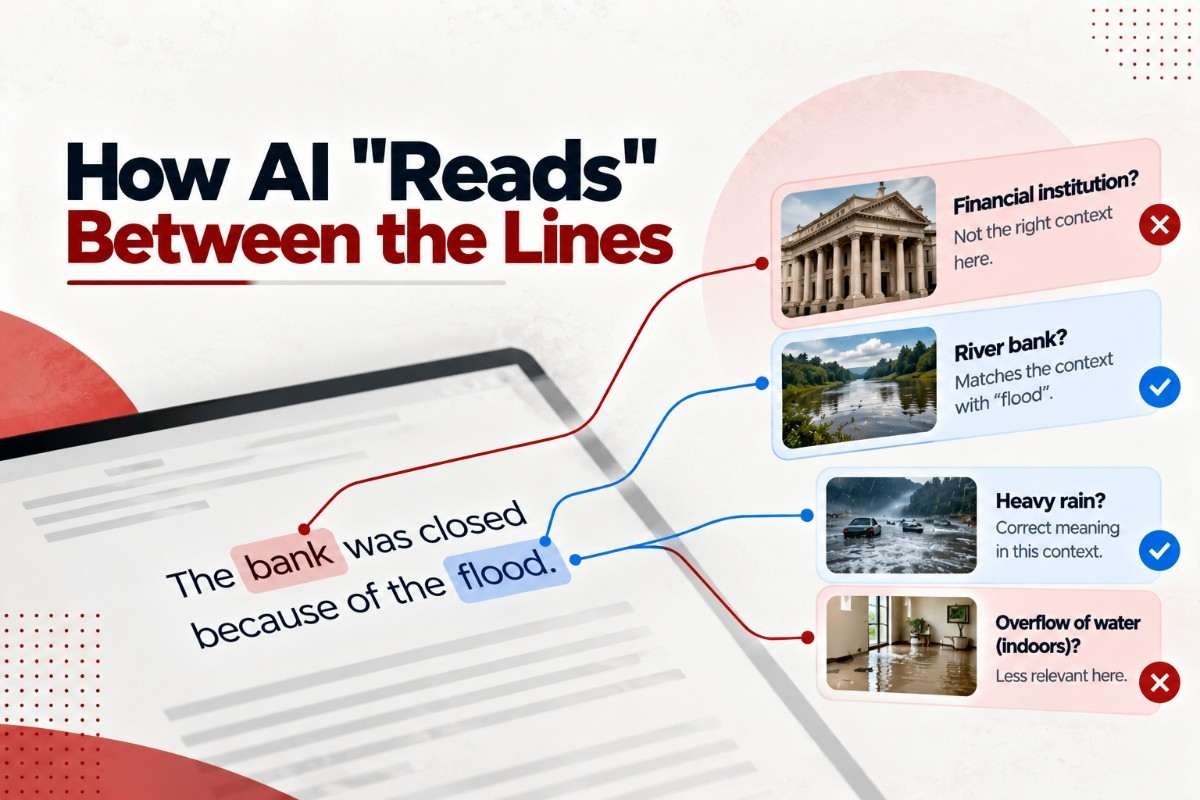
This method enables a model to assign different weights to different words in a sentence depending on the task at hand. For example, in the sentence "The bank was closed because of the flood," the model checks the word "flood" and uses it to establish that "bank" in this sentence refers to a riverbank, not a financial institution. By constructing these semantic connections, the AI builds a meaning map that goes well beyond simple word definitions.
How Attention Works
The attention mechanism does not read words in isolation. It asks, for every word in a sentence, how much should every other word influence my interpretation of this one? That dynamic weighting is what separates modern LLMs from earlier rule-based NLP systems.
The Role of Vector Embeddings
- Semantic Proximity: LLMs map words to high-dimensional vectors. Words that appear in similar contexts during training end up mathematically closer to each other in that space, allowing the model to detect meaning relationships that were never explicitly programmed in.
- Tokenization: The process of splitting text into tokens allows models to understand sub-word relationships, a critical part of LLM language interpretation for technical, compound, or unfamiliar terms that the model may not have encountered in full form.
- Bidirectional Processing: Modern models can process text forward and backward simultaneously, using the second half of a sentence to clarify what the first half means before producing any output.
The Sarcasm Problem: Why AI Still Struggles with Irony
Sarcasm is probably the final boss of LLM language interpretation. At its core, sarcasm is a linguistic device where the intended meaning is the exact opposite of the literal words being used. "What a great day to have a flat tyre" means the opposite of what it says, and every fluent speaker knows it instantly.
Because LLMs are trained on enormous corpora of largely factual and descriptive text, they tend to fall back on the literal polarity of a word. A user who writes "Great, another system update right before my deadline" may receive a response that zeroes in on the word "great" and interprets the sentiment as positive. The model lacks the world knowledge to recognise that software updates arriving at inconvenient times are reliably frustrating rather than welcome. This gap between a positive word and a negative situation is precisely where LLM ambiguity handling breaks down unless the model has been specifically fine-tuned for irony detection.
Why Sarcasm Is Hard for Models
- Missing Cues: AI cannot hear tone of voice or observe a raised eyebrow. Research suggests that more than 70% of sarcastic communication in human conversation relies on non-verbal signals that are entirely absent in text.
- Cultural Nuance: Sarcasm is highly localised. A phrase that reads as obvious irony in one cultural context can be read as a sincere statement in another. Models trained predominantly on one language or culture carry those biases into every language they subsequently handle.
- Pattern Over Emotion: LLMs select the statistically most probable next word based on what they have seen in training data, not based on emotional resonance or lived experience. When sarcasm is underrepresented in training data, the model learns to ignore the signals that would otherwise flag it.
Semantic Cues and the Ambiguity Trap
Ambiguity in language is a feature, not a flaw. It is what makes language brief, poetic, and efficient. For LLM language interpretation, however, it introduces a significant source of entropy -- uncertainty that must be resolved before the model can produce a coherent response. Two major types of ambiguity that every model must navigate are:
- Lexical Ambiguity: When a single word carries multiple distinct meanings. "Crane" can be a long-necked bird or a piece of construction equipment. "Pitch" can be a musical note, a sports field, a sales presentation, or the act of throwing a ball. The model must decide which meaning fits the context before it can proceed.
- Syntactic Ambiguity: When sentence structure allows more than one valid grammatical reading. "I saw the man with the telescope" is syntactically ambiguous: either I used a telescope to see the man, or the man I saw was carrying a telescope. Both readings are grammatically correct, and resolving them requires broader contextual inference.
To improve LLM ambiguity resolution, developers apply Chain-of-Thought (CoT) prompting. This technique instructs the model to walk through its reasoning step by step before committing to an answer. By externalising its intermediate logic, the model is more likely to catch a misreading in its AI context understanding before it propagates into the final output. CoT has been shown to substantially reduce confident errors on tasks that require disambiguation or multi-step inference, which is one reason it has become a standard technique in modern digital marketing AI tools and enterprise language applications.
The Ambiguity Insight
Chain-of-Thought prompting does not make models smarter. It makes them more careful. By requiring the model to show its reasoning, it creates a checkpoint where errors in interpretation are more likely to surface before they become confident wrong answers.
Why Models Get It Wrong: The Limits of Text-Only Learning
Even with billions of parameters, LLMs are fundamentally advanced pattern-matching systems. Their language comprehension is bounded by text-only training. A human child learns the word "apple" by seeing, touching, smelling, and tasting a real apple alongside hearing the word. The word becomes anchored in multisensory experience.
An LLM, by contrast, knows only that "apple" appears frequently near "fruit," "tech," "cider," and "orchard" in text. There is no physical referent. This absence of grounding means that when a sentence relies on physical logic, bodily experience, or rare situational irony, AI context understanding can break down entirely, producing hallucinations or confidently stated incorrect interpretations. Good SEO strategy for content designed to surface in AI-generated answers must account for this: the clearer and less ambiguous a piece of content is, the more reliably an LLM can extract and cite it accurately.

Common Failure Points
- Long-Range Dependencies: If the contextual signal that resolves an ambiguous word was established 2,000 tokens earlier in a document, the model may no longer treat it as relevant. Attention has limits, and distant context is discounted over long passages.
- Over-Smoothing: Models calibrated to be helpful and agreeable sometimes get trapped following a sarcastic or incorrect premise offered by the user, producing factual errors by agreeing with a setup that was never meant seriously.
- Domain Mismatch: A model trained heavily on legal documents may struggle with the casual register and slang ambiguity found in social media threads. The statistical patterns that resolve ambiguity in one domain do not always transfer cleanly to another.
Key Takeaways
- Context is Everything: LLMs use the attention mechanism to weight semantically important words against each other. This is the core of how AI understands context and why longer, richer context windows generally produce better disambiguation.
- The Sarcasm Gap: AI finds sarcasm difficult because it cannot physically ground language and relies on literal word meanings. Without tone, expression, or shared situational knowledge, irony is a statistical guessing game.
- Ambiguity Handling: To improve LLM ambiguity resolution, reasoning-style instructions are generally required, forcing the model to justify its interpretation before committing to it.
- The Tone Problem: Because LLMs receive only text, their language interpretation is a statistical approximation of human sentiment rather than a genuine reading of emotional intent.
- Future Growth: The next generation of AI will be multimodal, able to process images, audio, and text together, which will substantially reduce the interpretation errors that text-only training currently produces.
Conclusion: The Path Toward Truly Fluent AI
As AI models become more sophisticated, the emphasis is shifting from simply generating text to genuinely interpreting intent. Making LLM ambiguity handling more robust is central to building AI that can serve as a real collaborator rather than a search tool with a confident writing style. Through techniques like Reinforcement Learning from Human Feedback (RLHF) and multimodal training that combines text with images and audio, researchers are gradually teaching machines to understand the meaning behind statements rather than just the statistics of their words.
At Oddtusk, we believe the future of digital communication sits at the intersection of technology and human nuance. Just as LLMs are working toward more reliable AI context understanding, our work is grounded in reading the semantic cues that matter in every industry we serve. Whether that means navigating the complexities of LLM language interpretation in content strategy or building tools that connect data with human experience, the real intent should never be lost in translation. If you want to build a content and SEO strategy designed for a world where AI decides what gets cited, we would like to help. Get in touch.
[ Common questions ]
LLM Ambiguity and Sarcasm FAQs
LLM ambiguity refers to the difficulty large language models have when a word, phrase, or sentence carries more than one plausible meaning. Because human language is naturally imprecise, models must make probabilistic decisions about what a sentence most likely means rather than knowing it with certainty. This matters because errors in ambiguity resolution lead to incorrect answers, misclassified sentiment, and confidently wrong outputs. Improving how LLMs handle ambiguity is one of the core challenges in making AI a reliable communication partner.
The transformer attention mechanism allows a model to weigh the importance of every word relative to every other word rather than reading text left to right in a fixed sequence. When a model encounters an ambiguous word like "bank," it checks surrounding words for the strongest signal: "flood" or "river" pull interpretation toward a riverbank, while "loan" or "mortgage" pull it toward finance. This dynamic reweighting is how attention gives LLMs their ability to resolve many common forms of lexical ambiguity, though the quality of resolution still depends on training data consistency.
AI models struggle with sarcasm because it depends on a gap between the literal meaning of words and their intended meaning, a gap that human listeners close using tone of voice, shared cultural knowledge, and real-world context. LLMs process text only and rely on statistical patterns from training. When a phrase like "Oh great, another delay" appears in data, it may cluster near other positive uses of "great," pulling the model toward a positive sentiment reading. Without audio cues, situational awareness, or cultural grounding, the model must guess, and it guesses wrong more often than a human would.
Lexical ambiguity arises when a single word has more than one meaning: "crane" can be a bird or a construction machine. Syntactic ambiguity arises when the grammatical structure of a sentence permits more than one valid reading: "I saw the man with the telescope" is ambiguous about who held the telescope. Both types create distinct challenges for LLM language interpretation. Lexical ambiguity is often resolvable through nearby context words; syntactic ambiguity sometimes requires understanding the broader intent or scene behind the sentence, which text alone rarely supplies with certainty.
Chain-of-Thought prompting instructs a language model to reason through a problem step by step rather than jumping directly to a conclusion. By making intermediate reasoning visible, the model is more likely to catch logical inconsistencies before committing to an interpretation. In the context of LLM ambiguity handling, CoT helps because it forces the model to consider multiple interpretations, evaluate which one fits the context best, and articulate its reasoning. Research has shown that CoT significantly reduces confident errors on tasks requiring multi-step inference or disambiguation, making it a standard technique in enterprise AI deployments.
LLMs hallucinate or produce incorrect interpretations because they are pattern-completion systems trained on text, not reasoning systems grounded in the physical world. When a sentence depends on physical logic or rare situational irony that appeared infrequently in training data, the model fills the gap with the statistically most likely continuation rather than a reasoned answer. Over-smoothing is another contributing factor: models calibrated to be agreeable sometimes follow a user's mistaken premise rather than correcting it. Long-range dependencies also cause failures when key context was established thousands of tokens earlier and is no longer weighted heavily in the attention window.
Vector embeddings are numerical representations of words and phrases in a high-dimensional mathematical space. Words that appear in similar contexts during training end up positioned close to each other in that space, so "ocean" and "sea" are mathematically near each other while "ocean" and "spreadsheet" are far apart. This semantic proximity is what allows LLMs to detect meaning relationships even when words do not appear together in the specific sentence being processed. Tokenization extends this further by splitting words into sub-word units, helping models handle compound terms, technical vocabulary, and morphological variations they may not have seen in full form during training.
The future of LLM context understanding lies in multimodal training and stronger grounding in real-world signals. Next-generation models are being trained on combinations of text, images, audio, and video, meaning they can learn that sarcasm often pairs with a certain tone, that "hot" in a cooking context differs from "hot" in a weather context, and that ambiguous sentences frequently carry visual cues that resolve the meaning. Reinforcement Learning from Human Feedback is also improving how models handle edge cases by training them on human corrections. Together, these developments are narrowing the gap between how AI reads language and how humans actually use it.
