A step-by-step local SEO guide for businesses in Bhubaneswar to improve Google Maps visibility and attract more local customers.
Local SEO and AI: How Machine Learning Is Personalizing Location-Based Results
Date: 10 - 05 - 2026
Time to read: 9 minutes

Subscribe to our newsletter
[ Related Posts ]
Read article
Read article
How Google uses knowledge graphs and entity recognition to understand what your content is really about.
[ Table of Content ]
How AI Has Changed the Way Local Search Works
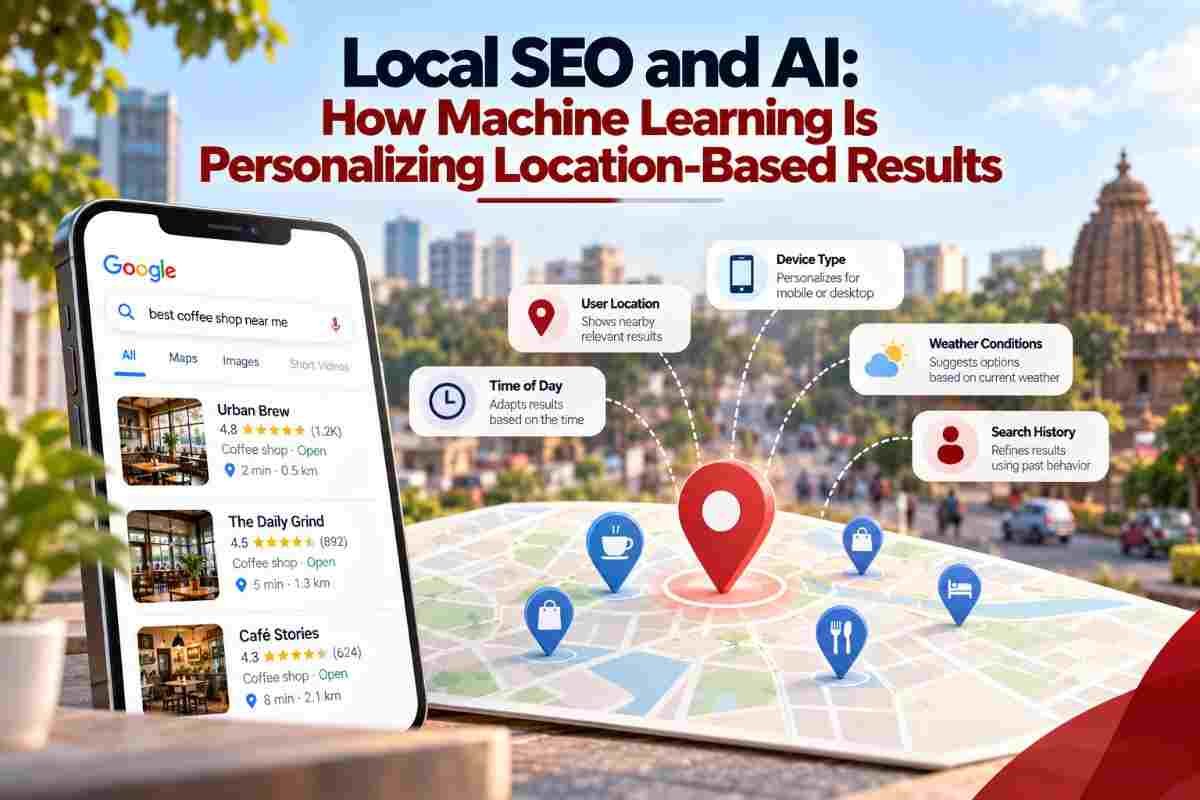
When someone searches for "coffee shop near me," two people standing a few blocks apart can get completely different results. One sees a specialty cafe that opened last month. The other sees a chain with strong review signals. Neither result is random. Both are the outcome of AI deciding, in real time, which business is the most relevant match for that specific person at that specific moment.
This is the new reality of local SEO in 2026. Machine learning has moved local search far beyond simple directory listings. Google now considers your location, the time of day, your device, your search history, current conditions like traffic or weather, and the intent behind your words, all at once, before showing you a single result.
For local businesses, this shift is significant. A profile that was good enough two years ago may no longer be enough to show up in the right moment for the right customer. The good news is that AI is also making things fairer. A small, well-optimized business can now outperform a larger competitor if its data is fresher, more specific, and better matched to what people are actually searching for.
Key Insight
AI does not just rank businesses. It matches them to people. The more clearly and completely you describe what you offer, the more confidently AI can choose you as the right answer.
From Keywords to Context: What AI Now Evaluates
Traditional local SEO focused on three things: your Google Business Profile, correct NAP (Name, Address, Phone) data, and star ratings. Those things still matter, but they are now just the starting point. AI evaluates a much richer set of signals:
- Conversational intent. Queries like "family-friendly pizza place open late near the park" are now interpreted precisely. AI breaks down each element of that phrase and tries to find a business that matches all of it.
- Behavioral context. If someone tends to search for upscale restaurants, the algorithm accounts for that preference even in a generic search.
- Temporal signals. A search for "breakfast near me" at 7 a.m. produces different results than the same search at 11 a.m.
- Entity relationships. AI connects your business to nearby landmarks, neighborhoods, and known features. A coffee shop that is consistently mentioned near "the financial district" builds that association over time.
- Review specificity and recency. A review from last week that mentions "great vegan options" tells AI something very specific about your business. A review from two years ago that says "good food" tells it much less.
This is why entity-based SEO and local SEO are becoming the same conversation. Google is trying to understand your business as a real-world entity, not just as a listing on a page. If you want to understand how this works at a deeper level, our guide to entity SEO walks through the full framework.
How AI Personalizes Location-Based Results
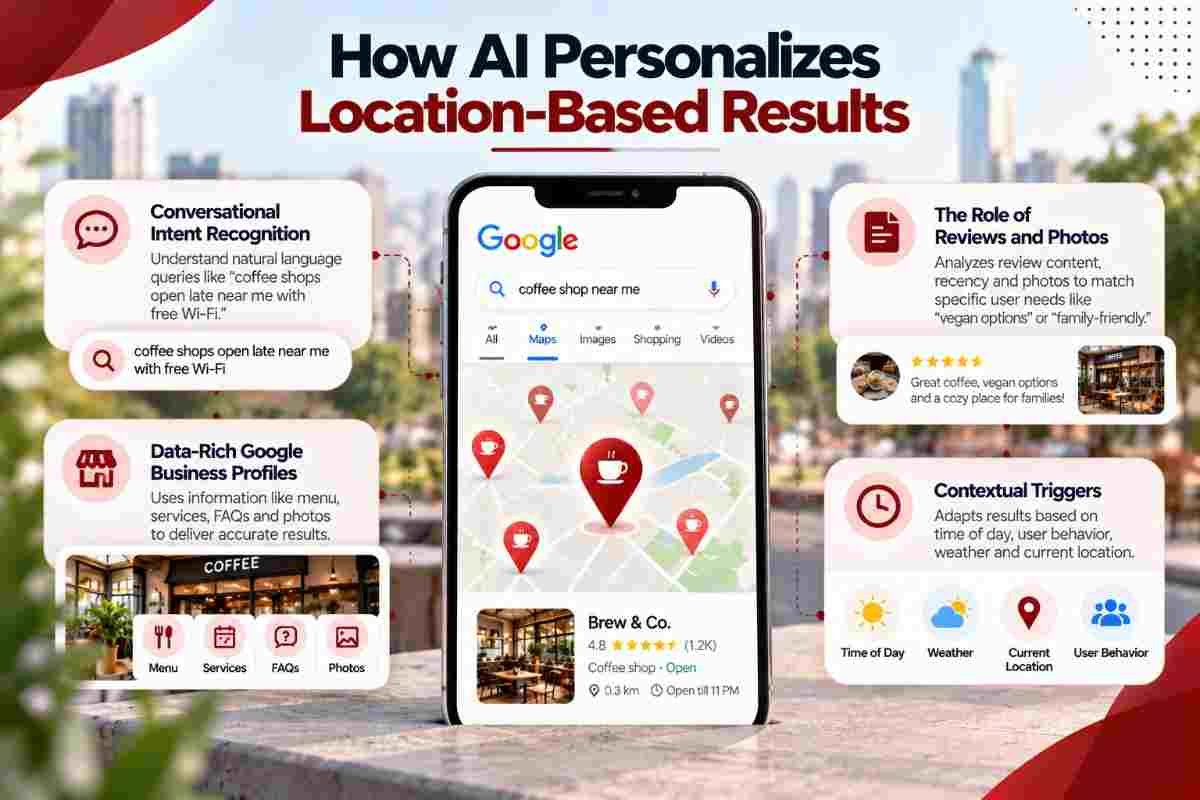
Personalization in local search is not a single feature. It is the combined output of several AI systems working at the same time. Here is how each one shapes what your potential customers see.
1. Conversational Intent Recognition
Search queries have become much more specific. People no longer type "dentist." They type "dentist that takes walk-in appointments near me open Saturday morning." AI has been trained on billions of these natural-language queries and now understands the components: service type, availability, proximity, and timing.
Businesses that publish this kind of information explicitly, in their Google Business Profile, on their website, and in their review responses, are the ones AI can confidently recommend. If your profile does not say you take walk-ins, you simply will not appear for that search, even if you do.
2. Data-Rich Google Business Profiles
Your Google Business Profile (GBP) has become your most important local SEO asset. It is no longer just a contact card. AI retrieves structured data from your GBP to answer user questions directly on the search results page, often without the user ever visiting your website.
A complete GBP includes accurate category tags, updated service lists, seasonal hours, a menu or pricing section where relevant, uploaded photos with descriptive filenames, answers to the Q&A section, and responses to recent reviews. Every field you fill in is a data point that AI can use to match you to a search.
3. How AI Reads Reviews and Photos
Machine learning does not just count your reviews. It reads them. A restaurant with 200 reviews that frequently mention "outdoor seating" and "dog friendly" will surface for those searches, even if neither phrase appears anywhere on the restaurant's website. The words your customers use in reviews become part of your business profile in AI's understanding.
Photos are treated the same way. AI systems can now analyze images to identify whether a business has features like "outdoor dining," "wheelchair access," or "modern interior." Photos that show these features clearly help AI verify your attributes and rank you for related searches.
4. Contextual and Situational Triggers
Local search results are not static. They shift throughout the day. A search for "quick lunch" at noon favors fast-service options. The same person searching at 7 p.m. on a Friday might see results weighted toward sit-down restaurants with a relaxed atmosphere. AI adjusts these results based on time, day of week, and even seasonal patterns.
This means that showing up in local results is not just about having the most reviews or the highest rating overall. It is about being the right fit at the right moment. Businesses that keep their hours, service types, and attributes up to date give AI the information it needs to make that call correctly.
Why Local Businesses Need to Adapt Right Now
The gap between businesses that are optimized for AI-driven local search and those that are not is widening fast. A business with an outdated profile, no recent reviews, and inconsistent NAP data across directories is not just less visible. In some cases, AI actively deprioritizes it in favor of a competitor with cleaner, fresher data.
There is also an opportunity here that many small and mid-sized businesses are not yet taking advantage of. AI search levels the playing field in a meaningful way. A local specialty shop with a detailed, regularly updated profile can outrank a national chain if its data more precisely matches what the searcher is looking for.
The businesses winning in local search right now share a few traits. They treat their online presence as a live, ongoing asset rather than something they set up once. They respond to reviews. They upload fresh photos. They write content that answers real questions people in their area are asking. And they make sure every piece of information about their business is accurate and consistent everywhere it appears online.
Practical Local SEO Strategy for the AI Era
Below is what the most effective local businesses are doing right now to stay visible in AI-powered search. These are not one-time tasks. They are habits.
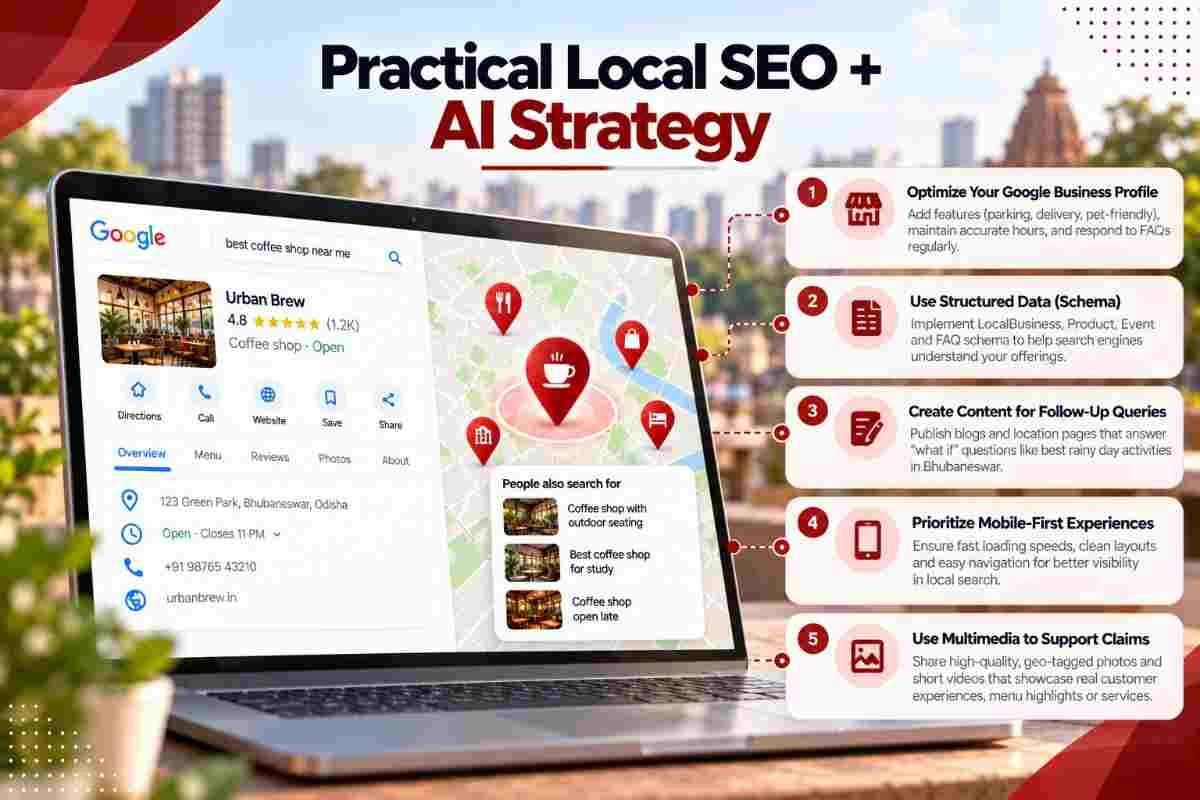
Keep Your Google Business Profile Current, Not Just Correct
Accuracy is the baseline. Freshness is the advantage. Update your hours whenever they change, including public holidays and seasonal adjustments. Add new services as you offer them. Upload photos from the last 30 days, not from when you first set up the profile. Answer every question in the Q&A section, both the ones customers have submitted and the ones AI generates automatically based on your profile.
Also make use of the attributes section. Features like "free Wi-Fi," "outdoor seating," "parking on site," "accepts credit cards," and "wheelchair accessible" all feed directly into AI's understanding of your business. The more attributes you confirm, the more searches you become eligible to appear in.
Add Schema Markup to Your Website
Schema markup is the technical layer that helps search engines read your website the way a human would. For local businesses, the most important schema types are:
- LocalBusiness schema with your full address, phone number, opening hours, and service area.
- FAQ schema for any question-and-answer content on your site, this feeds directly into AI Overviews and featured snippets.
- Event schema if you run workshops, pop-ups, or community events.
- Product or Service schema to describe what you offer in structured, machine-readable terms.
You do not need a developer to add schema. Plugins for most website platforms handle this automatically once you configure them. The point is to give AI a precise, structured description of your business rather than making it piece together details from unstructured text. Oddtusk's schema markup service handles the full implementation for local businesses if you want this done properly from the start.
Suggested reading:Schema SEO Power Moves: How Structured Data Wins in AI Search
Build a Steady Flow of Recent, Specific Reviews
The most common local SEO mistake is focusing on the total number of reviews rather than their recency and specificity. A business with 12 reviews from the past 60 days will often outperform one with 200 reviews from three years ago. AI treats review freshness as a proxy for how active and reliable a business is right now.
Encourage your customers to be specific. A review that says "great experience" gives AI very little. A review that says "the lunchtime buffet was excellent, and the staff was helpful with a nut allergy" gives AI several specific attributes to work with. You cannot write reviews for customers, but you can ask them to share the details that matter to others like them.
Respond to every review, both positive and negative. Your responses are read by AI and by potential customers. A business that engages thoughtfully with feedback signals that it is active, accountable, and trustworthy.
Create Location-Specific Content That Answers Real Questions
Generic location pages, the kind that say "We serve customers in [City Name]" and little else, no longer work. AI can detect boilerplate content and treats it as low value. What works instead is content that is genuinely useful to people in your specific area.
Think about the questions your customers actually ask before visiting you. "What is parking like?" "Do you have private rooms for events?" "Is your space good for remote workers?" Write short, clear answers to these questions on your website and in your GBP Q&A section. This kind of content matches the conversational queries AI is being asked to answer.
If you serve multiple neighborhoods or areas, create a dedicated page for each one that includes genuinely specific information: nearby landmarks, community events you participate in, local partnerships, or neighborhood-specific offerings. Pages that include real local detail perform significantly better than pages that simply mention a city name. Our guide on local SEO covers how to build these pages the right way.
Use Photos and Video to Verify Your Attributes
AI systems are increasingly able to analyze images to verify what a business offers. A photo of your outdoor seating area tells AI that you have outdoor seating. A photo of your accessible entrance confirms wheelchair access. A short video tour of your space gives AI visual evidence of your atmosphere and offerings.
Label your photos with descriptive filenames before uploading them. "coffee-shop-outdoor-patio-downtown.jpg" is far more informative than "IMG_4523.jpg." Add alt text on your website that describes what is shown. These small details add up to a clearer, more complete picture of your business that AI can use with confidence.
Keep Your NAP Data Consistent Everywhere
NAP stands for Name, Address, Phone number. If your business name appears as "Smith's Bakery" on Google, "Smiths Bakery" on Yelp, and "Smith Bakery and Cafe" on Facebook, AI treats those as three different businesses. Inconsistency creates confusion that directly hurts your local rankings.
Audit every directory where your business is listed: Google, Yelp, Bing Places, Apple Maps, Facebook, TripAdvisor, and any industry-specific directories. Make sure the name, address, phone number, and website URL are identical everywhere. Use the same abbreviations (or none) consistently. This is one of the highest-impact, lowest-cost local SEO improvements you can make. Our technical SEO audit includes a full NAP consistency check across all major directories.
Common Mistakes That Hurt Local Visibility
Understanding what not to do is just as valuable as knowing best practices. Here are the patterns that consistently hold businesses back in AI-driven local search.
Generic Location Pages
A page that says "We offer plumbing services in Austin, Texas" with no other specific local content is a missed opportunity. AI can identify thin, templated content. Every location page should include something that is genuinely unique: staff who grew up in that neighborhood, specific services that are popular locally, events or sponsorships in that area, or photos taken at that location.
Ignoring the GBP Q&A Section
The Questions and Answers section in your Google Business Profile is one of the most underused features in local SEO. Customers ask real questions there, and if you do not answer them, someone else might, or AI might generate an answer that does not represent your business accurately. Check and respond to your Q&A section regularly. Better yet, seed it yourself by submitting and answering the questions your customers ask most often in person.
Relying on Old Reviews
A large collection of reviews from two or three years ago is not the asset it looks like. AI weights recency heavily because it sees old reviews as a signal about what the business used to be, not what it is today. Build systems that make it easy for recent customers to leave a review. A follow-up email, a QR code near the exit, or a simple ask at checkout can be enough to generate a consistent flow of current feedback.
Inconsistent Business Data Across Platforms
As covered above, inconsistent NAP data confuses AI and suppresses your visibility. But inconsistency goes beyond the basics. If your GBP says you are open until 9 p.m. but your website says 8 p.m., AI has conflicting signals. If your menu on GBP is six months out of date, AI may send customers for items you no longer offer. Treat every platform where your business appears as part of the same data ecosystem, because for AI, it is.
What Is Coming Next in AI-Powered Local Search
Local search is not done evolving. The signals that matter most are shifting again, and businesses that understand where things are headed can prepare now rather than catch up later.
Conversational Maps and "Ask About This Place"
Google Maps is adding AI features that let users ask direct questions about a business and get answers generated from the business's data, reviews, and photos. A user can ask "Is this place good for a first date?" and get an AI-synthesized answer based on what other customers have said. Businesses with rich, specific review content and detailed GBP profiles will benefit most from this feature.
Zero-Click Local Search Is Growing
More and more local queries are being answered directly on the search results page. AI shows the business hours, menu, booking link, or answer to the question without the user needing to click through to a website. This is called zero-click search, and it is becoming the norm for simple local queries.
The response is not to fight this trend but to adapt to it. Make sure your GBP is so complete that AI can represent your business accurately in these direct answers. Focus on building brand recognition and trust signals so that when users do choose to visit a website or call, they choose yours.
Entity-First Indexing and What It Means for Local Businesses
AI is moving toward what is called entity-first indexing. Rather than crawling pages for keywords, it builds a profile of your business as a real-world entity: what you do, where you are, what you are known for, who your customers are, and how reliably your information can be trusted. Businesses that present a consistent, complete, well-documented entity profile across their GBP, website, and third-party platforms are the ones AI will recommend with confidence.
This connects directly to the principles of topical authority: the more completely and clearly you define who you are and what you offer, the more confidently AI can match you to the people searching for exactly that. Read our deeper breakdown of how topical authority works in 2026 for a full picture of this approach.
Multimodal Signals: Images, Video, and Voice
Local search is becoming more visual and more conversational at the same time. Voice searches like "find me a pet-friendly brunch spot near Koramangala" are being processed with the same precision as text searches. Images and short videos are being analyzed by AI to confirm business attributes. Businesses that invest in strong visual content and voice-search-friendly descriptions are building an advantage that will only grow over the next two to three years.
Suggested reading:What Is Answer Engine Optimization (AEO)? The Complete Guide
Conclusion: Local SEO in the Age of AI Is About Being Understood
The rules of local search have not been thrown out. They have been upgraded. The fundamentals still matter: your Google Business Profile, your NAP consistency, your reviews, and your website content. But the standard for what "good" looks like has risen significantly.
AI is now the gatekeeper between your business and your next customer. It is deciding, in real time, whether your business is the right answer to a specific question from a specific person in a specific place at a specific moment. The businesses that win that decision are not necessarily the biggest or the oldest. They are the most clearly understood.
Clear means your data is complete and consistent. Current means your information reflects your business today, not two years ago. Specific means you describe what makes your business right for the customer asking, not just that you exist. When all three of those are true, AI has what it needs to recommend you with confidence.
At Oddtusk, our approach to local marketing is built around making businesses legible to AI: entity-clear, data-rich, and continuously updated. We help local and regional businesses build the kind of presence that AI-powered search treats as trustworthy and recommendable. Our AEO and GEO optimization service is designed specifically for this new era of search, and our technical SEO audit can identify exactly where your current presence is falling short. If you are ready to stop relying on a profile you set up years ago and start building one that works for you every day, let's talk about what that looks like for your business.
[ Common questions ]
Local SEO and AI FAQs
AI personalizes local search results based on the user's location, time of day, device, past behavior, and current conditions. This means every search returns a result tailored to that specific person at that moment. Businesses need to keep their data fresh, earn recent reviews, and provide detailed, structured information so AI can match them to the right searches.
The most effective local SEO optimization tips right now are: keep your Google Business Profile fully updated, earn a steady flow of recent and specific reviews, add schema markup to your website, create location-specific content that answers real questions, make sure your NAP is identical everywhere online, and upload labelled photos and short videos showing what your business actually offers.
Google Business Profile is the primary data source AI uses to understand and represent your business. It pulls structured information directly from your GBP, including services, hours, photos, menus, FAQs, and reviews, to answer user queries on the search results page. A complete, regularly updated GBP increases your chances of appearing in the local pack, AI-generated answers, and Google Maps results.
AI evaluates reviews based on recency, keyword specificity, and volume. A business with recent reviews mentioning specific terms like "outdoor seating" or "vegan options" is more likely to appear when someone searches for those attributes. Older reviews carry less weight even in large numbers. AI also reads review sentiment and detail to verify business attributes that match user queries.
Zero-click local search happens when a user gets the answer they need directly from the search results page without clicking through to a website. This is increasingly common as AI generates answers directly from business data. Businesses should respond by making their GBP so complete that AI can represent them well in these direct answers. Focus on brand trust and the quality of information you publish, not just website traffic.
Schema markup adds structured, machine-readable data to your website that helps search engines understand exactly what your business does, where it is, and who it serves. For local SEO, the most useful schema types are LocalBusiness (with address, hours, and service area), FAQ (to capture question-based searches), and Event (for businesses running local events). Schema makes it easier for AI to match your business to specific user queries.
Entity-first indexing means Google prioritizes businesses it can recognize as well-defined, trustworthy entities connected to a location, a category, and a reputation. Instead of just crawling pages for keywords, Google builds a profile of your business from your GBP, reviews, website schema, mentions on other sites, and the consistency of your information. Businesses with strong, consistent entity signals are easier for AI to understand and more likely to rank prominently in local results.
Conversational intent means people are searching using full, natural-language phrases rather than short keyword strings. Instead of typing "pizza near me," someone might search "best pizza place open now near downtown with outdoor seating." AI understands these detailed queries and matches them to businesses that explicitly list those attributes. Businesses that provide specific information in their GBP and website content have a higher chance of appearing for these searches.
