
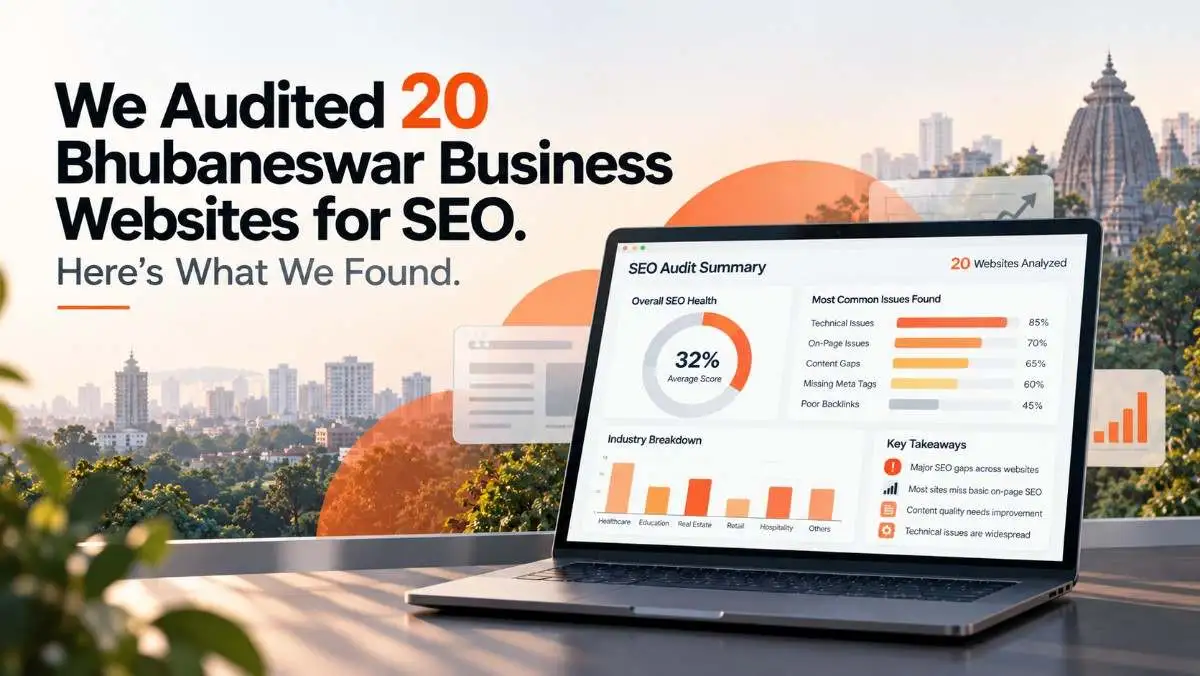
We audited 20 Bhubaneswar business websites for SEO. See findings on technical SEO, Core Web Vitals, local SEO, and on-page issues across 8 industries.
Local SEO for Bhubaneswar: The Complete 15-Step Guide for Odisha Businesses [2026]
Date: 09 - 09 - 2026
Time to read: 28 minutes
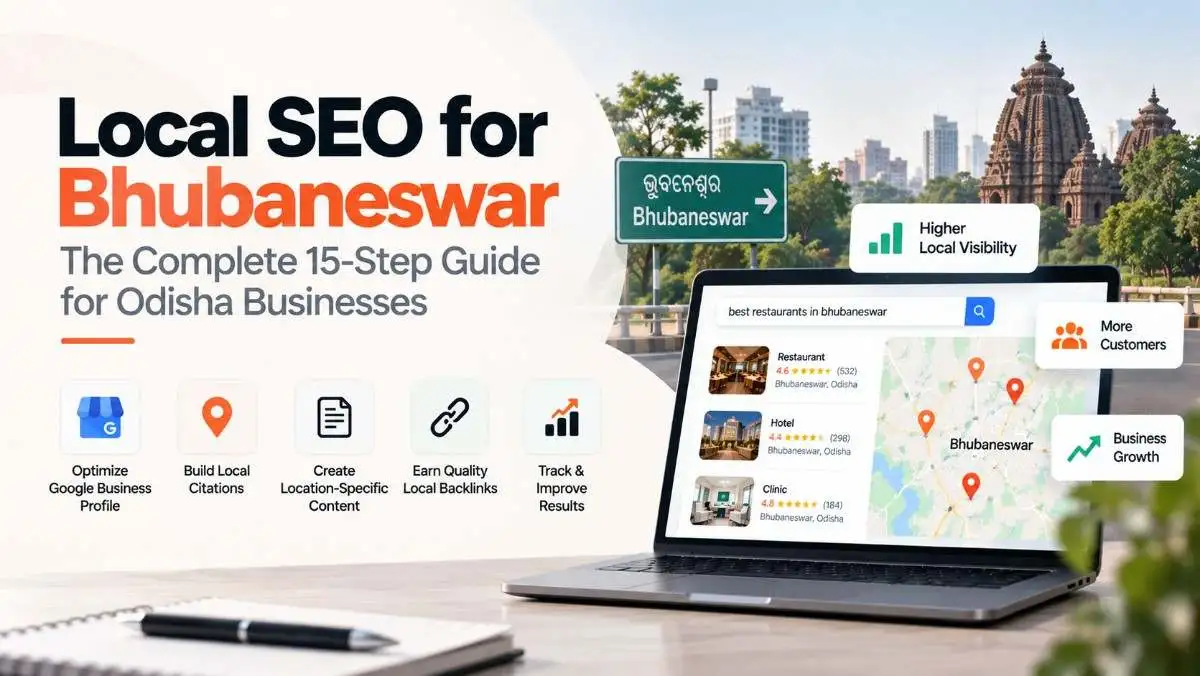
If you run a business in Bhubaneswar and people cannot find you when they search on Google, you are invisible to the customers who matter most. Local SEO is how you fix that. It is the process of making your business visible in Google Search and Google Maps when someone nearby looks for what you sell or the service you provide. This guide walks you through 15 steps to build a local SEO strategy that actually works for businesses in Bhubaneswar and across Odisha.
There is no Bhubaneswar-specific local SEO guide anywhere on the internet right now. Every existing guide is written for a global audience or targets metros like Delhi and Bangalore. The advice is generic. The examples are irrelevant. And the directories, citation sources, and competitive dynamics of a Tier-2 city like Bhubaneswar are completely different from what works in a metro.
We built this guide to fill that gap. The data and examples come from real Bhubaneswar businesses we have worked with and researched. If you have read our audit of 20 Bhubaneswar business websites, you already know how widespread the local SEO gaps are in this city. This guide gives you the playbook to close those gaps.
[ Table of Content ]
What Is Local SEO (and Why Should You Care)?
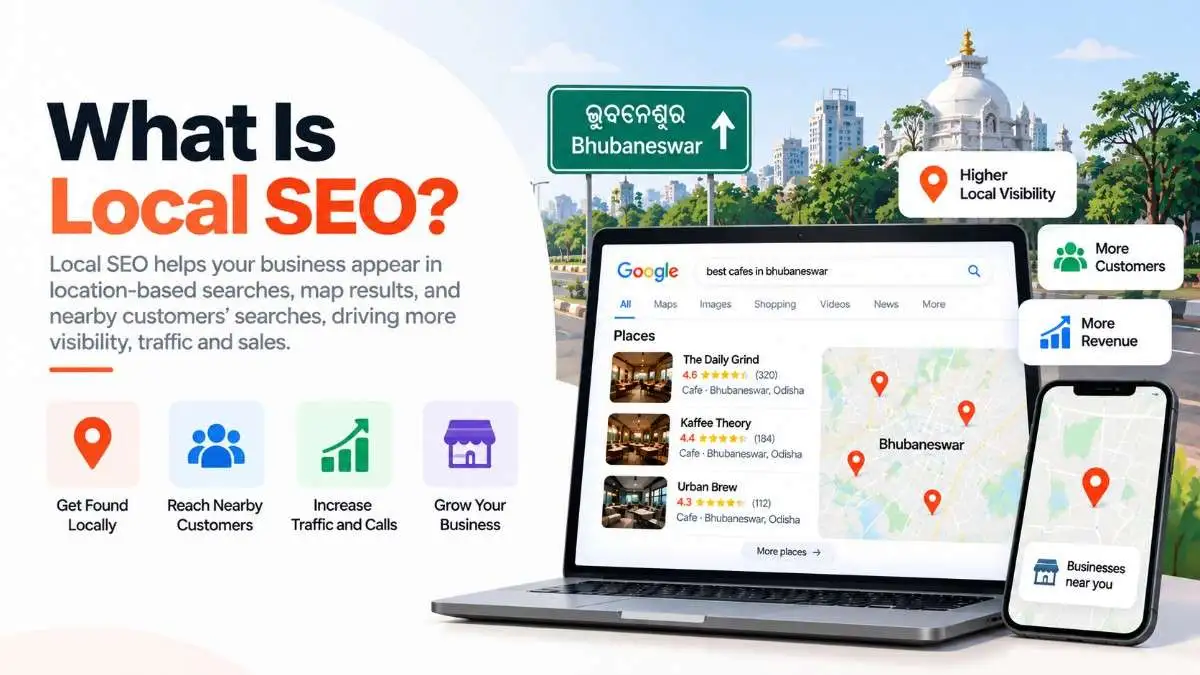
Local SEO is a branch of search engine optimization focused on making your business visible to people searching in a specific geographic area. When someone in Bhubaneswar opens Google and types "dentist near Saheed Nagar" or "best biryani in Patia," local SEO is what determines which businesses appear in the results. It covers everything from your Google Business Profile to your website, reviews, citations, and the way Google understands where your business is and what it does.
Think of it this way. Traditional SEO is about ranking for topics and keywords regardless of location. Local SEO is about ranking for your services in your city, your neighborhood, and the areas your customers actually come from. For a business in Bhubaneswar, one matters a lot more than the other.
Here is why this matters in concrete terms. According to Google's own data, 46% of all searches have local intent. That means nearly half of every search happening right now is someone looking for something nearby. And 76% of people who search for something local on their phone visit a related business within 24 hours. If your business does not appear in those searches, you are handing those customers to whoever does.
Bhubaneswar makes this even more relevant. The city has over 1 million residents, a growing IT corridor, thousands of new businesses every year, and a population that is rapidly shifting to mobile-first search behavior. Yet when we audited 20 Bhubaneswar business websites, we found that the majority had incomplete or missing Google Business Profiles, no local schema markup, no structured citation strategy, and no location-specific content. The opportunity is enormous, and the competition, for now, is low.
Key Takeaway
Local SEO is not a subcategory you get to later. For any business that serves customers in a physical location or a defined service area, local SEO is the most important form of SEO. In Bhubaneswar, the bar is still low. That will not last.
Understand How Local Rankings Work
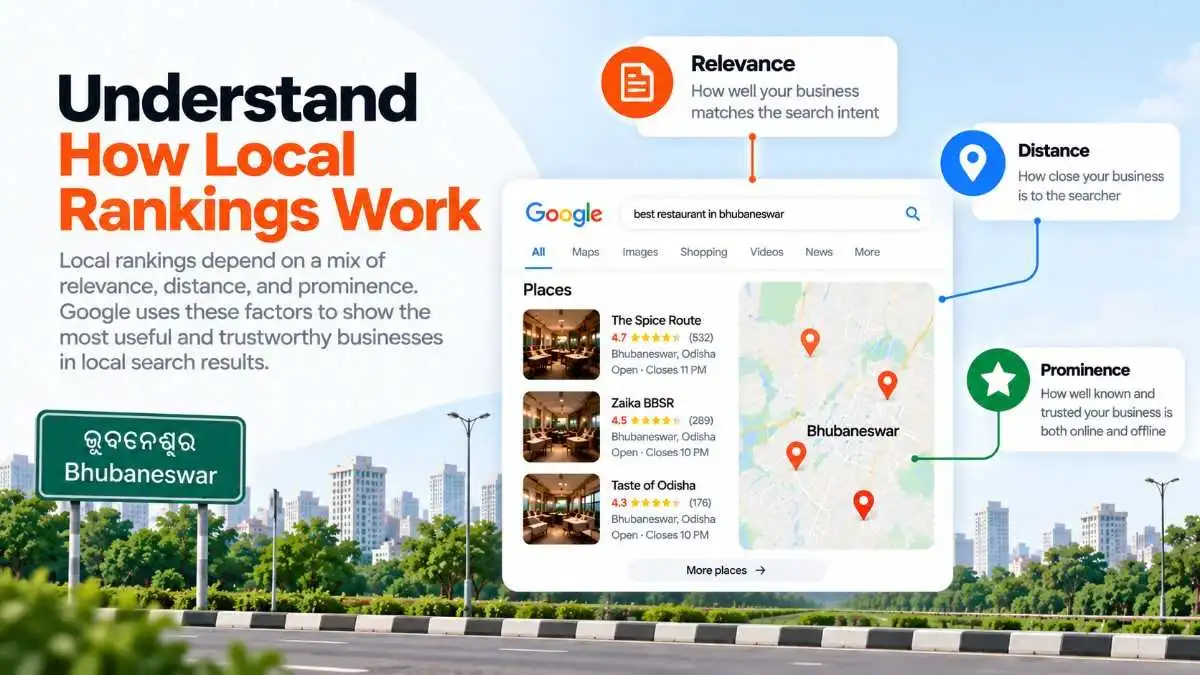
Before you start optimizing anything, you need to understand how Google decides which local businesses to show. Google uses three primary factors for local search rankings: relevance, distance, and prominence.
Relevance is how well your business profile and website match what the searcher is looking for. If someone searches "AC repair in Bhubaneswar" and your Google Business Profile lists your category as "Electrician" with no mention of air conditioning services, Google has no reason to show you. The more specific and complete your information, the better Google can match you to relevant searches.
Distance is straightforward. Google measures how far each potential result is from the searcher or the location they specified. If someone searches "salon near Jaydev Vihar," businesses within a few kilometers of that area get priority. You cannot change your physical address, but you can make sure Google knows your exact location and service area.
Prominence is where most of the optimization work happens. It refers to how well-known and trusted your business is across the web. Google measures prominence through review count and quality, citation consistency, backlink profile, website authority, and behavioral signals like how often people click on your listing and engage with it.
In 2026, there is a fourth layer that matters: AI Overviews. Google now generates AI-powered summaries at the top of many local search results. These overviews pull information from Business Profiles, websites, and review content. Being cited in an AI Overview gives your business visibility above the traditional Local Pack. This is where answer engine optimization meets local search.
What this means in practice
You cannot "hack" distance. What you can control is relevance (complete profiles, targeted content) and prominence (reviews, citations, links, authority). Every step in this guide targets one or more of these signals.
Set Up and Optimize Your Google Business Profile
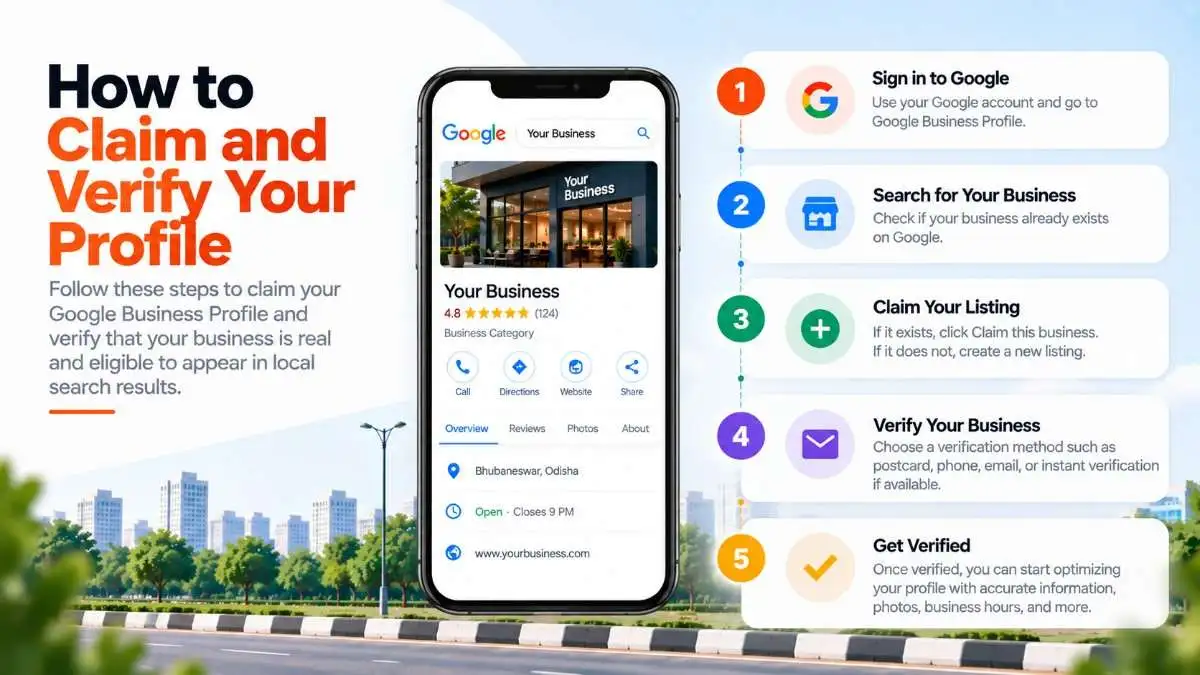
Your Google Business Profile (GBP) is the single most important element of local SEO. It is what appears in the Local Pack (the map and three business listings at the top of local search results) and in Google Maps. If you do nothing else from this guide, do this step properly.
GBP optimization has seen a surge in search interest, with the keyword "google business profile optimization" growing over 3,700% in recent months. There is a reason for that. Google keeps expanding what GBP can do, and businesses that take advantage of each feature pull further ahead of those that set it up once and forgot about it.
How to Claim and Verify Your Profile
Go to business.google.com and search for your business. If it already exists, claim it. If not, create a new listing. Google will ask you to verify ownership, typically via a postcard to your Bhubaneswar address or through phone or email verification. Do not skip verification. An unverified profile is essentially invisible.
Complete Every Section
Google rewards completeness. A profile that is 100% filled out performs significantly better than one that only has the basics. Here is what to fill in, and how to do it right:
Business name: Use your real registered business name. Do not add keywords to it. "Swastik Dental Clinic" is fine. "Swastik Dental Clinic Best Dentist Bhubaneswar" is keyword stuffing and can get your profile suspended.
Primary and secondary categories: Choose the most specific primary category that matches your core service. A multi-cuisine restaurant should pick "Restaurant," not "Food." Then add secondary categories for additional services. You can have up to 10.
Address and service area: Enter your exact address. If you serve customers at their location (like a plumber or caterer), set your service area instead. You can list up to 20 areas. For Bhubaneswar businesses, include the neighborhoods and nearby towns you actually serve: Saheed Nagar, Patia, Chandrasekharpur, Khandagiri, Mancheswar, Cuttack, and so on.
Business hours: Include regular hours, special hours for holidays, and mark any days you are closed. Incorrect hours are one of the most common reasons people leave negative reviews.
Business description: You get 750 characters. Use them. Describe what you do, who you serve, and where you are located. Write naturally. Include your city name and primary service, but do not force keywords.
Photos and videos: Upload high-quality images of your storefront, interior, team, products, and services. Businesses with more than 100 photos get 520% more calls than the average, according to Google's own data. Add your logo and a cover photo. Update them regularly.
Products and services: List every product or service you offer with descriptions and, if applicable, pricing. This section feeds directly into Google's understanding of what you sell.
Attributes: Mark all relevant attributes like "wheelchair accessible," "free Wi-Fi," "women-owned," "outdoor seating," and so on. These appear on your profile and filter into search results.
GBP Optimization Checklist
- Profile claimed and verified
- Real business name (no keyword stuffing)
- Correct primary and secondary categories
- Exact address or service area defined
- Business hours current (including holidays)
- Description uses all 750 characters
- 30+ high-quality photos uploaded
- All products and services listed
- All relevant attributes selected
- Website URL and phone number correct
Related: How Much Does SEO Cost in Bhubaneswar? covers how to evaluate SEO providers who can help with ongoing GBP management.
Step 3 of 15
Use Google Business Profile Posts
Most business owners in Bhubaneswar set up their GBP and never touch it again. That is a missed opportunity. Google Business Profile posts are free mini-updates that appear directly on your profile and in search results. They signal to Google that your business is active and give searchers a reason to engage with your listing.
Search interest in "google business profile posts" has grown 125% recently. Google is clearly investing in making posts more prominent, and businesses that post regularly benefit from increased engagement and visibility.
What to Post
GBP supports several post types: Updates, Offers, Events, and Products. Use them strategically.
Updates are your most versatile tool. Share news about your business, announce a new service, highlight a recent project, or share a tip related to your industry. A Bhubaneswar restaurant could post about a new menu item. A dental clinic could share a tip about monsoon dental care.
Offers let you promote time-limited deals with a clear start and end date. These appear with an "Offer" badge on your profile and tend to get higher engagement than regular updates.
Events are useful for businesses that host workshops, sales events, or community activities. An education center in Bhubaneswar running a free coding workshop can promote it directly on their Google profile.
How Often to Post
Aim for at least one post per week. Posts expire after seven days (offers expire on their end date), so consistency matters. Think of GBP posts like a low-effort social media channel where your audience is people actively searching for your type of business.
Bhubaneswar context
Most Bhubaneswar businesses we audited had zero GBP posts. Starting a weekly posting habit immediately sets you apart from the majority of your local competitors.
Run a Local SEO Audit
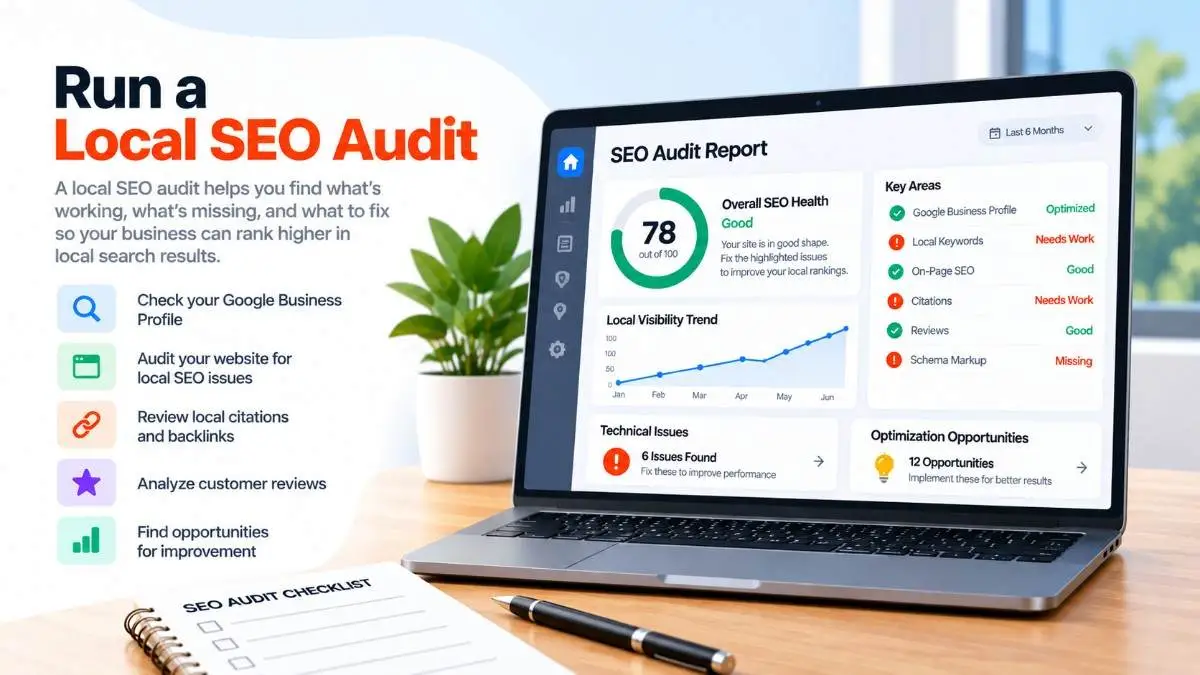
Before you build a strategy, you need to know where you stand. A local SEO audit gives you a clear picture of what is working, what is broken, and where the biggest gaps are. This is not a one-time exercise. Run a local SEO audit at least once every quarter to catch issues before they hurt your rankings.
A proper audit covers five areas: your Google Business Profile, your website's on-page SEO, your citation profile, your review presence, and your technical SEO health. Let us walk through each one.
GBP Audit
Check every field against the checklist in Step 2. Look for outdated hours, missing categories, stale photos, and incomplete product or service listings. Search for your own business on Google and see what your profile looks like from a customer's perspective. Are there any suggested edits from Google or users that you have not addressed?
On-Page Audit
Check that your website includes your city name in title tags, meta descriptions, H1 headings, and body content where it makes sense. Look for a dedicated contact page with your full address, embedded Google Map, and phone number. If you serve multiple areas, check that you have location-specific pages (more on this in Step 5).
Citation Audit
Search for your business name on Google and check the first 3 to 4 pages of results. Note every directory, listing, and mention. Is your name, address, and phone number (NAP) identical everywhere? Even small differences, such as "Rd" in one listing and "Road" in another, can confuse Google.
Technical Audit
Check your website's loading speed, mobile responsiveness, and Core Web Vitals using Google's PageSpeed Insights. A slow website that breaks on mobile will hurt your local rankings regardless of how good your GBP is. Our audit of 20 Bhubaneswar websites found that the average mobile performance score was below 40 out of 100. If your site is in that range, fixing speed should be a top priority.
For local SEO tools that help with auditing, technical SEO audit services can run a comprehensive check across all these areas. Free tools like Google Search Console, Google Business Profile Insights, and PageSpeed Insights cover the basics. Paid tools like Whitespark, BrightLocal, and Semrush offer deeper citation tracking and rank monitoring.
Quarterly Local SEO Audit Checklist
- GBP: all fields current and complete
- GBP: no unaddressed suggested edits
- Website: city name in key on-page elements
- Website: contact page with full NAP and map
- Website: mobile PageSpeed score above 60
- Citations: NAP identical across all listings
- Citations: no duplicate listings
- Reviews: responded to all reviews (past 30 days)
- Schema: LocalBusiness markup present and valid
- GSC: no crawl errors on location pages
Build Location Pages on Your Website
If your website does not mention Bhubaneswar on a single page, Google has very little reason to rank you for Bhubaneswar searches. Location pages are dedicated pages on your website that target a specific area you serve. They are one of the strongest on-page signals for local SEO.
The concept is simple. If you are a dental clinic in Saheed Nagar that also serves patients from Nayapalli, Jaydev Vihar, and Chandrasekharpur, each of those areas can have its own page on your website. Not a thin, cookie-cutter page with just the area name swapped in. A genuine page with unique content about your service in that area.
What a Good Location Page Includes
Every location page should have a unique title tag and meta description that includes the area name. The H1 should clearly state your service and the location. The body content should cover what you offer in that area, how to reach you, parking or landmark information, and any area-specific details that a potential customer would find useful.
Include your full NAP for that location, an embedded Google Map, business hours, and a clear call to action. Add photos of the actual location if possible. Google can read EXIF data from photos, and images taken at the location add a small trust signal.
Avoid Thin Location Pages
One of the most common mistakes in local SEO for small businesses is creating dozens of identical pages with only the city or neighborhood name changed. Google calls this doorway pages and can penalize you for it. Each location page needs genuinely unique content. If you cannot write at least 400 to 500 words of unique content about your service in a specific area, that area probably does not need its own page.
Related: Content Gap Analysis explains how to identify which location and service pages your competitors have that you are missing.
Step 6 of 15
Optimize for Google Maps
Google Maps SEO and Google Business Profile optimization overlap significantly, but they are not identical. When someone opens Google Maps and searches for "gym near me" in Bhubaneswar, Google uses a different weight distribution than it does for regular search. Distance carries more weight in Maps because the user is explicitly looking at a map and expects nearby results.
The keywords "google maps seo" and "google maps ranking" reflect a real question business owners have: how do I get my pin to show up on the map? Here is what influences your Maps ranking specifically.
Pin Accuracy
Make sure your map pin is in the correct location. It sounds obvious, but we have seen Bhubaneswar businesses with their pin placed on the wrong side of the road or in the middle of a field because they did not adjust it during setup. Log into your GBP, click "Edit profile," and verify that the map pin matches your exact storefront or office entrance.
Driving Directions and Engagement
Google tracks how many people request directions to your business through Maps. Businesses with higher direction requests tend to rank better in Maps results. While you cannot artificially inflate this, you can encourage it by linking directly to your Google Maps listing from your website, email signature, and social media profiles. Use a Google Maps URL (maps.google.com) rather than an embedded static map for click-to-navigate links.
Photos with Location Data
When you upload photos to your GBP, Google can read the GPS metadata embedded in the image. Take photos at your business location with a phone that has location services enabled. This creates a small but real signal connecting your photos to your physical address.
Reviews Mentioning Your Location
Reviews that naturally mention your area ("Great dentist in Saheed Nagar, highly recommend") help Google associate your business with specific neighborhoods. You should never ask customers to include specific keywords in their reviews. But you can ask them to describe their experience naturally, and location details often come through organically.
Step 7 of 15Apply Local SEO by Business Type
Local SEO is not one-size-fits-all. A hotel in Bhubaneswar faces a completely different competitive landscape than a dental clinic or a coaching institute. The directories that matter, the keywords that drive traffic, and the content strategy that works all vary by industry.
Bhubaneswar's local search volume data tells the story. "Hotels in Bhubaneswar" gets 22,200 searches per month. "Restaurants in Bhubaneswar" gets 18,100. "Interior designers in Bhubaneswar" gets 3,600. "Salons in Bhubaneswar" gets 1,600. Each of these numbers represents a different market with different intent, competition, and strategy requirements.
| Business Type | Monthly Search Volume (Bhubaneswar) | Key Local SEO Focus |
|---|---|---|
| Hotels | 22,200 | OTA listings, TripAdvisor reviews, photo-rich GBP |
| Restaurants | 18,100 | Zomato/Swiggy presence, menu schema, review velocity |
| Interior Designers | 3,600 | Portfolio pages, project photos, location pages |
| Salons & Spas | 1,600 | Service listings, booking integration, before/after photos |
| Dental Clinics | Moderate | Practo listing, treatment pages, patient reviews |
| Real Estate | 480 | Area guides, project listings, 99acres/MagicBricks presence |
| Coaching/Education | Moderate | Course pages, results/testimonials, location-specific landing pages |
| Gyms & Fitness | 390 | Class schedules, trainer profiles, virtual tour photos |
Industry-Specific Directories Matter
A generic citation strategy misses the directories that matter most for your industry. Healthcare businesses need to be on Practo, Lybrate, and 1mg. Dental clinics need strong Practo profiles with treatment-level listings. Real estate businesses need 99acres, MagicBricks, and Housing.com listings. Restaurants need Zomato, Swiggy, and Dineout profiles. Travel and hotel businesses need MakeMyTrip, Goibibo, and TripAdvisor.
The point is this: do not just build citations on generic directories. Identify the 5 to 10 platforms where your specific type of customer actively searches, and build a complete, optimized presence there.
Related: Oddtusk offers industry-specific SEO for healthcare, dental, real estate, law firms, and travel businesses.
Step 8 of 15
Build Local Citations and Fix NAP Consistency
A local citation is any mention of your business name, address, and phone number (NAP) on the web. Citations appear on directories like Justdial and Sulekha, social media profiles, industry portals, news articles, and local business listings. Google uses citations to verify that your business exists, that you are located where you say you are, and that your contact information is reliable.
NAP consistency is the idea that your business information should be identical across every platform. Not "mostly the same." Identical. If your GBP says "Plot 42, Jaydev Vihar, Bhubaneswar 751013" and Justdial says "Jaydev Vihar Road, BBSR," Google treats that as conflicting data. Multiply that across 30 or 40 listings and you have a trust problem.
The Bhubaneswar Address Problem
Bhubaneswar has a specific challenge with NAP consistency that metro businesses do not face. Many areas have multiple commonly used names. Jaydev Vihar and Nayapalli overlap. Chandrasekharpur gets abbreviated to CSpur. Rasulgarh and Mancheswar borders are ambiguous. Postal codes sometimes cover overlapping areas. Pick one format for your address and use it everywhere. Do not abbreviate in some places and spell out in others.
Where to Build Citations
Start with the major national directories: Justdial, Sulekha, IndiaMART, Google Maps, Bing Places, and Apple Maps. Then add industry-specific platforms from Step 7. After that, look for Bhubaneswar-specific sources: the Bhubaneswar Municipal Corporation business directory, Odisha tourism portals (for hotels and restaurants), local chamber of commerce listings, and Bhubaneswar-based news or community websites that list local businesses.
Quality matters more than quantity. 20 citations with perfect NAP consistency on trusted directories will outperform 200 citations on low-quality, spammy sites. In 2026, the role of citations has evolved. They are less of a direct ranking signal than they were five years ago and more of a trust verification signal. Google already knows where you are. Citations confirm it.
NAP Consistency Checklist
- Choose one exact format for your business name
- Use one exact address format (no abbreviations in some places)
- Use one phone number format consistently
- Audit your top 20 existing citations for mismatches
- Claim and update listings you do not control
- Remove or merge duplicate listings
- Document your official NAP in a shared team reference
Build a Review Strategy
Reviews are the most visible and influential local SEO signal from a customer's perspective. They are also one of the fastest-growing ranking factors. Search interest in "google business profile reviews" has surged over 420% recently, and Google continues to give reviews more weight in both Local Pack rankings and AI Overviews.
Here is what matters about reviews for local SEO: volume, velocity, quality, and response.
Volume is the total number of reviews. A business with 150 reviews looks more credible than one with 8, both to searchers and to Google's algorithm. For Bhubaneswar businesses in competitive categories like restaurants and hotels, aim to build your review count steadily over time.
Velocity is how often new reviews come in. A business that got 50 reviews in 2024 and nothing since looks stale. Google prefers businesses that receive consistent, recent reviews. This tells Google the business is active and customers are still engaging with it.
Quality covers both star ratings and review content. Detailed reviews that mention specific services, staff members, or experiences carry more weight than a one-word "Good" review. Google's natural language processing extracts entities and sentiment from review text, so reviews that describe what you do and where you are located add to your relevance signals.
Response means your replies to reviews. Respond to every review, positive or negative, within 24 to 48 hours. Thank positive reviewers by name and mention the specific service or context they described. For negative reviews, acknowledge the issue, explain what you are doing about it, and invite the person to continue the conversation offline. How you handle negative reviews is visible to every future customer who looks at your profile.
How to Ask for Reviews Without Violating Google's Policies
Google's review policies are clear on one thing: review gating is prohibited. You cannot selectively ask only happy customers for reviews while filtering out unhappy ones. You also cannot offer discounts, gifts, or any incentive in exchange for a review.
What you can do is ask every customer. Create a short Google review link from your GBP dashboard. Share it via WhatsApp message after a completed service, print it as a QR code at your billing counter, or include it in your post-service email. The best time to ask is immediately after a positive interaction when the experience is still fresh.
The review link trick
In your GBP dashboard, go to "Ask for reviews" to get your direct review link. Shorten it with a URL shortener or generate a QR code from it. Tape that QR code next to your billing counter, print it on your receipt, or add it to your WhatsApp business auto-reply. Make leaving a review as easy as scanning a code.
Earn Local Backlinks
Backlinks, links from other websites pointing to yours, are still one of the strongest signals Google uses to determine authority. For local SEO, the key is not just any backlinks. You need local backlinks: links from other Bhubaneswar and Odisha websites, organizations, and publications.
A link from a Bhubaneswar news portal, a local event website, or an Odisha business association tells Google that your business is connected to and recognized within the local community. That signal is far more valuable for local rankings than a random link from a generic directory in another country.
Where to Earn Local Links in Bhubaneswar
Local news and media: If your business does something newsworthy, reaching out to local Bhubaneswar publications can earn you a mention with a link. This could be a new store opening, a community initiative, or an expert quote on a topic related to your industry.
Business associations: The Bhubaneswar chapter of industry associations, startup communities (like the Startup Odisha network), and commerce bodies often maintain member directories with links back to member websites.
Event sponsorships and partnerships: Sponsoring local events, college festivals, or community programs in Bhubaneswar often comes with a mention on the event website. Even small events can provide a valuable local backlink.
Local blogs and content collaborations: Bhubaneswar's content ecosystem is growing. Travel bloggers covering Odisha, food bloggers reviewing restaurants, and tech bloggers covering the startup scene are all potential sources. A genuine collaboration where you provide value (an expert interview, a venue, a product to review) can earn you a natural, contextual link.
Supplier and partner pages: If you work with other local businesses, ask them to link to you from their "partners" or "clients" page, and offer to do the same. These reciprocal links between genuinely connected businesses are a normal part of the web.
For a deeper understanding of how internal linking and link architecture strengthen your overall SEO, start with your own site structure and then build outward to external link acquisition.
Quality over quantity
Five links from respected Bhubaneswar sources will do more for your local rankings than 50 links from irrelevant directories. Focus on links that make sense for your business. If someone would naturally link to you because of a real relationship or genuine value, that is the right kind of link.
Add Local Business Schema Markup
Schema markup is structured code you add to your website that tells search engines exactly what your business is, where it is located, what it offers, and how to contact it. For local SEO, the most important schema type is LocalBusiness schema.
Let us be clear about what schema does and does not do. Schema markup does not directly boost your rankings. Google has said this repeatedly. What schema does is help Google understand your information more accurately and can earn you enhanced search results like star ratings, business hours, price ranges, and FAQ snippets. In 2026, it also increases your chances of being cited in AI Overviews, since structured data makes it easier for AI to extract and present your business information.
What to Include in Your Local Schema
At minimum, your LocalBusiness (or a more specific subtype like Dentist, Restaurant, or LegalService) schema should include your business name, address, phone number, website URL, opening hours, geo coordinates (latitude and longitude), price range, accepted payment methods, and service area.
For Bhubaneswar businesses, make sure your geo coordinates are accurate. The easiest way to get them is to find your business on Google Maps, right-click on your location, and copy the coordinates. Entering rough coordinates that point to a general area rather than your actual building reduces the effectiveness of the markup.
If you have reviews on your website, add AggregateRating schema. If you have an FAQ section (like the one at the bottom of this page), add FAQPage schema. If you have events, add Event schema. Each layer of structured data gives search engines more to work with.
You can validate your schema using Google's Rich Results Test or Schema.org's validator. Test your pages after adding markup to make sure there are no errors. Common mistakes include mismatched address formats between your schema and your GBP, incorrect opening hours syntax, and missing required properties.
Deep dive: Schema SEO Power Moves covers advanced schema strategies beyond the basics discussed here.
Step 12 of 15
Go Hyperlocal
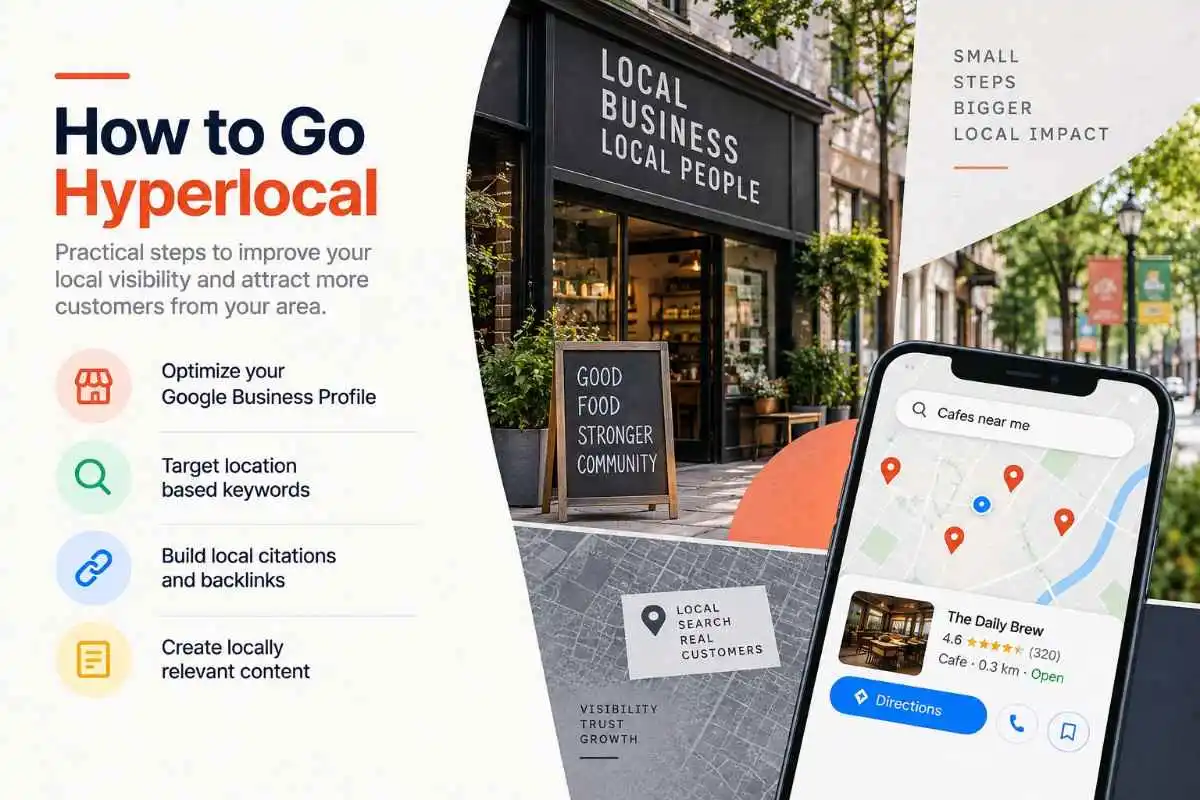
Hyperlocal SEO takes the neighborhood-level approach even further. Instead of targeting "Bhubaneswar" as a whole, you target specific colonies, streets, landmarks, and micro-areas within the city. This matters because search behavior in Indian cities is increasingly hyperlocal. People do not just search for "restaurant in Bhubaneswar." They search for "restaurant near Infocity" or "salon in Patia."
Bhubaneswar is especially well-suited for hyperlocal SEO because the city has distinct neighborhoods with strong identities: Saheed Nagar, Jaydev Vihar, Patia, Khandagiri, Nayapalli, Chandrasekharpur, Mancheswar, Rasulgarh, Acharya Vihar, and more. Each of these areas has its own set of searches, its own businesses, and its own customer base.
How to Go Hyperlocal
Create neighborhood-specific content. Write blog posts or service pages that reference specific Bhubaneswar areas. A pest control company could write about monsoon pest problems in Patia. A real estate agent could create area guides for Chandrasekharpur vs Sailashree Vihar.
Mention landmarks in your content. Google understands landmarks. If your business is "200 meters from KIIT Square" or "opposite Esplanade One Mall," use those references on your website and in your GBP description. Searchers use landmark-based queries, and having those references on your page helps Google make the connection.
Target micro-area keywords. Use keyword research to find search volume for neighborhood-level terms. You may find that "gym in Patia" or "tutor near KIIT" have enough search volume to justify dedicated content, even if the numbers are small. In hyperlocal SEO, low-volume keywords often convert at very high rates because the intent is specific and immediate.
Step 13 of 15Optimize for "Near Me" Searches
The search term "restaurants near me" gets 24.9 million searches per month globally. "Hotels near me" gets 11.1 million. "Near me" searches have exploded over the past five years and continue to grow. But here is what most guides get wrong about optimizing for them: you should not stuff "near me" into your content.
When someone searches "dentist near me," Google does not look for pages that contain the phrase "near me." It looks at the searcher's device location and returns the closest, most relevant results. The "near me" modifier is essentially a location signal, not a keyword to target on your page.
What Actually Helps You Rank for "Near Me"
Everything in this guide feeds into "near me" performance. Your GBP accuracy determines whether Google knows where you are. Your categories and description determine relevance. Your reviews and citations determine prominence. Your website's location pages and schema markup give Google additional confirmation. When all of these signals are strong and consistent, you become a natural result for "near me" searches in your area.
The one thing you can add is making sure your website is mobile-optimized. The vast majority of "near me" searches happen on mobile devices, often while the person is walking or driving. If your website is slow on mobile, hard to navigate, or does not display your phone number and address prominently, you will lose the click even if you rank.
Voice Search and "Near Me"
Voice search through Google Assistant, Siri, and Alexa often uses natural language that defaults to "near me" behavior. Someone saying "Hey Google, find a good restaurant near me" triggers the same local search algorithm. The growing adoption of voice search in India, especially in tier-2 cities like Bhubaneswar where mobile-first usage is dominant, makes this increasingly relevant. The best optimization for voice search is the same as for "near me": strong GBP, accurate location data, and clear, well-structured website content.
Step 14 of 15Track What Matters
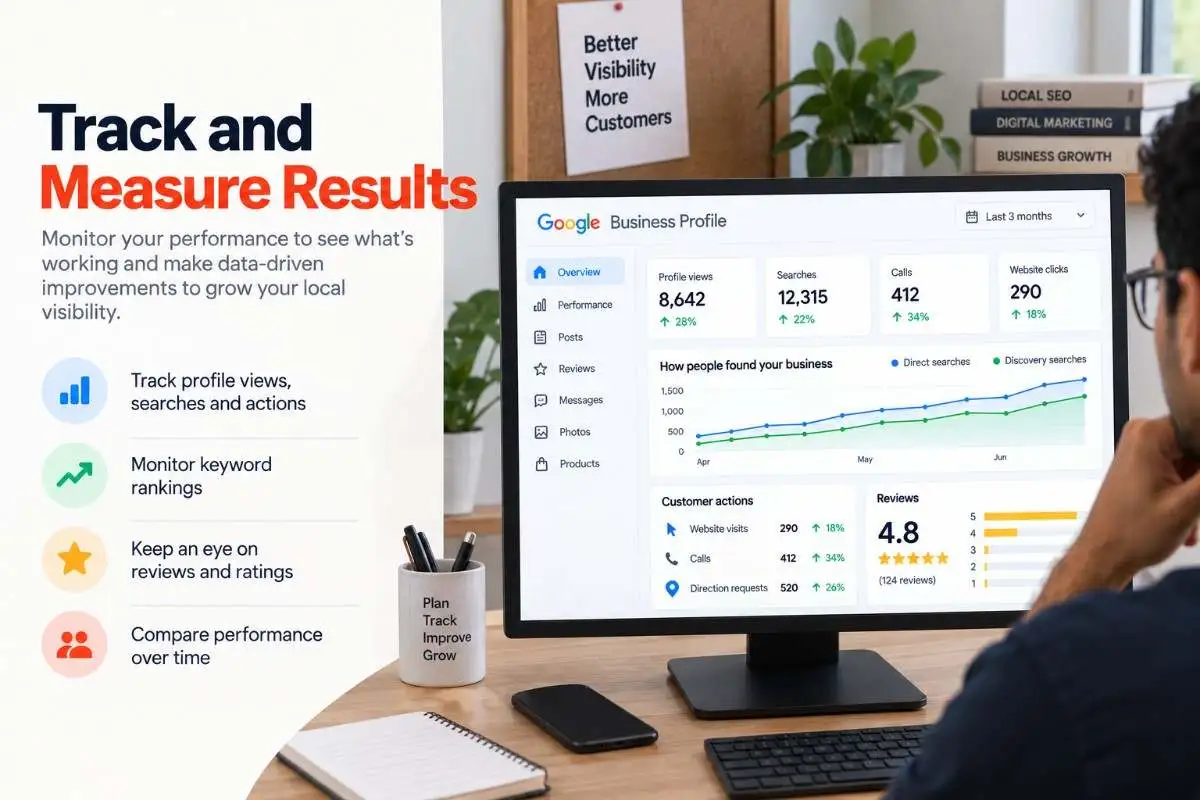
A local SEO strategy without tracking is guesswork. You need to measure performance across your GBP, your website, and your overall visibility in local search. Here is what to track and which local SEO tools to use for each.
Google Business Profile Insights
GBP Insights shows you how many people found your profile through direct searches (they searched your business name) versus discovery searches (they searched for a category or service). It also tracks what actions people took: visited your website, requested directions, or called you. Monitor these monthly and look for trends. A spike in discovery searches after optimizing your profile tells you it is working.
Google Search Console
Search Console shows which queries bring people to your website, your average position for those queries, and click-through rates. Filter by queries containing your city name or "near me" to isolate local performance. Track impressions and clicks for your location pages specifically.
Local Rank Tracking
Standard rank trackers often show national rankings, which are useless for local SEO. You need a tool that tracks rankings from a specific geographic location. Tools like BrightLocal, Whitespark, and Semrush allow you to set your tracking location to Bhubaneswar and see how your business appears in local results from that area. Track your top 10 to 20 local keywords weekly.
Review Monitoring
Set up Google alerts for your business name and check your GBP for new reviews at least twice a week. Some review management tools aggregate reviews from multiple platforms (Google, Justdial, Facebook, industry sites) into one dashboard. If your business gets more than a handful of reviews per month, this kind of tool is worth the investment.
What Not to Track
Vanity metrics distract you. Total website traffic without segmenting for local visitors is meaningless. Rankings for keywords you do not actually target are noise. Social media followers are not a local SEO metric. Focus on the signals that connect to actual customer behavior: calls from GBP, direction requests, website visits from local queries, and review velocity.
Monthly Local SEO Metrics to Track
- GBP discovery vs direct search ratio
- GBP actions: calls, direction requests, website clicks
- GSC: impressions and clicks for local queries
- Local keyword rankings (from Bhubaneswar location)
- New reviews: count, average rating, response rate
- Citation accuracy score (quarterly)
- Mobile PageSpeed and Core Web Vitals
Scale to Multiple Locations
Once your local SEO is working for one location, the question becomes: how do you scale it? Multi-location SEO applies to businesses expanding within Bhubaneswar (opening a second branch in a different part of the city) or expanding across Odisha (adding locations in Cuttack, Puri, or Rourkela).
The principles stay the same, but the execution gets more complex. Each location needs its own Google Business Profile, its own location page on your website, its own citation profile, and its own review strategy. You cannot manage five locations from a single GBP listing.
The Multi-Location GBP Structure
Every physical location gets its own verified GBP. Use a consistent naming convention: "Your Business Name - Saheed Nagar" and "Your Business Name - Patia." Each profile should have its own unique photos, its own specific hours (if they differ), and its own phone number or extension. Manage all locations from a single Business Profile Manager account for consistency.
Website Architecture for Multiple Locations
Build a location hub page that lists all your locations, then create individual location pages for each one. The URL structure should be clean: /locations/saheed-nagar/ and /locations/patia/. Each page gets its own LocalBusiness schema, its own NAP, its own embedded map, and its own unique content.
For businesses expanding beyond Bhubaneswar, consider whether you need city-level pages as well. A dental chain with locations in Bhubaneswar and Cuttack should have /locations/bhubaneswar/ and /locations/cuttack/ as hub pages, with individual branch pages beneath each.
Common Multi-Location Mistakes
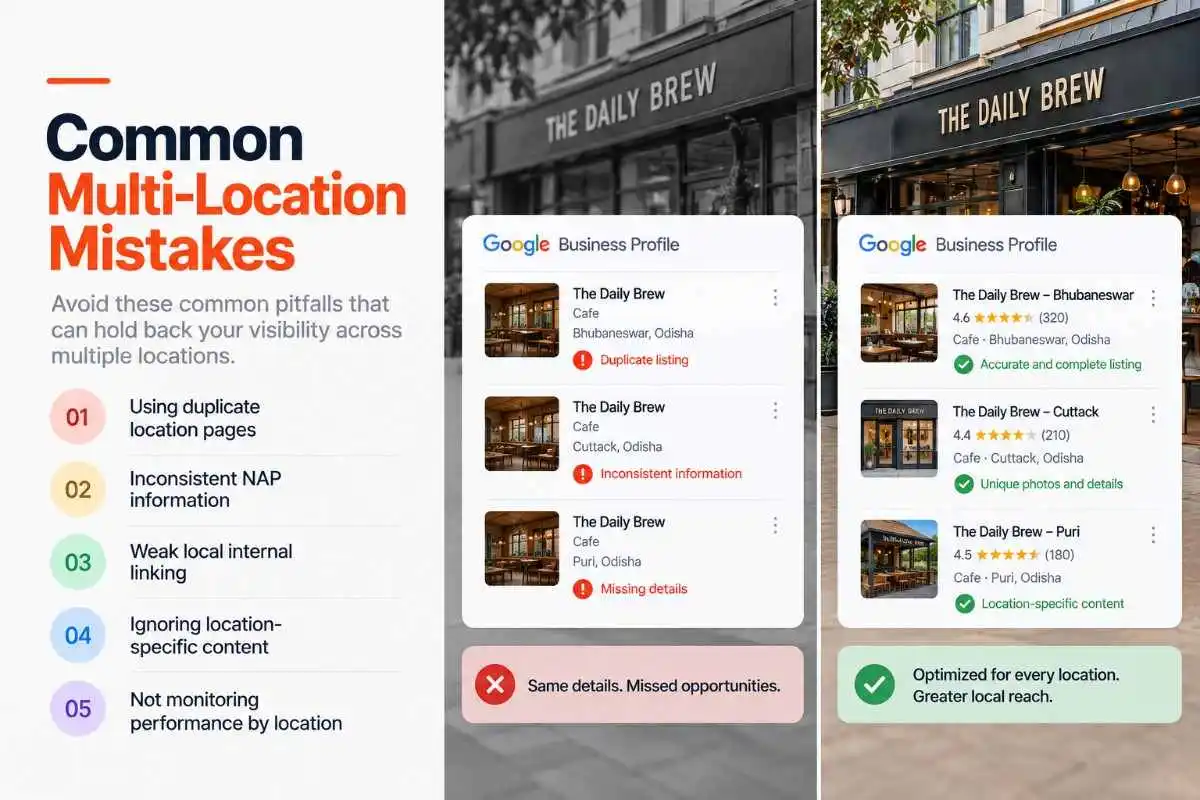
The biggest mistake is trying to manage multiple locations with a single GBP and a single set of citations. Each location needs its own digital identity. The second biggest mistake is creating identical content across location pages. Google sees this as duplicate content. Each page must have genuinely unique information, even if the services are the same.
For businesses at this stage, professional help often makes sense. Managing multi-location SEO across GBP profiles, citation networks, review streams, and individual location pages is a significant ongoing effort. This is exactly the kind of complexity where working with an experienced local SEO provider saves time and prevents costly mistakes.
What Should You Do First?
Fifteen steps is a lot. If you try to do everything at once, you will do nothing well. Here is the priority order for a Bhubaneswar business starting from scratch.
Week 1 to 2: Claim, verify, and fully optimize your Google Business Profile (Step 2). This is the single highest-impact action you can take. Start posting weekly (Step 3). Ask your first 10 customers for reviews (Step 9).
Week 3 to 4: Run a local SEO audit (Step 4). Fix any NAP inconsistencies you find (Step 8). Build citations on the top 15 directories relevant to your industry (Step 8) and your specific business type (Step 7).
Month 2: Build or improve your location pages (Step 5). Add LocalBusiness schema to your website (Step 11). Make sure your site is mobile-fast (Step 4 technical audit).
Month 3 onward: Start your local link building (Step 10). Create hyperlocal content targeting specific Bhubaneswar neighborhoods (Step 12). Set up tracking (Step 14) and make local SEO part of your monthly business operations.
Local SEO is not a project with a finish line. It is an ongoing discipline. The businesses that win in local search are the ones that consistently maintain their profiles, earn fresh reviews, publish relevant content, and adapt to changes in how Google displays local results. Bhubaneswar's local search landscape is still developing, which means the businesses that invest now will have a compounding advantage over those that wait.
If you want help building a local SEO strategy specific to your business and your market in Bhubaneswar, we build every engagement around your actual business requirements, not a package menu. Start a conversation and we will scope out what makes sense for you.
[ Common questions ]
Local SEO FAQs
Local SEO is the process of optimizing your online presence so your business appears when people in your area search for what you offer. For a Bhubaneswar business, this means showing up in Google's Local Pack, Google Maps, and organic results when someone searches for terms like "dentist in Saheed Nagar" or "best restaurant near Patia." It matters because 46% of all Google searches have local intent, and most of those searchers visit a business within 24 hours.
Go to business.google.com and click "Manage now." Enter your business name, category, and address. Google will ask you to verify ownership, usually through a postcard mailed to your Bhubaneswar address or via phone verification. Once verified, complete every section of your profile: hours, photos, services, description. A fully completed Google Business Profile is the foundation of local SEO.
You can handle the basics yourself. Setting up and optimizing your Google Business Profile, building citations on directories like Justdial and Sulekha, responding to reviews, and keeping your NAP consistent across the web are all things a business owner can do. Where it gets harder is technical SEO, schema markup, competitive keyword strategy, and ongoing content creation. If your competition is actively investing in SEO, a professional can help you move faster.
For a Bhubaneswar business starting from scratch, expect 3 to 6 months of consistent work before you see meaningful movement in the Local Pack and Maps results. Bhubaneswar has lower competition than metros like Delhi or Bangalore, so results tend to come faster here than in saturated markets. But local SEO is not a one-time project. It requires ongoing optimization, fresh reviews, and regular content to maintain and improve rankings.
There is no fixed number because the scope depends entirely on your business type, competition, and goals. A single-location restaurant in Bhubaneswar needs a very different scope than a multi-branch hospital chain. The right approach is to find a provider who understands your specific market and builds a plan around your needs rather than selling you a generic package. Be cautious of anyone quoting a price before understanding your business.
Google's local ranking factors fall into three categories: relevance, distance, and prominence. In practice, the signals that matter most are your Google Business Profile completeness and activity, the number and quality of your reviews, NAP consistency across the web, local backlinks from relevant Bhubaneswar sources, on-page signals like location pages and schema markup, and behavioral signals like click-through rate and engagement. In 2026, Google also factors AI Overviews into local search, so being cited in AI-generated answers gives you an additional visibility layer.
Yes. Creating and managing a Google Business Profile is completely free. You do not need to pay Google anything to appear in Maps or the Local Pack. What costs money is the time and expertise to optimize it properly, manage reviews, create content, and build the supporting signals like citations and backlinks that push your profile higher in rankings.
Ask every satisfied customer directly. The simplest method is to create a short review link from your Google Business Profile dashboard and share it via WhatsApp, SMS, or a printed QR code at your counter. Time the ask for right after a positive interaction. Respond to every review, positive or negative, within 24 to 48 hours. Never offer incentives for reviews or selectively ask only happy customers. Google calls this review gating and it violates their policies.
NAP stands for Name, Address, and Phone number. Consistency means your business information is identical everywhere it appears online: your website, Google Business Profile, Justdial, Sulekha, social media profiles, and every other listing. When Google finds conflicting information, it loses confidence in your data and may rank you lower. This is especially common in Bhubaneswar where businesses operate from areas with multiple naming conventions, like Jaydev Vihar vs Nayapalli.
Google Business Profile alone will get you into Maps results, but a website dramatically strengthens your local SEO. Your website is where you build location pages, publish local content, add schema markup, earn backlinks, and give Google more signals about what you do and where you do it. Businesses with optimized websites consistently outrank those relying only on their GBP listing.
Start with the national directories that Google trusts most: Justdial, Sulekha, IndiaMART, and Google Maps itself. Then add industry-specific platforms. Restaurants should be on Zomato and Swiggy. Hotels need presence on MakeMyTrip, Goibibo, and TripAdvisor. Healthcare providers should list on Practo. After that, look for Bhubaneswar-specific directories and local business associations. The goal is consistent NAP information across 15 to 30 high-quality directories, not hundreds of low-quality ones.
Schema markup does not directly boost rankings. What it does is help Google understand your business information more accurately and can earn you rich results like star ratings, business hours, and FAQ snippets in search results. For local businesses, LocalBusiness schema tells Google your exact address, service area, opening hours, and accepted payment methods in a structured format. It also makes your content more likely to be cited in AI Overviews, which is increasingly important in 2026.
