

An independent pricing guide with real numbers, package breakdowns, and what to expect at every budget level.
We Audited 20 Bhubaneswar Business Websites for SEO. Here Is What We Found.
Date: 09 - 07 - 2026
Time to read: 24 minutes
[ Table of Content ]
We were expecting to find issues. We were not expecting to find the same issues on almost every single website.
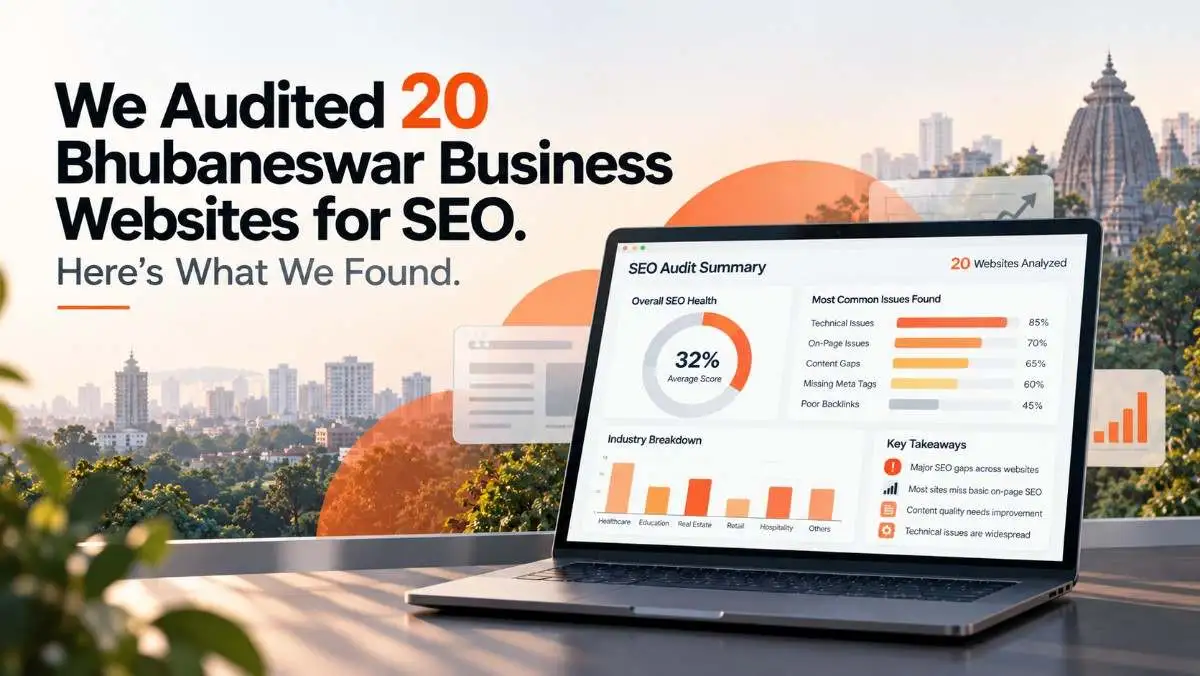
At the start of 2026, the Oddtusk team ran a structured SEO audit across twenty business websites in Bhubaneswar. These businesses spanned eight industries: restaurants, clinics, coaching institutions, retail, real estate, logistics, legal services, and IT firms. All twenty had a website. All twenty were paying for some form of digital marketing. Sixteen out of twenty had at least five correctable SEO problems that were costing them daily search visibility.
This is not a post about hypothetical problems. This is a report based on real audits of twenty actual Bhubaneswar business websites. If you own a business in Bhubaneswar and you have a website, the probability is high that at least three of the findings below apply to you.
Related: How much does SEO cost in Bhubaneswar? Our pricing guide breaks down what businesses actually pay for SEO services in this market.
Why Did We Audit 20 Bhubaneswar Business Websites?
The idea started from a pattern we kept seeing during client consultations.
Business owners in Bhubaneswar would come to us with the same complaint: they already had a website, someone had told them it was good, and yet Google was sending them zero organic traffic. Some had hired an SEO company in Bhubaneswar to handle things. Some had worked with local developers. A few had built the site themselves. None of them had ever gotten a proper website audit done on it.
An SEO audit is not as complicated as it sounds. It is a thorough check of every factor that affects how Google sees your website: technical structure, page content, mobile experience, loading speed, indexing status, and local search signals. Think of it as a diagnostic scan for your website's search health.
We wanted to find out whether the problem was specific to these clients or whether it reflected something systemic about how websites get built in Bhubaneswar. So we picked twenty sites across eight industries and ran each one through the same structured audit process.
The answer turned out to be systemic.
How Did We Run the SEO Audit?
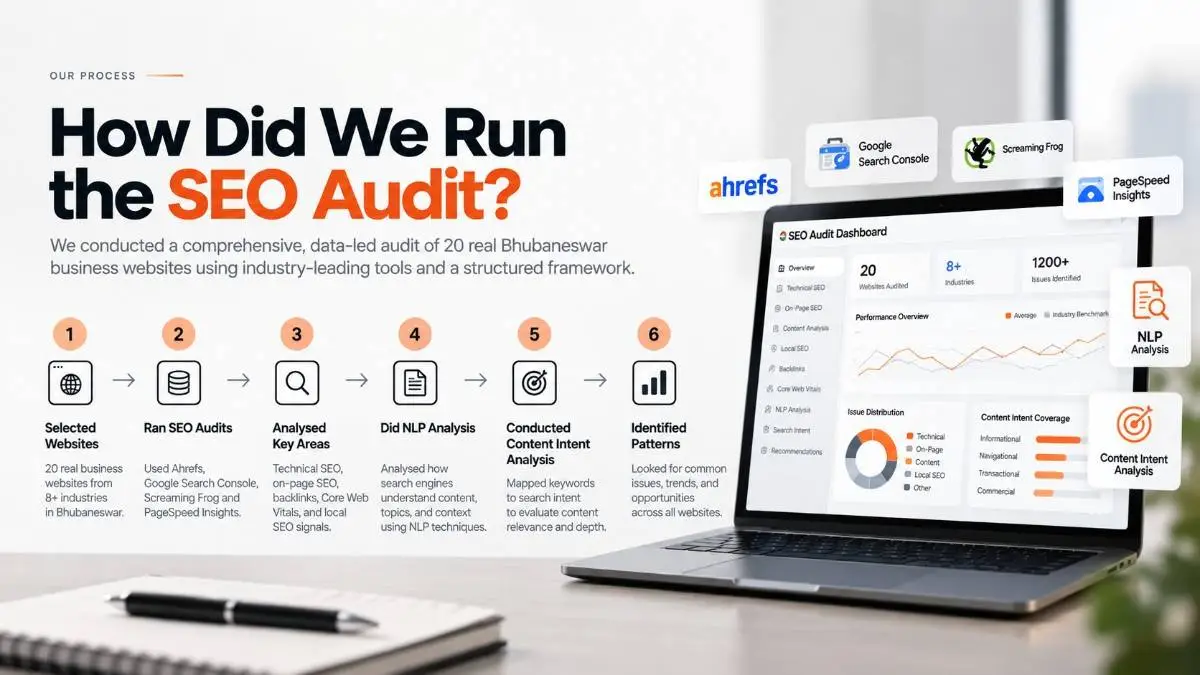
We evaluated each website across five categories using a consistent methodology. The tools included Google Search Console, Google PageSpeed Insights, Screaming Frog, and Ahrefs. Here is what we measured:
Technical SEO covered crawlability, indexing, site architecture, redirect chains, broken links, XML sitemap status, and robots.txt configuration.
On-page SEO covered title tag optimization, meta descriptions, heading structure, keyword relevance, content depth, and duplicate content.
Mobile usability covered responsiveness, tap target sizes, font readability, and overall mobile page experience under Google's mobile-first indexing standard.
Core Web Vitals and page speed covered Largest Contentful Paint (LCP), Cumulative Layout Shift (CLS), Interaction to Next Paint (INP), image optimization, script bloat, and overall load time on a standard 4G connection.
Local SEO covered Google Business Profile completeness, NAP consistency across directories, local schema markup, and review signals.
The eight industries were chosen to represent the range of businesses operating in Bhubaneswar: healthcare, education, food and hospitality, retail, real estate, logistics, legal, and IT services.
Why Were Missing Meta Tags the Most Common On-Page Problem?
Title tags and meta descriptions are the most basic building blocks of on-page SEO. The title tag tells Google and users what a page is about. The meta description gives them a reason to click on it. Getting these right is the simplest form of search engine optimization you can do.
14 out of 20
websites had significant meta tag problems, ranging from completely missing titles to duplicates across multiple pages.
Seven websites had pages with no title tag at all. Google was generating its own titles by pulling text from the page body, which almost never represents the business well. Nine websites had duplicate title tags, meaning two or three pages were competing against each other for the same search terms. This is a classic case of keyword cannibalization that silently splits your ranking power. Eleven websites had no meta descriptions on most of their inner pages. Four had descriptions over 200 characters long, which Google truncates in search results.
Why does this matter beyond rankings? It affects click-through rate directly. A page sitting in position four with a sharp, relevant title and description often gets more clicks than a page in position two with a generic or auto-generated one. Title tag optimization is one of the quickest wins available to any business website.
What to fix
Audit every page on your site. Give each one a unique title tag between 50 and 60 characters that includes your primary keyword for that page. Write a meta description between 150 and 160 characters that answers the searcher's question and gives them a reason to click through.
How Bad Is Mobile Usability on Bhubaneswar Business Websites?
Google moved to mobile-first indexing years ago. This means Google crawls the mobile version of your website first when deciding how to rank it. Poor mobile experience does not just hurt mobile visitors. It hurts your rankings on every device.
12 out of 20
websites had mobile usability issues serious enough to affect both user experience and search rankings.
Eight websites had text too small to read on a standard mobile screen without zooming. Six had buttons and links spaced so closely that tapping the right one was a matter of luck. Five had content that overflowed the screen width and forced horizontal scrolling. Four had clickable elements hidden behind fixed navigation bars or popups on mobile. Three were loading images in formats and sizes designed for desktop, causing the mobile page to load slowly and consume unnecessary data.
The most common root cause was that each website had been built as a desktop experience first and then briefly checked on a phone. The developer tested it on a large screen and assumed it would translate. That assumption fails more often than not.
A visitor who arrives on your site from a local mobile search and cannot read the text or tap the right button will leave within seconds. That bounce sends a signal to Google about the quality of your page experience.
What to fix
Check the Mobile Usability report in Google Search Console. Test your website on an actual phone, not a simulated mobile view in a desktop browser. The difference between the two is often significant.
Why Did Almost Every Website Fail Core Web Vitals and Speed Tests?
Core Web Vitals are Google's performance metrics for real user experience. They became an official ranking factor in 2021 and remain influential in 2026, especially in competitive local search results where multiple businesses target the same terms. Modern SEO strategy requires passing these thresholds, not just targeting the right keywords.
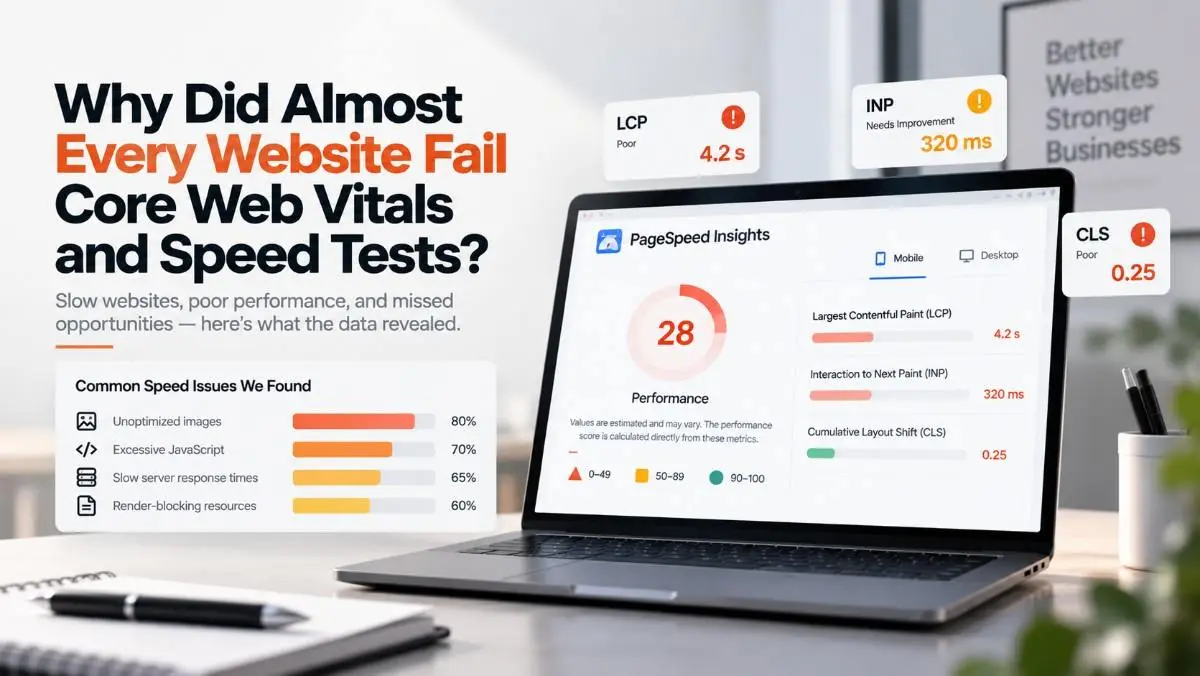
17 out of 20
websites failed at least one Core Web Vitals metric, and 19 out of 20 took longer than three seconds to load on a standard 4G connection.
Fifteen websites had poor LCP (Largest Contentful Paint) scores above 2.5 seconds. Some exceeded five seconds. LCP measures how quickly the main content of a page appears. Ten websites had visible layout shift (CLS), where elements moved around as the page loaded, causing a confusing and unreliable visual experience. Eight websites had poor INP (Interaction to Next Paint) scores, meaning noticeable delays between a user tapping something and the page responding.
The causes were remarkably consistent across all twenty sites. Uncompressed images were the single biggest culprit. Some homepage images exceeded 3MB, and several topped 5MB. WordPress sites were running too many plugins that loaded unnecessary scripts. Not a single one of the twenty websites used a CDN, which meant all resources loaded from a single server location instead of from a geographically closer node. Several used shared hosting where the server response time itself was slow before any page content even began loading. JavaScript and CSS files were not minified on most sites.
For local businesses in Bhubaneswar competing in niches like clinics, restaurants, real estate, and coaching institutes, the gap between a page-one result and a page-two result sometimes comes down to these performance margins. Research consistently shows that abandonment rates rise sharply after three seconds. A website that takes six seconds to load on mobile has lost a significant share of its visitors before they see a single word.
What to fix
Run your site through Google PageSpeed Insights and check the Core Web Vitals report in Google Search Console. For most local business websites, the fastest improvements come from compressing images and converting them to WebP format, removing unused third-party scripts, and setting explicit width and height dimensions on all images and media to prevent layout shift.
What Indexing Problems Are Hiding in Plain Sight?
If Google has not indexed a page, that page does not exist for organic search. The dangerous part about indexing issues is that nothing looks wrong when you visit the website. The page loads fine. The content displays correctly. But Google either cannot find the page, has been told to ignore it, or thinks it does not exist.
13 out of 20
websites had indexing problems that were silently keeping pages out of search results.
Six websites had noindex tags in the code that were blocking pages from Google's index entirely. In two cases, these were main service pages, which meant the business's core offerings were invisible in search. Five websites had no XML sitemap or had a sitemap that was never submitted to Google Search Console. Four had robots.txt files that accidentally blocked Google from crawling parts of the site. Seven websites had pages returning soft 404 errors: the page loaded fine for visitors, but the server was telling Google the content did not exist. Three websites had broken internal links pointing to pages that no longer existed.
This category of SEO problems is the most damaging because it is entirely invisible to anyone who is not specifically looking for it. The business owner sees their website working perfectly. Meanwhile, Google sees a maze of blocked pages, dead-end links, and conflicting signals about what content actually exists.
What to fix
Set up Google Search Console if you have not already. Check the Coverage report for pages that are excluded or flagged with errors. Submit your XML sitemap. Review your robots.txt file to make sure nothing important is blocked. Use a crawler like Screaming Frog to find broken internal links and soft 404 errors.
Keep reading
Wondering what it actually costs to fix these problems?
We broke down real SEO pricing across Bhubaneswar agencies, freelancers, and in-house teams. Read the full pricing guide here.
Why Is Thin Content the SEO Problem That Disappoints Us the Most?
Content is the one part of SEO that every business owner can control directly. It does not require technical knowledge. It does not require a developer. It requires understanding what your customers search for and answering those questions clearly on your website. And yet, of everything we measured, content quality was the area where Bhubaneswar business websites performed worst.
18 out of 20
websites had significant content problems on their most important pages.
Twelve websites had service pages with fewer than 150 words. The entire page was images and whitespace with almost nothing for Google to evaluate. Nine had homepages with so little text that Google could not determine what the business actually did or which searches it should rank for. Eight had duplicate or near-duplicate content across multiple pages. Seven had no logical heading structure (H1, H2, H3) at all. Fifteen had no blog, resource section, or any form of educational content, which meant they were competing entirely on thin service pages with no supporting content to build topical depth.
The pattern is obvious. These websites were designed to look impressive, not to inform. Designers were hired. Developers were hired. Nobody was hired to write content that would actually help the website rank for the searches its customers are making.
What good content looks like
A service page for, say, dental care in Bhubaneswar should have at least 400 to 600 words that describe the service using the terms patients actually search for. It should have a clear H1 title. It should use H2 subheadings to organize the content logically and answer the questions potential patients might have. This is basic E-E-A-T: demonstrating experience and expertise through the depth and specificity of your content.
How Incomplete Are Local SEO Signals Across Bhubaneswar Businesses?
For a Bhubaneswar business serving a local customer base, local SEO may matter more than any other category. A large share of all searches in Indian cities carry local intent, either explicitly ("best physiotherapist in Patia") or implicitly (Google infers the searcher wants nearby results).
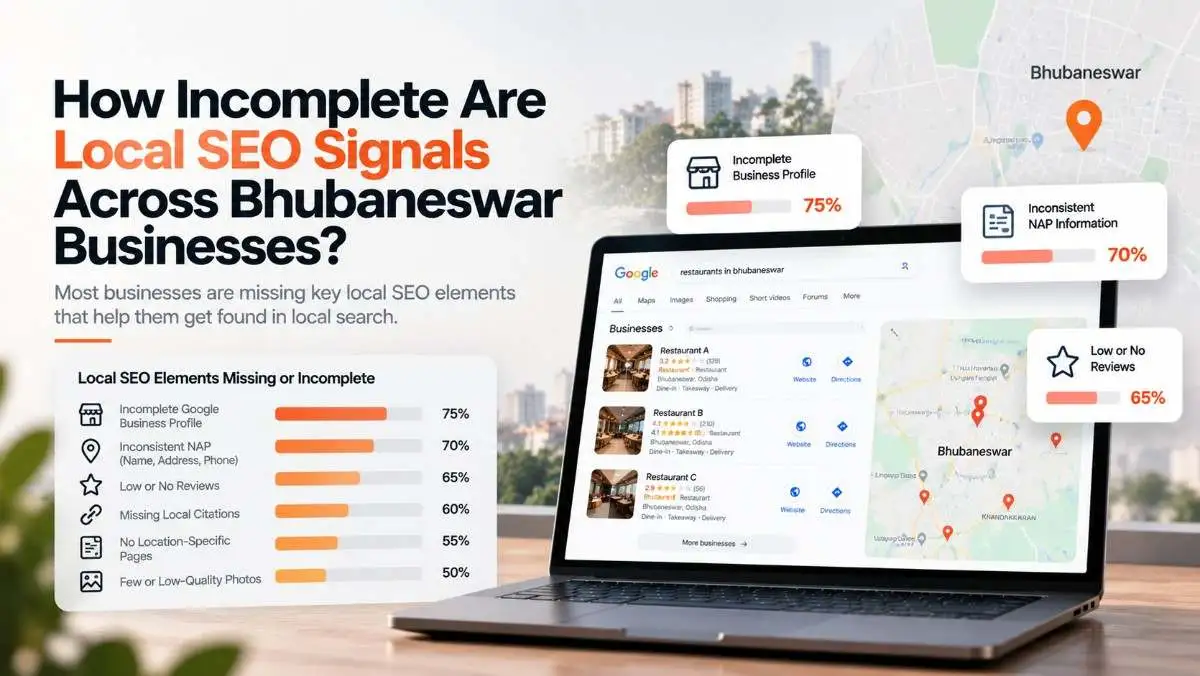
15 out of 20
websites had weak or incomplete local SEO signals that were limiting their visibility in local search results and the Google map pack.
Nine websites had inconsistent NAP (name, address, phone number) information between their website, their Google Business Profile, and third-party directories. Small differences like "Nayapalli" versus "Naya Palli," or different phone number formats, make it harder for Google to verify the business's legitimacy. Eleven websites had no local business schema markup, meaning there was no structured data to help Google confirm the business type, location, operating hours, or service area. Fourteen had Google Business Profiles that were missing categories, services, or recent posts. Seven had no area-specific landing pages, which meant they were trying to compete for local searches from a single generic homepage.
When someone searches for "income tax consultant Saheed Nagar" or "coaching institute near Jaydev Vihar," Google looks for the strongest combination of signals: consistent NAP data, a complete Google Business Profile, local schema markup, and pages that specifically address the area and service being searched. The business with those signals in place will outrank a better-designed website that lacks them.
What to fix
Start with your Google Business Profile. Fill in every section: categories, services, description, photos, and regular posts. Then verify that your name, address, and phone number are identical across your website, your GBP listing, and every directory where your business appears (Justdial, Sulekha, IndiaMART, and others). Add LocalBusiness schema markup to your homepage and contact page.
Which Industries Performed Best and Worst in Our Audit?
The eight industries in our audit did not all struggle equally. Here is how they compared across our five audit categories.
| Industry | Technical SEO | On-Page | Mobile | CWV / Speed | Local SEO |
|---|---|---|---|---|---|
| IT Services | Moderate | Best | Best | Moderate | Weak |
| Healthcare / Clinics | Poor | Poor | Moderate | Poor | Moderate |
| Education / Coaching | Poor | Poor | Poor | Poor | Poor |
| Restaurants / F&B | Poor | Poor | Moderate | Poor | Best |
| Real Estate | Moderate | Moderate | Poor | Poor | Moderate |
| Retail | Poor | Poor | Poor | Poor | Moderate |
| Logistics | Moderate | Moderate | Moderate | Moderate | Poor |
| Legal Services | Poor | Poor | Moderate | Poor | Poor |
IT services websites performed best overall, which makes sense given their proximity to the technology itself. Even so, none scored well across all five categories. Restaurants had the strongest local SEO signals (likely because Google Business Profile matters visibly to them), but their on-page content and technical foundations were among the weakest. Education and coaching websites consistently performed at the bottom, which is concerning given how competitive that market is in Bhubaneswar.
The takeaway for business owners looking at SEO for real estate, healthcare, education, or restaurants: the baseline in your industry is low. The first business in each niche that invests in a proper SEO foundation will have a significant head start.
Are Bhubaneswar Business Websites Ready for AI Search?
Beyond traditional SEO, we assessed each website for its readiness to appear in AI-powered search results: Google's AI Overviews, ChatGPT citations, and other generative engine responses. This is what the industry calls AEO (Answer Engine Optimization) and GEO (Generative Engine Optimization), and it is becoming a real factor in how businesses get discovered online.
The short answer: almost none of the twenty websites are prepared for AI search.
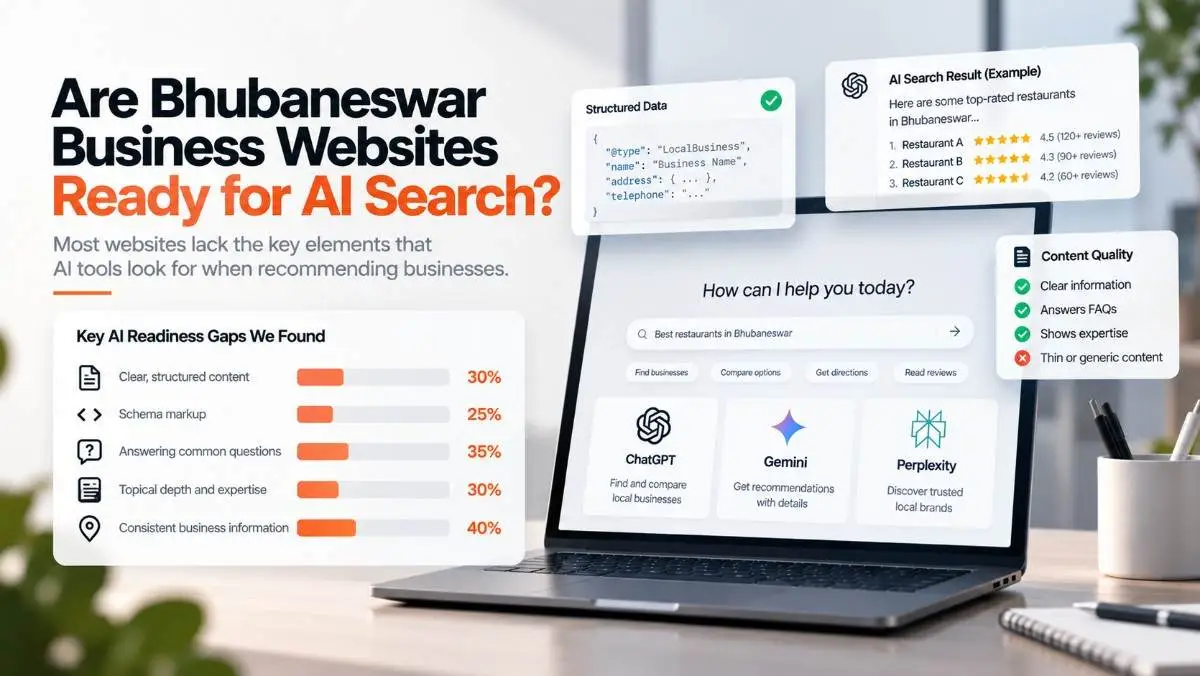
Eleven out of twenty websites had no structured data at all, which means AI systems have no machine-readable signals to pull from. Zero-click searches, where the user gets their answer directly from Google's AI Overview without visiting any website, are growing steadily. The businesses best positioned for this shift are the ones whose websites give clear, structured, factual answers to the questions their customers ask. Eighteen of the twenty websites we audited had no FAQ sections, no structured content organized around questions, and no schema markup to help AI systems parse their content.
This is not a future problem. Google AI Overviews are already appearing for local searches in Indian cities. The businesses that show up in those overviews will be the ones whose websites are structured to feed AI systems with clear, authoritative, well-organized information.
What Should You Do If Your Website Has These Problems?
None of the issues we found are catastrophic, and none are permanent. Here is a practical priority order for a business owner who recognizes their website in this report.
Week 1: Measure everything
Set up Google Search Console if you have not already. Set up Google Analytics 4. Run your website through Google PageSpeed Insights and note the specific failures. Check your Core Web Vitals scores in Search Console.
Weeks 2 to 4: Fix the technical foundation
Fix all indexing errors flagged in Search Console. Repair broken links. Compress all images and convert to WebP where possible. Ensure every page has a unique title tag and meta description. Submit your XML sitemap to Google Search Console.
Month 2: Improve content quality
Audit every service and product page for word count and keyword relevance. Rewrite thin pages with genuinely useful information about what your business does and who it serves. Add local business schema markup to your homepage and contact page. Verify NAP consistency across your website and every directory listing.
Month 3 onwards: Build sustained visibility
Start a blog or resources section that answers the questions your target audience actually asks. Build area-specific landing pages if you serve multiple neighborhoods in Bhubaneswar. Optimize your Google Business Profile with complete information, photos, and regular posts. Respond to every review on your profile. Consider adding FAQ schema and structured content to prepare for AI search visibility.
Related: How to choose the right digital marketing agency in Bhubaneswar if you want professional help implementing these fixes.
What Does This Audit Tell Us About SEO in Bhubaneswar?
The pattern across all twenty audits tells a clear story. These websites were built by developers and designers who focused on how things look and how they function for visitors, but received no guidance on what search engines need. Nobody checked the website's search performance six months or a year after launch. Nobody ran a website audit to see whether Google could actually find and rank the pages.
The result is an entire city's worth of business websites that appear polished but are nearly invisible to the search engine that most of their potential customers use to find services.
This is not unique to Bhubaneswar. We see the same pattern across tier-2 and tier-3 Indian cities where the digital marketing ecosystem is still maturing and professional SEO expertise is underrepresented. But Bhubaneswar is where we are based, and it is where we have the data.
The gap is fixable. And for any business willing to address these issues, the competitive advantage is immediate. When 16 out of 20 businesses in your city have five or more correctable SEO problems, the bar for standing out in search results is not as high as you might think.
The 7 most common problems, ranked by frequency:
- Slow loading and unoptimized images: 19 of 20
- Thin or generic on-page content: 18 of 20
- Core Web Vitals failures: 17 of 20
- Incomplete local SEO signals: 15 of 20
- Missing or duplicate meta tags: 14 of 20
- Indexing issues and broken links: 13 of 20
- Mobile usability problems: 12 of 20
At least three of these issues were present on every single website. Eleven out of twenty had all seven.
The Oddtusk team runs structured SEO audits like this one for businesses across Bhubaneswar and beyond. We evaluate technical SEO, Core Web Vitals, on-page content, mobile usability, and local signals. We find what is broken, prioritize fixes by revenue impact, and either implement the changes ourselves or guide your team through them. If you see your website in the findings above, an SEO audit is the right place to start.
Get your own website audited for free
We will run the same audit framework from this study on your website and send you a report with the exact issues and priorities. No strings attached.
Request Your Free Audit
[ Common questions ]
SEO Audit FAQs
An SEO audit is a structured review of every factor that affects how your website performs in search results. It covers technical health, on-page content, mobile usability, Core Web Vitals, and local signals like your Google Business Profile. For a small business, an audit matters because most visibility problems are invisible from the outside. Your site might look fine to visitors but have indexing errors, missing meta tags, or broken schema markup that prevent Google from ranking it. In our audit of 20 Bhubaneswar businesses, 16 out of 20 had at least five correctable issues costing them daily traffic.
The cost varies based on the size and complexity of your website. A basic technical audit of a small business site with under 50 pages is far less involved than a full audit of a 500-page ecommerce store. What matters more than the price is the scope. A proper audit should cover crawlability, indexing, Core Web Vitals, on-page content, meta tags, mobile usability, local SEO signals, and structured data. If a provider quotes you without asking about your site size or business goals, the audit is unlikely to surface the issues that actually affect your rankings.
A website that looks good to visitors can still be invisible to Google. In our audit, the most common hidden issues were noindex tags accidentally blocking important pages from search results, missing XML sitemaps, thin content with fewer than 150 words on service pages, and incomplete Google Business Profiles. These problems do not show any visible signs when you browse the website normally. The only way to find them is through a proper technical SEO audit using tools like Google Search Console, PageSpeed Insights, and a site crawler.
Based on our audit of 20 business websites across 8 industries in Bhubaneswar, the most common SEO mistakes ranked by frequency were: unoptimized images causing slow page loads (19 of 20 sites), thin or generic page content (18 of 20), Core Web Vitals failures (17 of 20), incomplete local SEO signals (15 of 20), missing or duplicate meta tags (14 of 20), indexing issues (13 of 20), and mobile usability problems (12 of 20). These patterns are consistent with what we observe across tier-2 and tier-3 cities in India where websites are designed for visual appeal without an SEO framework.
Technical fixes like repairing broken links, submitting an XML sitemap, and fixing indexing errors can show results within two to four weeks as Google recrawls the affected pages. Content improvements like rewriting thin service pages and adding proper meta descriptions typically take one to three months to influence rankings. Local SEO changes such as completing your Google Business Profile and fixing NAP consistency can improve local pack visibility within four to six weeks. The exact timeline depends on your domain authority, the competitiveness of your target keywords, and how many issues your site currently has.
You can identify many of the issues we found using free tools. Google Search Console shows indexing errors, mobile usability issues, and Core Web Vitals scores. Google PageSpeed Insights tests individual page performance. Google Business Profile lets you check your listing completeness. For a more thorough technical audit, free tiers of tools like Screaming Frog or Ahrefs Webmaster Tools can crawl your site and flag broken links, duplicate meta tags, and missing structured data. What you cannot easily do yourself is prioritize which fixes will move the needle most for your specific business and keywords.
