
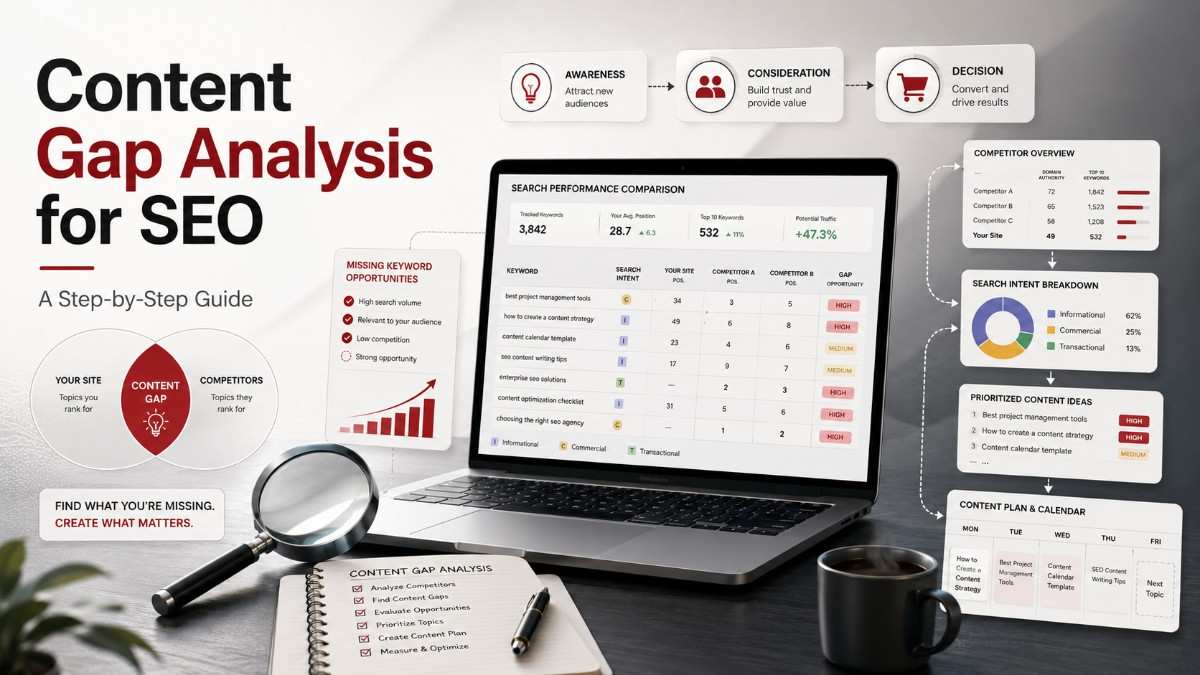
How complete topic coverage directly affects your site's authority signals in both traditional and AI-powered search.
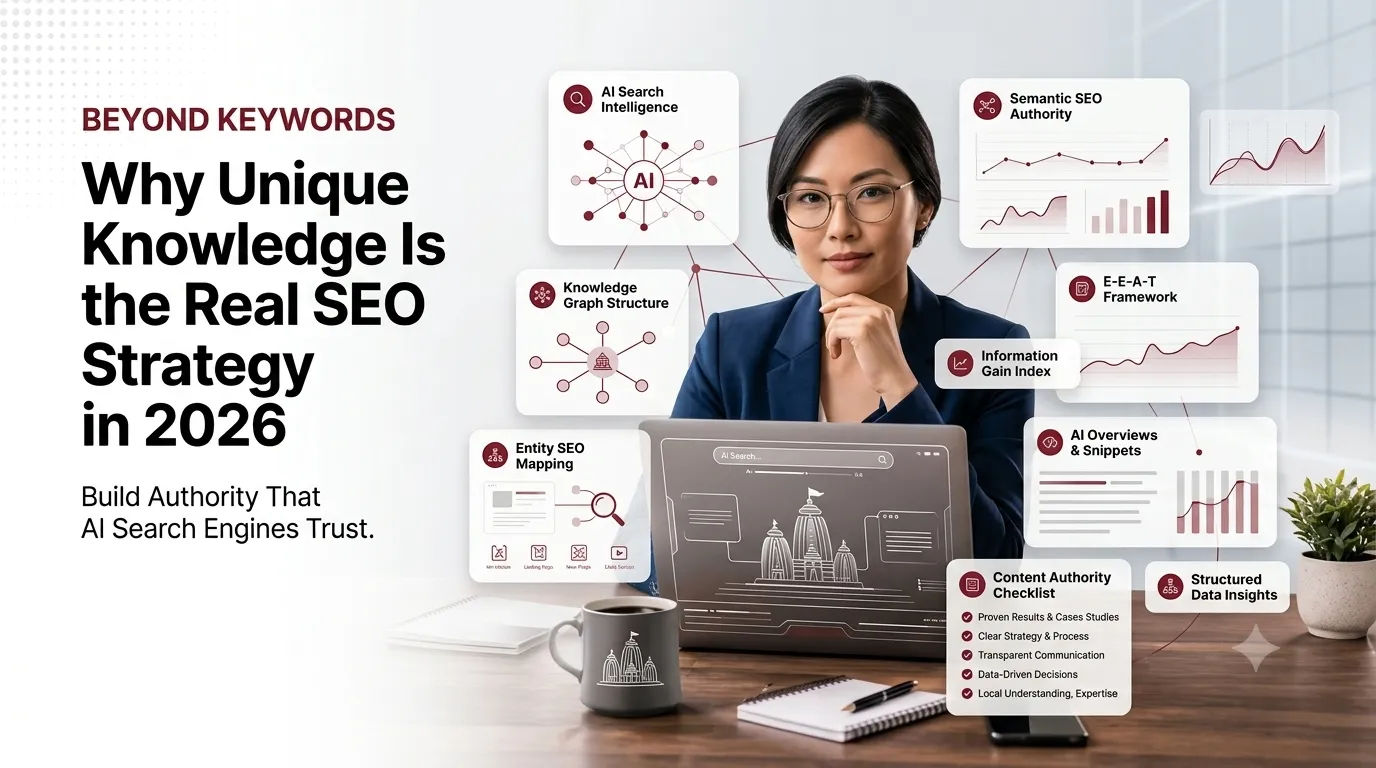
Beyond Keywords: Why Unique Knowledge Is the Real SEO Strategy in 2026
Date: 07 - 20 - 2026
Time to read: 9 minutes
[ Table of
Content ]
The brands succeeding in search today are not the ones producing more content. They are the ones publishing facts no other company has, backed by experience no AI model can manufacture.
If your current marketing strategy is built around fitting a target keyword into a blog post fifteen times, you are not optimising for search — you are running a digital museum. Keyword matching was the game twenty years ago. AI-powered search engines now look past the words to evaluate original concepts, contextual relationships, and genuine expertise.
The question Google's systems ask has fundamentally changed. It is no longer "does this page contain the keyword?" It is "does this page add something the searcher cannot find anywhere else?"
How Search Evaluation Changed — and What It Means for Your Brand
Think about asking five people where to eat dinner. Four of them say the same thing: "The food is amazing, the atmosphere is great, and the staff is friendly." The fifth one tells you something specific: "Go on Thursday — the head chef runs a hidden tasting menu that isn't on the website."
You remember the fifth person. Not because they used better vocabulary, but because they revealed something genuinely useful that the others did not know to share.
Search works exactly the same way now. Repackaging another website's content with slightly different wording does not send a useful signal to the algorithm. It tells Google you are the fifth person in line with the same answer, not the one worth remembering.
This shift has practical consequences for every part of your content strategy. The editorial question is no longer "what keywords do we need on this page?" It is "what does our brand know that nobody else has published yet?"
Suggested reading:What AI
Visibility Means for Brands in 2026
Why Keyword Stuffing Is Dead — and What Replaced It
In an earlier era of search, repeating your target phrase twenty times across a page was enough to reach page one. The entire industry built workflows around this mechanic. Those workflows are now actively counterproductive.
Today's search systems understand that the following terms all refer to the same underlying subject:
- Semantic SEO Optimization
- Entity-Based Search Architecture
- Knowledge Graph Integration
- Structured Data Mapping
A page that covers these related concepts in depth, connecting them through coherent explanation and real examples, signals far deeper expertise than a page that repeats one phrase at a set density. Google's language models are evaluating comprehensiveness and depth, not keyword count.
The new hierarchy of search signals
The rules have reorganised around a different priority order. Keyword repetition establishes only the most basic topical relevance signal — it tells the algorithm what the page is broadly about, nothing more. In-depth topic coverage, where you explain concepts completely with examples and address the sub-questions a reader will naturally have, establishes genuine competence. Adding unique data, original research, or insights derived from firsthand implementation is what creates the kind of unbeatable authority that is very difficult for a competitor to replicate overnight.
This is why semantic SEO has displaced traditional keyword optimisation as the primary discipline. The goal is not to rank for a phrase; it is to become the most trusted source on a topic.
The Information Gain Framework: Google's Most Underrated Ranking Signal
Information gain is Google's measure of whether a page teaches readers something new that is not already covered by the other pages ranking for the same query. It is the algorithmic equivalent of the dinner recommendation story above — the question the system is asking is whether your page is the first four friends or the fifth.
High-information-gain content has several identifiable characteristics that distinguish it from standard recycled material.
Standard recycled content versus high information-gain content
| Standard Recycled Content | High Information-Gain Content |
|---|---|
| Repeats basic textbook facts | Introduces proprietary survey findings |
| Gives generic strategy advice | Shares actual campaign failure metrics with analysis |
| Lists common industry definitions | Explains step-by-step implementation with edge cases |
| Cites the same public statistics | Introduces original test data from real client work |
Every piece of content you produce should pass a simple test before it goes live: if a researcher already read the five top-ranking pages for this keyword, would your article still teach them something new? If the honest answer is no, the article is not ready.
Firsthand Experience Is Your Unfair Advantage
Generic content cannot win this race. Firsthand experience — the specific knowledge that comes from actually implementing what you are writing about — is something no AI content tool can generate and no competitor can easily copy. It is also exactly what Google's E-E-A-T framework is designed to reward.
The distinction becomes immediately clear when you compare two approaches to the same subject.
Weak versus strong authority signals in practice
Weak: "We know SEO can help increase your website traffic."
Strong: "Based on auditing 120 D2C brands, we found that comparison guides convert 38% better than standard product pages when the product requires a considered purchase decision."
The second version does three things simultaneously. It names the source of the claim (direct audit work), it quantifies the finding (a specific percentage), and it adds context that makes the finding applicable (the purchase consideration qualifier). This is what E-E-A-T looks like when it is executed well: expertise made visible through specifics, not claimed through adjectives.
Your proprietary operations data is your most defensible content asset. Campaign results, client outcomes, implementation notes, test data from experiments — these are the raw materials for content that competitors cannot replicate without doing the same work.
Suggested reading:Ranking Is Not Enough: How AI
Overlooks Traditional SEO
How to Build Content That Search Engines and AI Systems Trust
Authority in modern search is built through a combination of original knowledge, structural clarity, and ecosystem depth. None of these elements work in isolation. Here is how to approach each one.
Gather proprietary research and back every claim with evidence
Stop making unsubstantiated assertions. Every claim in your content should have a source, and the best source is your own work. Rather than explaining why site speed matters, describe exactly how a one-second improvement in Largest Contentful Paint affected conversion rate on a specific project. Rather than listing the benefits of email segmentation, share the open rate delta between your segmented and non-segmented campaigns. Numbers with context are the building blocks of high-gain content.
Share the actual problems you faced and the specific solutions that worked
The most credible content in any niche is the post-mortem or the case study — the piece that says "here is what we tried, here is what broke, here is exactly what we changed, and here is what happened." This level of transparency creates credibility that general advice never can, because it demonstrates that the author actually did the thing rather than read about it. It is also the type of content that attracts links naturally, because other practitioners want to reference it.
Create topic ecosystems, not isolated articles
A single strong article on a subject is a start. A network of interconnected articles covering every meaningful sub-topic, linked with deliberate internal linking, is a topical authority signal. Topical authority mapping is the process of identifying every question your audience might ask about a subject and building pages that answer each one completely, with cross-links that show Google how the pieces fit together.
Google evaluates how completely a site covers a subject area, not just how good individual pages are. A site that answers every meaningful question about a topic earns more authority than a site with a few strong pages and large gaps elsewhere. Those gaps are opportunities for competitors — and they are findable through a content gap analysis.
Match your content format to the search intent behind each topic
Expertise conveyed in the wrong format does not rank. A definitive research study published as a 4,000-word narrative essay will not capture a featured snippet. A step-by-step process presented as a listicle without numbered structure will not rank for a "how to" query. Understanding AEO and GEO optimization means knowing which format Google rewards for each intent type — and building to that specification from the start, not retrofitting it later.
Entity SEO and the Knowledge Graph: The Architecture Underneath
Beneath the surface of every modern search result is a structured map of entities — the named people, products, organisations, concepts, and places that Google's Knowledge Graph connects to one another. Entity SEO is the practice of making sure your brand and your content are correctly mapped within that structure.
When your content correctly defines an entity, describes its properties, and connects it to related entities using natural language and schema markup, Google can match your pages to a much wider range of queries than keyword matching alone would support. This is why entity-optimised pages frequently rank for dozens of related queries simultaneously — the system understands what the page is about at a conceptual level, not just a lexical one.
What entity optimisation looks like in practice
Entity optimisation is not a checklist — it is a way of writing. It means defining every key term clearly when it first appears. It means explaining the relationships between concepts explicitly rather than assuming the reader will make the connections. It means using structured data to signal entity types to Google's crawlers, and it means building the kind of external citation profile — mentions on authoritative third-party sources — that helps Google confirm your brand is a real, recognised entity in your space.
The same principles that make content clear to a knowledgeable human reader also make it parseable to a language model. Precision, explicit relationships, and well-defined terms are the foundation of both good writing and good entity SEO.
Making Your Brand Visible in AI-Generated Answers
The conversation around AI search visibility — often framed as GEO (Generative Engine Optimization) or AEO (Answer Engine Optimization) — is in practice an extension of everything above. The systems generating answers in ChatGPT, Gemini, Perplexity, and Google AI Overviews are trained on the same kind of trustworthy, evidence-based, entity-rich content that ranks well in traditional search.
What changes is the emphasis. AI Overviews strongly favour content that makes specific claims clearly, supports them with evidence, and organises information so that a language model can extract and paraphrase a useful answer accurately. Practically, this means:
- Define every key term explicitly near the top of each page.
- Use step-by-step structures where the logical sequence is immediately apparent.
- Include a FAQ section with direct, self-contained answers to the questions people actually ask.
- Apply schema markup — FAQ schema, HowTo schema, Article schema — to flag the content type to crawlers.
- Build external citation signals so that AI models consistently associate your brand with the topic, not just your website.
The brands showing up in AI-generated answers are not the ones that optimised for AI. They are the ones that built genuine authority through original knowledge, clear writing, and systematic topic coverage — and the AI systems recognise that quality. There is no shortcut that skips the foundational work.
Suggested reading:Authority SEO: How Reddit,
Quora and Brand Mentions Drive AI Visibility
Key Takeaways
- Stop optimising for keyword frequency: Google's AI evaluates meaning, depth, and originality. Keyword density is a basic relevance signal, not a ranking lever. Focus your editorial energy on semantic SEO — covering topics completely rather than placing phrases precisely.
- Ask what your brand knows that nobody else has published: Your proprietary data, client outcomes, and implementation experience are your most defensible content assets. Turn them into content before a competitor does.
- Information gain is the metric that matters: Every piece of content should teach the reader something they could not find on the top five competing pages. If it does not, it is not ready to publish.
- Ten well-researched articles beat fifty generic ones: Depth and originality compound over time. Thin, repetitive content dilutes authority rather than building it.
- Build topic ecosystems, not isolated posts: Use topical authority mapping to identify every meaningful sub-topic in your niche and build deliberate coverage with strong internal linking.
- Entity SEO is the architecture: Make sure your brand, your content, and your key concepts are correctly represented in Google's Knowledge Graph through schema markup and external citations.
- E-E-A-T is made visible through specifics: Do not claim expertise through adjectives. Demonstrate it through numbers, case studies, named sources, and implementation detail that only someone who did the work could provide.
- AI visibility follows authority, not optimisation tricks: The brands appearing in AI Overviews and LLM-generated answers are there because they built genuine authority. Our AEO/GEO optimization service operationalises this principle end to end. This article makes the case for unique knowledge; for the companion deep-dive on how these signals work together across a full service stack, read our AI Overviews, entities and E-E-A-T playbook.
[ Common questions ]
SEO Strategy 2026 FAQs
Modern AI-powered search engines evaluate meaning, context, and expertise rather than keyword frequency. Google's systems now assess whether a page contributes genuinely new information to a topic, not whether a phrase appears a certain number of times. Brands that optimise only for keywords are competing against thousands of identical pages; brands that contribute unique proprietary knowledge, firsthand experience, and original data stand apart in a way that algorithms can measure and reward.
Information gain is a quality signal Google uses to measure whether a page teaches readers something genuinely new that is not already present in competing pages for the same query. Pages that simply restate what everyone else says provide no information gain. Pages that introduce proprietary survey findings, real campaign results, or implementation-level details that others lack score highly on this metric and receive stronger ranking signals as a result.
Traditional keyword SEO focused on placing exact-match phrases at a target density across a page. Semantic SEO focuses on covering a topic completely by mapping entities, their relationships, and all the sub-questions a user might have. Google's language models understand that "semantic SEO optimization," "entity-based search architecture," and "knowledge graph integration" all describe aspects of the same subject. A page that covers these related concepts in depth signals deeper expertise than one that repeats a single keyword phrase.
Entity-based SEO structures content around named entities — people, places, products, concepts, and organisations — and the relationships between them. Google's Knowledge Graph maps these entities. When your content correctly describes an entity, its properties, and its connections to other entities, Google can match your page to a much wider set of queries than keyword matching alone allows. This is why entity-optimised pages often rank for many related queries simultaneously.
Firsthand experience means sharing knowledge you acquired by actually doing the thing you are writing about, not by summarising what others have written. Examples include specific campaign metrics you achieved, client results with actual numbers, a real problem you encountered and the exact fix you found, or test data from your own experiments. This is what separates an agency that writes "SEO increases traffic" from one that writes "after auditing 120 D2C brands, we found that comparison guides convert 38% better than standard product pages."
AI search systems like Google AI Overviews, ChatGPT search, and Perplexity evaluate sources partly by how comprehensively they cover a subject area. A site that answers every meaningful question about a topic, at the right depth, across interconnected pages is more likely to be cited as a reliable source than a site with a single strong article and nothing else. Building topical authority means deliberately mapping the full question landscape for your niche and creating content that covers it completely.
Answer Engine Optimization (AEO) focuses on getting your content cited in structured answer formats such as Google's featured snippets and People Also Ask boxes. Generative Engine Optimization (GEO) is broader: it focuses on making your content citable in AI-generated answers from large language models. Both require clear entity definitions, structured formatting, FAQ schema, and genuine expertise. Our AEO/GEO optimization service is built around closing these citation gaps systematically.
Identify data you have that no one else does: client results, internal audits, survey responses, test outcomes, or operational metrics. Then build content that presents this data with full context — what you measured, how you measured it, what the result was, and what it means for your audience. Specificity is what information gain looks like in practice. "A 1.2-second improvement in LCP increased add-to-cart rate by 11% across 47 Shopify stores" is the kind of claim that earns citations and backlinks.
There is no fixed number — it depends on how many meaningful questions exist within your topic area. The right approach is to start with a topical map: list every question your audience might ask from awareness through to purchase. Audit what you already have and identify the gaps. A topic with 40 meaningful sub-questions needs 40 pages with strong coverage, not 200 thin pages repeating the same information.
Yes, but its role has changed. Rather than identifying a phrase to repeat, keyword research in 2026 maps which questions people are asking, how demand distributes across sub-topics, and where competitors have gaps. The output feeds entity mapping and topical authority planning rather than on-page density targets. Search volume and keyword difficulty remain useful for prioritisation; they are just no longer the primary ranking levers.
AI Overviews favour content that makes specific claims clearly, supports them with evidence, and organises information so that a language model can extract and paraphrase it accurately. Define every key term explicitly, use step-by-step structures, include FAQ sections with direct one-paragraph answers, apply schema markup, and build external citation signals so that AI models associate your brand with the topic consistently.
In almost every case, yes. Ten articles that each introduce original research, specific examples, and actionable implementation detail will accumulate more topical authority, earn more backlinks, and generate more AI citations than fifty articles that restate common knowledge. The exception is large-scale programmatic SEO for ecommerce catalogs — and even then, each page needs a distinct angle or unique data set to avoid thin-content penalties.
