

How to build pillar and cluster content structures that earn topical authority in both traditional and AI-powered search.
Internal Linking Strategy: The Most Underrated SEO Tactic (2026 Guide)
Date: 17 - 08 - 2026
Time to read: 12 minutes
[ Table of Content ]
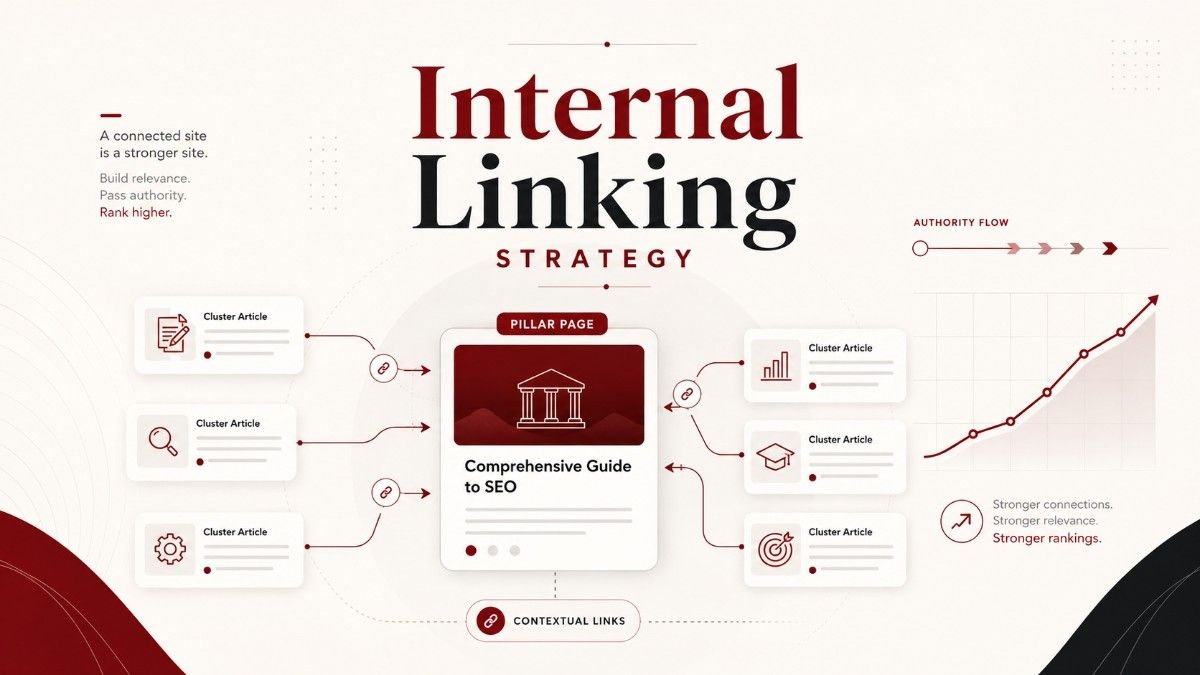
Website administrators spend thousands of dollars on outreach budgets chasing expensive backlinks, while a vast source of untapped ranking power sits dormant inside their own CMS. An intelligent internal linking strategy is the fastest and most cost-effective way to distribute search equity without writing a single guest post.
By interlinking related content pieces, you signal topical expertise to search engine crawlers while simultaneously helping users navigate your site intuitively. This guide breaks down what makes an internal linking strategy work in 2026, how to structure site architecture, and how to build internal links that actually move rankings.
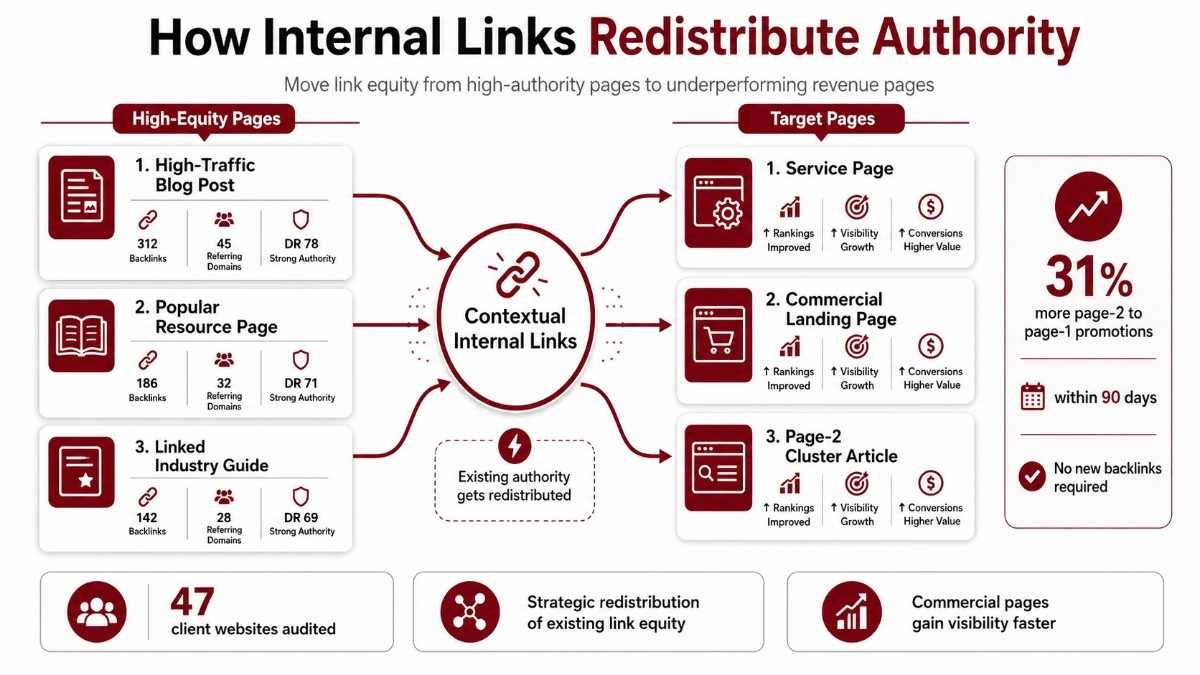
What we have seen in practice: After auditing and relinking client websites at Oddtusk since 2025, we consistently see page-2-to-page-1 keyword promotions within 90 days without acquiring a single new backlink. The only change was strategic redistribution of existing link equity through contextual internal links.
Why Do Internal Links Beat Expensive External Link Building?
Internal links give you 100% control over how PageRank flows through your website, something no external backlink campaign can offer. While external links build domain authority, internal links determine where that authority lands. Most websites leave the majority of their accumulated link equity trapped on a handful of high-traffic pages, never transferring it to the commercial landing pages that generate revenue.
Unlocking Hidden PageRank Across Your Domain
When external websites link to your popular blog posts or resource pages, that authority accumulates on those URLs. Without a deliberate internal linking strategy, it stops there.
PageRank Distribution: Contextual internal links transfer accumulated authority from high-equity pages to commercial landing pages and under-performing cluster articles. According to Ahrefs' 2025 internal link study, pages receiving contextual links from high-DR pages rank on average 2.3 positions higher than comparable pages without those links.
Crawl Budget Control: Google's crawlers have a finite budget per domain. A well-structured internal linking strategy ensures bots reach your most important pages during every crawl cycle, not just your homepage and most-linked posts. Our technical SEO audit process always starts with mapping crawl depth before recommending link structure changes.
Rescuing Orphan Pages: Pages with no internal links pointing to them are effectively invisible to both crawlers and users. Google's own documentation confirms that pages not linked from anywhere on the site may not be crawled or indexed at all, regardless of whether they appear in your XML sitemap.
How Internal Links Guide User Engagement
Contextual links are not only for search bots. They are a core part of the user journey.
Decreasing Bounce Rate: Providing relevant follow-up links keeps readers on your site rather than returning to the search results page. Semrush's 2025 UX study found that pages with 3 to 5 contextual internal links had an average bounce rate 18% lower than pages with none.
Building Topic Clusters: Linking supporting blog articles to core pillar pages signals to Google that your site covers a topic comprehensively. This is a critical factor for topical authority in 2026, especially as AI Overviews favour sources that demonstrate depth across a subject. Our guide on topic clusters for AI SEO covers how to build this architecture end to end.
Improving the Conversion Journey: Connecting informational blog posts to solution pages creates a natural progression from awareness to conversion. A reader learning about crawl budget optimisation is a natural candidate for a link to your SEO service page.
Suggested reading:Why Topical Authority Matters More Than Ever for AI Search
What Are the Core Components of an Internal Linking Strategy?
A successful internal linking strategy rests on three pillars: site architecture, anchor text selection, and link context. Getting all three right is what separates sites that rank on page one from sites that plateau on page two despite producing good content.
How Should You Structure Site Architecture and Topic Hubs?
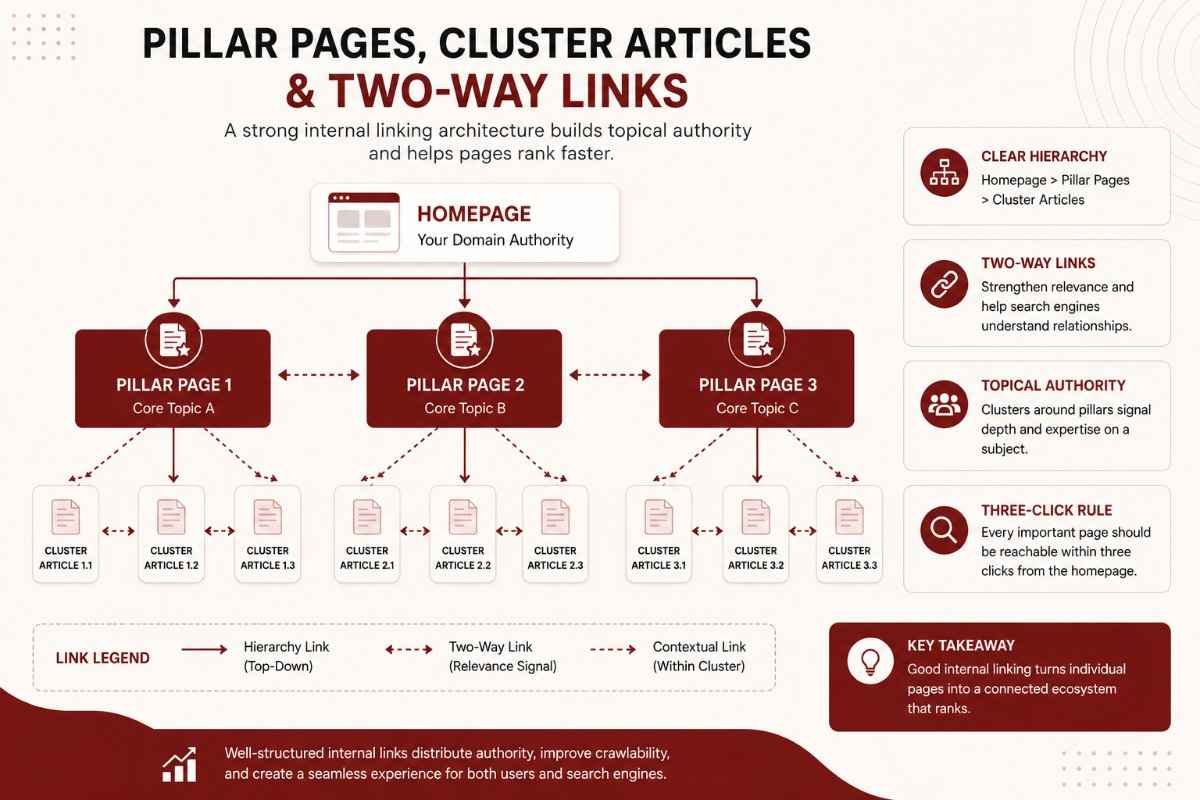
A well-defined content hierarchy allows search engines to understand the relationships between your pages and assign topical authority accordingly.
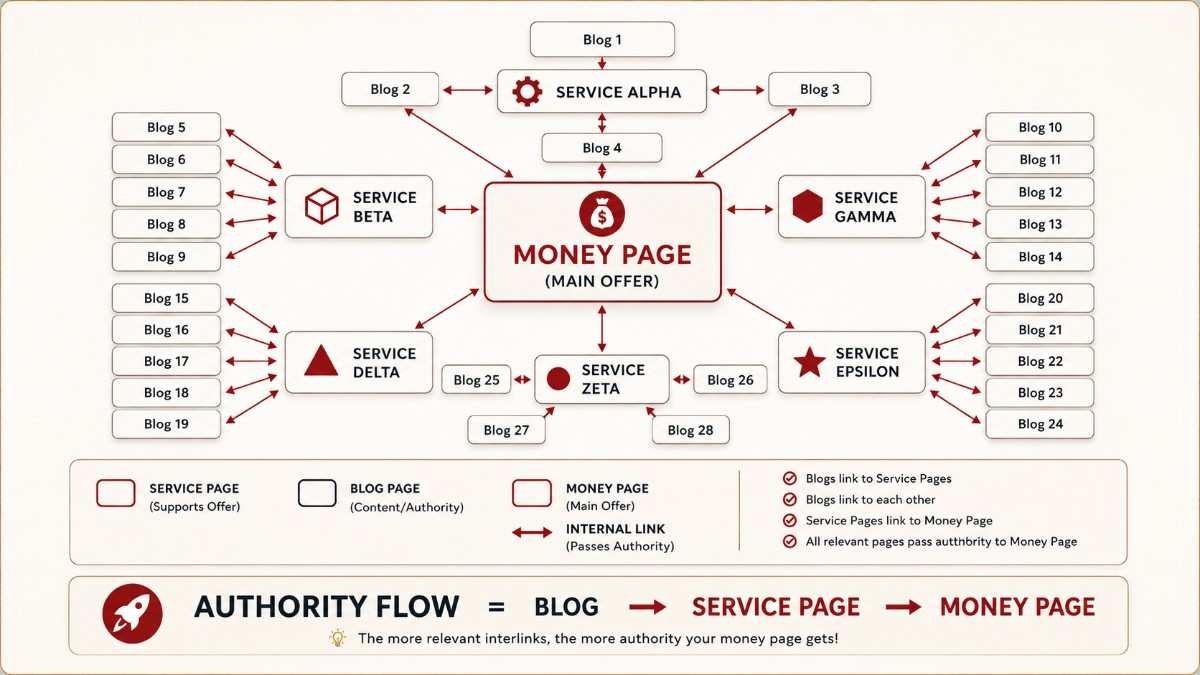
Pillar Pages: Create comprehensive guides covering broad industry topics at a high level. These become the equity hubs of your content cluster, the pages you want to rank for your most competitive head terms.
Cluster Articles: Develop specialised posts addressing specific sub-topics within the pillar's broader theme. Each cluster article links back to the pillar and receives a link from it. This is the foundation of the content strategy approach we apply for every client at Oddtusk.
Two-Way Links: Ensure cluster pages link to pillar pages and pillar pages link back to cluster articles. This bidirectional relationship reinforces the semantic connection in both directions for crawlers.
Three-Click Rule: Every important page on your site should be reachable within three clicks of the homepage. Pages buried deeper than three levels receive significantly less crawl attention and authority flow.
How Do You Choose the Right Anchor Text?
Anchor text is the primary signal Google uses to understand what the destination page is about. Use it strategically, not mechanically.
Descriptive Anchor Text: Use natural, keyword-rich anchor phrases rather than generic labels like "click here" or "read more." For example, instead of "learn more," write "how pillar pages distribute topic authority" with the link embedded in that phrase.
Diverse Phrases: Mix exact-match anchors (5 to 10% of your links), partial-match anchors (25 to 35%), and natural contextual variations. An over-optimised anchor text profile where every link uses the exact same phrase triggers spam filters post-Penguin.
Surrounding Context: Google reads the sentences around your link, not just the anchor text itself. Placing a link in a paragraph that is topically relevant to the destination page multiplies the relevance signal. This is why semantic SEO and internal linking are so closely connected.
Suggested reading:Entity-Based SEO: How AI Uses Content Context
How to Execute an Internal Linking Strategy That Moves Rankings
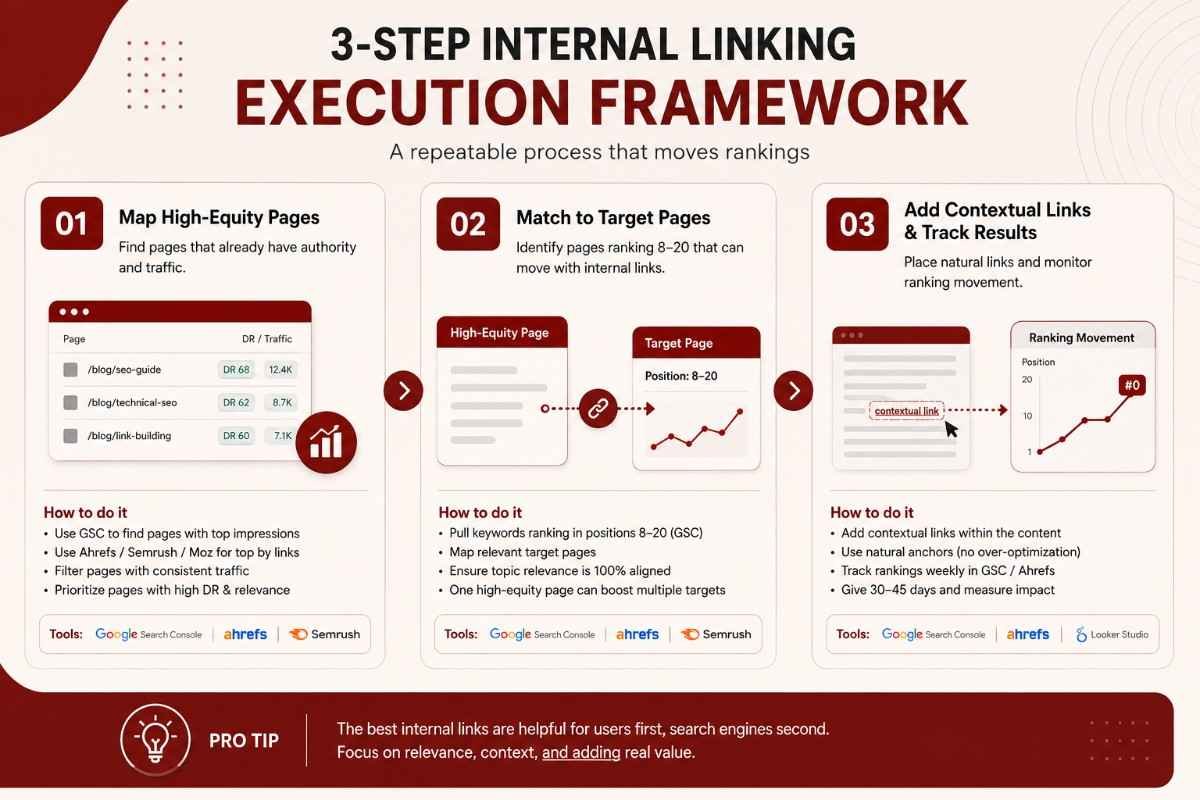
Use this three-step workflow to audit, organise, and optimise internal linking across your entire domain.
Step 1: Map Out Your High-Equity Pages
Open Google Search Console and filter by pages with the highest number of external backlinks. Cross-reference with your SEO platform (Ahrefs, Semrush, or Moz) to get a ranked list of pages by referring domain count. These are your equity distributors, the pages that will fund the ranking growth of the rest of your site.
What we observe across client audits: In most B2B and ecommerce sites, the top 10% of pages hold over 70% of all link equity. Most of that equity is never passed anywhere useful.
Step 2: Match Equity Drivers to Under-Performing Target Pages
Pull a GSC performance report filtered to keywords ranking in positions 8 to 20 (page two and the bottom of page one). These are your target pages. They have enough relevance to rank but lack the authority to break through. Sort by pages with the highest conversion rates or commercial intent. These are the pages that, if promoted, generate revenue.
For ecommerce clients, this step connects directly to collection and product pages. Our ecommerce SEO process maps these equity gaps to the product catalog before any new content is written.
Step 3: Add Contextual Links and Track Results
Edit the source (equity driver) pages and insert descriptive contextual links within the body text pointing to your target pages. Use natural anchor text variants. Avoid placing all links in the introduction. Distribute across the article at logical reading points. Record current rankings for all target keywords as a baseline, then monitor weekly for four to eight weeks. Most clients see measurable movement within 30 to 45 days.
Following this workflow precisely ensures equity flows to revenue-generating pages. Revising your internal linking strategy quarterly prevents traffic loss as your content library grows and page relationships evolve.
What Are the Most Common Internal Linking Mistakes to Avoid?
Even experienced content teams make structural errors that silently undermine their internal links. These are the four most damaging patterns we see in site audits.
| Common Mistake | Why It Hurts SEO | Simple Fix |
|---|---|---|
| Over-Optimised Anchors | Appears manipulative to Google's spam filters; Penguin penalises repetitive exact-match anchor patterns | Use natural, conversational variations of your target keyword across different source pages |
| Broken Internal Links | Wastes crawl budget and creates dead-end user experiences; a 404 on an internal link loses any equity that link would have passed | Run quarterly site audits using Screaming Frog or Ahrefs to catch and redirect 404 link errors |
| Excessive Links Per Page | Dilutes the value passed by each individual link; Google distributes a page's equity across all outgoing links | Limit in-body links to 5 to 10 highly relevant references per 2,000 words |
| Footer-Only or Nav-Only Linking | Sitewide boilerplate links carry less contextual weight than editorial in-body links | Prioritise contextual links placed within the main body text of relevant articles |
Correcting these four patterns alone, without adding a single new piece of content, can produce meaningful ranking improvements within a single crawl cycle.
Internal Linking and AI Search: What Changes in 2026?
A well-structured internal linking strategy now directly affects your visibility in AI-powered search results, not just traditional blue-link rankings. Google's AI Overviews, Perplexity, and ChatGPT Search all use crawled page content to generate answers. The way your content is linked and structured determines whether you get cited.
Topical completeness signals: AI systems favour sources that cover a topic comprehensively. A tightly interlinked pillar and cluster architecture signals that your domain has depth on a subject, increasing the probability that an AI cites your site as an authoritative reference. This is the same principle behind our AEO/GEO optimization service.
Crawlability of supporting content: If your cluster articles are orphaned or buried beyond three clicks, AI crawlers may never index them. Internal links are what surface your full content ecosystem to these systems.
Answer-extractable structure: Pages with clear heading hierarchies, short paragraphs, and contextually linked supporting content are significantly more likely to be cited in AI Overviews. According to a 2025 BrightEdge study, 68.7% of AI-cited pages use a strict H1/H2/H3 hierarchy versus roughly 40% of uncited pages.
Content freshness: Pages not visibly updated within 90 days are 3x more likely to lose AI citations than regularly refreshed content. Dating your internal link audits and noting a "last reviewed" date on each page supports both traditional SEO and AI visibility.
This means your internal linking strategy is no longer just about passing PageRank. It is about building a content ecosystem that AI systems can navigate, understand, and cite with confidence. Our article on what is Answer Engine Optimization explains how this ecosystem approach translates into AI citation strategy.
Suggested reading:Understanding Google AI Overviews
Key Takeaways for SEO Growth
- Control your equity. External links build credibility; internal links decide where that credibility lands. Most sites waste the majority of their accumulated authority by never passing it to the pages that matter.
- Context is the currency. Links placed within relevant body paragraphs with descriptive anchor text carry far more weight than sidebar links, footer links, or generic navigation items.
- Build pillar clusters. Organise your content into tight topical clusters anchored by comprehensive pillar pages. This architecture is what signals topical authority to both Google and AI-powered search systems. Our topical authority mapping service builds this structure from scratch.
- Audit quarterly. Broken links, orphan pages, and missed linking opportunities accumulate with every publishing cycle. A quarterly sweep preserves the integrity of your equity distribution network.
- Update for freshness. Pages not refreshed within 90 days lose ground in both traditional search rankings and AI citation probability.
- User intent first. Every internal link should serve a genuine reader need, guiding them to the next logical resource. Search engines follow user signals; links that users actually click send stronger relevance signals than links that are mechanically placed.
- Build for AI citation. Structure your pages with clear definitions, FAQ sections, and step-by-step content so they qualify for AI Overviews. Our AEO/GEO optimization process covers this end to end.
Conclusion: Elevating Search Performance with Oddtusk
Intentional site architecture enables search engines and increasingly AI systems to better understand, index, and rank your digital content. Rather than funding costly external link campaigns, the fastest path to ranking improvement for most sites is a systematic audit and restructure of what already exists inside the CMS.
When technical site architecture aligns with reader intent, the result is a content ecosystem that compounds: each new article strengthens the cluster, each new link raises the equity of surrounding pages, and organic traffic grows without proportional increases in content or link spend.
Oddtusk builds custom search architectures for ambitious companies ready to grow organically. Through data-driven content systems, strategic internal link structures, and quarterly optimisation cycles, we ensure that every page on your domain earns its place in the rankings. Contact Oddtusk to get started.
[ Common questions ]
Internal Linking Strategy FAQs
For posts in the 1,500 to 2,000 word range, aim for 5 to 10 contextual internal links within the body text, roughly one link every 200 to 300 words. Links in headers and footers do not count toward this target; focus on editorial links placed naturally within paragraphs.
Yes. Google confirmed in 2024 that PageRank remains a core ranking signal, and internal links are one of the primary ways PageRank is distributed across a domain. John Mueller has stated that contextual internal links help Google understand both the existence and the relevance of pages, two distinct signals beyond just authority flow.
A pillar page is a comprehensive high-level guide on a broad topic (for example, "The Complete Guide to Content Marketing"). A cluster article covers a specific sub-topic within that theme (for example, "How to Write a Content Brief"). The cluster article links back to the pillar; the pillar links out to all cluster articles. Together they form a topic cluster that signals topical authority to Google.
Orphan pages, those with no internal links pointing to them, receive no equity distribution from the rest of your site. Google's documentation confirms these pages may not be crawled or indexed at all, even if they appear in your XML sitemap. Finding and linking to orphan pages is one of the highest-ROI actions in any technical SEO audit.
Yes. A tightly interlinked content architecture signals topical depth to AI crawlers, increasing the probability of being cited in Google AI Overviews, Perplexity, and ChatGPT Search. Our AEO/GEO optimization service is built around closing these citation gaps through structured content and internal link architecture.
Quarterly is the minimum for most sites. For large sites publishing more than 10 articles per month, monthly audits are worth the investment. Every time you publish new content, you create new opportunities to link from existing high-equity pages. Every time you update old pages, check for broken or missing links.
