Lead Nurturing Services India
Indian B2B buying cycles run 45 to 90 days. US SaaS playbooks mark a lead cold at week four. Indian D2C buyers need 3 to 7 touchpoints before a first purchase. Most brand email sequences end at touchpoint two. Nurture sequences built on the wrong timeline assumptions discard prospects who are still moving through a normal Indian buying journey. Oddtusk builds nurture sequences calibrated to how Indian buyers actually buy. Every programme connects to our CRM integration and WhatsApp automation services.
- Buying stage map (B2B or D2C)
- Content audit by stage
- Lead scoring criteria and MQL definition
- MQL to SQL handoff agreement with sales
- Awareness stage email sequence
- Consideration stage email sequence
- Evaluation stage email and WhatsApp
- Behavioural trigger configuration
- D2C first-purchase flow (3-7 touchpoints)
- Trial-to-paid sequence (SaaS)
- Re-engagement sequence for cold leads
- Monthly sequence performance review
US playbooks drop Indian B2B leads too early; we align automation to the 6 to 13 week deal cycle.
Applying US SaaS benchmarks to India is a significant mistake. Local mid-market deals take longer due to multiple decision-makers and procurement steps. A sequence ending at day 21 misses prospects still in active consideration. Similarly, Indian D2C buyers in high-consideration categories like skincare or supplements need 3 to 7 touchpoints to resolve hesitations. Oddtusk maps the actual Indian journey, ensuring message frequency and content types match local research habits. Every nurture programme is built on our CRM integration foundation and connects WhatsApp at high-intent stages for maximum open rates.
B2B MQL to SQL sequences (45-90 day cycles)
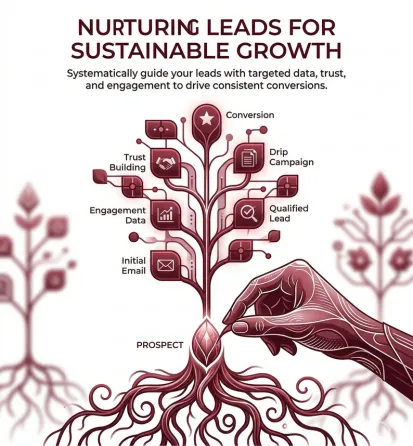
B2B nurturing involves three stages: Awareness uses educational content to build credibility; Consideration provides case studies and product details; Evaluation offers proof points and pricing context. For high-intent leads at Evaluation stage, we introduce WhatsApp to leverage its superior open rates. Before launching, we define MQL thresholds with your sales team based on specific signals that accurately predict Indian B2B sales readiness.
D2C first-purchase flows (3-7 touchpoints)
D2C sequences guide subscribers from interest to purchase over 3 to 7 touchpoints. We address specific category hesitations like sizing or ingredients and provide relevant social proof. A WhatsApp message triggers at peak intent, followed by a first-purchase incentive. We calibrate the timing: high-consideration brands get longer sequences, while impulse-purchase brands use faster flows.
Behavioural triggers and content stage mapping
Triggers fire messages based on actions, like pricing page visits or webinar signups. This is more effective than time-based drips because it delivers content at the moment of highest intent. We map content to each buying stage, ensuring prospects receive helpful information rather than premature sales pitches. Effective trigger-based nurturing relies on the robust data from our CRM integration and GA4 analytics services.
WhatsApp in nurturing and re-engagement sequences
WhatsApp is reserved for high-intent moments where its 80 percent open rate ensures critical messages are seen. It is not for cold outreach, which damages brand reputation. For lapsed leads, we run re-engagement sequences with clear win-back offers and unsubscribe options. This maintains list hygiene and protects your domain's email deliverability by removing inactive contacts from active retention workflows.
45-90 day Indian B2B buying cycle. 3-7 touchpoints before D2C first purchase. MQL handoff agreed with sales before any sequence launches. WhatsApp at Evaluation stage, not Awareness.

Indian enterprise and mid-market B2B buying cycles run 45 to 90 days because of multiple decision-maker layers, internal approval processes, and procurement steps. Sequences calibrated to a 21-day US timeline abandon Indian prospects at the exact point they are beginning to seriously evaluate. Oddtusk builds nurture sequences that sustain engagement across the full Indian buying cycle.
Indian D2C buyers in high-consideration categories typically need 3 to 7 brand touchpoints before a first purchase. Most brand welcome sequences end at touchpoint two and switch to promotional broadcasts. The buyers who needed touchpoints three through seven are lost to a brand that kept communicating.
The MQL definition is agreed with the sales team before the nurture programme launches. A programme that passes contacts to sales too early wastes sales time and creates conflict. A programme that holds contacts too long loses them to competitors. The MQL alignment is the single most important decision in a B2B marketing programme setup.
Mapping, scoring, architecture, and monitoring
Buying stage mapping
Lead scoring configuration
Sequence architecture
Behavioural triggers, re-engagement, and monitoring
Everything you need to know about lead nurturing for Indian brands.
Lead nurturing is the process of building a relationship with a prospect through relevant WhatsApp, email, and content communications that guide them from first awareness to a purchase decision. For Indian B2B brands, nurturing covers the MQL to SQL journey: typically 45 to 90 days. For Indian D2C brands, nurturing covers the discovery to first purchase journey: most Indian D2C buyers in high-consideration categories need 3 to 7 touchpoints between first brand exposure and first purchase.
Indian enterprise and mid-market B2B buying cycles are structurally longer because of multiple decision-maker layers, internal approval processes, vendor reference requirements, and procurement steps absent from US direct-buy scenarios. A US SaaS buyer can approve a purchase in two to four weeks. The same process at an Indian mid-market company often takes six to twelve weeks. Nurture sequences calibrated to a 21-day US timeline abandon Indian prospects who are still actively considering at week three of a nine-week evaluation.
An MQL has shown enough engagement with marketing content to be a potential buyer but has not yet explicitly requested a sales conversation. An SQL has been evaluated by the sales team and confirmed to match the ICP, have a genuine buying need, and be within a timeframe where a commercial conversation is appropriate. The MQL threshold: the lead score at which marketing passes a contact to sales, is agreed between marketing and sales before the programme launches via our CRM integration.
Behavioural triggers fire a specific message when a contact takes a specific action: pricing page visit fires an Evaluation stage email immediately, webinar registration triggers a pre-event sequence, second product page visit fires a WhatsApp message. Time-based drips send the same message on a fixed schedule regardless of what the prospect has done. Behavioural triggers deliver relevant content at the moment of highest intent. Effective trigger-based nurturing requires CRM integration to track the actions that fire the triggers. All outcomes are tracked in GA4 reporting.
WhatsApp is most effective in lead nurturing at the Evaluation stage: when a prospect has already engaged with awareness and consideration content and is actively evaluating whether to have a sales conversation. At this stage, a direct WhatsApp message feels like a natural next step and the 80-plus percent open rate versus email's 25 to 35 percent means the message is almost certainly read. WhatsApp is not appropriate for cold Awareness stage outreach: it produces opt-outs from contacts who have not yet established a relationship with the brand. See our WhatsApp marketing service.
A D2C first-purchase nurture sequence runs from a new subscriber's first interaction through to their first purchase across 3 to 7 touchpoints. High-consideration categories like supplements, skincare, and specialty food need 5 to 7 touchpoints over two to three weeks. The sequence addresses category-specific hesitations: brand story, category hesitation, social proof from similar customers, high-intent WhatsApp at second product page visit, and a first-purchase incentive. Most brand welcome sequences end at touchpoint two: the buyers who needed touchpoints three through seven are lost.
Lead nurturing ends at the first purchase: from that point, the contact enters the retention marketing programme. The handoff is handled in the CRM: the lifecycle stage changes from Lead to Customer, the first-purchase nurture sequence ends, and the post-purchase retention flow begins: review request, cross-sell, replenishment reminder, and loyalty programme onboarding. The quality of the lead nurture programme directly affects the quality of the retention programme. See our retention marketing service.
For Indian B2B lead nurturing, HubSpot is the recommended platform: workflow builder, lead scoring, and CRM pipeline integration. For Indian D2C first-purchase nurturing, Klaviyo is recommended: its Shopify integration and ecommerce event triggers are purpose-built for the D2C purchase journey. WhatsApp nurturing for high-intent stages runs through WATI or Interakt. All sequences are configured in the same platform that handles CRM integration to ensure behavioural triggers fire correctly from CRM events.