Turn clicks into sales with expert Ecommerce SEO. We enhance store visibility, driving targeted organic traffic and boosting revenue. Our strategy focuses on visibility and high-intent keyword rankings that convert visitors into loyal customers sustainably. Brands that pair organic growth with semantic SEO and topical authority mapping compound results faster.
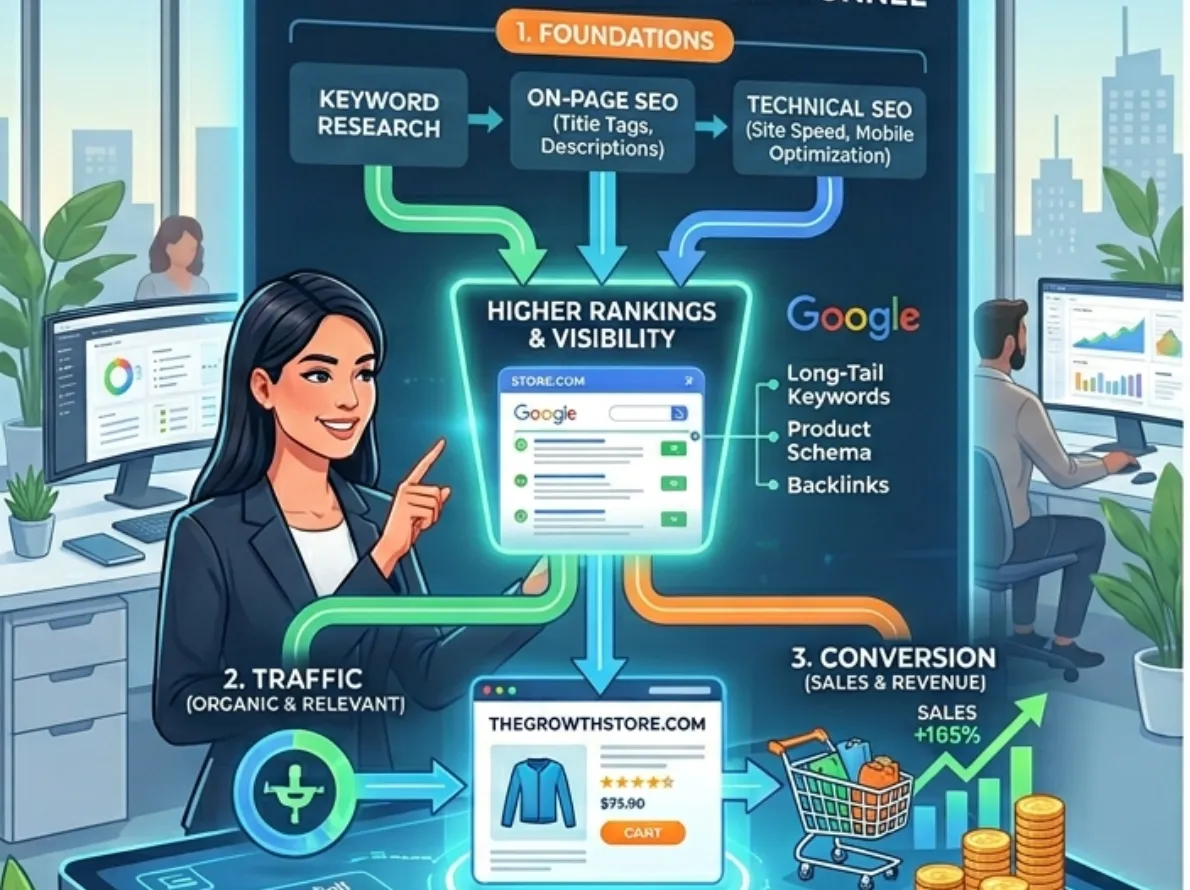
Ranking matters only if it drives revenue. Generic traffic is useless if it doesn't buy. We optimize your store to capture high-intent shoppers, ensuring your products appear exactly when and where your target customers are searching.
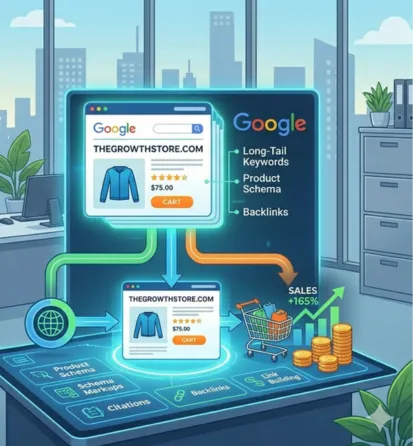
Platform-specific defaults often sabotage SEO. Shopify's faceted navigation can balloon 5,000 products into 50,000 crawlable URLs, while WooCommerce pagination and Magento's layered navigation create indexation chaos. These issues: canonical confusion, thin collection pages, and duplicate manufacturer descriptions, starve high-value pages of crawl budget. Oddtusk performs specialized audits across all major platforms to rectify broken internal linking and missing schema markup. By fixing these platform-inherent flaws, we align your technical SEO with our Shopping ads strategy, ensuring organic and paid channels effectively dominate the same high-converting categories.
Collection page topical authority
Collection and category pages are an e-commerce store's most valuable SEO assets, targeting high-volume transactional queries. Unlike empty product grids, pages with comprehensive, entity-rich body content rank for hundreds of keyword variations. Adding category-level text covering buyer factors and product attributes is the highest-impact SEO action for Indian stores to dominate entire query clusters. This is the foundation of topical authority mapping applied to ecommerce.
Product page NLP optimisation
Most Indian stores use duplicate manufacturer descriptions, which lack buyer-intent signals and unique SEO value. Oddtusk rewrites product copy using entity-rich natural language to match actual search patterns and consumer questions. When paired with product, review, and breadcrumb schema, these optimized pages earn rich results that significantly boost click-through rates compared to standard, unoptimized search listings.
Platform-specific technical fixes
Platform defaults like Shopify's path duplication, WooCommerce's pagination issues, and Magento's layered navigation often create millions of duplicate URLs, depleting your crawl budget. Oddtusk identifies and implements precise technical SEO fixes for each ecosystem, ensuring search engines prioritize your high-value pages. See our specialized Shopify SEO service for the platform-specific detail.
Organic revenue attribution
Ecommerce SEO success is defined by organic revenue, not just traffic volume. Oddtusk utilizes GA4 tracking to attribute actual sales to organic sessions, segmenting conversion rates by collection and category. By measuring which content investments drive commercial returns, we align SEO with performance marketing reporting, providing a clear picture of how organic growth contributes to your total business profitability. This mirrors the full-funnel attribution approach we apply across all channels.
Collection pages with comprehensive content rank for hundreds of queries. Product pages with rich schema earn more clicks. Technical fixes unlock rankings that were already being suppressed.

Oddtusk has delivered ecommerce SEO across all four major platforms. Each has specific SEO architecture quirks, canonical handling differences, and technical constraints. See dedicated services for Shopify SEO, WooCommerce SEO, and Magento SEO for platform-specific detail.
Adding comprehensive, entity-rich body content to empty collection pages is consistently the single highest-impact SEO action for Indian ecommerce stores that have no existing organic strategy. Collection pages with no text rank for almost nothing. Pages with comprehensive topical content rank for hundreds of keyword variations across the category.
Across ecommerce stores audited by Oddtusk, unfixed canonical issues: primarily the Shopify /products/ vs /collections/products/ duplication, suppress organic traffic by an average of 35 percent by splitting ranking signals between duplicate URLs. This is recoverable traffic that requires no new content, only a technical SEO fix.
Audit, technical fixes, collection content, product NLP, schema, internal links, revenue tracking
Ecommerce SEO audit
Collection page topical authority build
Product page NLP optimisation and schema
Blog content and organic revenue tracking
Everything you need to know about ecommerce SEO in India.
Ecommerce SEO involves page types and technical challenges that do not exist in content or service websites. Collection pages need topical authority content that generic product listings do not provide. Product pages need NLP-optimised descriptions that match buyer search intent. Faceted navigation creates near-duplicate URL crawl waste. Platform-specific canonical issues suppress rankings for products appearing under multiple collection paths. Ecommerce SEO requires platform-specific expertise and revenue attribution, not just traffic tracking.
Collection and category pages target broad transactional queries at category level and typically generate the most organic traffic in ecommerce stores when well optimised. Adding comprehensive, entity-rich body content to empty collection pages is consistently the single highest-impact SEO action for Indian ecommerce stores. A collection page with no descriptive text ranks for almost nothing. A collection page with comprehensive topical content ranks for hundreds of keyword variations across the category.
Shopify generates two URLs for every product: the clean /products/product-name URL and a collection-scoped /collections/collection-name/products/product-name URL. Both serve the same content, splitting ranking signals. Oddtusk audits canonical consistency across the full product catalog, fixes internal linking to reinforce the canonical URL, and monitors indexation coverage to ensure the correct URL is indexed. Full detail at our Shopify SEO service page.
Faceted navigation is the filter system on ecommerce category pages that generates unique URLs for each filter combination. A store with 1,000 products and 10 filter attributes can generate millions of near-duplicate URLs, wasting the crawl budget that should be spent on high-value collection and product pages. Oddtusk configures faceted navigation with noindex, canonical, or disallow directives depending on which filter combinations have genuine search demand, protecting crawl budget for pages that can actually rank. This is covered in detail during our technical SEO audit.
Product schema markup communicates structured data about your products: name, price, availability, reviews, and ratings, directly to search engines in machine-readable format. This enables rich results in Google Search showing price, rating stars, and availability directly in the search listing, which increases click-through rate significantly over standard text listings. Review schema aggregates product ratings into rich snippet format. Oddtusk implements the full Product, Review, and BreadcrumbList schema set across every product page.
Oddtusk tracks organic revenue as the primary KPI for ecommerce SEO, not just traffic. We configure GA4 ecommerce tracking to attribute revenue to organic sessions and segment organic conversion rate by collection page and product category. Secondary metrics include keyword rankings for target collection queries, organic impression share by category, crawl coverage, and indexed URL count. This means we can show you which collection pages are driving revenue from SEO, not just which pages improved their ranking position. The same attribution logic applies to our AEO and GEO measurement across AI answer channels.
Oddtusk delivers ecommerce SEO for Shopify, WooCommerce, Magento, and Squarespace. Each platform has distinct SEO architecture, canonical handling, schema implementation methods, and technical constraints. Shopify SEO focuses on canonical duplication and collection body content. WooCommerce SEO focuses on pagination and category hierarchy. Magento SEO focuses on faceted navigation and XML sitemap management. Platform knowledge matters because generic advice applied to the wrong platform creates new problems.
Ecommerce SEO and Shopping ads are complementary channels targeting the same buyers at different costs. Shopping ads capture immediate purchase intent at a cost per click. SEO builds organic collection and product page rankings that generate the same clicks without ongoing spend. Oddtusk plans both channels together so they prioritise the same product categories: Shopping ads drive revenue while SEO builds, and as organic rankings establish, they reduce the total paid spend needed to maintain the same revenue level.