Every Shopify store has the same three problems by default: canonical duplication between /products/ and /collections/products/ URLs suppressing rankings, collection pages with no content that cannot rank for category queries, and product descriptions copied from manufacturers that offer no differentiated signal. Oddtusk fixes all three, in sequence, and measures the result in organic revenue. Brands also running semantic SEO and topical authority mapping across the full site compound results faster.
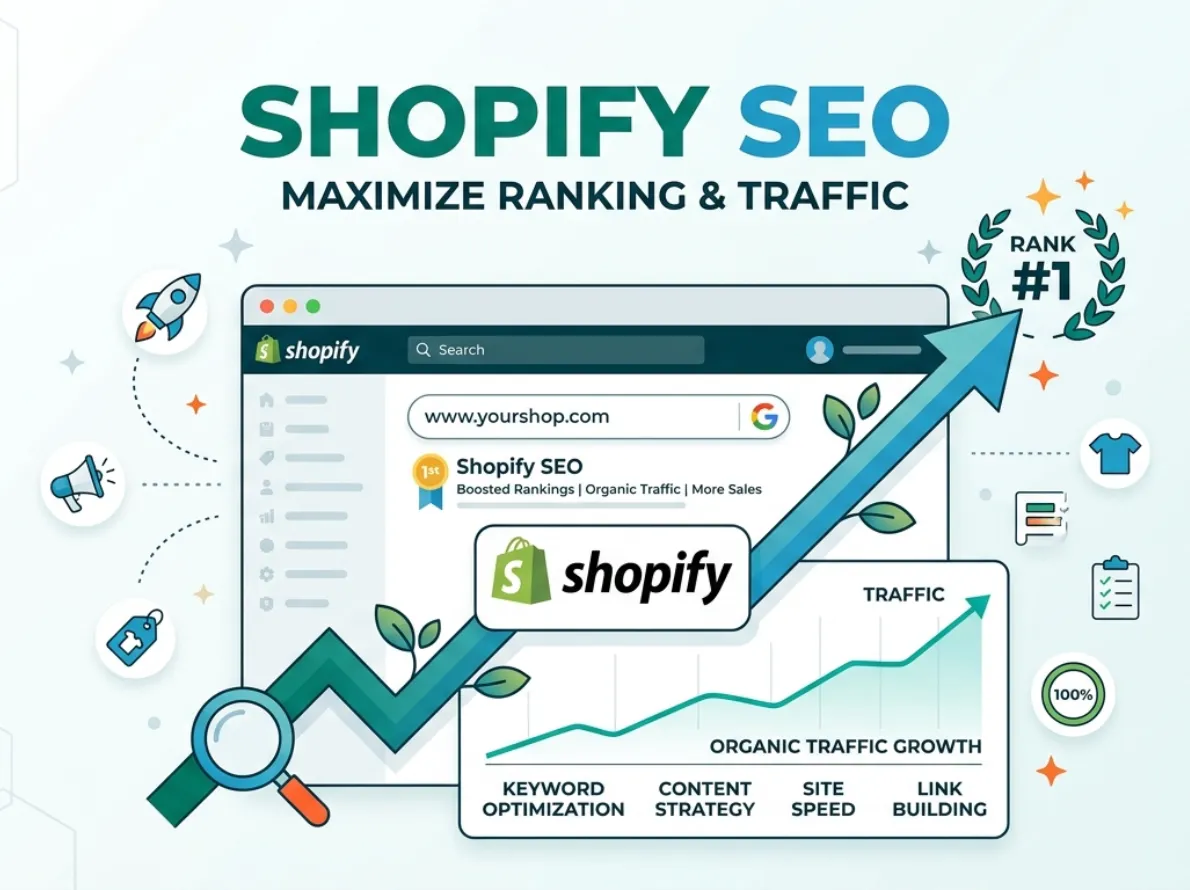
- Shopify SEO audit
- Canonical duplication fix
- Shopify URL structure review
- Collection page topical authority
- Product page NLP optimisation
- Shopify metafields for SEO
- Product and review schema
- Breadcrumb schema
- Pagination and sitemap
- Core Web Vitals remediation
- Blog topical authority strategy
- Blog-to-product internal linking
Shopify's default behavior actively sabotages SEO. Generic advice won't work; platform-specific problems require specialized, technical fixes to recover suppressed organic traffic.
Shopify is an excellent platform with problematic SEO defaults, including architectural canonical duplication and empty collection pages. These aren't store owner errors; they are consequences of Shopify's native structure. Oddtusk provides Shopify-specific solutions, fixing technical canonical issues, scaling entity-rich collection content, and utilizing metafields for clean structured data without requiring a theme overhaul. This specialized expertise differentiates our Shopify SEO engagement from generic alternatives. By addressing platform-inherent flaws with precise technical execution, we transform Shopify's default environment into a high-performance organic revenue engine that builds E-E-A-T brand authority over time. Our broader ecommerce SEO framework applies across platforms; the Shopify-specific execution lives here.
Canonical duplication fix
Shopify often splits ranking signals by indexing two identical product URLs. Oddtusk enforces consistent internal linking to the canonical /products/ path across themes and navigation. By resolving this common duplication via Google Search Console monitoring, we typically recover 30 to 50 percent of organic traffic previously suppressed by indexing confusion.
Collection page topical authority
Empty collection pages rank poorly. Oddtusk transforms them by adding comprehensive, entity-rich body content covering category attributes and buyer decision factors. By moving beyond product grids to high-intent NLP content, we enable Shopify collections to rank for hundreds of transactional queries, delivering the highest revenue impact for Indian ecommerce SEO strategies. This is the practical application of topical authority mapping at the collection level.
Product NLP and metafields
Manufacturer descriptions lack unique SEO signals and buyer-intent language. Oddtusk rewrites product copy using natural language and entity signals that match actual search patterns. By implementing Shopify metafields alongside Product, Review, and Breadcrumb schema markup, we ensure rich result eligibility and improve click-through rates across all product pages. See our dedicated Shopify SEO service for the full detail.
Blog strategy and internal linking
Most Indian stores underuse Shopify's blog as an SEO asset. Oddtusk transforms it by creating educational comparison and category guides that build topical authority. By strategically linking these informational posts to commercial pages via a deliberate internal linking architecture, we amplify ranking signals and capture high-intent buyers earlier in their research process. See our Shopping ads strategy for how paid and organic align.
30 to 50 percent organic traffic suppressed by unfixed canonicals. Hundreds of keyword variations missed by empty collection pages. These are recoverable losses with the right fix.

Recoverable traffic that requires no new content: only a technical SEO fix applied correctly and monitored through to correct indexation.
A collection page with no body text ranks for almost nothing. The same page with topical authority content can rank for hundreds of transactional keyword variations across the category.
Built into every Shopify store by default. The stores with strong organic revenue have fixed all three deliberately, combining technical fixes with a clear content strategy.
Audit, canonical fix, collection content, product NLP, schema, blog, revenue tracking
Shopify SEO audit
Canonical fix and technical remediation
Collection content, product NLP, and schema
Blog strategy and organic revenue tracking
Everything you need to know about Shopify SEO in India.
Shopify creates two accessible URLs for every product: the clean /products/product-handle URL and a collection-scoped /collections/collection-handle/products/product-handle URL. Both serve identical content. Shopify adds a canonical tag pointing to /products/ but Google regularly crawls and indexes the /collections/products/ version, splitting ranking signals between two URLs for the same page. Across Shopify stores audited by Oddtusk, this issue suppresses organic traffic by 30 to 50 percent. It is the first issue addressed in our technical SEO audit for every Shopify engagement.
The fix has two components. First, we audit every internal link across the Shopify theme and update any links pointing to /collections/products/ URLs to point to the canonical /products/ URL instead, reinforcing which URL Google should treat as canonical. Second, we verify that the sitemap.xml includes only /products/ URLs rather than /collections/products/ variants. We then monitor Google Search Console over the following weeks to confirm the correct URLs are indexed and the suppressed pages begin recovering their rankings.
Most Shopify collection pages consist of a collection title and a product grid with no descriptive body text. Without substantive content, Google has no topical signal to rank the page for the broad category queries it should target. A collection page for Women's Kurtas with no body text will rank for almost no queries beyond the exact collection name. The same page with comprehensive body content covering the category, sub-types, materials, and buyer decision factors can rank for hundreds of transactional queries. This is why topical authority mapping at the collection level is the highest-impact action for most Shopify stores.
Shopify metafields are custom data fields that store structured information for products, collections, and other Shopify resources beyond the default fields. For SEO, they allow product attributes, review data, FAQ content, and specifications to be stored in schema-compatible format and rendered as structured data. Oddtusk uses metafields to implement clean Product schema, Review schema, and FAQ schema without requiring custom app dependencies, keeping schema implementation maintainable as the catalog scales.
Shopify blog posts targeting buyer education queries build topical authority for the categories your collection pages are trying to rank in. A blog post answering how to choose the right running shoe for Indian weather builds topical relevance for the running shoes collection and, when it includes internal links to the collection and product pages, passes that relevance signal directly. Oddtusk plans Shopify blog content as a deliberate topical authority investment tied to collection ranking goals. Brands using this blog strategy as part of a wider ecommerce SEO programme see compounding returns as collection authority deepens.
Oddtusk implements Product schema including name, description, image, price, availability, brand, and SKU on all product pages. Review and AggregateRating schema is added where review data exists. BreadcrumbList schema is implemented on all product and collection pages to communicate category hierarchy. FAQPage schema is added to collection pages with buyer FAQ content. All schema is validated through Google's Rich Results Test and monitored in Google Search Console for rich result appearance.
Core Web Vitals are Google ranking signals measuring page loading experience. Shopify stores in India commonly fail LCP because of unoptimised hero images, render-blocking scripts, and app-loaded JavaScript that delays main content from displaying. Indian mobile connections amplify speed problems because slower connections take longer to load unoptimised assets. Oddtusk identifies specific CWV failures in your Shopify store, prioritises fixes by ranking impact, and implements or directs the development team on corrections. Core Web Vitals remediation is always part of our technical SEO audit deliverable. We apply the same CWV discipline to WooCommerce and Magento stores.
Shopify SEO and Shopping ads target the same buyers at different costs. SEO builds organic collection and product page rankings generating clicks without cost per click. Shopping ads capture immediate purchase intent at a cost per click from the Google Merchant Center feed. When both target the same product categories: which Oddtusk plans deliberately, the combined organic and Shopping presence increases click-through rate and brand credibility. As organic rankings establish, they reduce the Shopping ad spend needed to maintain the same revenue from those categories.