Search engines now rank content based on topical depth, entity relationships, and semantic relevance, not keyword repetition. OddTusk builds the content architecture that earns and holds authority across entire topic clusters. Brands running semantic SEO alongside technical SEO and E-E-A-T optimisation see the fastest compounding results.
Topical authority is what separates brands that rank once from brands that rank consistently

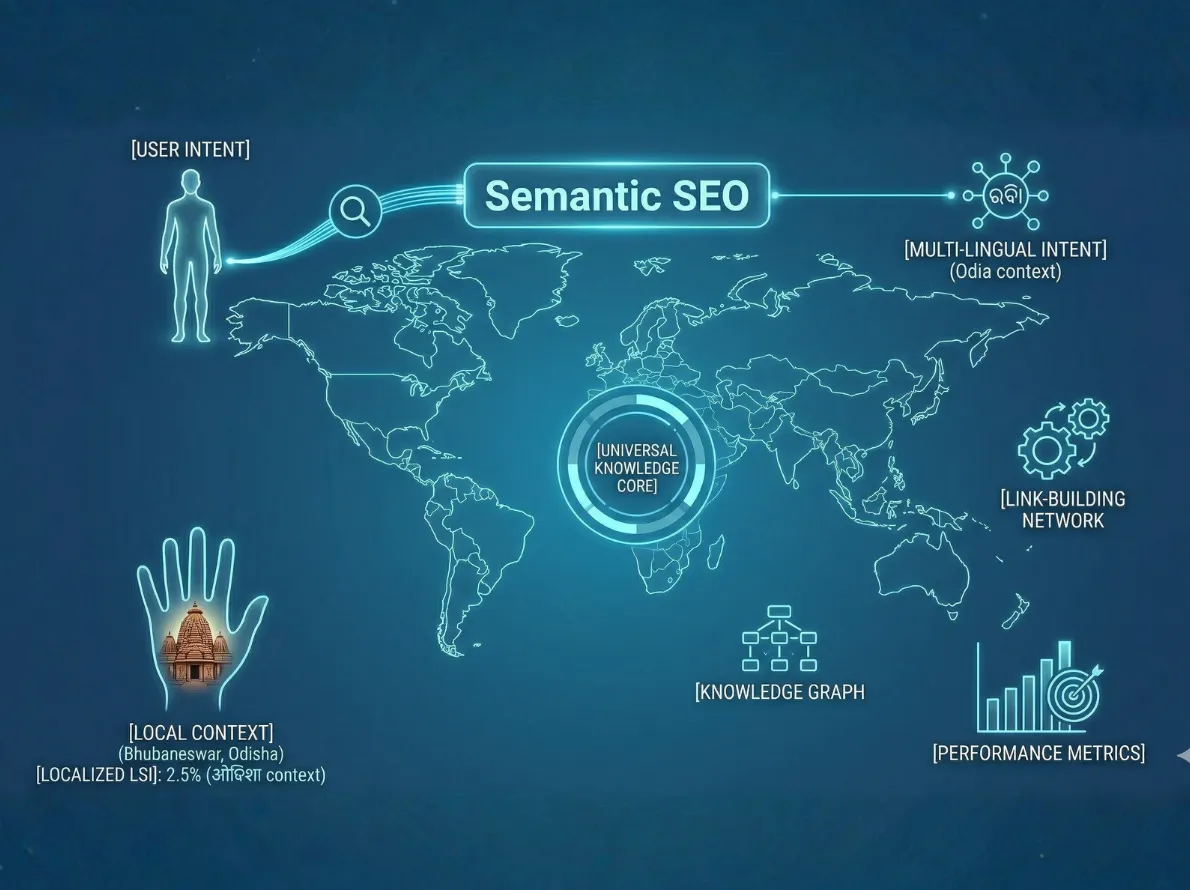
Most SEO strategies optimize individual pages in isolation. Semantic SEO treats your entire website as a knowledge graph. When every page is connected through a shared topical architecture, search engines recognize your site as the definitive source on your subject, and your content authority compounds with every new page you publish. Our full SEO services are built on this semantic foundation, from technical SEO through to schema and structured data.
Entity-first
Every page is built around a clearly defined central entity. We identify what the page is about, what attributes need to be covered, and what values complete the picture. This entity-attribute-value completeness is what Google uses to assess topical depth and determines eligibility for AI citation and featured snippet placement.
Intent-driven
We map the full query journey for every cluster, from awareness through comparison to conversion. Each page is positioned to satisfy one clear micro-intent, so your site captures users at every stage of the search journey without pages competing against each other. This query-intent mapping feeds directly into our content brief service for every page.
AI-ready
Semantic SEO is the foundation of AI search visibility. When your content has sufficient depth, structured answers, and entity completeness, AI systems including Google AI Overviews, ChatGPT, and Perplexity are far more likely to cite it in their responses. See our dedicated AEO and GEO optimisation service for the full approach.
Compounding
Unlike link building or paid search, topical authority builds on itself. Each new piece of content strengthens the entire cluster. Brands that build semantic content networks see organic traffic grow month over month without proportional increases in effort or spend. This compounds further when paired with a structured internal linking architecture.
8 layers of semantic SEO that work together to build authority that holds.

Entity architecture, query semantics, topical mapping, lexical depth, EAV completeness, information gain, internal linking, and schema — all connected into one cohesive strategy.
Applied across ecommerce, SaaS, healthcare, education, and local service businesses in India and internationally.
Deep specialization in semantic content architecture and AI search optimization for Indian markets, with hands-on experience across the full SEO services stack.
From audit to architecture to authority
Audit your current architecture
Build your topical authority map
Execute, optimize, and compound
Everything you need to know about semantic SEO.
Semantic SEO is the practice of optimizing content around topics, entities, and their relationships rather than individual keywords. It involves building topical authority through structured content clusters, covering the full query semantics of a subject, and ensuring each page satisfies a clear search intent with sufficient lexical depth.
Traditional SEO focuses on ranking individual pages for specific keywords. Semantic SEO focuses on building authority across an entire topic so search engines recognize your site as a trusted source. The result is that multiple pages rank simultaneously for related queries rather than one page targeting one keyword. It pairs naturally with E-E-A-T optimisation and technical SEO to create durable rankings.
OddTusk delivers a complete topical authority map with URL architecture, content briefs per page covering entity-attribute-value completeness, lexical field terms, query journey mapping, internal link mesh, schema directives, and meta optimization. Every deliverable is built for both search engine rankings and AI citation eligibility.
Yes. Semantic SEO is the foundation of AI search visibility. When your content covers a topic with sufficient depth, structured answers, entity completeness, and proper schema, AI systems are more likely to cite it. OddTusk specifically optimizes for AEO and GEO signals as part of every semantic SEO engagement. Our dedicated AEO and GEO optimisation service covers this in full detail.
After the topical map is implemented and 301 redirects are live, most clients see ranking improvements within 6 to 10 weeks. Topical authority compounds over 3 to 6 months as content clusters are fully indexed. AI citation visibility typically follows organic ranking improvements by 4 to 8 weeks. Combining semantic SEO with predictive SEO accelerates this timeline further.
Yes. OddTusk's semantic SEO work is particularly effective for ecommerce and D2C brands in India because product and category pages benefit significantly from topical authority. We build semantic content networks around your product verticals so your category pages rank alongside your editorial content. This is the same approach we apply for ecommerce SEO, Shopify SEO, and B2B SEO engagements.
Entity-attribute-value (EAV) is a framework for ensuring a page covers its central topic completely. The entity is the main subject, the attributes are its properties, and the values are the specific answers. Complete EAV coverage signals topical depth to search engines and improves eligibility for featured snippets and AI citations. Our content brief service builds EAV completeness into every page spec.
Information gain refers to the unique value a page adds beyond what already exists in search results. Pages with high information gain, original data, documented methodology, and case study results, rank higher because they give users a reason to visit rather than stay on the results page. OddTusk builds information gain into every content brief we deliver. This directly feeds E-E-A-T authority signals that search engines reward.