
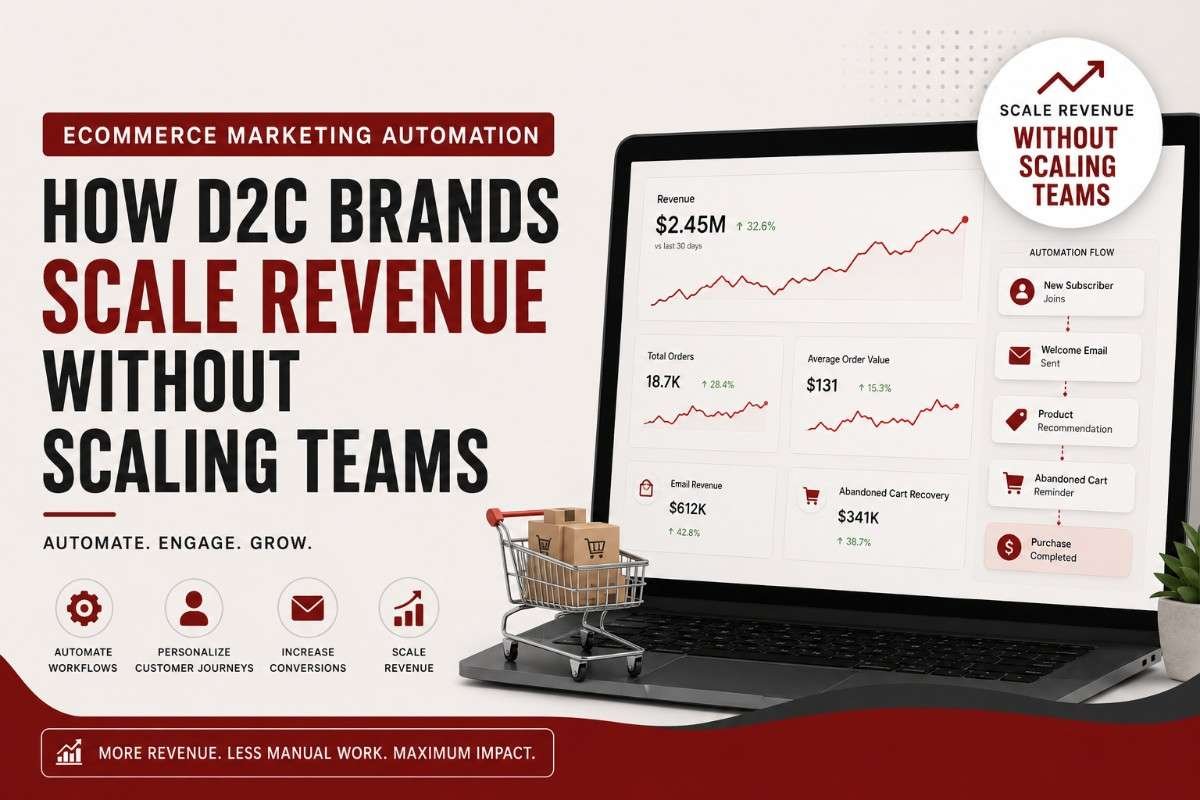
The complete guide to ecommerce marketing automation for D2C brands. Discover the workflows, channels, and playbooks that let lean teams scale revenue.
The Festival Sale Starts on Google Long Before It Starts on Your Website
Date: 08 - 26 - 2026
Time to read: 23 minutes

[ Table of Content ]
Every year, the pattern repeats itself. A D2C brand spends August and September perfecting its festive creatives, loading up ad budgets, and rehearsing the countdown-to-sale playbook. Then Diwali week arrives, the homepage banner goes live, the performance ads fire, and the dashboard lights up with underwhelming numbers. High acquisition costs. Thin margins. And a nagging sense that the brand showed up to a party that started without them.
That instinct is correct. The festival sale does not begin when the countdown timer hits zero. It begins weeks earlier, quietly, in search bars across the country.
This is the central problem with how most ecommerce brands approach their festive season marketing strategy. They pour everything into the transaction window while ignoring the discovery window. The consumers they are trying to reach in October have already made most of their decisions in August and September, through Google searches, short-form video feeds, AI-generated answers, and peer recommendations. By the time the sale page goes live, the real competition is already over.
Festival sale SEO is the practice of capturing this pre-sale search demand before your competitors do. Not through ad spend, but by making sure your brand shows up when consumers are actively researching what to buy and where to buy it. It is the difference between paying Rs. 180 per click in a crowded October auction and earning free traffic from content you published in August.
This article lays out the data behind when Indian consumers actually start their festive shopping journey, a practical readiness framework for D2C and ecommerce brands, and what brand owners need to put in motion well before the sale goes live.
When Do Indian Consumers Actually Start Searching for Festival Deals?
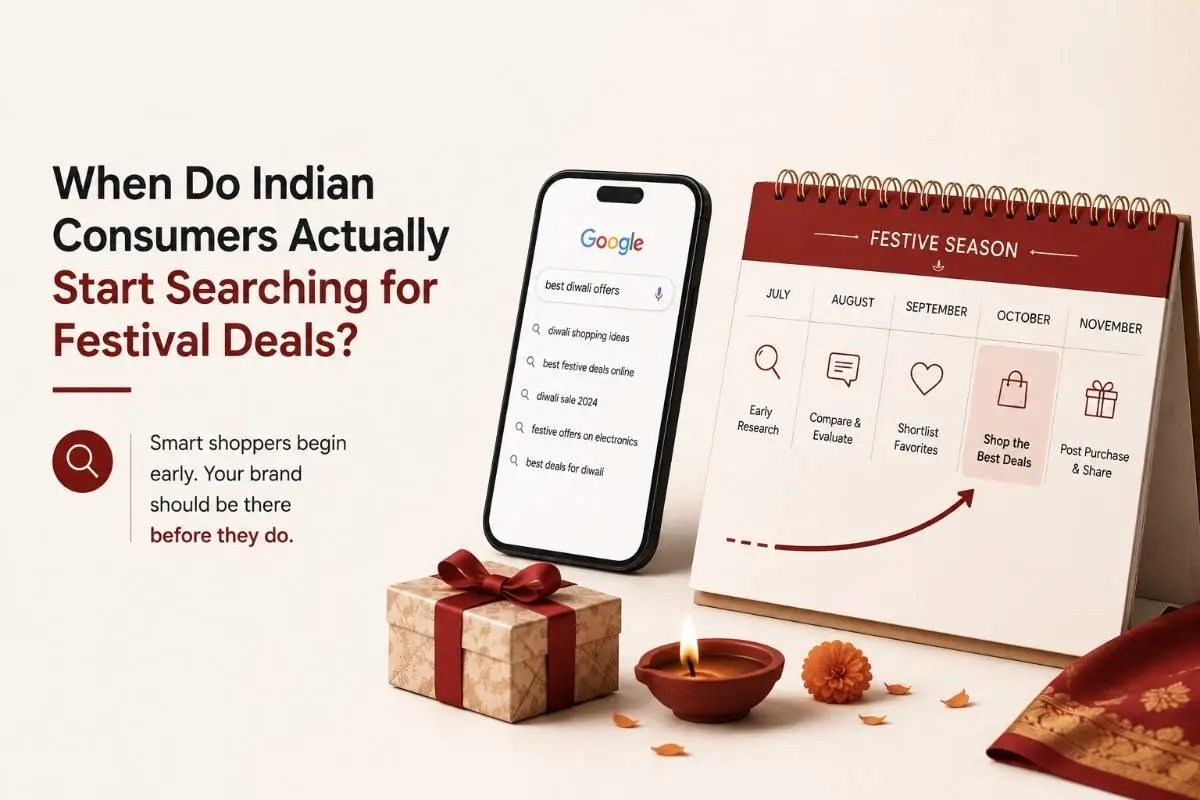
The assumption that festive shopping is impulsive does not survive contact with actual search data.
Google Trends data for India (2024-2026) shows that search demand for festival-related queries begins building in late July and early August, not in October when the major sales go live. The ramp from zero to peak takes eight to ten weeks, and the trajectory is consistent year after year.
Here is what the demand curve actually looks like:
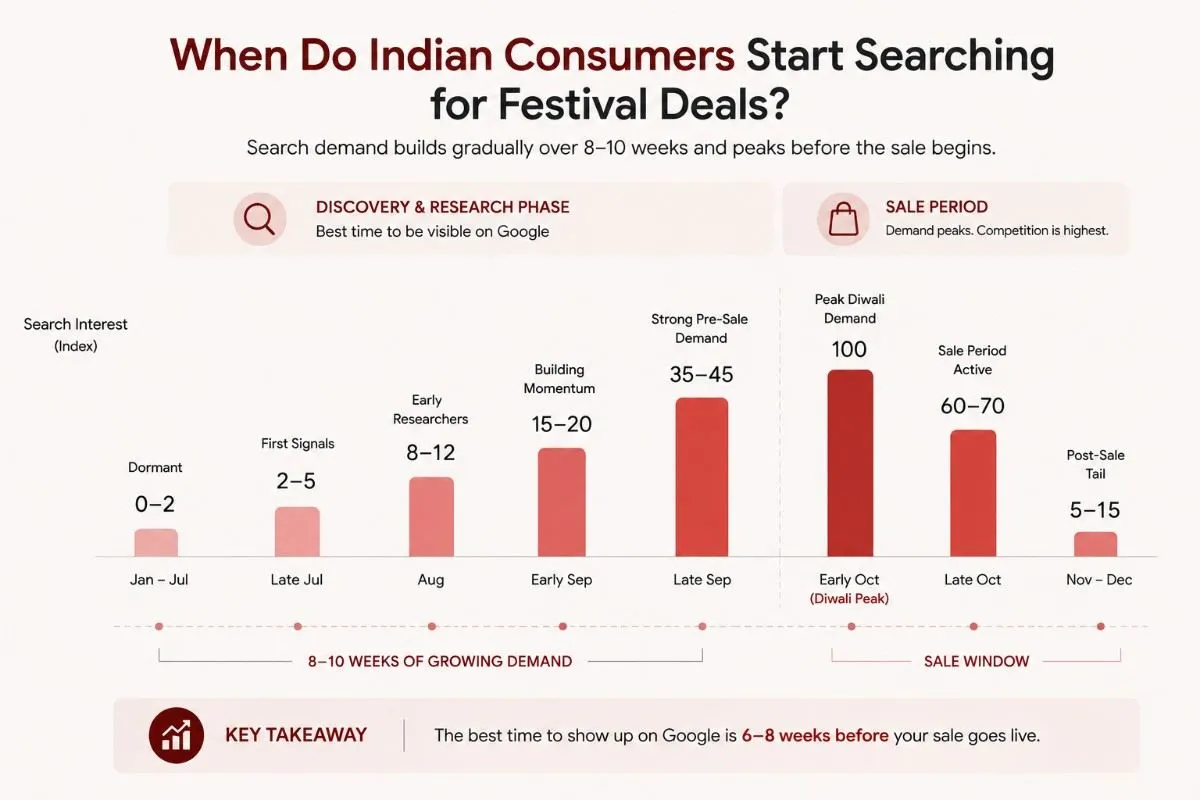
The pattern is clear. Demand does not spike on sale day. It builds gradually over eight to ten weeks, with the steepest acceleration happening in September, weeks before the first Diwali sale banner appears on any ecommerce homepage. These festive shopping trends are consistent year over year. And this is the window that most brands miss entirely.
Why Does Demand Build So Early?
Because festival buying is not an impulsive act. A consumer does not wake up on the morning of a Diwali sale and decide to purchase a Rs. 15,000 appliance or a designer silk saree. These are considered purchases. The research that precedes them follows a predictable pattern.
Data from Think with Google shows that more than 82% of festive buyers in India research and plan their purchases well before the sale starts. Meta's festive season insights put the number of digital touchpoints per purchase at four to eight, spanning Google search, AI-generated answers, short-form video, social media, and brand websites.
A 2026 MiQ report found that 43% of Indian consumers now discover new brands through AI-powered search tools ahead of major purchase periods. This is not a temporary shift. The consumer journey has fragmented across platforms and stretched across weeks. Brands that show up only at the point of transaction are fighting over the most expensive, most crowded slice of that journey. Any Diwali marketing effort or festive campaign that ignores the discovery window is at a disadvantage before it even launches.
How Your Customer Actually Makes a Festive Purchase Decision
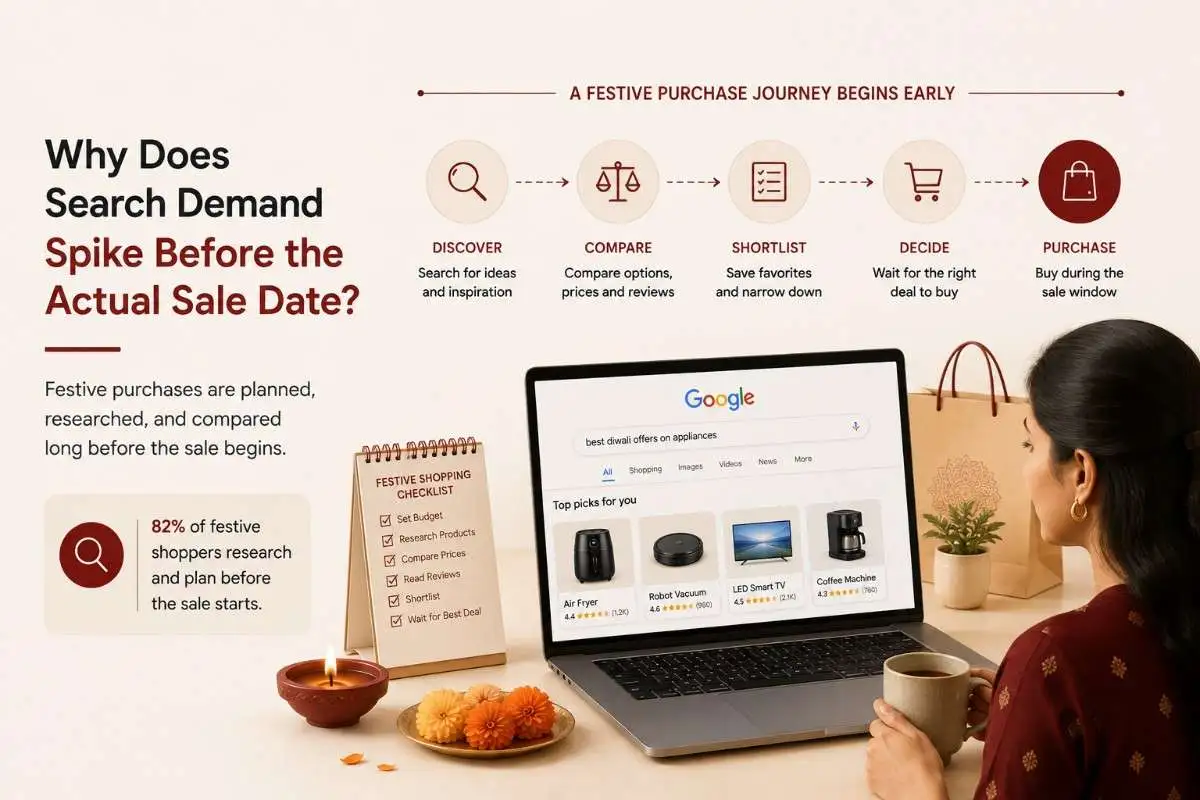
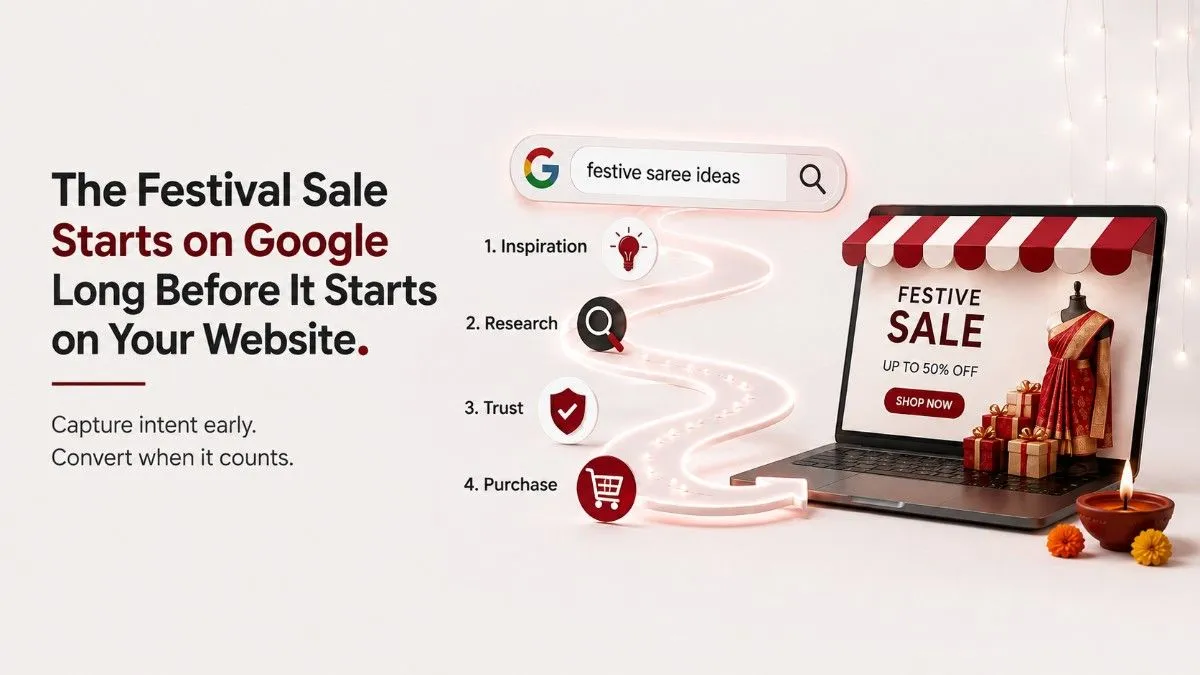
The festive buying journey in India follows four distinct stages. Understanding these is not an SEO exercise. It is a business decision about where to invest your marketing budget and when.
Stage 1: Inspiration. 4 to 6 Weeks Before the Sale
Consumers are browsing ideas, gathering visual inspiration, and forming preferences. They are not ready to buy. They are deciding what to want.
What they are searching: "Diwali outfit ideas for family photos," "festive living room decor trends 2026," "corporate Diwali gifting guide under Rs. 2,000."
What wins here: editorial content like style guides, trend reports, lookbooks, and curated gift lists. The brand that provides direction during this phase earns the consumer's attention before the sale even has a date.
Stage 2: Comparison. 2 to 3 Weeks Out
The consumer now knows what they want and is comparing options across brands. Searches become more specific and product-focused.
What they are searching: "pure mulberry silk sarees online India," "art silk vs handloom silk durability," "best festive skincare gift sets under Rs. 3,000."
What wins here: product comparison content, material and fabric guides, detailed value propositions, and unboxing videos. Your product pages need to answer the exact questions shoppers are asking, not just list features and prices.
Stage 3: Trust Check. 1 Week Before
The shortlist is made. The consumer is now looking for reasons to trust one brand over another. Searches shift from product attributes to brand credibility.
What they are searching: "Is [brand name] legit?", "[brand name] customer reviews," "[brand name] delivery timeline and return policy."
What wins here: customer testimonials, clear return and delivery policies, real customer photos and videos, visible trust signals. This stage is about removing doubt, not adding information. Every unanswered question at this point is a lost sale.
Stage 4: Purchase. Sale Window
The consumer returns with intent to buy. This is the window where your website's shopping experience matters most.
What they are searching: "[brand name] Diwali discount code," "buy [product name] festive offer."
What wins here: fast-loading product pages, smooth checkout, visible pricing and coupon codes, and urgency signals that feel honest rather than pushy.
Here is the business insight that matters: if your brand is invisible during stages one through three, you end up paying a premium to compete in stage four against brands that already earned the customer's trust weeks ago. You are not just late. You are paying more for worse odds.
The Real Cost of Starting Late
When a brand postpones its festive content and search presence until one or two weeks before the sale, the consequences show up directly on the P&L.
Your ad costs go up. When everyone bids on the same purchase-ready keywords during the same two-week window, auction prices spike. Customer acquisition costs typically jump 2x to 3x, compressing net margins during what should be the most profitable period of the year.
Your competitors already own the customer's attention. Brands that showed up during the research phase, the ones whose blog posts, gift guides, and comparison pages appeared in August and September, have already built familiarity. When a consumer finally reaches the purchase stage, those early-bird brands have the advantage. Your store traffic converts at lower rates because visitors are still comparison-shopping, not committed.
Your new pages do not show up in time. Google needs time to discover, process, and rank new web pages. A Diwali sale page published on October 1 might not appear in search results until October 15, by which point the peak is already passing. Last-minute content gets zero organic visibility during the event it was created for.
You end up funding your competitor's remarketing. This is the hidden cost most brand owners never see. When a consumer searches for your product category in September and finds your competitor's content instead of yours, that consumer enters your competitor's remarketing audience. When you start running ads in October, the higher auction prices you pay partly fund the ecosystem your competitor is already profiting from.
Every marketing decision made in the last two weeks before a sale carries a premium. A brand that puts up a well-written festive collection page in August and earns a search ranking by September gets free traffic during the highest-value weeks of the year. A brand that launches the same page in October pays for the same traffic through ads, competing against brands that are already visible.
A Practical Readiness Framework for Brand Owners
Capturing early festive demand is not a one-time task. It is a sequence of content and marketing actions that needs to start sixty to ninety days before your peak selling window.
Here is what that looks like mapped to the India festive calendar, using Diwali as the anchor event. Think of it as your festive season marketing plan, timed to when your customers actually start searching, not when your sale goes live.
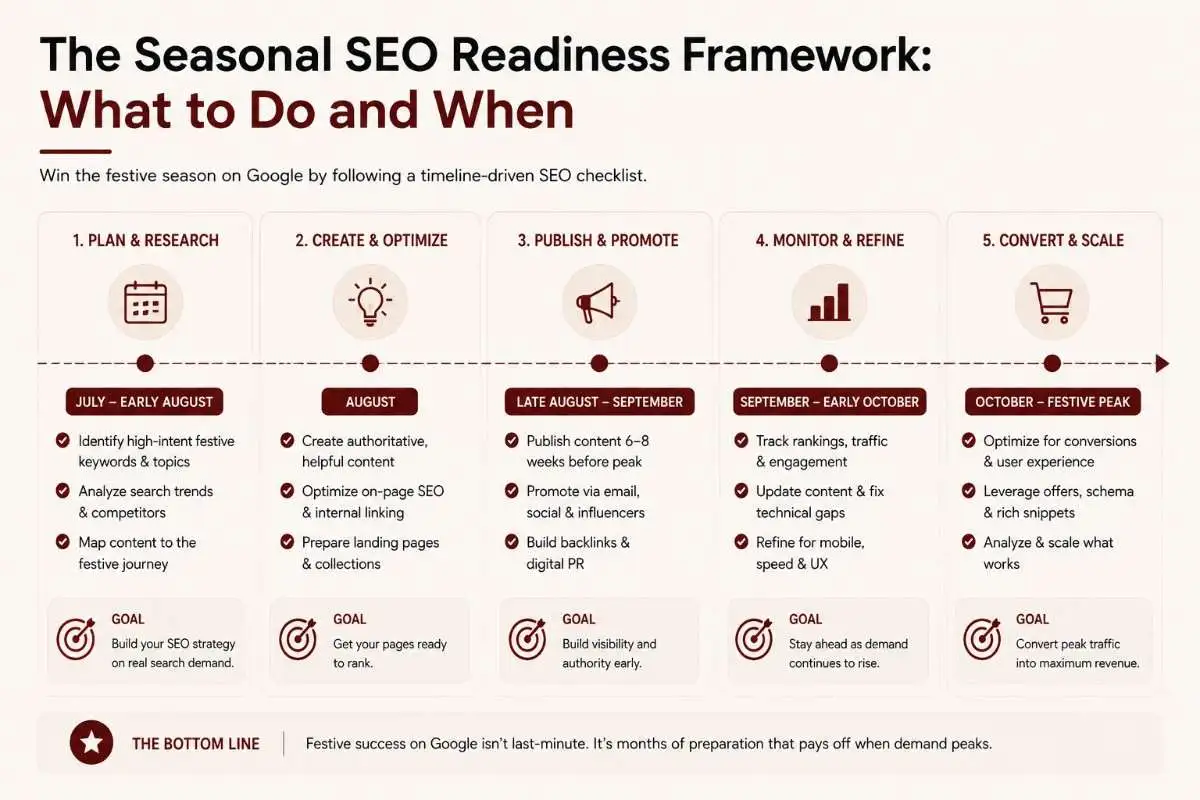
90 Days Before (July): Understand the Landscape
Before creating anything, understand what your customers will be searching for and when.
Research festive search patterns for your category. What do people type into Google when they start thinking about buying your kind of product during the festive season? The search terms, the timing, and the competition all vary by category. A skincare brand and a furniture brand will have very different demand curves.
Check what you already have. If you ran a festive sale last year, your old pages may still carry some search authority. Updating an existing page almost always works better than building a new one from scratch. If last year's Diwali page is still live, refresh it rather than replacing it.
Map the timeline. Use free tools like Google Trends to see exactly when demand for your product category starts rising. "Rakhi gifts" peaks in early August. "Diwali sarees" starts climbing in September. Your content calendar should follow this curve, not your sale date.
60 Days Before (Late July to Mid-August): Build the Content
Every page that needs to show up in search results by September needs to be live by mid-August. Google takes four to six weeks to pick up and rank a new page.
Publish helpful, search-ready content. This is not about writing blog posts for the sake of it. It is about creating the kind of content your ideal customer is searching for during the inspiration and comparison stages. Gift guides, product comparisons, "how to choose" articles, trend roundups. The content should be genuinely useful, not a thinly disguised sales pitch.
Get your festive collection pages ready with real content. Category pages for festive collections, gift guide pages for different price points, and any dedicated sale pages should be live with real product descriptions, real images, and clear value propositions. A placeholder "coming soon" page cannot rank and will not earn you anything.
Make sure your product pages are set up for search visibility. Your products should appear in Google Shopping results and featured product listings, not just in regular search results. This requires proper technical setup on your product pages, something your development team or agency can handle. If you are on Shopify, WooCommerce, or BigCommerce, most of this can be done through apps and plugins.
Connect the dots across your website. Your homepage, category pages, and existing blog should link to your new festive content. If a festive page exists on your site but no other page points to it, Google treats it as unimportant and may take much longer to surface it.
Suggested article:Ecommerce Marketing Automation: How D2C Brands Scale Revenue Without Scaling Teams
45 Days Before (August to Early September): Build Credibility
The content is live. Now it needs to gain credibility in Google's eyes before the demand surge.
Get other websites and publications to link to your content. Original data, consumer insights, and trend reports are the strongest tools here. If you publish a well-researched piece on festive shopping behaviour or category-specific buying trends, industry publications and marketing blogs are more likely to reference and link to it. These backlinks from other websites are one of the strongest signals Google uses to decide which pages deserve top rankings.
Share your festive content across email and social. Send it to your existing customer list. Share it on social media. The early traffic and engagement signals tell Google that the content is relevant and worth surfacing.
Verify your pages are actually appearing in Google. Sometimes new pages get stuck and do not show up in search results due to technical issues. A quick check through Google Search Console (your agency or marketing team can do this) ensures nothing is stuck.
30 Days Before (September to October): Optimise and Convert
As demand peaks, shift from creating content to refining what you already have.
Keep an eye on your search rankings. Are your festive pages climbing in Google results? If something is stuck, it may need more depth, better answers to customer questions, or more links from other pages on your site.
Update your content with fresh data. Google gives preference to recently updated content for time-sensitive searches. A festive guide updated with 2026 data will outperform one that still references 2024 trends.
Turn your organic visitors into retargeting audiences. Every person who reads your festive blog post or gift guide in September is someone you can show ads to in October, without paying for a cold click. Set up retargeting and email capture on your informational content so early visitors become warm leads by the time your sale launches.
How D2C Brands Can Compete with Flipkart and Amazon During Festive Season
This is the question that keeps D2C founders up at night. Flipkart's Big Billion Days and Amazon's Great Indian Festival dominate the purchase-related searches during the festive season. Competing with them on "Diwali sale" or "festival sale" is not realistic when their websites carry decades of search authority.
But here is what the marketplaces cannot do: they cannot educate your customer.
Amazon does not publish "how to choose the right silk saree for Diwali." Flipkart does not create "festive skincare routine for dry winter skin." These are exactly the kind of searches that consumers make during the research phase, and they represent uncontested territory for any D2C brand with genuine product expertise.
What to Focus On
Be the expert in your category, not a generic retailer. If you sell handloom textiles, publish content about fabric types, weaving traditions, care instructions, and styling ideas. If you sell skincare, create seasonal skincare routines and ingredient guides. This kind of content comes from real product knowledge, and that is something no marketplace can replicate at scale. Google increasingly rewards content backed by genuine experience and expertise.
Create specific festive pages for your categories. Instead of one generic "festive sale" page, build pages around specific customer needs. "Handloom cotton kurtas for Navratri" is a page a D2C textile brand can own in search results. Amazon will never build that page.
Build D2C brand awareness through your own channels. Organic search, email, and social media work as a connected system during the festive season. A blog post brings in search traffic. Email captures those visitors. Retargeting brings them back during your sale. This entire sequence only works if the first touchpoint happens early enough, which is why starting in August matters.
Win on trust, not just price. In the trust check stage, consumers searching "[brand name] reviews" or "[brand name] quality" are making their final call. D2C brands with strong testimonial pages, transparent return policies, and visible delivery commitments convert these searches at higher rates than any marketplace listing can. Because unlike a marketplace listing, your brand page actually tells a story.
The numbers support this approach. D2C marketing as a search category sees 260 monthly searches in India with very low competition. D2C SEO as a concept has almost no competition at all. The brands that stake their claim in this space now will have a significant head start as the category grows.
Suggested article:Why Post-Purchase Paralysis Is Killing Your Repeat Sales
Stop Thinking Festival by Festival. Think Season.
One of the biggest missed opportunities for Indian ecommerce brands is treating each festival as an isolated campaign. But search demand does not work in isolation. It flows as a connected wave from August through December, with each festival feeding into the next.
| Festival | Typical Dates | When Searches Start | Peak Search Period | When to Start Preparing |
|---|---|---|---|---|
| Raksha Bandhan | August | Late June | Late Jul-Early Aug | June |
| Independence Day Sales | Aug 15 | Late July | Aug 10-15 | July |
| Navratri | Sep-Oct (varies) | August | September | Late July |
| Dussehra | October | Aug-Sep | Early October | August |
| Diwali | Oct-Nov (varies) | August | October-November | August |
| Christmas / New Year | Dec 25-Jan 1 | November | Late December | October |
A customer who discovers your brand while searching for "navratri outfits" in September is far more likely to return for "Diwali outfits" in October, especially if you captured their email address the first time around. A connected festive strategy treats the entire August-December window as one sustained acquisition opportunity rather than five separate scrambles.
A few practical implications:
Keep your festive pages alive year-round. A /navratri-collection/ page that exists for two years and accumulates search credibility will always outperform a /navratri-sale-2026/ page built from scratch every season. Update the content annually rather than starting over.
Connect your festival content to each other. Your Navratri guide should link to your Diwali guide. Your Diwali guide should reference your Christmas gift guide. This tells Google that your brand covers the full festive landscape, not just one moment of it.
Time your content to when customers start searching, not when the festival falls. A Diwali-focused piece published in late August has six to eight weeks to gain traction in search results before the October peak. Published in October, it is too late.
A Simple Festive Readiness Checklist for Brand Owners
This is the short version. Share it with your marketing team or agency.
By July (90 days before Diwali):
- Identify what your customers search for during the festive season
- Review last year's festive pages and decide what to refresh vs. rebuild
- Map out when search demand starts for your product categories
- Plan content across the full festive season, not just Diwali
By Mid-August (60 days out):
- Publish gift guides, comparison pages, and helpful festive content
- Get festive collection and sale pages live with real content
- Ensure product pages are set up for Google Shopping and rich results
- Link your festive content from your homepage and main category pages
By Early September (45 days out):
- Pitch content for links from industry publications and blogs
- Confirm all festive pages are appearing in Google search results
- Start building retargeting audiences from festive content visitors
- Add email capture to festive blog posts and guides
By Late September (30 days out):
- Update content with current-year statistics and trends
- Start tracking your search positions for key festive terms
- Activate email sequences for visitors who engaged with festive content
- Make sure sale pages are loading fast, especially on mobile
During the Sale (October-November):
- Monitor which search-driven pages are driving the most revenue
- Test product page elements (pricing, offers, checkout flow)
- Collect customer reviews and photos for next year's trust content
- Track how organic traffic is performing against paid campaigns
Post-Festival (November-December):
- Document what worked and what did not
- Keep festive pages live and update them for next year
- Archive search performance data for year-over-year benchmarking
- Start the cycle again for the next festive season
Do Shoppers Really Research on Google Before Buying on Amazon or Flipkart?
Yes, and this is the insight that changes the economics of festive marketing for D2C brands.
Even consumers who end up purchasing on a marketplace frequently start their journey on Google. They search for product comparisons, brand reviews, "best of" lists, and educational content before navigating to Amazon or Flipkart to complete the transaction. "Best Diwali gifts under Rs. 5,000" is a Google search, not an Amazon search. "Is [brand name] worth the price?" is asked on Google, not on Flipkart.
What this means for brand owners is significant: even if you lose some transactions to marketplaces, you can own the research and comparison phases through organic search. A consumer who discovers your brand through a Google search, reads your content, and then buys your product, whether on your website, Amazon, or in a physical store, is a consumer you acquired at essentially zero cost at that organic touchpoint.
Festive shopping in India is overwhelmingly mobile (75-80% of festive searches happen on phones), uses price-focused search words ("offers," "deals," "discount," "cashback"), and increasingly runs through AI-generated answers as a discovery channel. Brands that show up clearly in these formats, with fast-loading pages, clear answers, and helpful content, capture outsized visibility during the festive window.
Why Starting Now Is a Competitive Advantage
Here is something most brand owners do not know: for the search query "seasonal SEO strategy for ecommerce" in India, the entire first page of Google is occupied by agencies based in the UK and the US. Not a single India-focused result exists. For "festive season marketing strategy," the top results are dominated by software companies (Gupshup, MoEngage, Mailchimp) whose content is about their own tools, not about your business.
There is a clear gap. No comprehensive, data-backed, India-focused resource exists for D2C and ecommerce brand owners who want to understand how to prepare for the festive season from a search and content perspective.
Google needs four to six weeks to pick up and rank new content. What you publish in August has the best shot at ranking by the time October demand peaks. What you publish in October is fighting for visibility that will arrive after the festival is over.
The brands that will win the most festive revenue this year are not the ones with the biggest ad budgets on launch day. They are the ones whose content is already live, already showing up in search results, and already earning organic traffic while their competitors are still designing sale banners.
The festival sale starts on Google long before it starts on your website. The question is whether your brand will be there when your customers start looking.
At Oddtusk, we help D2C and ecommerce brands build the search visibility and content systems that capture festive demand months before the sale goes live. From seasonal SEO strategy and festive content planning to performance marketing and marketing automation, we design the infrastructure that turns early search intent into festive season revenue, without last-minute scrambles or inflated ad costs. Ready to get ahead of the festive season? Let's start the conversation.
[ Common questions ]
Festival Sale SEO FAQs
A festive season marketing strategy is a planned approach to reaching consumers during India's major shopping festivals, from Raksha Bandhan through Diwali to Christmas. It covers content creation, search visibility, paid advertising, email outreach, and website optimisation, all timed to when customers actually start looking rather than when the sale goes live.
Sixty to ninety days before the target festival. For Diwali, that means starting in July. Your content needs to be published by mid-August so that Google has enough time to discover it and start showing it in search results before the October demand peak. Brands that start in October are too late for organic visibility.
Seasonal SEO means making sure your website and content show up in Google when consumers are searching for products in your category during the festive season. Brand owners should care because organic search is the lowest-cost way to acquire customers during a period when ad costs spike 2-3x due to competition from marketplaces and well-funded competitors.
Before festival sales, shoppers search for ideas and comparisons: "Diwali outfit ideas," "best festive gifts under Rs. 2,000," "silk saree online India," "[brand name] reviews." These searches happen weeks before the actual sale. They represent the window where brands can earn attention for free rather than paying for it through ads.
By owning the research phase of the buying journey. Marketplaces dominate purchase-related searches, but they do not create helpful content like gift guides, product comparisons, or styling tips. D2C brands that publish genuinely useful expert content and build category-specific festive pages can capture high-intent traffic that marketplaces do not compete for.
A D2C skincare brand publishes a "Festive Season Skincare Routine for Dry Winter Skin" guide in August. By September, the page starts showing up in Google results and bringing in organic visitors. The brand retargets those visitors with product-specific ads in October. When the Diwali sale launches, these warm leads convert at 3x the rate of cold ad traffic, at a fraction of the cost.
Because most brands concentrate their ad spending into the same narrow two-to-three-week window around the sale event, all bidding on the same purchase-ready keywords. This floods the auction with demand and drives up costs. Brands that built organic search visibility in the preceding weeks spend less on ads because a share of their traffic is already arriving for free.
Start with the festival dates and work backwards. Each festival has a search demand onset that precedes the actual event by several weeks. Map your content to those onset dates, not the festival dates. Publish inspirational content earliest (gift guides, trend pieces), comparison content next (product comparisons, material guides), trust-building content closer to the sale (reviews, policies), and have your transaction pages ready for the sale window itself.
Yes. Many consumers start their purchase journey on Google with informational searches like product comparisons and brand reviews before going to a marketplace to buy. This means D2C brands can capture the discovery phase through organic search even when the final purchase happens elsewhere, effectively reducing customer acquisition costs.
