

How to build a content strategy that demonstrates E-E-A-T for both traditional search and AI-driven answer engines.
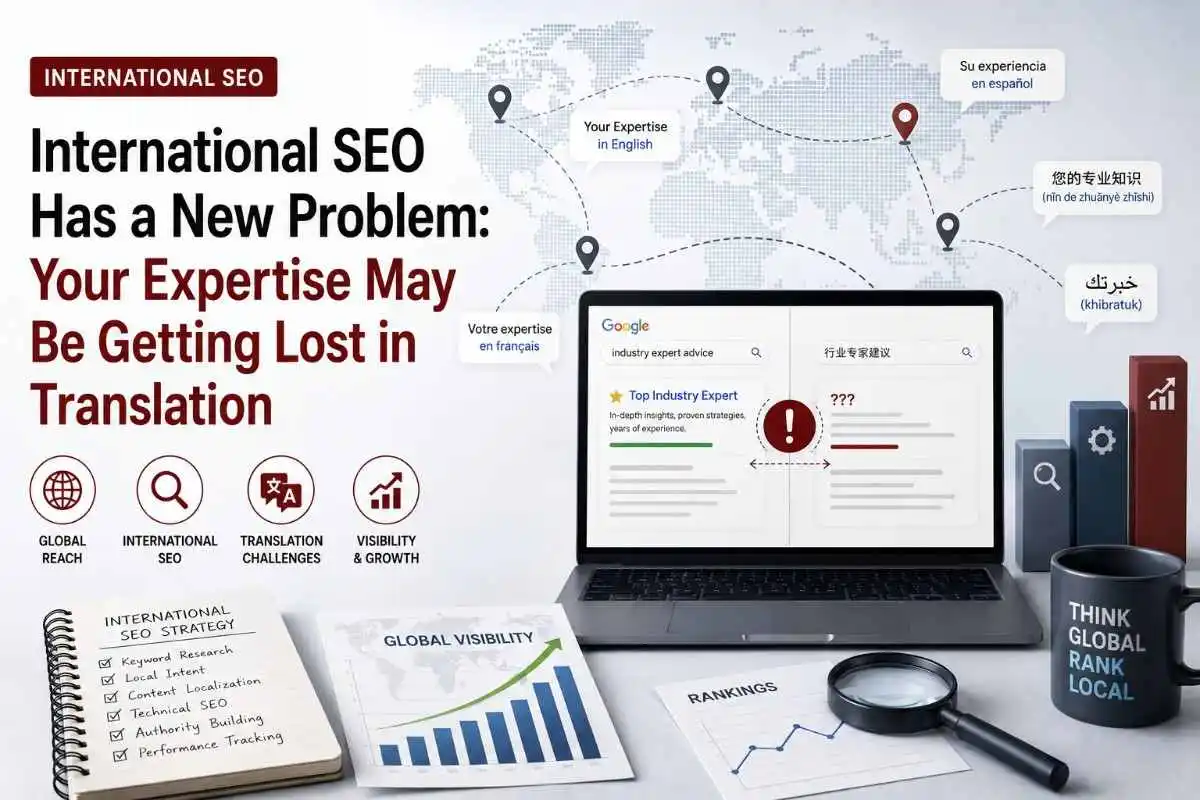
International SEO Has a New Problem: Your Expertise May Be Getting Lost in Translation
Date: 08 - 27 - 2026
Time to read: 15 minutes
[ Table of Content ]
Your brand has spent years building expertise in a specific market. You have qualified professionals, local case studies, real customer relationships, and deep knowledge of how your industry works in that country. None of that matters if AI cannot see it.
This is the emerging challenge in international SEO. For years, the playbook has been simple: translate your website, switch currencies, add hreflang tags, and maybe localize a few examples. That approach still has value. But it no longer covers the full picture, especially for brands running multilingual SEO across multiple regions.
AI search engines are now forcing brands to answer one question: can a machine tell why your brand is credible in a specific market?
If it cannot, your expertise is invisible. And invisible expertise does not rank.
What Is Machine-Recognizable E-E-A-T?
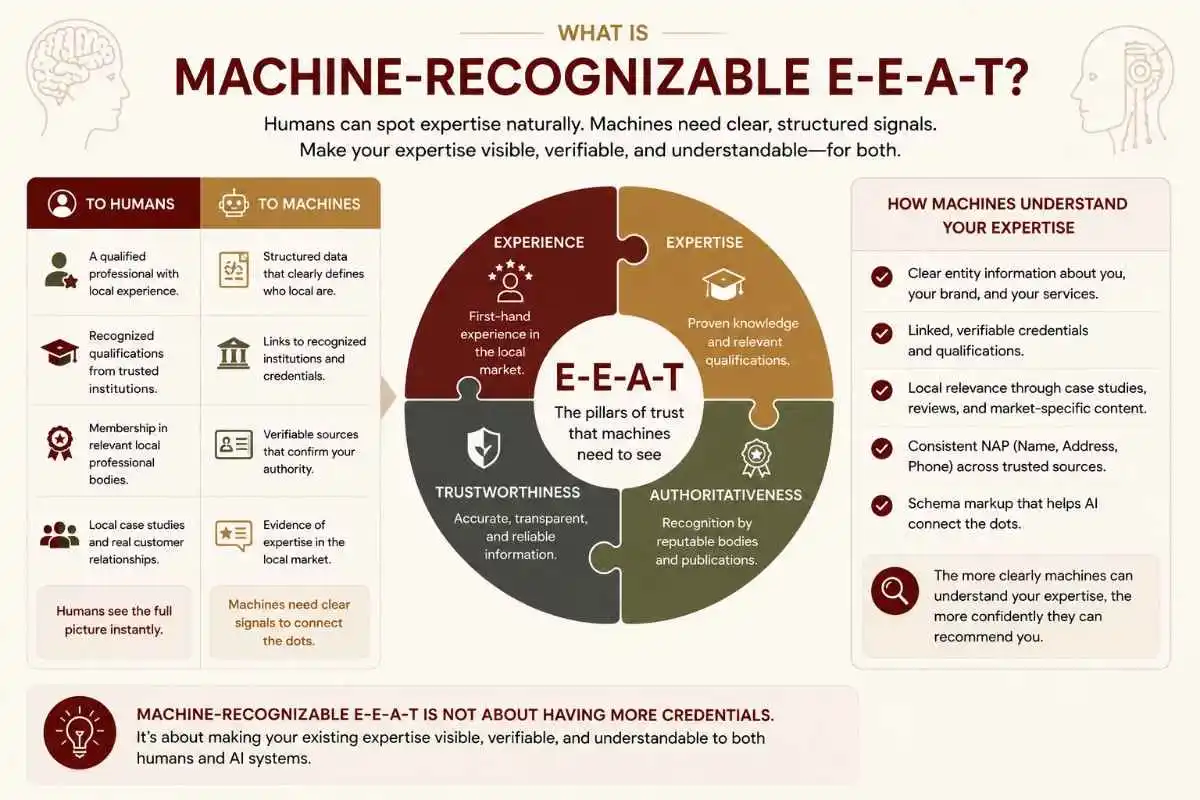
E-E-A-T stands for Experience, Expertise, Authoritativeness, and Trustworthiness. Google has said that E-E-A-T is not a direct ranking signal. Instead, Google's algorithms look at various signals to decide if a page shows these qualities, with trust sitting at the center.
For a human reader, spotting expertise is natural. A German financial consultant with a recognized German qualification, 15 years of experience, membership in a professional body, and local case studies is clearly credible. A German reader sees all of that right away.
For an AI system reading that same page, the picture changes. It needs clear, structured signals to connect the dots between the consultant, the qualification, the institution that granted it, and the market where that qualification carries weight.
This is what machine-recognizable E-E-A-T means. You are not inventing new credentials. You are making your existing credentials visible and verifiable so both humans and AI can process them.
SEO Localization Is Not the Same as Translation
This distinction sits at the heart of the problem, and it is the single biggest gap in how most brands approach international SEO today.
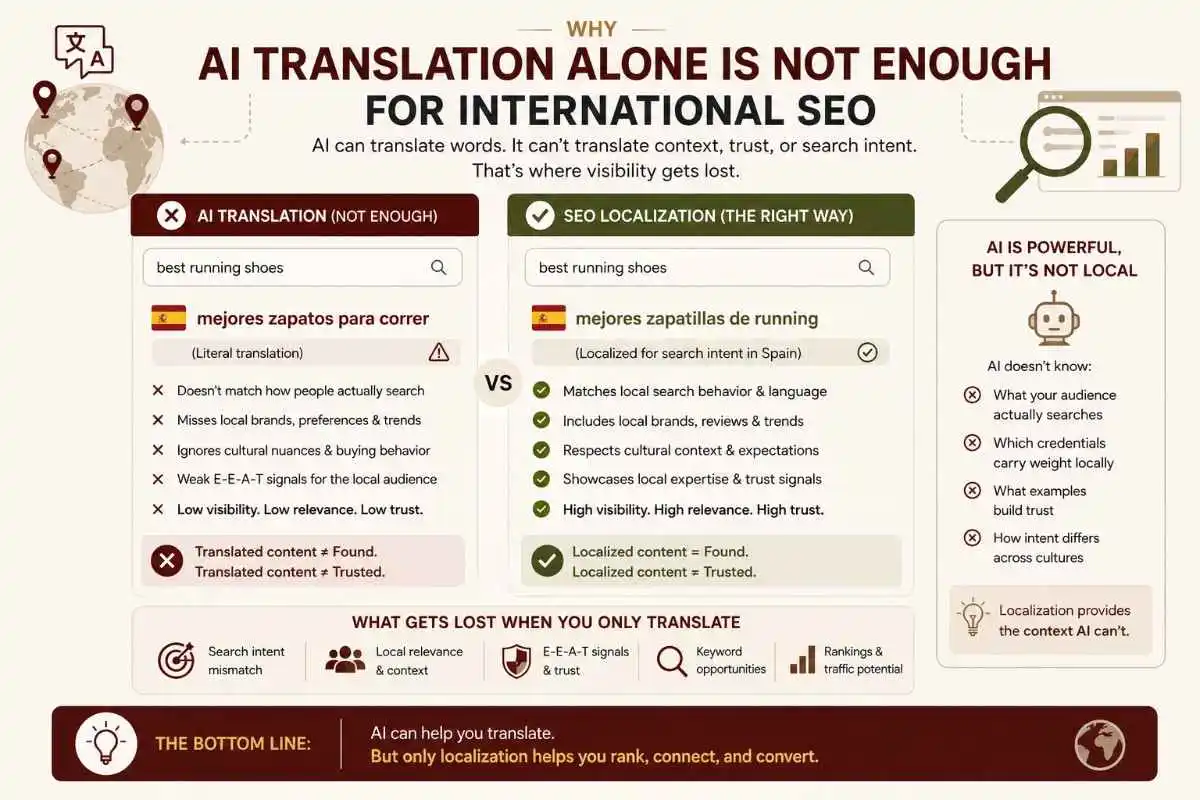
Translation converts words from one language to another. SEO localization adapts the entire search experience for a specific market. That means the keywords people actually use, the questions they ask, the cultural references that build trust, the credentials that carry weight, and the content structure that matches local search intent.
The difference is not just theoretical. It has direct, measurable consequences for search performance.
Keywords Do Not Translate
Take the term "cheap flights." A direct translation into Spanish does not produce a phrase that Spanish speakers actually type into Google. The search volume may be zero. The intent may be different. The competitive landscape is entirely separate.
This pattern holds across every language and every industry. International keyword research is not a translation exercise. It requires understanding how people in a specific market search for a specific topic. That often reveals completely different terms, different levels of knowledge, and different stages in the buyer journey.
Our keyword research shows this clearly. In India, "website translation" gets 880 monthly searches while "SEO localization" gets just 10. The Indian market still sees this as a "translation" problem rather than a "localization" opportunity. In the US, the pattern reverses. A brand that simply translates its US keyword strategy for the Indian market would target the wrong terms entirely.
Search Intent Shifts Across Markets
The same query can carry different intent in different countries. "Football" means soccer in the UK and American football in the US. A product comparison that makes sense in one market may be irrelevant in another where different brands lead.
Content localization means mapping search intent independently for each market. It requires cultural adaptation: understanding not just what people search for, but why they search for it, what kind of answer they expect, and what local context shapes their decision.
E-E-A-T Signals Are Locally Bound
A US-certified accountant means nothing in Germany. A qualification from one professional body may carry no recognition in another country. Author bios written in the source language, referencing source-market credentials, do not build trust with a local audience.
When content is only translated, these expertise signals get carried over unchanged. They may be accurate in language but meaningless in context. And that is exactly the kind of gap that AI systems are unable to fill on their own.
Translation vs Localization vs Transcreation: What Each Means for Your Brand
These three terms often get used as if they mean the same thing. They do not. Each one describes a different level of content adaptation, and each produces a different SEO outcome.
Translation converts your text into another language while keeping the original meaning, structure, tone, and examples intact. For SEO, this means your metadata, URLs, and alt text get converted. But the keyword strategy, search intent mapping, and cultural context stay unchanged.
Localization adapts content for a specific market. It changes not just the language but also the currency formats, date formats, regulatory references, cultural examples, product availability, and contact details. For SEO, localization means doing local keyword research, mapping local search intent, and creating content that matches what people in that market actually search for.
Transcreation goes further still. It recreates the message and emotional impact of your content for a new audience, often rewriting entirely. The original may say "Save big this Black Friday." The transcreation for India might reference Diwali instead. The intent stays the same. The delivery feels native.
Each level produces better SEO outcomes than the one before. Translation preserves meaning. Localization preserves relevance. Transcreation preserves impact.
The real question for your brand is not which one is "best" as a rule. It is which level of adaptation each piece of content needs in each market, given the competition and the search behavior in that market.
Why AI Translation Alone Is Not Enough for International SEO
AI translation has improved by leaps. Tools powered by neural machine translation can now produce fluent, grammatically correct output across dozens of language pairs. The search volume for "AI translation" reflects this shift: 14,800 monthly searches in the US and 12,100 in India. Businesses are paying attention.
But fluent is not the same as effective. And for SEO, the gap between the two matters.
What AI Translation Does Well
AI translation handles large volumes of content quickly and at lower cost. For internal communications, basic product descriptions, and content where speed matters more than nuance, it works as a practical starting point.
What AI Translation Cannot Do
AI translation cannot do international keyword research. It cannot figure out that people in Germany search for a product using completely different words than people in the US. It cannot adapt a case study to reference local regulations, local competitors, or local buying behavior. It cannot build topical authority in a market it does not understand.
Most importantly, AI translation cannot preserve or create E-E-A-T signals. It cannot add local credentials, local expert voices, or local proof points. It produces content that reads well but does nothing for your search visibility.
Post-Editing Machine Translation: A Practical Middle Ground
Post-editing machine translation (MTPE) offers a workable compromise. In this approach, AI generates the first draft, and a human editor with local market knowledge reviews and refines it. The editor corrects keyword choices, adjusts cultural references, adds local context, and makes sure E-E-A-T signals fit the target market.
MTPE is not a replacement for full localization on your most important pages. But for brands managing content across dozens of markets, it is an efficient way to keep quality high while focusing full localization effort on the pages that matter most for search visibility.
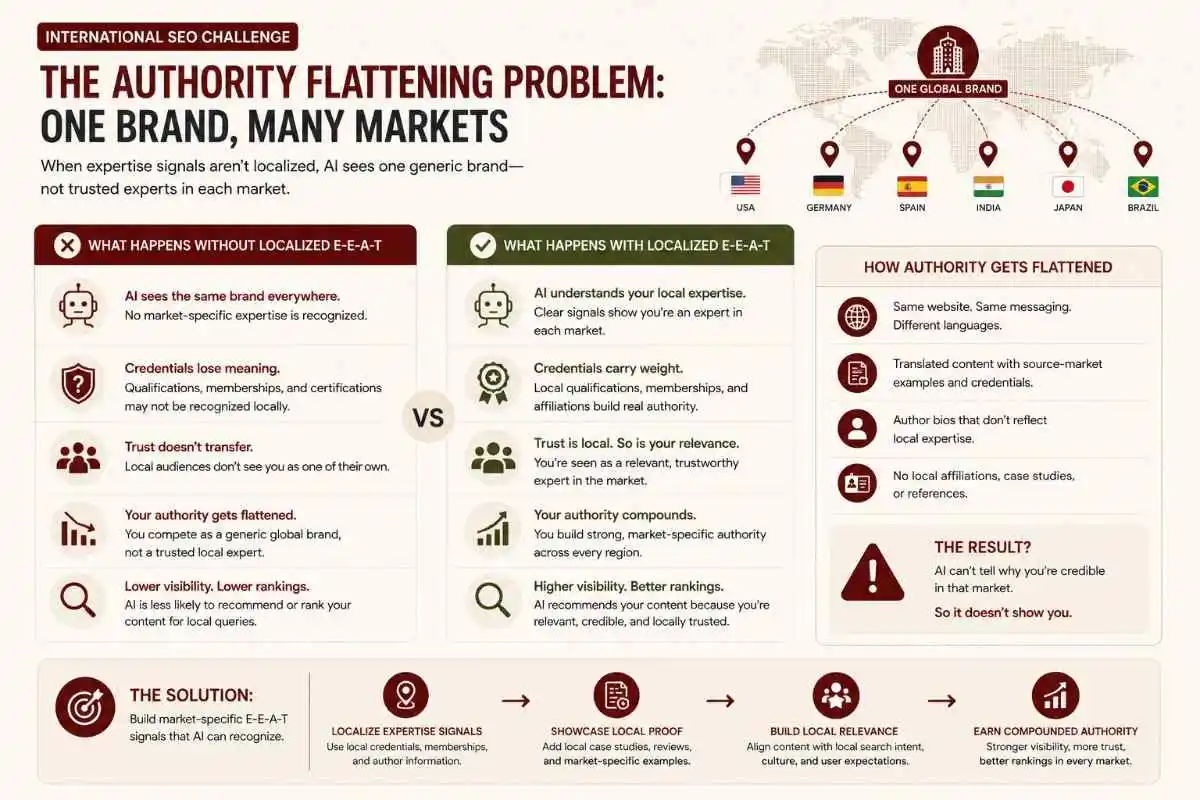
The Authority Flattening Problem: One Brand, Many Markets
Picture a brand that operates in 40 countries. It runs 40 websites, each with localized product information, local vocabulary, local authors, and local examples. From a human perspective, these are 40 separate demonstrations of market-specific authority.
AI systems may not see it that way.
When localized pages across dozens of markets share the same structure, the same arguments, and largely the same content with only surface-level changes, AI can treat them as one big expression of the brand rather than dozens of distinct shows of expertise.
Think of it like mixing 40 cups of coffee in one pot. You know one was brewed in India, another in Japan, and another in Germany. Once they are blended, the individual flavors become impossible to tell apart.
The brand becomes recognizable. The local expertise becomes invisible.
This hits especially hard with professional credentials. A German professional qualification, a French certification, or a Japanese architectural license carries deep meaning for people in those countries. But when a qualification appears rarely in an AI model's training data, the model may not understand its importance on its own. This is not a weakness in the qualification. It is a gap in the connection between the qualification and the level of expertise it represents, one the machine has not learned to make.
What Your Brand Should Do Differently
The fix is not to create thousands of new pages. Google keeps promoting useful, unique, user-focused content and encourages brands to show who created their content and what qualifies them. What global SEO strategies need now is an authority layer that makes your existing expertise visible, verifiable, and locally connected.
1. Put Your Experts Front and Center
Stop using generic bylines like "Written by our team." Every market-specific page should feature an author with clear local expertise.
Author profiles should include the person's name, job title, qualifications and certifications, professional memberships, years of experience in that specific market, publications or speaking engagements, and areas of specialization. Google itself advises brands to establish authorship through bylines and provide relevant background on authors.
A named expert with verifiable credentials is always more useful than an anonymous team credit. This holds true for human readers and for AI systems processing the page.
2. Connect Credentials to Institutions
A credential that stands alone on a page is just text. Context gives it meaning.
Saying "John is a Certified Financial Adviser" is a start. Saying "John is a Certified Financial Adviser registered with [professional organization], with 12 years of experience advising on retirement planning in the UK" is far more useful.
The second version builds a clear chain: Person to Certificate to Institution to Market to Expertise to Topic. This kind of structured relationship carries meaning for both human readers and AI systems reading the page.
3. Stop Making Every Regional Page a Copy
This may be the single most important change for global brands.
If you sell software in India, Germany, and Japan, your regional pages should not be the same page translated three times with a line like "Our software makes business more productive."
Your Indian page should reference Indian workflows, Indian regulations, Indian case studies, Indian terms, and Indian integrations. Your German page should reference German legislation, German business processes, German case studies, and German industry standards. Your Japanese page should bring its own distinct perspective.
Google advises brands to use clear signals for different versions of international websites because search engines need help telling which page belongs to which audience. But the deeper benefit is that truly different content is useful in a way that merely translated content can never be.
4. Build Local Proof, Not Just Local Pages
Ask yourself this about each market: what evidence do we have that we understand this country?
Local proof takes many forms. Local case studies. Customer reviews from that market. Interviews with local experts. Local statistics and research. References to local regulations. Industry reports specific to that country. Partnerships with local professional groups. Product testing done under local conditions.
When a skincare company enters the Japanese market, simply translating its Indian skincare guide is not enough. The Japanese version should address local skin concerns, local product rules, seasonal factors specific to Japan, and ideally include perspectives from local dermatologists or beauty professionals.
This is what the SEO world calls informational gain. It means your content adds something the existing search results do not have. Localized content with real local proof is almost always a source of informational gain, because most competitors are still just translating.
5. Think in Entities, Not Just Keywords
This is the biggest strategic shift in international SEO right now.
Traditional SEO asks: "What keyword will rank this page?"
The better question is: "What are the people, organizations, credentials, and relationships that prove this brand is an expert on this topic in this market?"
An entity-based approach maps out connections: Brand to Expert, Expert to Credential, Credential to Institution, Institution to Market, Market to Topic, Topic to Regulation.
This kind of structure means far more to AI systems than a page built around a single keyword. It becomes critical as AI search keeps moving toward summarizing answers instead of showing ten blue links. When an AI writes a response, it draws on the entities and relationships it can find. If your expertise is not spelled out in those terms, it may not show up in the answer at all.
The Technical Foundation: Get the Basics Right
None of the content work above matters if the technical setup is broken. International SEO still requires solid fundamentals.
Hreflang tags tell search engines which language and regional version of a page to show to which audience. Mistakes are common: wrong language codes, missing self-referencing tags, and incomplete coverage across all language versions. Every regional page must reference every other version, including itself.
URL structure means choosing between country-code top-level domains (like .de or .jp), subdirectories (/de/, /jp/), or subdomains (de.example.com). Each option has trade-offs around authority, server management, and geographic signals. Subdirectories are the most common choice for brands that want to keep domain authority in one place while still signaling regional targeting.
Website localization goes beyond language in its technical signals too. Date formats, currency formats, phone number formats, address formats, and schema markup should all match the target market. These signals seem small on their own, but together they tell both users and search engines that this page was built for this specific audience.
Internal linking between language versions should be deliberate and complete. Language versions that are not linked from the main site can struggle to get indexed. A language selector that is visible and easy to find on every page helps both users and crawlers move between versions.
The India Opportunity: A Market Still Framing This as "Translation"
India presents a specific and telling case for international SEO.
Search data shows that Indian users search for "website translation" at 88 times the rate they search for "SEO localization." The Indian market is earlier in its understanding of the gap between translation and localization. This creates both a challenge and an opening.
The challenge is that Indian businesses may not yet see the need for full localization. The opening is that brands and agencies that educate this market now can build topical authority before the space gets crowded.
India's E-E-A-T awareness is nearly level with the US (2,400 monthly searches in India vs 2,900 in the US). The SEO community in India is sharp and growing. What is lagging is the specific understanding that localization is a separate skill from translation, and that it directly affects search performance.
For brands targeting India, this means your content should meet the audience where they are. Use "website translation" as the entry point. Then educate toward "content localization" and "SEO localization" as the deeper, more effective approach.
The International SEO Checklist for the AI Era
Before you build another regional website, run through these questions.
About Your Experts
- Is the author clearly named?
- Are their qualifications visible on the page?
- Can a reader and a machine both understand why this person is qualified to write about this topic in this market?
About the Market
- Does the content include real local knowledge?
- Are local regulations and standards addressed?
- Are the examples relevant to local users, or are they translated from another market?
About Authority Signals
- Are credentials linked to the institutions that granted them?
- Are local professional groups referenced?
- Are local experts involved in creating local content?
About Content Differentiation
- Is the regional page meaningfully different from the global version?
- Does it offer something the global page does not?
- Is there clear evidence of local market expertise?
About Technical Implementation
- Are regional URLs clearly structured?
- Are hreflang tags set up correctly and completely?
- Can search engines crawl and index all language versions?
- Are localized schema, date formats, and currency formats in place?
International SEO Needs an Authority Translation Layer
Here is the simplest way to think about this shift.
Localization translates your content. Authority translation conveys your credibility.
A global brand may have deep expertise in dozens of markets. The problem is not a lack of authority. The problem is that the authority is buried, unspoken, and invisible to the systems that now decide who gets seen.
The fix is not to make up credentials or overstate expertise. It is to surface what already exists. Make it visible. Make it verifiable. Make it specific to each market. Make it connected. Make it consistent.
Google has been saying this for years: show who created your content and why they are qualified to create it. The rise of AI search just makes this more pressing. Expertise that is not clearly stated is expertise that AI cannot find, cannot check, and cannot cite.
The brands that win in international SEO over the next few years will not be the ones with the fastest translation tools. They will be the ones that can show, in terms machines can read, that they know each market they serve.
Not "We have a website in this country."
But "We can prove we understand this country."
That is much harder to fake. And it is much more valuable to build.
[ Common questions ]
International SEO FAQs
Translation gets the words right but often misses what actually drives search traffic. If your translated pages use keywords that nobody in that country searches for, reference credentials that hold no weight there, or repeat the same examples across every market, they will struggle to rank. The next step is localization, where each version is built around the way people in that specific market search, buy, and evaluate trust.
AI translation is a useful starting point for speed and volume. But it cannot do local keyword research, add local case studies, or build E-E-A-T signals like regional credentials and expert voices. For pages that matter most to your search visibility, pair AI with a local editor who can adapt the content for the market. This approach is called post-editing machine translation (MTPE), and it gives you speed without sacrificing relevance.
Read your German page, your Indian page, and your Japanese page side by side. If the only differences are the language and the currency symbol, AI systems may treat them as one piece of content rather than three separate demonstrations of expertise. Each page should have its own local examples, local regulations, local customer stories, and local expert perspectives. If you cannot point to something on the page that only applies to that country, the page is not localized enough.
Start with your authors. Replace generic bylines like "Written by our team" with named experts who have verifiable local qualifications. Connect each credential to the institution that granted it and the market where it carries weight. This single change makes your expertise visible to both readers and to the AI systems that decide which brands show up in search results.
Because that is exactly the gap you can fill. Search data shows that most results for international SEO queries come from translation companies and generic tool providers. Almost nobody is showing real, locally grounded expertise. Brands that invest in genuine content localization, with local proof, local experts, and local search strategies, stand out in a space where everyone else is still copy-pasting.
Yes, and India is a particularly revealing case. Indian users search for "website translation" at 88 times the rate they search for "SEO localization." The market still frames this as a translation problem. But India's E-E-A-T awareness is nearly level with the US. Brands that educate Indian audiences on the difference between translation and localization can build topical authority in a space that is wide open right now.
