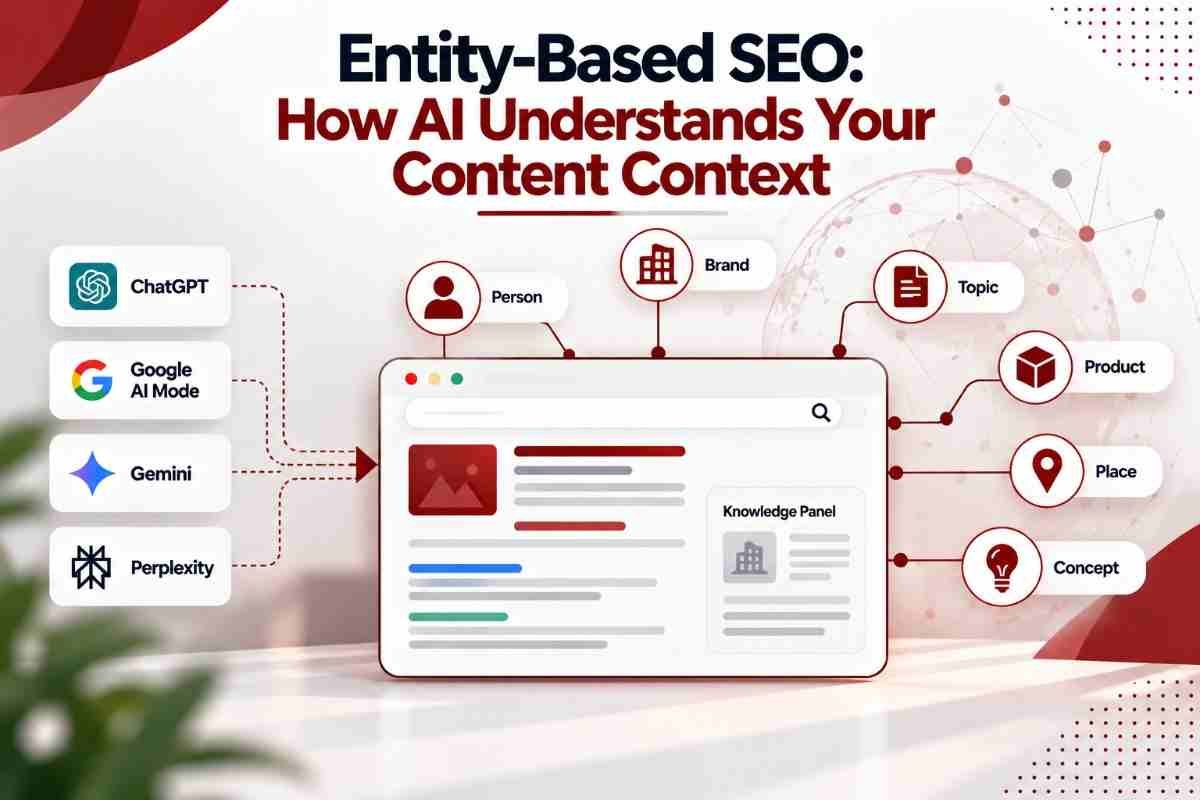
How entity relationships and semantic context are replacing keyword density as the primary ranking signal in modern search.
Entity SEO and Knowledge Graphs: How They Drive Rankings in 2026
Date: 10 - 05 - 2026
Time to read: 8 minutes

Subscribe to our newsletter
[ Related Posts ]
Read article
Read article

Practical schema markup strategies that improve Knowledge Graph presence and AI search visibility for real businesses.
Let's Talk Entity SEO
Ready to build a verified entity identity that AI search can find and cite? We can help.
Get in touch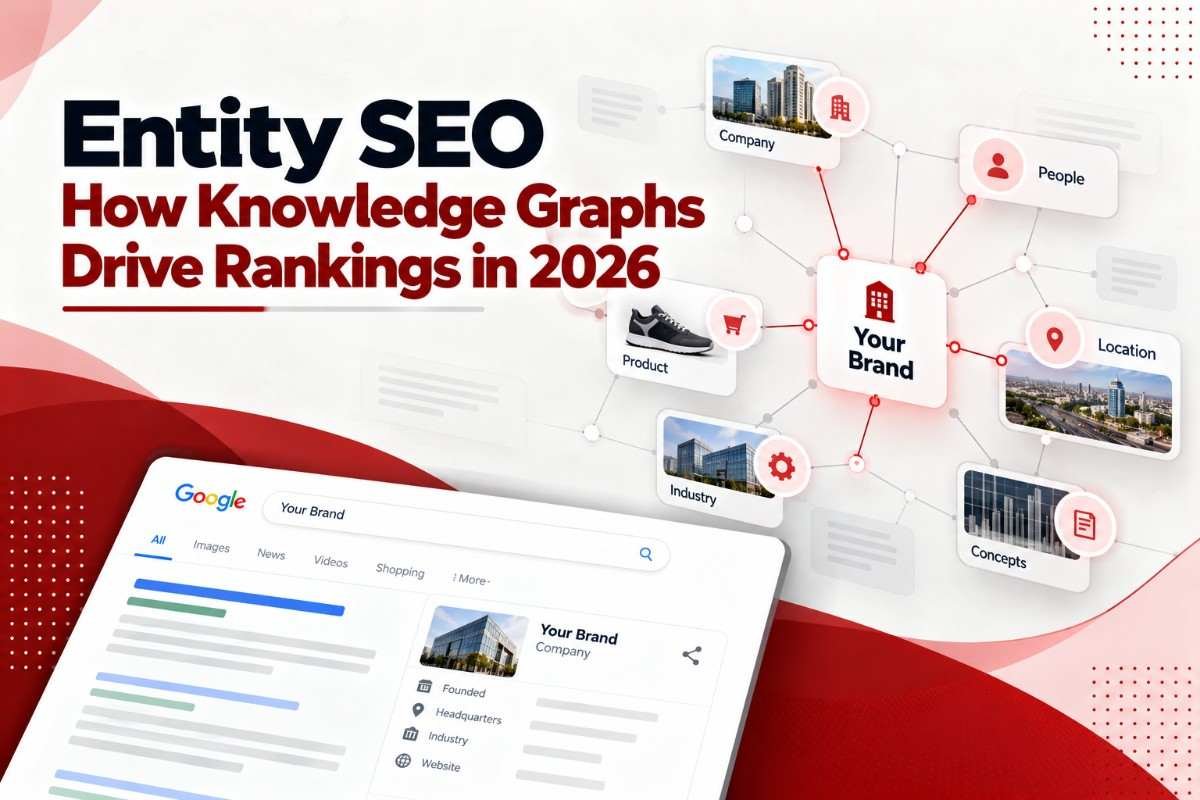
[ Table of Content ]
Search visibility is not what it used to be. The days of packing a page with keywords and waiting for traffic are long gone. Modern search engines, AI answer tools, and conversational interfaces now handle most queries by retrieving verified concepts from deep relational databases -- not by matching words in a text file. If your business does not exist as a named, verified entity inside Google's Knowledge Graph, you are invisible to a growing share of how people actually search.
This shift has a name: entity SEO. It describes the move from keyword matching to concept ownership. Instead of ranking a page for a phrase, the goal is to make your brand, your people, and your content become verified nodes in the semantic web that powers AI search, rich results, and zero-click answers.
This article explains exactly how entity SEO works, what the Knowledge Graph is and why it controls rankings, and what practical steps you can take today to build a machine-readable digital identity. Whether you run an e-commerce store, a professional service, or a content site, understanding entity-based SEO is no longer optional -- it is the foundation of modern organic growth.
Suggested reading:SEO Strategy Beyond Keywords: What Actually Works in 2026
What Is Entity SEO and Why It Matters Now
An entity is anything in the real world that can be uniquely identified and described. A specific company, a named individual, a physical location, a product, a concept. Search engines no longer treat the web as a pile of text -- they treat it as a network of entities and the relationships between them.
Entity SEO is the discipline of making your digital presence recognisable as a verified entity within that network. When Google can confirm that "Oddtusk" is a specific digital marketing company in Bhubaneswar, India, founded in 2025, with a verified LinkedIn presence and a named founder, it stops second-guessing your content and starts confidently surfacing it when users ask relevant questions.
This matters because of how AI search now works. Google AI Overviews, Perplexity, and ChatGPT browsing all pull information from the same semantic databases. Brands that are verified entities inside those databases get cited. Brands that are just collections of pages with keywords do not. The three reasons this shift is happening now are:
- AI overview dominance: A large share of informational queries now return an AI-generated answer at the top of results. Only verified, trustworthy entities get included in those answers consistently.
- Zero-click behaviour: Users often get their answer directly on the search page without clicking through. Being the entity cited in that answer is the new first-page ranking.
- Algorithm resilience: Pages rank and fall. Entities persist. Once your brand is established as a Knowledge Graph node, algorithm updates become far less threatening because your identity is verified at a level above individual page rankings.
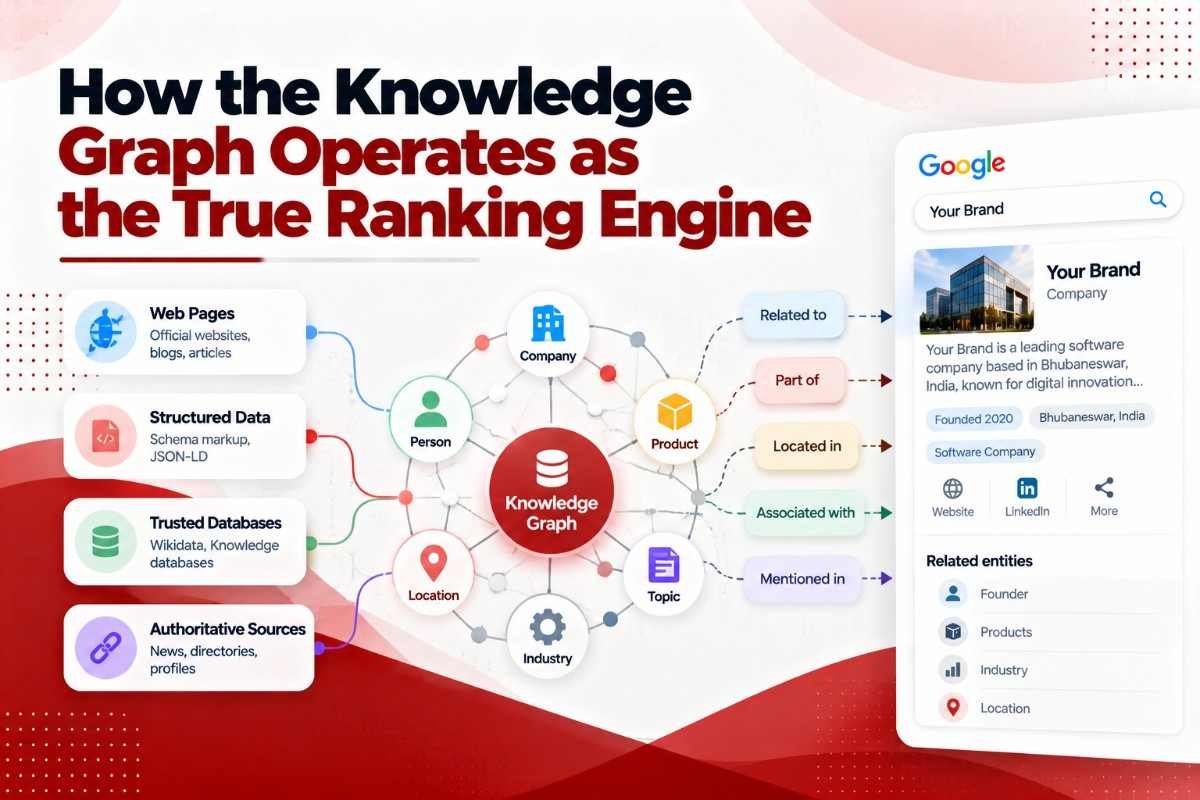
How Entity-Based SEO Is Built
To understand entity-based SEO, it helps to understand how search engines model knowledge. They do not see your website as a page with words. They see it as a node that potentially represents a concept, and they spend considerable effort deciding whether they can trust that concept to be what it claims.
Every recognised entity has four structural elements that define how search engines understand and use it:
The Core Node
This is the entity itself -- a single, uniquely identifiable concept. For a business, this is your brand name, your registered company, your official online identity. Everything else connects to this node. The stronger and clearer your core node, the easier it is for search engines to build a reliable profile around it.
Object Properties
Every entity carries descriptive attributes that pin down its identity. For a business these include things like industry category, founding date, location, and primary services. These properties eliminate ambiguity. When Google knows that "Oddtusk" is a digital marketing agency in Bhubaneswar (not a tusk company in Texas), it can serve your content to the right queries with confidence.
Relational Vectors
Entities do not exist in isolation. They connect to other entities through defined relationships: "founded by," "located in," "works with," "is an authority on." These connections, built through proper schema markup and cross-platform mentions, are what make your entity trusted rather than just recognised. A business entity linked to a verified founder entity, a verified location entity, and verified industry authority entities is far more credible than a standalone company page with no relational context.
Disambiguation
Language is full of words that mean different things. "Apple" can be a fruit or a technology company. "Jaguar" can be an animal or a car brand. Entity SEO uses structured data and sameAs references to ensure search engines always resolve ambiguity in your favour. When a user searches for something related to your brand, the disambiguation signals in your entity data point the algorithm to the right interpretation immediately.
Entity SEO Insight
Keywords tell search engines what your page is about. Entities tell search engines who you are. The difference is the difference between being a result and being a trusted source.
The Knowledge Graph as a Ranking Engine
Google's Knowledge Graph is the database that underpins how modern search understands the world. It maps hundreds of billions of facts across billions of verified entities. When your brand is integrated into this graph, your content is no longer evaluated purely on page-level signals like word count or backlink anchor text. It is evaluated as part of a trusted entity with a known identity and verified relationships.
The Knowledge Graph matters for three specific reasons in 2026:
- Scale and pruning: The graph regularly removes low-quality, ambiguous, or poorly defined entries. This means that simply appearing in the graph is not enough -- you need to maintain clear, consistent signals to stay in it. Recent updates have removed millions of entities that lacked sufficient verification signals.
- Zero-click protection: When your entity is a recognised graph node, your brand information populates Knowledge Panels, AI Overviews, and answer carousels directly. You win visibility even when users never click a traditional result.
- AI retrieval priority: Large language models and retrieval-augmented generation (RAG) systems used by AI search tools actively prefer information from verified entities. A brand with a clear graph presence is cited far more often than a brand that exists only as crawled text.
Building Knowledge Graph presence is not something that happens overnight. It requires consistent entity signals across your own site and across the external web. The more places that reference your entity consistently and accurately, the faster and more firmly you become embedded in the graph. This is why topical authority and entity SEO go hand in hand.
Building a Practical Entity SEO Strategy
Moving from keyword-focused SEO to an entity-based approach requires changes at both the technical and content level. Here is what a real entity SEO strategy looks like in practice.

Create an Official Entity Home Page
Choose one canonical page -- usually your homepage or About page -- as the definitive source of information about your company entity. This page carries your Organisation schema, your official description, and your sameAs links. Everything else on your site should reference this page as the entity anchor. Think of it as your entity's registration record for search engines.
Implement Complete Schema Markup
Add comprehensive JSON-LD schema markup to every key page on your site. For the entity home page, this means full Organisation schema. For blog posts, BlogPosting schema with linked Author and Publisher nodes. For team profiles, Person schema with career history, job title, and sameAs links to LinkedIn and professional databases. Do not guess at schema -- validate every implementation through Google's Rich Results Test before going live. Poorly formatted schema can confuse crawlers rather than help them.
Build sameAs Cross-Platform Links
The sameAs property inside your schema markup is one of the most powerful signals in entity SEO. It tells search engines that the entity on your website is the same entity that appears on Wikidata, LinkedIn, Crunchbase, industry directories, and government business registries. Each sameAs connection is a verification point. The more authoritative the external source you link to, the stronger the confirmation signal. Start with Wikidata, LinkedIn, and any industry-specific registries relevant to your sector.
Build Tight Topic Clusters
Arrange your content into tightly linked pillar-and-spoke structures that demonstrate deep expertise on specific topics. A pillar page on semantic SEO supported by spoke articles on schema markup, topical authority, internal linking strategy, and search intent vs. keywords signals to search engines that your entity owns this topic area. Each spoke article strengthens the pillar's entity signals, and each internal link is a relational vector connecting your content nodes. This is how topical authority mapping works in practice.
Suggested reading:Why Topical Authority Matters More Than Ever in AI Search
Elevating E-E-A-T Through Structured Association
Google's E-E-A-T guidelines (Experience, Expertise, Authoritativeness, Trustworthiness) and entity SEO are almost inseparable. When a search engine can identify the real person behind an article as a verified expert entity with a professional history, institutional affiliations, and consistent public presence, the trust level it assigns to that content rises dramatically.
Here is how to build E-E-A-T through entity signals:
Author Node Validation
Every author on your site should have a detailed Person schema record that includes their full name, job title, employer (linked to your Organisation schema), and sameAs links to their LinkedIn profile and any professional databases. The goal is to create a verified author entity that search engines can confirm independently. An author whose identity can be cross-referenced against external authority sources is far more trustworthy than an anonymous byline.
Cross-Platform Consistency
Every piece of biographical information about your executives and authors must be exactly consistent across your website, LinkedIn, Wikidata, and any other platforms where they appear. Even small discrepancies in job titles, employer names, or professional history can weaken the entity match confidence that search engines use to verify identity. Audit all external profiles at least quarterly and bring them into alignment with the official descriptions in your schema markup.
Original Research and Unique Data
One of the strongest E-E-A-T signals is publishing information that no one else has. Original industry studies, proprietary data sets, and first-hand analysis based on real client work cannot be replicated and force other sites to cite you, which creates the authoritative inbound references that reinforce your entity's Knowledge Graph position.
Earn Relational Mentions From Authority Entities
Being cited or mentioned by entities that are already well-established in the Knowledge Graph transfers authority to your own entity. Target digital outreach at publications, directories, and organisations that are already verified graph nodes in your industry. A mention from an established industry body does far more for your entity signals than a mention from a new blog with no Knowledge Graph presence. This is why link building strategy now overlaps heavily with entity SEO -- the source entity matters as much as the link itself.
Writing Content That Search Engines Understand
Even with perfect schema markup and strong entity signals, your content itself has to be structured in a way that makes it easy for search engines and AI systems to extract reliable, citable information. This is called content salience -- how clearly and confidently a page communicates its core concepts.
- Lead with definitions: Every article covering an important concept should open with a clear, direct definition of that concept. AI systems are trained to pull definitional answers from the first strong statement on a page. A crisp opening sentence that states the concept and its primary characteristic is far more likely to surface in AI Overviews than a vague introductory paragraph.
- Use headings to signal topic context: Embed your primary and secondary keywords directly into H2 and H3 subheadings. This tells search engines what specific concepts each section covers and helps them map your content to the correct topics in the semantic graph. Avoid heading variations that obscure meaning for the sake of creativity.
- Include semantically adjacent terms: Deliberately use related concepts and terms throughout your body copy. An article about semantic SEO that also covers Knowledge Graph, entity recognition, structured data, and topical authority gives search engines strong contextual signals that confirm the article's place in the semantic landscape.
- Use descriptive anchor text for internal links: Every internal link should use anchor text that accurately describes the destination page's topic. Anchors like "learn more" or "click here" provide no semantic value. Anchors like "internal linking strategy" or "content gap analysis" tell search engines exactly what concept the linked page represents and reinforce the relational structure of your topic cluster.
Legacy SEO vs. Modern Semantic Architecture
The table below makes the difference between old-school keyword tactics and modern entity SEO concrete. If you are auditing your current approach, this comparison helps identify where your strategy is still using legacy signals that AI search systems largely ignore.
| Optimisation Element | Legacy Keyword Practices | Modern Entity SEO Framework |
|---|---|---|
| Primary System Focus | Exact-match plain text strings | Identifiable concepts, real relationships, and unique identities |
| Core Ranking Signals | Basic word frequency and raw hyperlink volume | Structured schema data, sameAs arrays, and Knowledge Graph presence |
| Disambiguation | Virtually none; multi-meaning terms fail silently | Unique entity identification through structured backend code |
| AI Visibility | Very low; AI systems skip keyword-heavy pages | Maximum visibility; clear entities serve as AI information blocks |
| Algorithm Resilience | Vulnerable; each core update can eliminate rankings | Resilient; entity trust survives most page-level updates |
2026 Content Checklist for Entity SEO
Use this checklist for every piece of content you publish. It is designed to keep your production process aligned with semantic architecture from the first draft to publication.
- Single page primary focus: Each page targets one main canonical concept. Do not combine multiple unrelated topics on a single URL.
- Schema validated before going live: Run all JSON-LD through Google's Rich Results Test. Fix all errors and warnings before publishing.
- sameAs links present for all entities: Organisation, Person, and Place schemas include sameAs links to Wikidata and relevant external authority sources.
- Author entity linked: Every article has a byline linked to an author profile page with Person schema.
- Internal links use descriptive anchor text: No generic anchors. Every internal link names the destination concept explicitly.
- NLP tools used to measure confidence score: Run published content through a natural language processing tool to check how confidently the main entity is identified.
- Knowledge Panel monitored: Check regularly whether your brand or key team members have active Knowledge Panels in live search results.
- Topic cluster link complete: Each article links to its pillar page and at least two relevant spoke articles within the same cluster.
Key Takeaways
- Shift from words to networks: Stop measuring success by keyword density. Start measuring it by how clearly your entity is recognised and how many verified relationships it has inside the Knowledge Graph.
- Schema is tier-one infrastructure: Structured data is not an optional technical add-on. It is the primary language through which you communicate your identity to search engines and AI systems. Treat it with the same priority as your site architecture.
- Author authority is measurable: Build out detailed, verifiable digital profiles for every author and executive on your site. Cross-reference them consistently across all external platforms. This is the fastest way to lift E-E-A-T scores for content-heavy sites.
- Eliminate ambiguity at every level: Every page, every heading, every anchor text, and every schema node should communicate exactly one clear concept. Ambiguity is the enemy of entity recognition. The clearer your signals, the more confidently search engines use your content as a trusted source.
- AI search is the new first page: Ranking on page one is no longer enough if your brand is not cited in AI-generated answers. Entity SEO is the primary path to AEO and GEO optimisation -- being the source that AI tools actually quote.
Conclusion: Building a Digital Identity That AI Search Can Trust
The core shift in search is this: the web is no longer a collection of pages. It is a network of entities. The brands that build verified, machine-readable identities inside the Knowledge Graph will keep their visibility as AI search takes over more query volume. The brands that do not will find that keyword rankings offer less and less protection against the way search is evolving.
Entity SEO is not a shortcut or a hack. It is a structural investment in how your business is perceived and processed by every intelligent system that decides what information to surface. Done properly, it gives you resilience against algorithm updates, visibility inside AI-generated answers, and a compounding advantage as the semantic web becomes the primary retrieval layer for search.
At Oddtusk, we build entity SEO programs that turn a business's existing content and online presence into verified, indisputable entities inside global retrieval indexes. We handle the JSON-LD data graphs, the topical authority mapping, the E-E-A-T optimisation, and the cross-platform alignment that search engines need to trust your brand. Contact us for a zero-obligation entity mapping assessment.
[ Common questions ]
Entity SEO and Knowledge Graph FAQs
Entity SEO is the practice of optimising a digital presence so that search engines recognise it as a distinct, verified concept (an entity) inside their Knowledge Graph rather than just a collection of web pages with matching keywords. Traditional keyword SEO focused on matching text strings and accumulating backlinks. Entity SEO focuses on building a machine-readable identity through structured data, consistent cross-platform signals, and clear relational context. The result is better protection from algorithm updates and stronger visibility inside AI-generated answers.
Google's Knowledge Graph is a vast semantic database that maps real-world entities and the relationships between them. When Google can identify your brand as a verified entity inside this graph, it includes your information in Knowledge Panels, AI Overviews, rich answer boxes, and voice search results without needing to re-crawl your pages for every query. Being inside the Knowledge Graph protects visibility because algorithmic updates targeting low-quality pages do not affect entity-level trust the same way they affect keyword-match rankings.
The sameAs property in schema markup is a JSON-LD attribute that links your entity to its corresponding entries on authoritative external databases such as Wikidata, LinkedIn, Crunchbase, or government registries. Search engines use these cross-references to confirm that the entity on your website is the same entity they have already verified elsewhere. The more high-authority sameAs connections you have, the more confident search engines become about your identity, and the more weight they give your content in semantic retrieval.
E-E-A-T is Google's framework for evaluating content quality across Experience, Expertise, Authoritativeness, and Trustworthiness. Entity SEO supports every dimension by making identities machine-readable. When an author has a verified Person schema with consistent biographical data across LinkedIn, Wikidata, and the publisher's website, Google can confirm they are a real expert. When an organisation has a verified entity with sameAs links to industry registries, trust scores rise. Entity SEO turns the qualitative signals E-E-A-T requires into structured, verifiable data that search systems can process automatically.
Every page that represents an entity should carry schema markup. The homepage or About page should have Organisation schema with sameAs links. Team profile pages should have Person schema for each author. Blog posts should have BlogPosting or Article schema with linked Author and Publisher nodes. Service pages should have Service schema. FAQ sections should use FAQPage schema. The goal is to create a consistent web of linked entities across your site so that every major concept is machine-readable and connected to the broader Knowledge Graph.
Topical authority is the degree to which a website is recognised as a reliable, comprehensive source on a specific subject. In entity SEO terms, it means your brand is strongly associated with a set of related concepts in the Knowledge Graph. You build it by creating content that covers a topic from multiple angles with consistent internal linking that signals which concepts belong together. When your entity becomes the go-to node for a topic inside the graph, your pages surface in AI-generated answers for that topic cluster automatically.
Search for your brand name directly in Google. If a Knowledge Panel appears on the right side of the results (desktop) or at the top (mobile), your brand has an entity entry in the Knowledge Graph. If no panel appears, your entity recognition is weak or absent. You can accelerate Knowledge Panel creation by ensuring your Organisation schema is implemented correctly with sameAs links, by claiming or creating a Wikidata entry, by maintaining a consistent brand name and description across all platforms, and by earning mentions from websites that are already well-established in the Knowledge Graph.
Yes. AI search systems pull information from the same semantic databases and crawled content that power traditional search. Brands with strong entity signals (clear schema markup, consistent sameAs references, verified Knowledge Graph presence, high-authority citations) are more likely to be cited in Google AI Overviews, included in Perplexity answer summaries, and referenced by ChatGPT browsing. Entity SEO is one of the most direct ways to improve visibility inside AI-generated search results because it makes your brand information structured, verifiable, and easy for language models to extract confidently.
