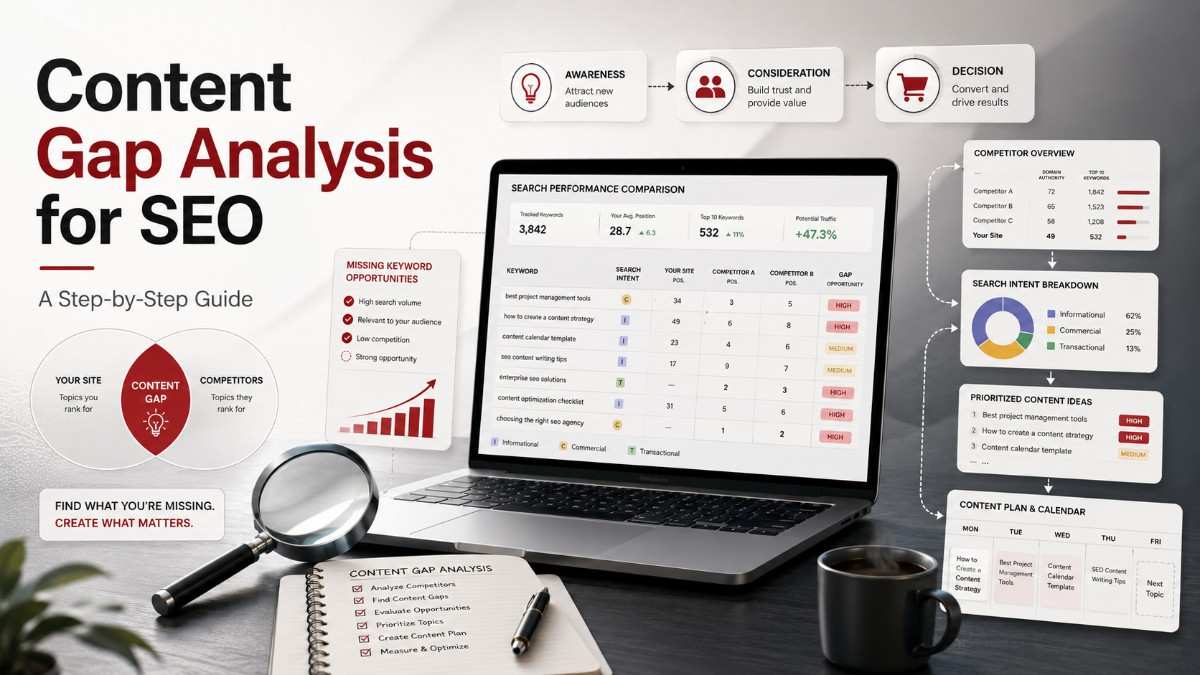
Find the keywords your competitors rank for that your site does not yet cover, then build the content plan around real data.
International SEO, Hreflang and AI Translation: A Practical Guide
Date: 06 - 03 - 2026
Time to read: 13 minutes

[ Case study ]Handicraft brand case study
Subscribe to our newsletter
[ Related Post ]
How to Do a Content Gap Analysis for SEO
Why Topical Authority Matters for AI Search

How complete topic coverage directly affects your site's authority signals in both traditional and AI-powered search.

[ Table of Content ]
International SEO is a set of technical and strategic decisions that decide whether search engines show the right version of your site to the right audience. When those decisions go wrong, search engines may ignore your translated content entirely, index the wrong page for the wrong country, or penalise you for duplicate content you did not know you had.
The hreflang attribute is the core technical mechanism that makes international SEO work. It is also one of the most consistently misimplemented parts of any multilingual website. AI translation tools now make it easy to publish content in a dozen languages overnight, which widens the gap between fast content production and correct international SEO structure.
This guide covers what hreflang actually does, how to implement it correctly, where AI translation helps and where it introduces new problems, and how to build a multilingual content strategy that earns traffic in each market.
What Is Hreflang, and What Does It Actually Tell Google?
Hreflang is an HTML attribute that signals to search engines which language and regional variant of a page to show to a specific user. You place it in the <head> section of each page using ISO 639-1 language codes (like en for English or fr for French) and, where needed, ISO 3166-1 country codes (like US or GB) to distinguish regional variants.
A basic hreflang tag for an English page targeting the United States looks like this:
<link rel="alternate" hreflang="en-US" href="https://example.com/en-us/page/" />
<link rel="alternate" hreflang="fr-FR" href="https://example.com/fr/page/" />
<link rel="alternate" hreflang="x-default" href="https://example.com/" />
<link rel="alternate" hreflang="fr-FR" href="https://example.com/fr/page/" />
<link rel="alternate" hreflang="x-default" href="https://example.com/" />
What hreflang tells Google is specific: "When a user in France searches for this topic, show the French page. When a user in the US searches for it, show the English page. If no specific version matches the user's language or region, show the x-default version."
What hreflang does not do: it does not replace canonical tags, it does not automatically redirect users, and it does not create the translated content for you. It is a signal, and Google uses it alongside other geo-targeting signals to make its indexing and serving decisions.
Key point
Hreflang is a hint, not a directive. Google processes it alongside server location, domain extension, and Google Search Console geo-targeting settings. All of these signals need to be consistent for the implementation to work.
Why International SEO Is Harder Than It Looks
International SEO looks like a translation problem on the surface. With international SEO, most websites have three problems running at once: the technical setup is wrong, the keyword research was never done in the target language, and the content is written for a generic audience.
The duplicate content problem
When you publish translated versions of your pages without hreflang, Google sees multiple pages with overlapping or identical content. It does not automatically understand that one is English and one is French. It sees two pages that appear to be about the same thing and has to choose which one to index. It will usually pick one and deprioritise the other, which is rarely the outcome you want.
Hreflang does not prevent this. It tells Google the relationship between the pages so it can index both correctly.
The wrong version shows in search
Even when Google correctly identifies your language variants, it may still serve the wrong one. A Spanish speaker in Mexico and a Spanish speaker in Spain have different vocabulary, cultural references, and search habits. If you have created one Spanish page and tagged it hreflang="es" without a country qualifier, both audiences get the same content regardless of whether it matches how either of them searches.
In markets where regional differences are commercially significant (Latin America vs. Spain, UK vs. Australia, Canada vs. the US), this is a real loss of relevance and CTR.
Keyword research in the target language is not the same as translating keywords
A search term that drives traffic in English rarely has a direct equivalent in another language that carries the same search volume. The intent, phrasing, and competition all differ. Translating your existing keyword list and building pages around the translations produces content optimised for nobody. International SEO requires keyword research done inside each target language, against the actual SERPs of each target country.
Suggested reading:How to Do a Content Gap Analysis for SEO
Where AI Translation Helps and Where It Falls Short
AI translation tools such as DeepL, Google Neural Machine Translation, and large language models including Claude and GPT-4 have made machine translation significantly more accurate than it was five years ago. For European language pairs, AI-translated text is now often indistinguishable from a competent human translation at the sentence level. For less represented languages, the quality drops considerably.
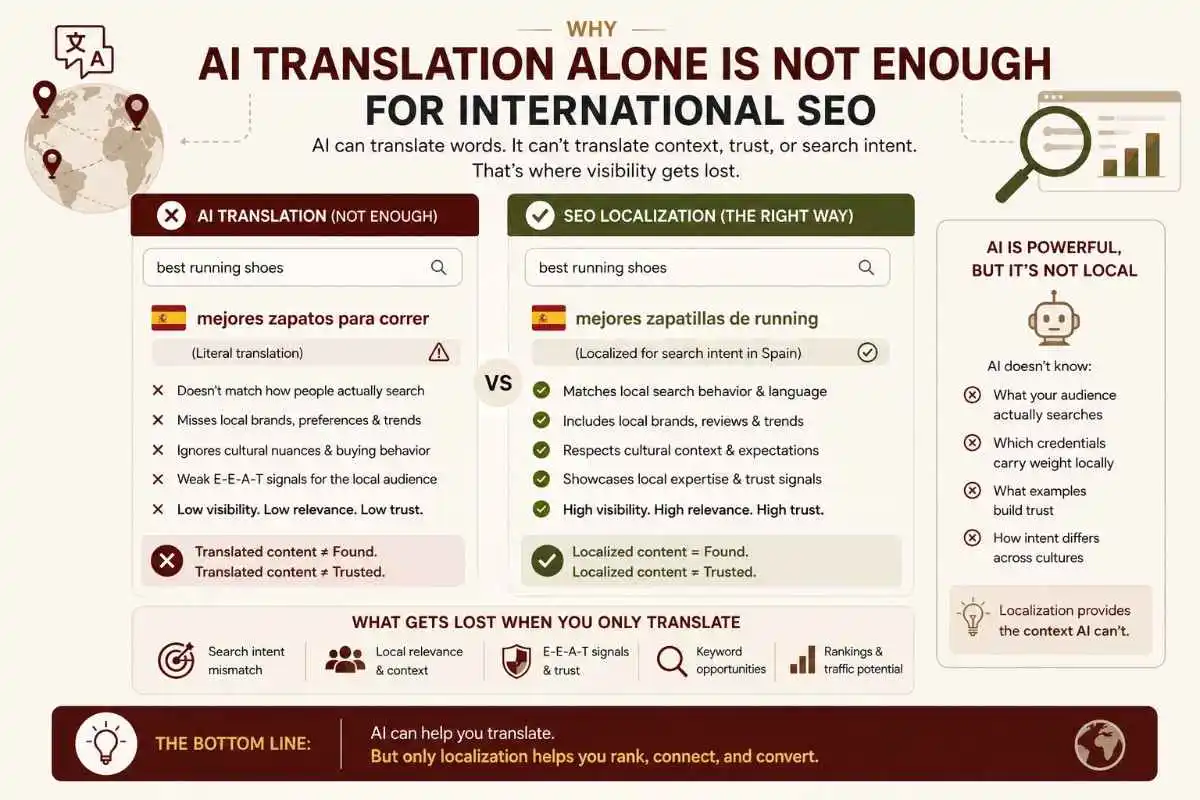
For international SEO, AI translation is usually accurate, so the question is whether the output is locally relevant.
What AI translation gets right
AI tools are fast, consistent, and cost-effective for producing a first draft of translated content. For reference pages, product descriptions, and support documentation where cultural tone matters less than factual accuracy, AI translation with a light editing pass produces publishable content at a fraction of the cost of full human translation.
AI also handles structural consistency well. If your original page uses a specific heading hierarchy and schema markup pattern, AI-translated content tends to preserve that structure, which means your schema markup and technical SEO implementation transfers more cleanly than it would with a manual translation that restructures the content.
Where AI translation introduces SEO problems
Keyword mismatch. AI translates the words on your page, not the search terms your target audience actually uses. The French term your AI tool produces for a product category may be a direct translation of the English term, and that direct translation may have near-zero search volume in France, where users search for something slightly different. The translated page ranks for nobody because nobody searches for those exact words.
Thin content at scale. AI translation makes it easy to publish hundreds of localised pages quickly. If those pages are thin on local context (no locally relevant examples, local data, or references to regional circumstances), Google's quality evaluation will treat them as thin content even if the word count is adequate. Quantity produced by AI without local editorial input does not build topical authority in a new market.
Cultural tone. Idioms, formality levels, regional humour, and culturally specific references do not translate automatically. AI-translated content can read as slightly off in tone even when it is technically accurate, and that affects engagement signals. Pages with high bounce rates and low dwell time in a new market are a signal to Google that the page is not satisfying users from that region. This is also a direct E-E-A-T concern, because experience and authenticity that reads as locally genuine cannot be manufactured by translation alone.
Rule of thumb
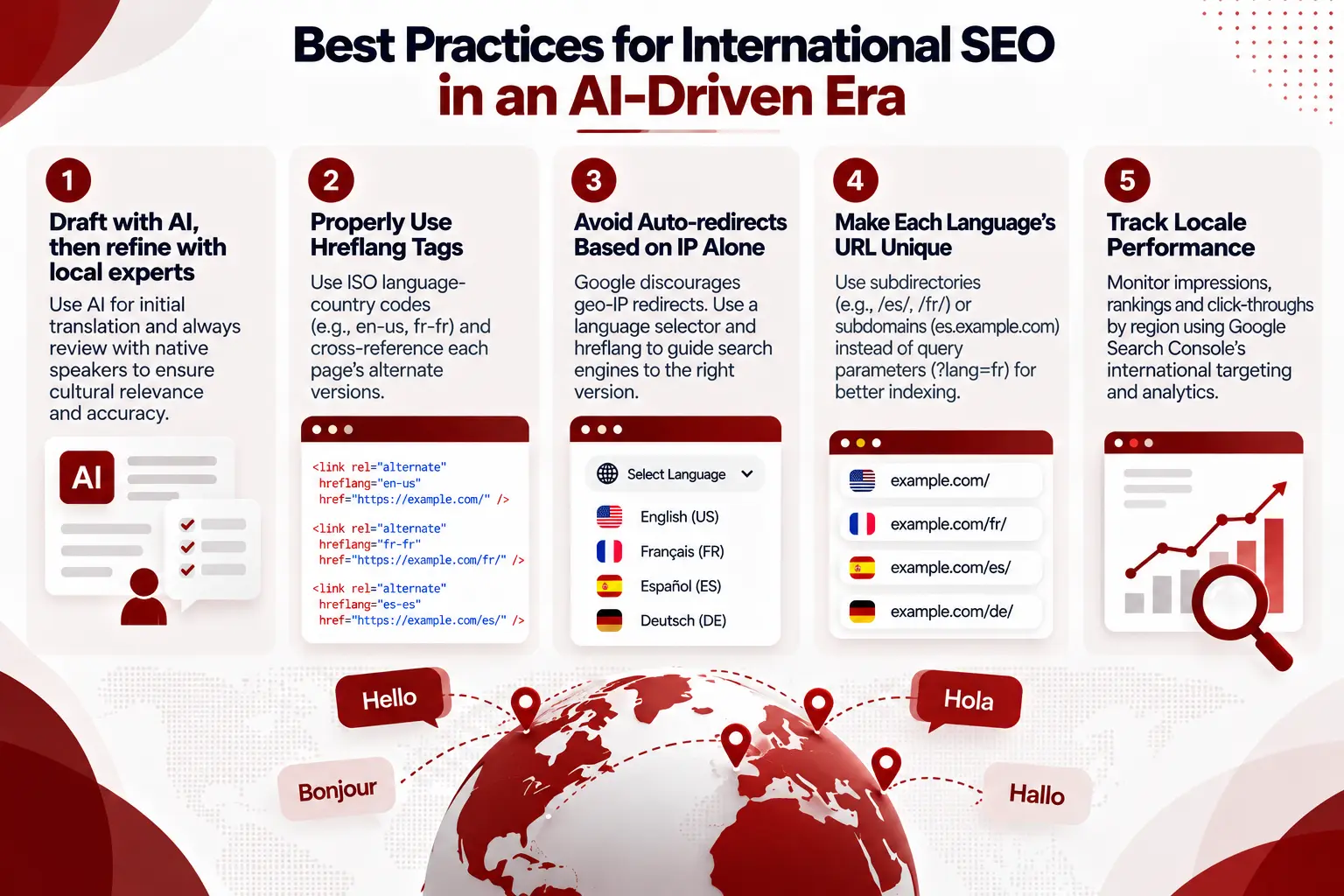
Use AI translation to produce the draft. Use a native editor with local market knowledge to review for keyword accuracy, tone, and cultural relevance. The SEO quality of a multilingual page depends on the editorial pass that follows the AI translation.
Choosing Your URL Structure Before You Add Hreflang
Hreflang tags reference full URLs. Your URL structure needs to be finalised before you begin implementing hreflang, because changing the URL structure after the fact invalidates the entire hreflang cluster and requires rebuilding it from scratch.
There are three common URL structures for multilingual websites, each with different trade-offs:
Subfolders: example.com/fr/
This is the most practical option for most businesses. All language versions sit on the same domain, so every link the site earns contributes to the overall domain authority regardless of which language version receives it. It is the simplest to implement technically and the easiest to maintain. Google handles it well and it is the structure most SEO tools can audit cleanly.
Subdomains: fr.example.com
Google treats subdomains more like independent sites than subfolders. Authority does not flow as freely across subdomains, which means a French version at fr.example.com needs to build its own backlink profile to compete in French search results. For large organisations with separate teams managing each regional site, subdomains can work well operationally. For everyone else, the SEO overhead is not worth the organisational convenience.
ccTLDs: example.fr
Country code top-level domains send the strongest geo-targeting signal Google can read. A .fr domain is clearly French. But this advantage comes with significant operational cost: separate domain registrations, separate hosting setups, separate authority-building efforts for each market, and separate Search Console profiles. For businesses with the budget and team to manage this, ccTLDs are worth it. For most, subfolders deliver comparable performance at a fraction of the complexity.
How to Implement Hreflang: Step by Step
Step 1: Finalise your URL structure
Choose subfolders, subdomains, or ccTLDs and implement them before touching any hreflang tags. Every hreflang tag references a specific URL. If you change URLs after implementing hreflang, you will need to update every tag across every language version, which is a big maintenance task on large sites.
Step 2: Add hreflang tags to every language version
Place the hreflang attribute in the <head> of every page, for every language version. Each page must list all versions, including itself. This is called the return link requirement and it is the most critical implementation detail.
A correctly implemented hreflang cluster for a page with English (US), French (France), and German (Germany) versions:
<!-- On the English (US) page -->
<link rel="alternate" hreflang="en-US" href="https://example.com/en-us/about/" />
<link rel="alternate" hreflang="fr-FR" href="https://example.com/fr/about/" />
<link rel="alternate" hreflang="de-DE" href="https://example.com/de/about/" />
<link rel="alternate" hreflang="x-default" href="https://example.com/about/" />
The same three links, pointing to all three language versions plus x-default, must appear on the French page and the German page too. If any one page is missing a return link to another, the cluster breaks.
Step 3: Add the x-default tag
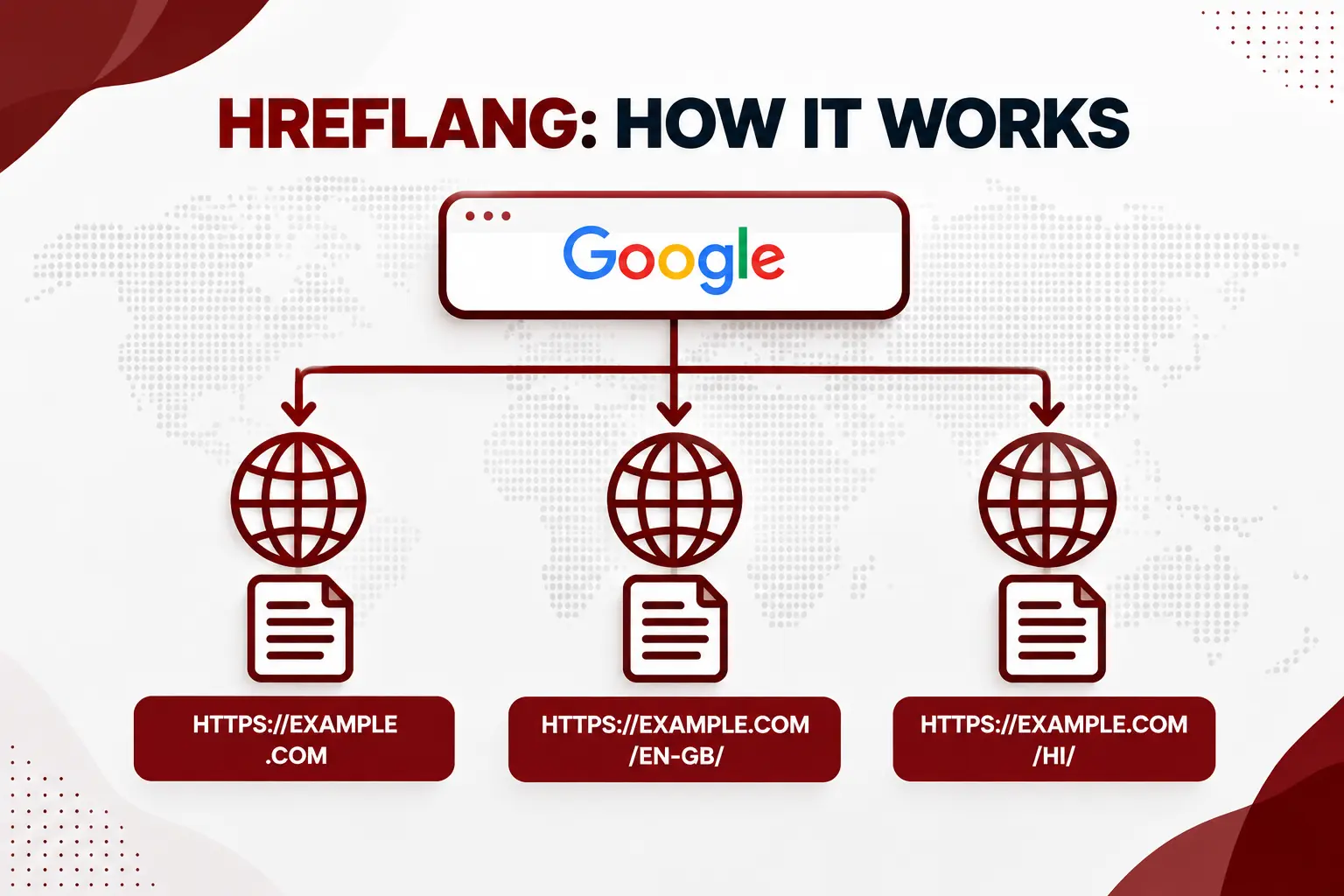
The hreflang="x-default" tag identifies the fallback page: the version to show when no language or regional version matches the user. This is typically the homepage or a language-selector page. Without it, Google picks an arbitrary version for unmatched users, which is usually not what you want.
Step 4: Validate with a hreflang checker
Before pushing hreflang to a live site, validate the full cluster using a dedicated hreflang checker. The Sistrix Hreflang Validator and other free hreflang testing tools are reliable options. Both will flag missing return links, broken URLs, unsupported language codes, and pages that reference themselves incorrectly.
Step 5: Monitor in Google Search Console
After deployment, open the International Targeting report inside Google Search Console. The Language tab shows hreflang errors Google has detected in its crawls. Common errors include return tags that reference a URL Google cannot access, language codes Google does not recognise, and pages where the hreflang language code conflicts with the declared page language.
Suggested reading:Why Topical Authority Matters More Than Ever for AI Search
The Most Common Hreflang Errors (and How to Fix Them)
Missing return links
Every language version of a page must reference every other version. When a page is missing from the cluster, because it was not yet published when hreflang was implemented or because a URL changed and the tag was not updated, Google rejects the entire cluster and reverts to standard indexing for those pages. This is the most common implementation failure and it is invisible until you run an audit.
Fix: Run the full site through a hreflang checker quarterly and after any URL changes. Build hreflang validation into your publishing workflow for any new language versions.
Wrong or unsupported language codes
Hreflang uses ISO 639-1 language codes (two lowercase letters) and ISO 3166-1 country codes (two uppercase letters). Common mistakes include using three-letter language codes (eng instead of en), using region codes from a different standard, and specifying en-UK instead of en-GB. Google does not recognise these codes and ignores the tag.
Fix: Use the official ISO 639-1 and ISO 3166-1 lists. When in doubt, reference Google's own documentation on supported language and region codes.
Hreflang on noindex pages
If any page in a hreflang cluster is set to noindex, Google will not be able to crawl and process the hreflang tags on that page. The cluster breaks at that point and the remaining pages are not reliably served to their intended audiences.
Fix: Ensure every page referenced in a hreflang cluster is indexable. If a translated page is not ready for indexing, do not add it to the hreflang cluster until it is.
Hreflang conflicting with canonical tags
A page that has a canonical tag pointing to a different URL and also appears in a hreflang cluster sends conflicting signals. Google has to decide which directive to follow, and the behaviour is not predictable. Canonicals should always point to the correct language version of each page, not to a cross-language consolidation URL.
Fix: Each language version of a page should have a self-referencing canonical tag. The canonical should be the same URL that appears in that page's own hreflang tag.
Building a Multilingual Content Strategy for International SEO
International SEO has a technical layer, which is hreflang, and a content layer. The content strategy decides whether the pages you are localising are worth localising at all.
Do keyword research in the target language, not from it
Run your keyword research directly inside the target market. Use a keyword tool set to the target country and language, and build your keyword list from the SERPs that users in that country actually see. The queries people use in French are not the French translations of English queries. They are searches shaped by French culture, French competitors, and the French language's own idiomatic patterns.
Localise as well as translate
Localisation means adapting content to the context of the target market, beyond converting it to another language. Examples, statistics, cultural references, pricing, units of measurement, and idiomatic expressions all need to reflect the market you are entering. A case study featuring an American company does not resonate with a French audience the way a locally relevant example does. AI translation handles the language conversion. The editorial pass handles localisation.
Build for each funnel stage in each market
Most multilingual websites translate their commercial pages (service, product, and pricing pages) and neglect to build the informational content that earns trust and drives earlier-stage traffic. In a new market, your brand has no existing authority. Earning it requires publishing content that answers the questions real users in that market are asking, at every stage of the buyer's journey. The informational content strategy that works in English needs to be rebuilt for each market, not translated from English.
Once that content exists in each language, a deliberate internal linking strategy within each language version connects educational pages to commercial ones and passes authority from the content that earns attention to the pages that generate enquiries. Without this, translated pages sit in isolation and do not compound the way a properly structured content cluster does.
Suggested reading:Intent vs Keywords: Why Semantic SEO Changes Everything
AEO and GEO: How AI-Powered Search Affects International SEO for Multilingual Content
Google's AI Overviews, Perplexity, and AI assistants like ChatGPT and Claude now pull answers from web pages and surface them to users without requiring a click. For international SEO, this creates an additional citation layer on top of traditional ranking.
When a user in Germany asks an AI assistant a question about your industry, the assistant will pull an answer from whichever page it finds most authoritative, accurate, and well-structured. If your German-language page is technically correct but poorly formatted, with no clear definitions, structured steps, or FAQ section, it will not be cited even if it ranks. The competitor whose German page has a concise definition, a step-by-step section, and schema-marked FAQ answers will be cited instead.
Structuring multilingual content for AI citation
Every language version of a page you want cited by AI engines needs the same structural properties as your strongest English content: a clear definition of the core topic near the top, step-by-step sections where the content has a process, FAQ sections with direct answers written in complete sentences, and appropriate schema markup, including FAQPage, HowTo, and Article schema in the language of the page. The underlying discipline here is entity-based SEO: Google and AI engines understand pages through the entities they cover, and those entity relationships need to be expressed correctly in each language version as well as the original.
Schema markup does not need to be translated literally, but the content inside the schema (the name, description, and acceptedAnswer fields) must be in the language of the page. A French page with schema markup that contains English text in the answer fields sends a conflicting signal and is less likely to be used for French-language AI responses.
This is the AEO/GEO optimization principle applied to multilingual content: the goal is to be cited as well as to rank. Citation requires structure, accuracy, and local relevance that simply translating an English page's schema does not guarantee.
How Oddtusk Handles International SEO for Clients
Oddtusk is a semantic SEO and ecommerce growth consultancy based in Bhubaneswar, India. We work with D2C brands, B2B service companies, and ecommerce retailers across markets in the US, UK, Europe, and Southeast Asia.
When we build an international SEO strategy for a client, we start with a full technical SEO audit: validating the existing hreflang implementation, mapping the current URL structure, and identifying any indexing conflicts between language versions. We use Ahrefs Site Audit and Screaming Frog to pull the full hreflang cluster across the site, then verify return link completeness and canonical consistency before touching any content.
The content layer comes next. For each target market, we run independent keyword research inside the target language and country SERP, identify the content gaps between what the client has and what competitors in that market rank for, and build a localisation brief for a native editor, who works on top of the AI translation.
The final layer is AEO structure. Every page we localise is reviewed for citation readiness: schema markup, FAQ coverage, definition clarity, and HowTo structure where applicable. In markets where AI-powered search is growing fastest, this layer is now as important as the ranking layer.
If you are looking at international expansion and want the SEO infrastructure in place before you scale content, contact Oddtusk directly.
Key Takeaways
- Hreflang tells Google which version to show whom. Without it, multilingual pages compete with each other and the wrong version gets indexed for the wrong audience.
- Every page in a cluster must reference every other page. Missing return links break the entire hreflang implementation and Google ignores it.
- AI translation is a production tool. It handles language conversion well. It does not handle keyword localisation, cultural tone, or local relevance, which require an editorial pass by someone who knows the market.
- Keyword research must be done inside each target market. Translating English keywords and building pages around them produces content that ranks for searches nobody makes. Our content strategy service covers this for each language individually.
- Decide your URL structure first. Changing it after implementing hreflang requires rebuilding the entire tag set. Subfolders work for most businesses.
- Use
x-defaultfor unmatched users. Without it, Google serves an arbitrary language version to users who do not match any of your specific hreflang targets. - Structure multilingual pages for AI citation. Definition, steps, FAQ with direct answers, and schema markup in the page's own language are required to appear in AI-generated answers in each market. Our AEO/GEO optimization process covers this end to end.
- Audit hreflang after every URL change. Hreflang needs ongoing checks. Any structural change to the site requires re-validating the full cluster.
[ Common questions ]
International SEO and Hreflang FAQs
Hreflang is an HTML attribute that tells search engines which language and regional version of a page to show to a specific user. You place it in the <head> of each language version of a page with an ISO language code and an optional country code. When implemented correctly, it prevents duplicate content issues across translated pages and ensures each audience sees the version written for them.
Yes. Whether a person or an AI tool did the translation does not change how search engines index multilingual pages. If you publish translated versions without hreflang tags, Google may treat them as duplicate content and surface the wrong version to users in the wrong region. Hreflang must be in place regardless of whether the translation was produced by a person or an AI tool.
Missing return links. Every language version of a page must reference every other version, including itself. If the English version references the French version but the French version does not reference the English version, the entire hreflang cluster is invalid and Google ignores it. Incomplete clusters are the single biggest reason hreflang implementations fail to produce results.
The x-default value is a special hreflang attribute that tells search engines which page to serve when a user's language or region does not match any of your specific hreflang targets. It is typically applied to the homepage or a language-selector landing page. Without x-default, users in unmatched regions may see an arbitrary version of your content.
Subfolders (example.com/fr/) are the most practical option for most businesses. They keep all authority on one domain, are easier to maintain, and are fully supported by Google. Subdomains (fr.example.com) are treated more like separate sites and require building authority independently. ccTLDs (example.fr) send the strongest geo-targeting signal but require separate domain registrations and ongoing maintenance for each market.
Google does not penalise content based on how it was produced. The evaluation criteria are the same: is the content helpful, accurate, and written for the user? AI translations fail on what they miss: cultural nuance, local keyword phrasing, and contextual tone. A machine translation that reads naturally and is locally accurate will rank as well as a human one.
Use the International Targeting report inside Google Search Console under Legacy Tools. The Language tab shows hreflang errors Google has detected across your site. For a more detailed per-page audit, run the site through the Sistrix Hreflang Validator or another free hreflang testing tool, both of which validate the full cluster of return links and flag missing or malformed tags.
Language targeting uses hreflang to tell Google which language variant to serve, for example en-US for English speakers in the United States and en-GB for English speakers in the United Kingdom. Geo targeting uses signals such as server location, ccTLD, or Google Search Console's geo-targeting tool to indicate the primary country a site or subdirectory is intended for. For most international SEO strategies, both work together: hreflang handles language and regional matching, while URL structure and GSC settings handle country targeting.
Yes, if it is structured correctly. Google's AI Overviews pull from pages with clear definitions, structured step-by-step content, FAQ sections with direct answers, and correct schema markup. For multilingual pages, this means the translated content must be as well structured as the original. Pages that lack context, local relevance, or proper markup are unlikely to be cited even if they rank.
Audit hreflang whenever you publish new pages in any language, change URLs, restructure the site, or migrate to a new CMS. Outside of these change events, a quarterly audit through a hreflang checker is sufficient for most sites. Larger sites publishing frequently across multiple markets should integrate hreflang validation into the publishing workflow rather than treating it as a periodic task.
