

See how generative AI is reshaping search behaviour, SEO strategy, and content discovery in 2026.
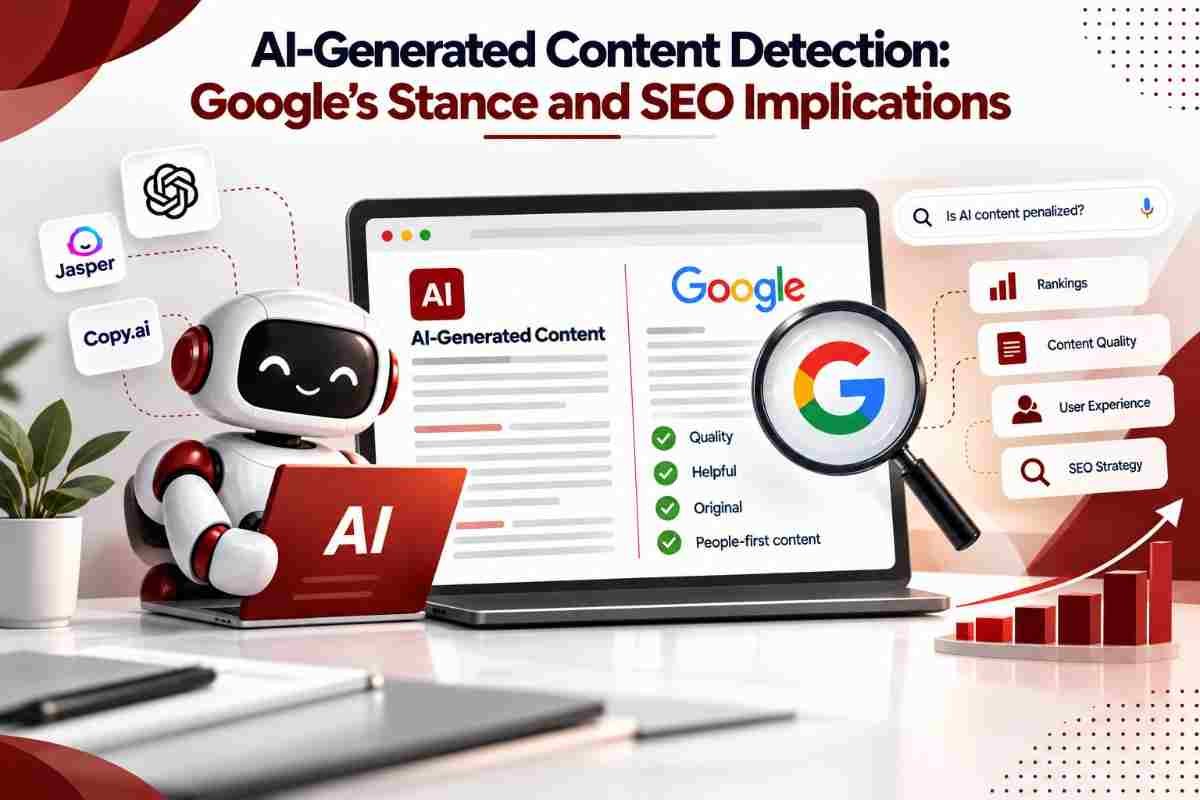
AI-Generated Content Detection: Google's Stance and SEO Implications
Date: 04 - 27 - 2026
Time to read: 12 minutes
[ Table of Content ]
Can Google Really Tell If AI Wrote Your Content?
The short answer is: sometimes, but that's not the right question to ask. The more important question is whether your content is genuinely helpful — because that is precisely what Google's systems are built to reward, regardless of how the words were produced.
Generative AI tools like ChatGPT, Gemini, Claude, Jasper, and Copy.ai have fundamentally changed how content is created. Marketers, bloggers, and businesses now produce articles, product descriptions, and thought-leadership pieces in minutes rather than days. But as AI-generated content floods the web, two critical questions arise: How does Google handle this content? And how does Google's position on AI-generated content affect your SEO strategy?
In this guide, we break down exactly how Google's AI content detection systems work, what quality thresholds your content must cross to rank, and the evidence-backed practices that let you use AI at scale without sacrificing search visibility. If you're building a content strategy for 2026 and beyond, this is the framework you need.
Key Insight
According to Semrush (2024), long-form content over 1,200 words receives 3× more traffic, 4× more shares, and 3.5× more backlinks than short-form content. AI can help you hit that word count — but depth and genuine insight must back it up.
Google's Official Position on AI-Generated Content
Google's stance on AI content has shifted significantly since 2022, and understanding that evolution is essential context for every content marketer.
The 2022 Starting Point: AI = Spam
When John Mueller, Google's Search Advocate, addressed AI-generated content in April 2022, his position was clear: content created primarily by automation — including AI — violated Google's webmaster guidelines and was treated as spam. The concern was straightforward: mass-produced, low-quality content manipulating search rankings.
The 2024 Shift: Quality Over Source
Google's formal position changed substantially in 2024, partly driven by the irony of Bard's own launch and the integration of generative AI into Google Search itself. The updated guidance states:
"It is against our spam policies to use automation — including artificial intelligence — to generate content whose main objective is to manipulate search engine ranking. However, Google policies do not prohibit AI-generated content that is unique, beneficial, and helpful to users."
— Google Search Central, 2024
— Google Search Central, 2024
In plain terms: Google does not penalise AI-generated content by default. It penalises low-quality, manipulative content — whatever its source. Helpful, people-first content that satisfies a genuine search need continues to rank well, whether a human wrote every word or AI assisted in drafting it.
This matters enormously for your strategy. The content bar is the same for human writers and AI assistants. Neither gets a pass for thin, unhelpful material. Neither is automatically penalised for the method of creation.
The Helpful Content System: A Site-Wide Signal
One critical nuance that many teams overlook: Google's Helpful Content System operates as a site-wide signal, not a page-level one. If a significant portion of your site's content is unhelpful or AI-generated without human enrichment, it can suppress rankings for your entire domain — including pages that are independently excellent. This is why content quality governance matters as much as individual article quality.
Understanding how entity-based SEO applies in an AI content context is one of the most effective ways to signal topical depth and relevance to Google's systems — helping every page on your site, not just the one you're currently optimising.
How Does Google Detect AI-Generated Content?
Google doesn't rely on a single "AI detector" switch. Its approach is layered, combining automated systems with human judgement. Understanding each layer reveals why quality, not origin, is what matters most.
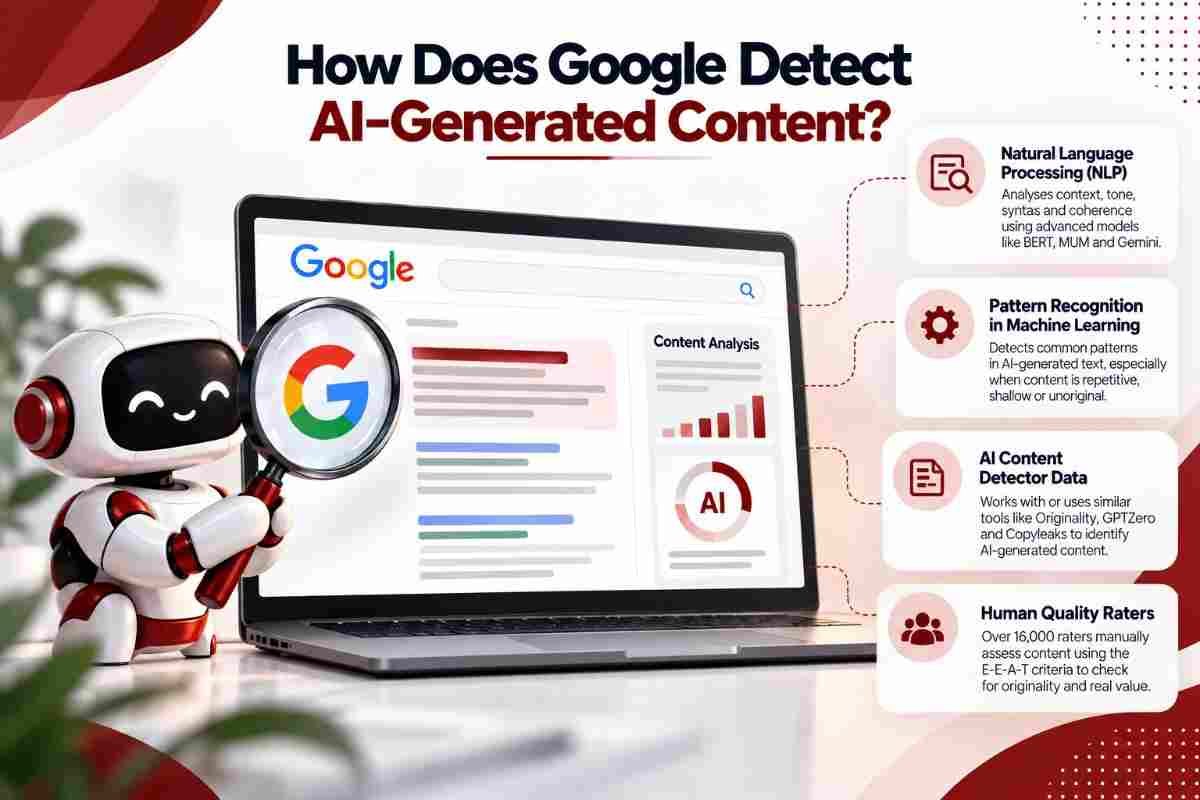
1. Natural Language Processing (NLP) Models: BERT, MUM, and Gemini
Google's understanding of text is built on its own sophisticated NLP architecture. BERT (Bidirectional Encoder Representations from Transformers) analyses how words relate to each other in context, not just in sequence. MUM (Multitask Unified Model) extends this to multimodal understanding. Gemini integrates generative capability directly into search ranking.
These models detect signals that often appear in AI-generated text: unnatural phrasing, repetitive sentence rhythms, vague transitions, generic examples that lack specificity, and a tendency toward hedged language ("it is important to note that…"). None of these signals automatically triggers a penalty — but they collectively reduce the probability of being assessed as a high-quality, authoritative source.
2. Machine Learning Pattern Recognition
Beyond linguistic analysis, Google's machine learning systems have been trained on vast corpora of both human-written and AI-generated content. They recognise statistical patterns in how AI models tend to structure arguments, use transitions, and distribute keyword density — especially when content is shallow or derivative.
The key indicator isn't "did an AI write this?" It's "does this content add something the existing top results don't offer?" If the answer is no, the machine learning layer will likely treat it as low-value content regardless of how it was produced.
3. AI Content Detection Signal Integration
While Google hasn't confirmed direct use of third-party AI detectors, its own systems almost certainly incorporate comparable detection signals. Tools like Originality.AI, GPTZero, and Copyleaks use perplexity and burstiness measurements — essentially, how predictable the text is and how much variation exists in sentence complexity — to estimate AI probability.
These metrics are imperfect: they produce false positives on human-written technical content and false negatives on well-edited AI text. Google's systems face the same limitations, which is why they layer behavioural and quality signals rather than relying on detection alone.
4. Human Quality Raters
Google employs over 16,000 Search Quality Raters worldwide — contractors who manually evaluate search results according to the Search Quality Evaluator Guidelines. Their assessments don't directly change rankings, but they feed into the training data and calibration of Google's automated quality systems.
Quality raters assess content against E-E-A-T criteria: Experience (does the author have first-hand experience?), Expertise (is the information accurate and authoritative?), Authoritativeness (is the site recognised as a trustworthy source in its field?), and Trustworthiness (is the information accurate, transparent, and safe?). A page that feels unoriginal, lacks a credible author signal, or fails to cite sources may be flagged as low-quality — particularly for YMYL (Your Money or Your Life) topics.
E-E-A-T Practical Implication
AI cannot demonstrate first-hand Experience or authentic Expertise on its own. This is the single most important gap between pure AI content and human-authored content in Google's quality assessment. Closing that gap requires human experts in the loop. Learn more about E-E-A-T optimisation strategies we use for clients.
The Quality Thresholds That Matter for Rankings
Knowing how Google detects AI content is useful. Knowing what makes content rank regardless of how it was produced is essential. Here are the four non-negotiable quality thresholds every piece of content — AI-assisted or not — must clear in 2026.
1. Uniqueness and Genuine Value
The first threshold is simple: does your content offer something that doesn't already exist at the top of the SERP? AI tools are excellent at synthesising existing information — but if you simply ask an AI to write about a topic and publish the result, you get a recycled version of what's already ranking. Google's systems are calibrated to detect this.
Genuine uniqueness comes from original data, first-hand experience, proprietary research, expert opinion that isn't available elsewhere, or a genuinely new angle on an established topic. AI can scaffold the structure; human expertise must provide the substance.
2. E-E-A-T Compliance with Expert Review
Google's Helpful Content System specifically rewards content that:
- Demonstrates first-hand experience with the subject matter (e.g., a practitioner writing about a technique they've actually used, not just read about)
- Is authored by — or at minimum reviewed by — a recognisable, credentialed expert whose bio signals relevant authority
- Originates from a site that has established topical authority in its niche through consistent, high-quality coverage
- Builds trust through fact-checking, citations, and transparent sourcing
AI content without human review rarely satisfies more than one or two of these pillars. Our E-E-A-T optimisation service is specifically designed to address these gaps at both the page and site levels.
3. Topic Depth Over Surface Coverage
Thin, surface-level content — regardless of how cleanly it is written — does not perform well in competitive SERPs. Google's systems, informed by quality rater feedback, increasingly favour comprehensive, well-structured coverage that leaves the reader with no need to go elsewhere.
This is where topical authority mapping becomes critical: instead of producing isolated AI articles on random keywords, high-performing content strategies build structured coverage of an entire topic cluster, with each piece supporting and contextualising the others through deliberate internal linking.
AI is genuinely helpful here — it can rapidly produce coverage across a content cluster. But the depth within each piece must come from human expertise and curation.
4. Search Intent and Readability
Google's RankBrain and neural matching systems assess whether content actually answers what the user was trying to accomplish — not just whether it contains the right keywords. Misaligned intent is one of the most common failure modes for AI content, because AI models optimise for comprehensiveness rather than intent-specificity.
Before publishing any AI-assisted piece, ask: what is the user's primary goal when they search for this query? Are they looking to learn, compare, buy, or execute a specific task? The content's structure, CTA, and depth should directly serve that goal. This is the core principle behind intent-based semantic SEO — moving beyond keyword matching to genuine query satisfaction.
Related reading:Intent vs. Keywords: Why Semantic SEO Changes Everything
SEO Implications of AI Content: Positive and Negative
AI-generated content carries real SEO upside — but also measurable downside risk when used carelessly. Understanding both sides gives you a strategic framework for deploying AI responsibly at scale.
Positive SEO Implications
- Content velocity at scale. AI dramatically accelerates the ability to build topical authority through volume. A site that previously published two articles per month can potentially publish twenty — if each is properly reviewed and enriched by human experts. This is a genuine competitive advantage in content-saturated niches.
- Keyword and semantic coverage. Modern AI tools are well-calibrated to incorporate primary keywords, LSI terms, and semantic variants naturally across long-form content — reducing the manual effort of keyword integration without stuffing.
- Content refresh efficiency. AI excels at taking outdated articles and restructuring them with current frameworks. Freshness signals matter for rankings, and AI makes systematic content refreshes feasible at enterprise scale.
- Structural consistency. AI-assisted content tends to follow logical structures (problem → solution → evidence → CTA), which aligns well with how Google's quality raters assess organisation and readability.
- AEO/GEO readiness. Well-prompted AI can generate FAQ sections, direct question-answer pairings, and definition blocks that are highly compatible with Answer Engine Optimization and Generative Engine Optimization — making content more likely to appear in AI Overviews, ChatGPT Search, and Perplexity.
Negative SEO Implications
- Spam filter activation. Generic, unedited AI output — particularly content that doesn't offer unique insight — triggers Google's automated spam filters and the Helpful Content classifier. The risk scales with volume: publishing hundreds of thin AI articles accelerates the site-wide quality penalty.
- Duplicate content risk. AI models are trained on existing web content and frequently produce text that closely mirrors existing sources. Without proper differentiation, this creates near-duplicate content issues that dilute ranking signals across similar pages.
- E-E-A-T signal absence. Sites publishing AI content without author attribution, expert review signals, or credible external citations lose E-E-A-T ground rapidly, particularly in YMYL categories like health, finance, and legal topics.
- Hallucination and factual inaccuracy. AI models generate false statistics, misattributed quotes, and invented citations with high confidence. Publishing unverified AI content creates trust and legal risks beyond pure SEO consequences.
Real-World Case Study
In December 2023, a well-known health blog that exclusively featured AI-written posts experienced a 52% decrease in organic traffic following Google's Helpful Content Update. The site had no expert author bios, no cited sources, and no editorial review layer. This wasn't a penalty for using AI — it was a penalty for publishing low-quality content that failed every E-E-A-T dimension.
The pattern here is consistent: the sites that suffered after Helpful Content Updates weren't penalised for using AI tools. They were penalised for replacing editorial judgement with AI output rather than augmenting it.
Related reading:How AI is Killing Traditional SEO & What You Should Do About It
Best Practices for Using AI Content Ethically
Responsible AI content use isn't just about avoiding penalties — it's about building a content operation that maintains audience trust and scales without degrading over time. Our content marketing services are built on exactly this hybrid approach: AI efficiency matched with human editorial rigour.
Step 1: Use AI for Scaffolding, Not Final Output
The most effective workflow treats AI as a research assistant and structural drafter, not a publishing machine. Prompt your AI tool to produce a detailed outline, a rough draft, or a list of key points. Then have a subject-matter expert rewrite, enrich, and verify the content before it goes near your CMS.
The distinction matters not just for quality, but for the authenticity that Google's quality raters are trained to detect. A page that clearly reflects genuine human knowledge reads and performs differently from one that is lightly edited AI output.
Step 2: Verify Every Fact, Statistic, and Quote
AI hallucination is not a corner case — it is a structural property of how large language models work. Models generate statistically probable text, which means they confidently produce false statistics, misattributed quotes, and invented research findings. Every data point, every quote, and every external claim must be cross-verified against a primary source before publication.
This is non-negotiable for YMYL content, but applies equally to any topic where accuracy affects reader trust and brand credibility.
Step 3: Layer In Original Expertise and Experience
The single most powerful differentiator between AI content and E-E-A-T-compliant content is first-hand experience and proprietary insight. Add your own case studies, client outcomes, specific tactical lessons learned, or expert commentary that only a practitioner could provide. This is the material that AI tools cannot generate — and that Google's systems are specifically calibrated to reward.
Consider augmenting key articles with entity-level topical authority signals — citing your own research, proprietary data, or content on related topics within your site's authority cluster.
Step 4: Strengthen On-Page E-E-A-T Signals
Every piece of content on your site should carry clear E-E-A-T signals visible both to readers and to Google's systems:
- Detailed author bio with credentials, experience, and a link to their author profile page
- Outbound citations to authoritative external sources (government sites, academic papers, recognised industry bodies)
- Schema markup — at minimum BlogPosting with author and dateModified; consider adding FAQPage, HowTo, and SpeakableSpecification for AEO/GEO optimisation
- Internal linking that contextualises the article within your broader topical authority structure — for example, linking from this article to your core SEO services and to related insights like content gap analysis
- Last-reviewed date visible on the page, reflecting genuine editorial refresh rather than cosmetic date changes
Schema Tip for AEO/GEO
Adding
SpeakableSpecification schema with CSS selectors pointing to your key answer blocks increases the probability of your content being cited in voice search results and AI-generated answers. Pair this with a well-structured FAQPage schema targeting high-volume question queries to maximise featured snippet and AI Overview appearances.
Step 5: Disclose AI Use Transparently
Add a brief editorial note disclosing AI involvement — for example: "This article was drafted with AI assistance and reviewed and expanded by a subject-matter expert." Transparency does not hurt rankings. It builds reader trust, aligns with emerging platform norms (many AI content guidelines are moving in this direction), and demonstrates editorial integrity.
Step 6: Monitor, Update, and Govern
AI-generated content requires active performance governance. Set a monthly review cadence in Google Search Console to track impressions, click-through rate, and average position for AI-assisted pages. Flag pages with declining signals for priority human review and enrichment. Set a six-month refresh cycle for all evergreen AI content, updating statistics, adding new developments, and deepening coverage where competitors have overtaken you.
A regular technical SEO audit should also check that AI-assisted pages aren't inadvertently generating thin content issues at scale — particularly if you're using AI for programmatic or template-based content generation.
Frequently Asked Questions About AI Content and Google SEO
Does Google penalise AI-generated content?
No — not automatically. Google's 2024 guidance explicitly states that AI-generated content is acceptable if it is unique, beneficial, and helpful to users. What Google penalises is content whose primary purpose is to manipulate search rankings, regardless of how it was produced. A well-edited, expert-reviewed piece of AI-assisted content can rank alongside — or above — purely human-written content.
Does Google's Helpful Content System specifically target AI text?
The Helpful Content System targets unhelpful content, not AI text per se. However, because unedited AI content frequently lacks the depth, originality, and E-E-A-T signals that the system rewards, AI content tends to score poorly if published without human enrichment. The risk is compounded by the system's site-wide nature: a pattern of thin AI content can suppress your best-performing pages.
Can AI content pass Google's E-E-A-T requirements?
AI-assisted content — where a qualified expert reviews, enriches, and adds genuine insight — can satisfy all four E-E-A-T dimensions. Pure, unedited AI output cannot, because it cannot demonstrate authentic first-hand Experience or verified Expertise. The distinction is between AI as a tool within a human editorial process versus AI as a replacement for that process.
What is AEO/GEO and why does it matter for AI content strategy?
AEO (Answer Engine Optimization) and GEO (Generative Engine Optimization) are strategies for making your content retrievable and citable by AI-powered answer engines — Google AI Overviews, ChatGPT Search, Perplexity, and others. For AI content specifically, AEO/GEO signals (direct question-answer structures, structured data, authoritative citations) are increasingly important because generative engines are the emerging discovery layer for many queries. Learn more about our AEO/GEO optimisation approach.
How often should I update AI-generated content to maintain rankings?
Set a minimum six-month review cycle for all AI-assisted evergreen content. Refresh statistics, deepen coverage in areas where competitors have overtaken you, add new case studies or expert commentary, and update the dateModified in your schema. For news-adjacent topics — like AI and search itself — a quarterly review is more appropriate. Track performance signals in Google Search Console rather than refreshing on a fixed schedule regardless of performance.
Does disclosing AI use hurt a page's SEO?
No. Transparency about AI involvement does not directly affect rankings. Google has not introduced any penalty for disclosed AI use. In practice, transparent disclosure can improve reader trust and reduce bounce rate — both of which are positive behavioural signals. The ranking risk comes from quality shortfalls, not from disclosure itself.
Conclusion: Win With AI, Don't Hide Behind It
AI content detection is ultimately a distraction from the real issue. Google isn't trying to eliminate AI from the content equation — it's trying to surface content that genuinely helps people. Those two goals are not in conflict.
The content teams that will win in 2026 and beyond are those that use AI the way it was designed: to accelerate, not replace, human expertise. AI handles research scaffolding, structural consistency, semantic keyword coverage, and first-draft velocity. Human editors and subject-matter experts provide the original insight, factual accuracy, first-hand experience, and editorial judgement that Google's quality systems are specifically trained to reward.
Originality, genuine helpfulness, E-E-A-T compliance, and search-intent alignment are not variables in the AI content conversation — they are constants. The method of content production changes the inputs, but it doesn't change the output requirements.
At Oddtusk, we build content strategies that treat AI as a capability multiplier within a rigorous editorial framework. From topical authority mapping and E-E-A-T optimisation to AEO/GEO content structuring, every layer of our approach is designed to protect and grow your organic visibility — through every algorithm cycle, including whatever Google deploys next.
Explore our content marketing services and SEO solutions built for the age of Helpful Content. Ready to publish AI-powered content that Google rewards instead of penalises? Let's build your hybrid content engine together.
