

How custom and template ecommerce websites compare on speed, cost, SEO and scale.
Custom vs Template eCommerce Websites: Which One Grows Your Business Faster?
Date: 08 - 04 - 2026
Time to read: 12 minutes
[ Table of
Content ]
Custom vs Template eCommerce Websites Are a Business Decision
Custom vs template ecommerce websites used to be a simple design choice. Today the choice affects your conversions, SEO, scalability and return on investment over the next three to five years.
The digital marketplace is more competitive, and consumer expectations have shifted. The brands that win online often have websites that load faster, convert better and scale without breaking, whatever their marketing budget. Choosing the build approach that gets you there is the first question an ecommerce founder or marketing leader needs to answer.
Custom vs template ecommerce websites differ in what templates do well, where they fall short and what custom builds make possible, and the right choice depends on your growth stage. Our ecommerce services and ecommerce growth consulting are built around this kind of stage-by-stage thinking.
Why Your Website Build Matters for Business Growth
Your website carries your brand's trust, credibility and revenue. The choice between custom and template determines how fast your pages load, how well your ecommerce SEO performs, how efficiently your checkout converts, and whether you can build the integrations your operations require as you scale.
Custom vs template ecommerce websites suit different stages, from a startup validating product-market fit to an established D2C brand scaling fast.
Suggested article:Post-Purchase Paralysis: Why Customers Regret Buying and How to Stop It
Understanding Template eCommerce Websites
A template ecommerce website is built on a pre-designed framework offered by platforms such as Shopify, WooCommerce, BigCommerce, or Magento. The layouts, design logic, and core functionality come pre-built. You add your products, branding, and content into the existing structure, without engineering the structure itself.
For many businesses, this is the right starting point. Templates have matured, and the best ones are fast, mobile-responsive and optimised for conversions out of the box. The open question is whether they keep working as your business grows.
Key Advantages of Template eCommerce Websites
Faster Time-to-Market
Template builds can go from setup to live in days rather than weeks or months. Because the layouts are already defined and tested, your team focuses on adding products, configuring payments, and setting up shipping, with no engineering problems to solve. This speed helps most with seasonal launches, market testing, or founders who need revenue before they can justify a larger build investment.
Cost-Effective for Early-Stage Brands
The upfront cost of a template ecommerce website is a fraction of a custom development project. Startups and early-stage brands can allocate their budget toward inventory, performance marketing, and customer acquisition rather than a six-figure development engagement. That makes templates the sensible choice for validating a business before committing to a custom infrastructure.
Beginner-Friendly Setup and Management
Platforms like Shopify and WooCommerce offer drag-and-drop builders, visual editors, and app ecosystems that do not require technical skills to use day-to-day. Small teams with no in-house developer can manage their store, update products, run promotions, and monitor performance without specialist support.
Reliable Core Features From Day One
Template ecommerce websites include all the core features a new store needs: product pages, cart functionality, checkout, payment processing, and basic SEO settings. For brands with straightforward catalogues and standard customer journeys, these features cover everything without customisation.
The Real Limitations of Template eCommerce Websites
Templates are efficient by design, and that efficiency comes with structural limits. Brands that know where those limits turn into business problems can plan ahead, while others hit walls and rebuild from scratch.
Limited Customisation at Depth
Templates constrain layout and UX at a structural level. You can change colours, fonts, and some section arrangements, but you cannot rebuild the underlying product page logic, the filtering architecture, or the checkout flow without stepping outside the template's framework, which often means writing custom code on top of a system not designed for it. As your catalogue expands or your brand evolves, you may find the template simply does not match your vision.
Performance Bottlenecks Under Load
Heavily customised templates slow down over time. Adding more apps, installing feature-heavy third-party tools, and layering customisations creates performance debt. Page load times increase, Core Web Vitals scores drop, and the conversion rate impact becomes measurable. A site that started fast can become a drag on conversions.
A Scalability Ceiling That Appears Too Late
Template ecommerce websites are not built for large product catalogues, multi-warehouse inventory, complex automation workflows, or advanced personalisation. Brands discover this ceiling mid-growth, often when they can least afford the distraction of a rebuild. Planning ahead for this transition, or choosing the right infrastructure from the beginning, saves cost and momentum.
The Brand Differentiation Gap
The same template used by thousands of stores creates an experience that is familiar to customers in a way that works against premium or distinctive branding. If your brand competes on trust, high-ticket positioning, or a unique customer experience, visual and structural similarity to your competitors is a conversion disadvantage. Ecommerce marketing can drive traffic, but the store still needs to convert.
What Is a Custom eCommerce Website?
A custom ecommerce website is built from the ground up around your specific business processes, brand requirements, performance goals, and long-term growth trajectory. Nothing is inherited from a pre-built template. The architecture, the UX flows, the integration layer, and the front-end experience are all designed to serve your exact needs.
Custom builds are the right choice for brands that have validated their market, understand their customer deeply, and need a website infrastructure that can grow with them. They also suit brands where the user experience itself is a competitive advantage.
Benefits of Custom eCommerce Websites
Unlimited Customisation at Every Layer
Every element of a custom ecommerce website is built to your specifications, including product page structure, filtering logic, cart behaviour, checkout flow and post-purchase experience. This flexibility allows user experiences that stand apart, with higher conversion potential and a closer brand fit than a template allows.
Built for High Traffic and Catalogue Scale
Custom builds use modular architecture designed around your expected growth. When your traffic triples, your SKU count doubles, or you expand into new markets, the website infrastructure supports that growth. This is the core ecommerce scalability advantage that makes custom development worth the investment for growth-stage brands.
Stronger Technical SEO and Performance
A custom-coded structure can be optimised precisely for speed, schema markup, crawl architecture, Core Web Vitals, and mobile performance. Every element exists because it serves the user or the search engine, with no template overhead. This gives custom builds a structural SEO advantage that grows over time, especially in competitive categories where technical performance differentiates rankings. Our technical SEO audit and ecommerce SEO services are built to support this kind of performance-driven architecture.
Enterprise Integrations
Custom development connects cleanly to ERP systems, warehouse management software, CRM platforms, subscription billing engines, advanced product configurators, and proprietary payment infrastructure. These integrations are the operational backbone of scaling brands, and template app ecosystems frequently cannot support them reliably at volume. Our GA4 setup and GTM setup services complement this integration layer.
Advanced Security and Compliance Standards
Custom ecommerce builds support advanced authentication methods, hardened checkout processes, secure API architecture, and compliance with PCI DSS, GDPR, and other regulatory frameworks relevant to your markets. For brands operating across multiple geographies or handling high transaction volumes, this level of control is necessary.
Custom vs Template eCommerce: The Real Comparison
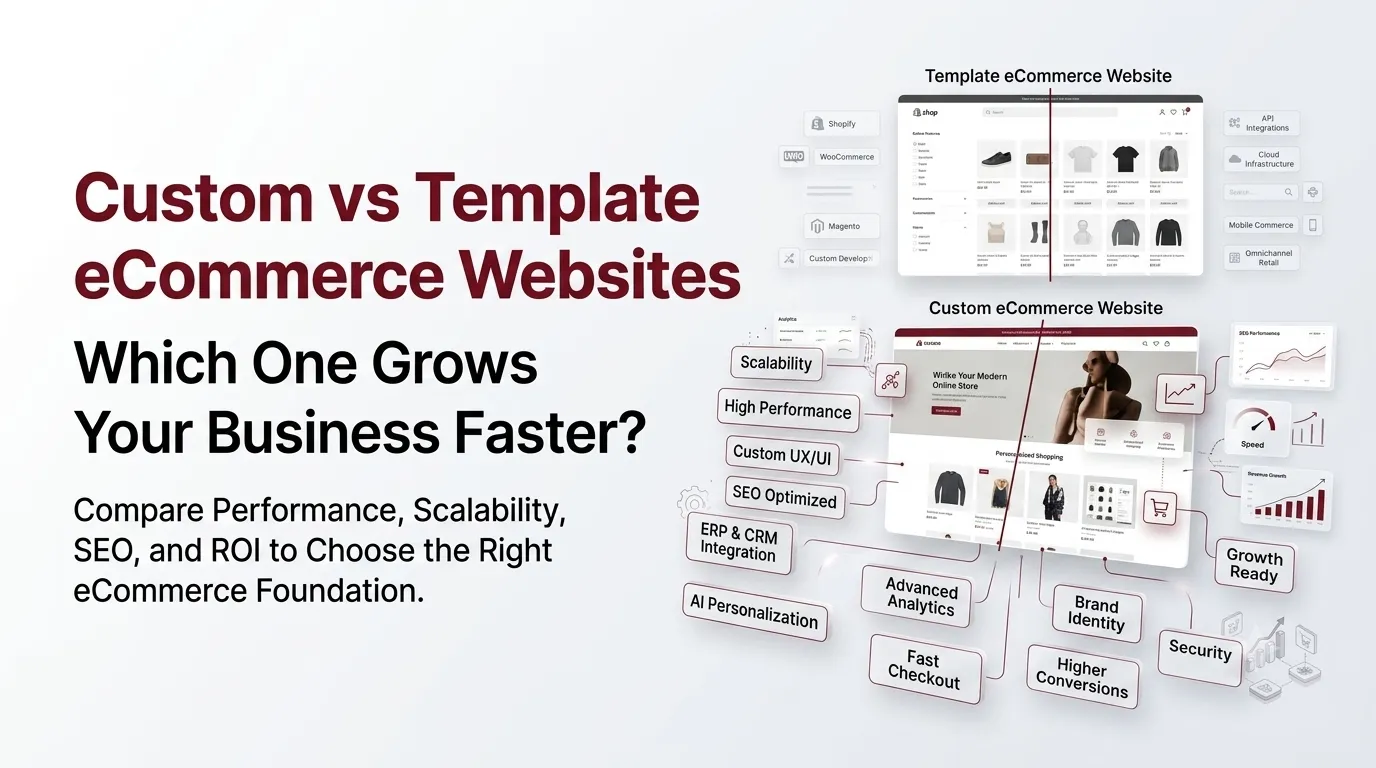
Custom vs template ecommerce websites are best compared against where you are today and where you need to be in 24 months. The right answer changes depending on your revenue stage, catalogue complexity, integration requirements, and brand positioning goals.
The two approaches compare like this on the points that matter most for growth:
- Speed to launch: Template wins clearly. Days versus weeks or months for custom development.
- Initial cost: Template wins on upfront investment. Custom development carries a higher entry cost.
- Long-term cost of ownership: Custom often wins. Template app stacks, rebuild costs, and performance debt accumulate.
- Design flexibility: Custom wins completely. Templates constrain at the structural level.
- Technical SEO ceiling: Custom wins. Template overhead limits how far you can push performance optimisation.
- Scalability: Custom wins for volume and complexity. Templates hit ceilings that require expensive workarounds or full rebuilds.
- Integration depth: Custom wins for complex operational requirements. Template app ecosystems are sufficient for standard needs.
- Brand differentiation: Custom wins. Templates produce visually similar experiences across thousands of stores.
- Ease of management: Template wins. Day-to-day operations require less technical support.
- Conversion optimisation control: Custom wins. Every element can be tested and adjusted without platform constraints.
Templates win on speed and simplicity at the start, and custom builds win on the points that decide performance and growth at scale. The choice depends on your stage and on which constraints matter most right now.
When Should You Choose a Template eCommerce Website?
A template ecommerce website is the right starting point for a well-defined set of business scenarios. Use the template for your current stage and plan the move to custom early.
Choose a template when:
- You are a new business testing product-market fit before scaling
- Your product catalogue is small and your customer journeys are straightforward
- Budget is the primary constraint and speed to revenue is the immediate goal
- You do not yet have the data to justify a custom build investment
- You are running a seasonal, campaign-driven, or limited-time store
- You are a solo founder or small team without in-house technical resources
If you choose a template, invest in your content architecture and topical authority from the beginning. This protects your SEO equity and makes any future migration cleaner and less disruptive.
When Should You Choose a Custom eCommerce Website?
Custom ecommerce development earns its cost when your business has outgrown what a template can support, or when your competitive positioning requires a level of experience and performance that templates structurally cannot deliver.
Choose a custom build when:
- You are scaling a D2C brand with an expanding product line and growing audience
- Your operations require ERP, CRM, or WMS integration that app ecosystems cannot handle reliably
- You manage high-volume transactions where performance degradation directly costs revenue
- Your brand competes on user experience, premium positioning, or distinctive identity
- You are preparing for international expansion with multi-currency, multi-language, or multi-region requirements
- You have outgrown your current template's performance or scalability ceiling and are planning a rebuild
Our D2C growth agency services are built for brands at this stage, ready to move beyond what a template can support and build the infrastructure that scales with them.
Key Takeaways
Custom vs template ecommerce websites come down to these points:
- Templates are a starting point. They are excellent for early-stage brands that need speed and simplicity, but they are not engineered for the performance and scalability that growth demands.
- Custom builds are an infrastructure investment. The return comes through better SEO performance, lower operational friction, higher conversion rates, and the elimination of recurring app and rebuild costs.
- Base your decision on long-term ROI as well as upfront cost. A template that requires a full rebuild in 18 months is often more expensive than a custom build that scales without intervention.
- Ecommerce scalability should be the primary lens. If your current build cannot grow with your business without significant workarounds, you are already paying a hidden scalability tax.
- You do not have to choose permanently. Starting on a template and migrating to a custom build at the right stage is a legitimate and common growth path. The key is planning the transition before you are forced into it.
- The right ecommerce partner helps you make the right call for your stage. Not every brand needs a custom build today, and not every brand should stay on a template next year.
Choosing the Build That Grows Your Business
The custom versus template question does not have a universal answer. It has the right answer for your business at your current stage, and that answer evolves as you grow. Make the decision with a plan, and look past what is cheapest today.
Template websites suit launching and testing. Custom websites suit scaling and standing apart. Knowing which one you need, and when to switch, gives you an advantage.
At Oddtusk, we work with brands at both stages. Whether you need a high-performance Shopify build, a custom WooCommerce architecture, or a growth consulting engagement to figure out which direction is right for your business, we bring the same focus: build for performance and search, and plan for scale. Let's map out the right ecommerce infrastructure for where your brand is going.
[ Common questions ]
Custom vs Template eCommerce FAQs
A template ecommerce website uses a pre-built design that can be deployed quickly and cheaply, but offers limited flexibility. A custom ecommerce website is built from scratch around your specific business needs, brand identity, and scalability goals. The key difference is the depth of functional control, performance optimisation, and integration capability you get with a custom build.
Yes, for most early-stage businesses a template ecommerce website is the right starting point. Platforms like Shopify, WooCommerce, and BigCommerce offer well-optimised templates that get you to market quickly at a fraction of the cost. The limitation appears once you start scaling, when you need advanced integrations, custom UX flows, or high-performance architecture that templates cannot support without costly workarounds.
Custom ecommerce websites have a structural SEO advantage because every element, including URL structure, page speed, schema markup, crawl architecture and Core Web Vitals, can be optimised for search. Template websites can rank well too, but they carry technical constraints that limit how far you can push SEO performance, especially as your catalogue grows. Our technical SEO audit services identify exactly where those constraints are costing you rankings.
Template ecommerce websites typically cost a fraction of a custom build to launch. Custom ecommerce development starts higher and scales with complexity. The real comparison is total cost of ownership: templates often require expensive app stacks and rebuilds as you grow, while custom builds are engineered to scale without those added costs. Weighing long-term ROI as well as upfront cost leads to the right decision.
Shopify, Magento, WooCommerce, and BigCommerce all support custom development to varying degrees. Shopify Plus and headless commerce architectures offer the most flexibility for brands that want a custom front-end experience on a reliable commerce backend. Magento is often chosen by enterprise brands needing deep ERP and CRM integrations. We support custom builds across all four platforms.
Ecommerce scalability refers to your website's ability to handle increased traffic, larger product catalogues, more complex integrations, and higher transaction volumes without degrading in performance. A scalable website grows with your business. Custom ecommerce builds are architected for scalability from the start, while template websites often require a complete rebuild once you outgrow their limits.
Yes, and this is a common and sensible path. Many successful brands start on a Shopify or WooCommerce template to validate their market and generate revenue, then invest in a custom build once they have the data and budget to justify it. The key is planning your content structure and SEO architecture carefully from the beginning, so the migration is clean and your rankings are protected during the transition.
Template websites can dilute brand identity because thousands of stores use the same base design. Customising a template partially addresses this, but structural limits remain. If your brand competes on trust, premium positioning, or distinctive experience, a custom build gives you the full canvas to create something of your own, which can be a conversion advantage in competitive markets.
ERP systems, warehouse management software (WMS), CRM platforms, subscription billing engines, advanced product configurators, multi-warehouse inventory management, and proprietary payment gateways generally require custom development. Template platforms support integrations through apps, but complex, high-volume workflows often hit the limits of what off-the-shelf apps can reliably handle at scale.
It depends on your growth stage. Early-stage D2C brands benefit from the speed and low cost of a template. Once you are generating consistent revenue, investing in a custom ecommerce website pays off through better conversion rates, lower app dependency costs, stronger SEO performance, and the ability to build retention and personalisation experiences that templates cannot support at scale. Our D2C growth agency services are built for brands at this stage.
Template ecommerce sites start fast but slow down as you add apps, customisations, and product volume. Each additional app injects JavaScript and CSS that adds to every page load. Custom ecommerce websites can be engineered for performance from day one, with only the code you need, optimised asset delivery, and architecture designed around your specific load patterns, which keeps speed scores high as you grow.
Look for a partner who asks about your revenue targets, growth trajectory, integration requirements, and long-term brand positioning before recommending a platform or build approach. A good ecommerce growth partner should map your current stage to the right solution. That means a template when a template fits, and a scalable custom architecture when your business needs one.
