
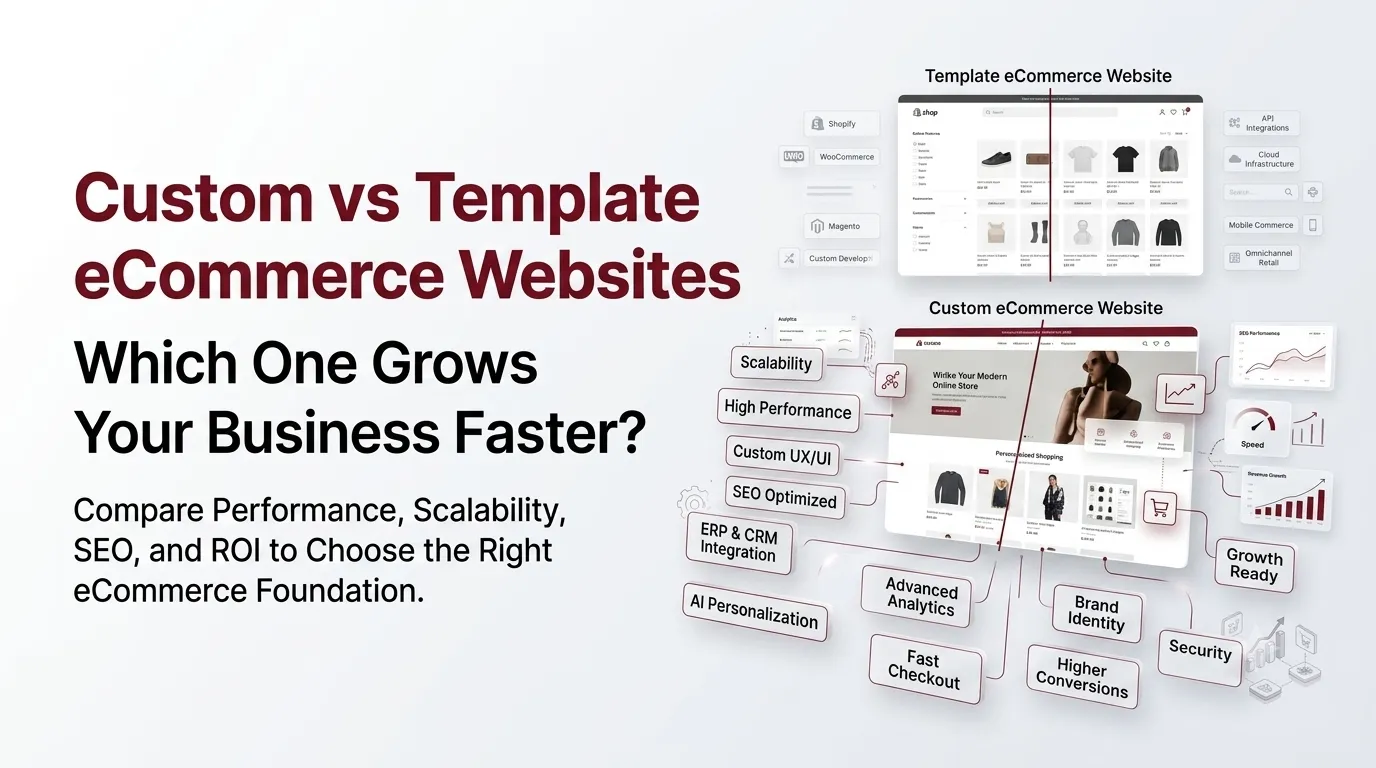
Ecommerce website development compared across custom and template builds, covering scalability, SEO, UX and long-term ROI.
Ecommerce Website Development: How Oddtusk Builds Scalable Stores That Drive Sales
Date: 08 - 04 - 2026
Time to read: 11 minutes
[ Table of
Content ]
Ecommerce Website Development Builds a Growth System
Ecommerce website development is an infrastructure decision that will speed up or limit every growth plan that follows. Many businesses treat the site as something to finish and ship, and the gap in results shows up in traffic, conversion rates, and revenue within months of going live.
Ecommerce website development at Oddtusk combines ecommerce marketing, UX strategy, and deep platform expertise. Whether the right build is Shopify, WooCommerce, Magento, BigCommerce, or a fully custom architecture, the focus is long-term growth after launch.
Why Scalable Ecommerce Website Development Matters
Scalable ecommerce website development is now a basic requirement for any brand that plans to grow, although scalability used to concern only enterprises. A site that performs well at launch but slows under load, gets slower as the catalogue expands, or breaks when you add a new sales channel becomes a bigger liability over time.
Scalable ecommerce website development puts growth-ready infrastructure at the core of every project. The architecture handles traffic spikes, catalogue expansion, new integrations, and seasonal demand without slowing down. The speed, stability, and user experience customers see on day one stay intact as the business grows, because that stability is part of the foundation from the start.
Today's online shoppers expect effortless browsing, sub-two-second page loads, smooth checkout, and consistent performance across every device. Ecommerce website development delivers that at scale through architecture decisions made before a single page is built.
Ecommerce Website Development Starts With the Right Platform
Every brand has specific requirements, and selecting the wrong platform creates friction that compounds as you grow. Ecommerce website development at Oddtusk starts by evaluating your business size, catalogue complexity, logistics setup, integration requirements, and growth trajectory, and only then recommends a platform or a custom build, because the strategy around the platform decides the outcome.
Ecommerce Website Development on Shopify
An ecommerce website on Shopify suits fast-growing brands that need reliable, high-quality results with minimal technical maintenance. The platform is hosted and handles server management, security updates, and infrastructure automatically, so your team can focus on products, marketing, and customers.
The Shopify development work starts from conversion-optimised theme selection and extends into custom section development, deep app integrations, and fast product page architecture that reduces bounce rates and increases add-to-cart rates. Our Shopify SEO services help the store earn organic traffic from day one alongside paid visits. Ecommerce website development at Oddtusk works best for brands that want a hosted platform's speed and simplicity with the performance of a custom build.
Ecommerce Website Development on WooCommerce
An ecommerce website on WooCommerce makes sense when a brand needs complete flexibility over its storefront: custom product types, complex shipping rules, unique checkout flows, multilingual capability, or deep WordPress content integration. The platform is open source and gives you full control over code and architecture, at the cost of more technical responsibility in hosting, maintenance, and plugin management.
Oddtusk's WooCommerce development includes custom theme development, plugin optimisation, advanced product filtering, user-friendly navigation architecture, and checkout journey refinement. We also provide WooCommerce SEO as part of the build, because organic visibility belongs in the infrastructure of an ecommerce website.
Ecommerce Website Development on Magento
An ecommerce website on Magento fits an operation that has reached enterprise scale: large catalogues with thousands of SKUs, multi-store management, combined B2B and B2C operations, complex inventory logic, or traffic volumes that require server-side performance control. No other platform in the ecommerce stack handles this level of complexity as natively.
Oddtusk's Magento website development incorporates complex inventory logic, multi-store management, layered navigation, B2B capability, and enterprise-grade security. Even under heavy traffic spikes, the store delivers fast load times and smooth user transitions. Our Magento SEO expertise keeps search rankings strong as the catalogue grows.
Ecommerce Website Development on BigCommerce
An ecommerce website on BigCommerce sits in a distinct position among platforms: enterprise-level built-in functionality without the operational overhead of Magento, and more native multi-channel selling capability than Shopify at scale. For brands that want powerful features, unlimited scalability, and lower total cost of platform ownership, it is a strong choice.
Ecommerce website development covers BigCommerce stores with the same conversion-first approach we bring to every platform: optimised product pages, clean checkout flows, structured data, and performance architecture that supports long-term organic growth alongside paid channel performance.
Custom Ecommerce Website Development for What Platforms Cannot Provide
Some brands have requirements that no standard platform can meet without compromising performance, user experience, or operational efficiency. Bespoke product configurators, advanced personalisation engines, multi-currency subscription logic, proprietary payment flows, or headless architecture with custom front-end experiences all require a custom ecommerce build.
Custom ecommerce website development is built around your specific user journeys, automation requirements, and system integration needs. Brands get full differentiation through UX (personalised flows, advanced filters, bespoke product variants) alongside integrations with ERP, CRM, and fulfilment systems that template platforms cannot support at the depth your operations require. Our ecommerce growth consulting helps you decide when a custom build is the right investment.
Ecommerce Website Development With Conversion-Driven UX & UI
An ecommerce website that looks good and does not convert is an expensive branding exercise. Each ecommerce website is designed with conversion as the main measure of success, so every layout decision, CTA placement, and product page structure is judged by whether it moves visitors toward a purchase.
Ecommerce website development uses heatmaps, scroll-depth analysis, A/B testing, and funnel analytics to identify exactly where users drop off and why. Those insights drive targeted improvements to product page layout, trust signals, image optimisation, and checkout flow. Our conversion rate optimisation services treat CRO as continuous work, because gains from ongoing optimisation far exceed what you capture at launch.
Good customer journeys have consistent visual branding, clear calls to action, benefit-led product descriptions, fast-loading imagery, and a checkout experience with as few steps as the customer's trust requires.
Speed, Performance & Technical SEO in Ecommerce Website Development
The fastest stores earn the most organic traffic and convert the highest share of it. Page speed is a revenue variable with measurable impact on both search rankings and checkout completion rates, and each extra second of load time lowers the conversion rate.
Every ecommerce website is optimised to meet Google's Core Web Vitals standards: clean schema markup, mobile-first responsiveness, efficient asset delivery, minimal render-blocking scripts, and structured data that supports rich results in search. Our technical SEO audit framework is built into the development process from the start. Our ecommerce SEO services help the store earn organic traffic from launch and keep growing it.
Fast-loading sites reduce cost-per-click, increase return on ad spend, and grow organic revenue over time.
Ecommerce Website Development With Integrations That Automate Operations
Manual workflows limit how far an ecommerce website can grow. Every hour your team spends on order management, inventory updates, or customer data reconciliation is an hour taken from product and customer experience, and integrations automate that work.
Ecommerce website development at Oddtusk connects stores with payment gateways, inventory systems, shipping partners, CRM platforms, and marketing automation tools across the full operational stack. We integrate with Razorpay, Shiprocket, Delhivery, Zoho, HubSpot, Klaviyo, and marketplaces including Amazon and Flipkart. Our CRM integration and workflow automation services handle the full technical layer, so your team operates on clean data and your customers get smooth fulfilment.
We also support GA4 setup and GTM configuration so every integration is measurable and every channel's contribution to revenue is attributed accurately.
Post-Launch Support in Ecommerce Website Development
An ecommerce website launch starts the optimisation work that produces most of a store's long-term performance gains. After the store goes live, ecommerce website development continues as an improvement cycle driven by data.
Post-launch, we monitor performance analytics, run CRO experiments, refine page layouts based on user behaviour, optimise product feeds, improve page speed as the catalogue grows, and iterate on retention marketing flows. Most clients see their strongest conversion and revenue performance in the three to six months after launch, as data feeds each round of optimisation.
Why Brands Choose This Approach to Ecommerce Website Development
Ecommerce website development at Oddtusk is planned for measurable business growth. Brands come back and refer others because of the revenue that follows when every build decision is treated as a growth decision.
Full-Stack Platform Expertise
Ecommerce website development here covers every major platform plus custom builds, so brands have one partner for development, SEO, and marketing at every stage of ecommerce growth.
Conversion-First Development
UI/UX psychology, fast loading, solid architecture, and CRO techniques are central to how we build an ecommerce website from the start. This integration consistently produces higher add-to-cart rates, better checkout completion, and improved overall revenue performance.
Data-Backed Workflows
Every decision, from product page layout to checkout flow, is supported by behavioural data, heatmaps, and funnel analytics. Your store is always performance-optimised because optimisation decisions rest on evidence. Our ecommerce marketing layer builds on the results that the development foundation makes possible.
Scalable Architecture From Day One
Each ecommerce website we build grows alongside your brand. New products, increased traffic, additional automation, and geographic expansion are handled by infrastructure designed for them from day one.
Comprehensive Digital Marketing Integration
As a full-service growth consultancy, we combine development with performance marketing, strategic SEO, account-based marketing, and consumer behaviour analysis together, so the development and the marketing support each other from the start.
Key Takeaways
- Scalability is a development decision. It is built into the architecture before a single page exists, and it determines how far your store can grow without requiring a costly rebuild.
- Platform selection is one variable among several. The strategy around the platform (SEO architecture, CRO, integration design, and post-launch optimisation) determines outcomes more than the platform choice alone.
- Conversion-first development consistently outperforms aesthetics-first development. Ecommerce website development at Oddtusk aims at revenue from the first technical decision.
- Technical SEO belongs in development. Page speed, schema, crawl architecture, and Core Web Vitals performance built at the development stage keep organic traffic growing over time.
- Post-launch optimisation is where most of the value is created. Launch begins a continuous improvement cycle.
- Integration and automation remove the operational ceiling on growth. Brands that scale without operational bottlenecks do so because their payment, fulfilment, CRM, and marketing systems are connected and automated from the start.
Ecommerce Website Development for Where Your Business Is Going
Ecommerce website development at Oddtusk combines design, technology, and conversion strategy so stores scale without friction. The platform is chosen for your stage and goals, the architecture is planned for where the business is going, and SEO is part of the build. Optimisation continues long after launch and keeps adding to revenue.
Ecommerce website development at Oddtusk covers Shopify, WooCommerce, Magento, BigCommerce and fully custom builds, each planned for long-term revenue.
Explore all our ecommerce services and our approach to ecommerce growth consulting, or get in touch to discuss your project and what the right build looks like for your business.
[ Common questions ]
eCommerce Development FAQs
Ecommerce website development at Oddtusk starts with your business, and the platform recommendation comes after. The right choice depends on your catalogue size, operational complexity, integration requirements, and growth goals. Shopify suits brands that need speed and reliability. WooCommerce suits brands that need maximum flexibility. Magento suits enterprise operations with high volume and complex logic. BigCommerce suits brands that want enterprise features with easier management. Custom builds suit brands that need something no platform can provide out of the box.
Scalable ecommerce development means your website infrastructure grows with your business without performance degradation. When your traffic doubles, your catalogue expands, or you add new sales channels, a scalable build handles the increase without slowing down, breaking integrations, or requiring a full rebuild. Ecommerce website development at Oddtusk builds this capacity into every project at the architecture stage.
Oddtusk uses heatmaps, scroll-depth analysis, funnel analytics, and A/B testing to identify exactly where users drop off and why. From there, we make targeted improvements to product page layout, CTA placement, checkout flow, and trust signals. This is an ongoing process, because conversion optimisation compounds over time when treated as a continuous discipline.
Yes. Technical SEO is built into the development process at Oddtusk from the start. We optimise for Core Web Vitals, structured data, clean URL architecture, mobile-first performance, and crawl efficiency during the build. We also provide platform-specific SEO for Shopify, WooCommerce, and Magento, as well as ongoing ecommerce SEO post-launch.
Oddtusk integrates ecommerce stores with payment gateways, inventory and warehouse management systems, shipping partners like Shiprocket and Delhivery, CRM platforms like Zoho and HubSpot, marketing automation tools like Klaviyo, and marketplaces including Amazon and Flipkart. For brands with enterprise requirements, we also handle ERP and custom API integrations.
Shopify is a hosted platform that handles server management, security, and updates automatically, making it faster to launch and easier to maintain for smaller teams. WooCommerce is self-hosted on WordPress, giving you complete control over code, plugins, and customisation, at the cost of more technical responsibility. For Indian D2C brands, Shopify is often the faster path to revenue; WooCommerce suits brands with unique workflows, complex product logic, or a strong content strategy built on WordPress.
Magento becomes the right choice when a brand operates at enterprise scale: large catalogues with thousands of SKUs, multi-store management, B2B and B2C combined operations, complex inventory logic, or heavy traffic requiring server-side performance control. Magento's architecture handles this complexity more natively than Shopify or WooCommerce, though it requires more technical investment to build and maintain.
Headless ecommerce decouples the front-end presentation layer from the back-end commerce engine, giving developers complete freedom over the user experience while using a reliable platform like Shopify Plus or BigCommerce as the commerce backbone. Oddtusk recommends headless architecture for brands that need exceptionally fast, highly customised front-end experiences, usually at growth stage, where performance and brand differentiation are direct revenue drivers.
Yes. Post-launch support is a core part of how Oddtusk works. After launch, we monitor performance data, run CRO experiments, refine page layouts, optimise product feeds, and continuously improve speed. The majority of measurable gains from an ecommerce build happen in the months after launch through this kind of structured, data-backed iteration.
Page speed is a direct conversion variable. Every additional second of load time reduces conversion rates measurably. Research across ecommerce categories consistently shows that faster sites convert higher percentages of visitors into buyers. Speed also affects Google rankings through Core Web Vitals, which means slow stores pay twice: lower organic traffic and lower conversion rates from the traffic they do get.
Yes. Platform migration is a service Oddtusk handles with a structured SEO-first approach: preserving URL architecture, implementing redirects, and protecting ranking signals wherever possible to maintain organic traffic during the transition. We handle migrations between Shopify, WooCommerce, Magento, and BigCommerce, as well as migrations from custom legacy builds to modern platforms.
Ecommerce website development at Oddtusk combines development, SEO, and growth strategy. These are integrated into every project from the start, so an ecommerce website built by Oddtusk is built to rank, convert, and scale. Post-launch, we continue to optimise using data. This full-stack approach to ecommerce growth is what distinguishes our work from a standard development engagement.
