

How ecommerce integrations support Shopify, WooCommerce, Magento, and custom ecommerce builds for performance, conversion, and long-term growth.
Scalable ecommerce integrations that support growth
Date: 08 - 04 - 2026
Time to read: 10 minutes
[ Table of
Content ]
Ecommerce integrations separate growing brands from stalling ones
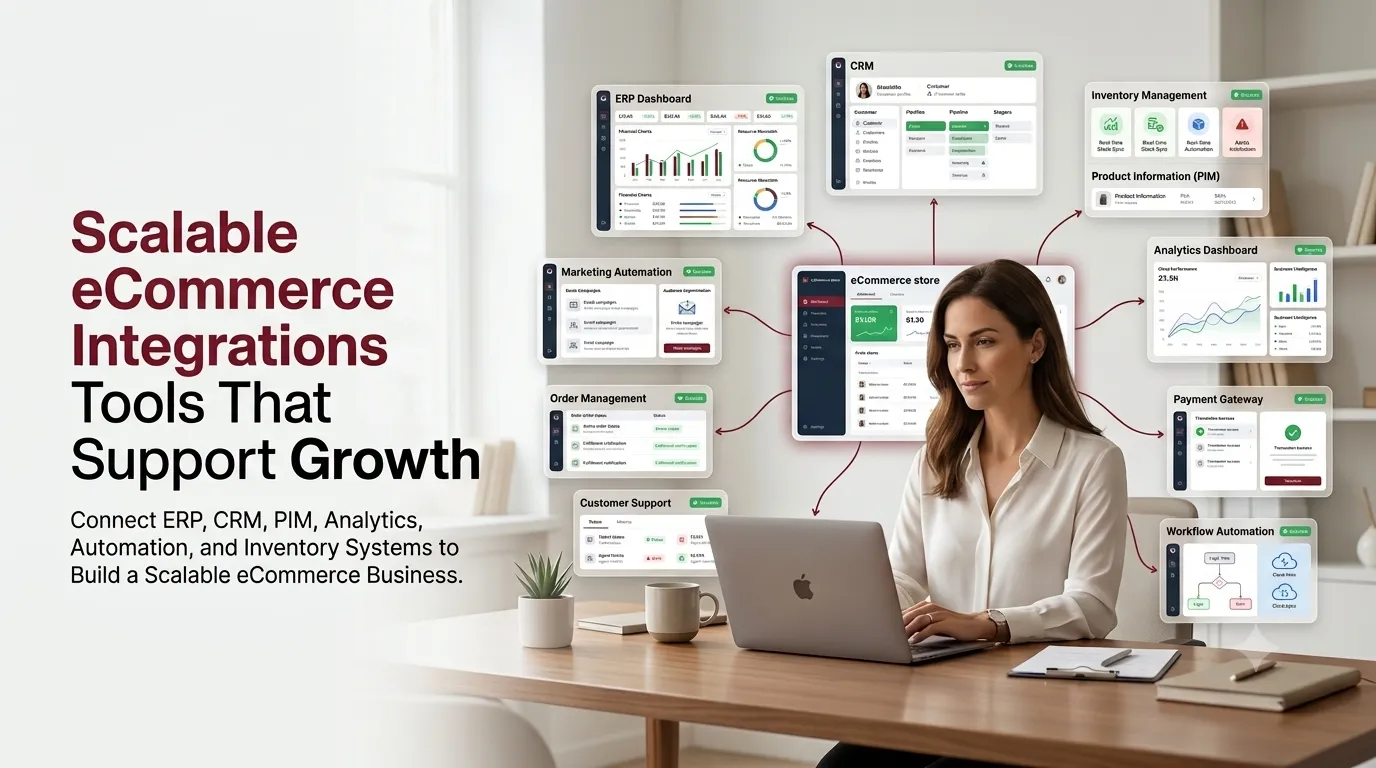
Ecommerce integrations are the connections between systems that let a business handle more orders, more customers, more complexity, and more channels without a matching rise in headcount. Running an online business takes more than listing products or running ad campaigns. Product listing and paid media are visible, while scalable ecommerce integrations work out of sight: data moves automatically between the systems that need it, without manual work, delay, or error.
Brands that scale well connect the right tools in the right sequence. Ecommerce integrations built this way remove operational friction, improve data visibility across the business, and support faster decisions when volume increases.
The ecommerce integrations that matter most for scalability are ERP, CRM, PIM, marketing automation, inventory management, and analytics, and each one does a different job for your business as it grows. Our ecommerce services are built around this kind of integrated approach to growth.
Why scalable ecommerce integrations matter
Scalability is commonly discussed in terms of traffic: will your website handle a spike in visitors? Operational scalability matters more, and ecommerce integrations decide it. As order volumes increase, every inefficiency in your processes multiplies. A manual order processing step that takes two minutes per order is manageable at fifty orders a day. At five hundred it becomes a bottleneck, and at five thousand it breaks.
When ecommerce integrations are in place, data transmission is automatic. Customer order information flows from your storefront to the warehouse. Customer records stay in sync with your customer database. Financial analysts access accurate real-time reports without waiting for manual reconciliation. Ecommerce integrations handle each transaction without human labour, through automation that is built once and maintained well.
Brands that do not plan ecommerce integrations hit a growth ceiling, where adding revenue means adding operational headcount that erodes margins. Brands that build integrated systems keep efficiency steady or better as volume increases. Whether you are building on Shopify, WooCommerce, or Magento, proper ecommerce integrations are foundational to reaching that next revenue tier cleanly.
Suggested article:How Oddtusk Builds Scalable eCommerce Websites That Drive Sales
Ecommerce integrations with ERP for operational scale
Ecommerce integrations with an Enterprise Resource Planning system connect inventory, order management, accounting, procurement, and logistics under one framework. The ERP becomes the central record for a growing ecommerce operation and removes the siloed data that creates errors, delays, and reconciliation work at scale.
Ecommerce integrations with a properly set up ERP update inventory across every platform the moment a sale is made. Order fulfilment stays accurate at higher volumes without manual work. Financial reporting is accurate in real time instead of being assembled from spreadsheets at month end. Compliance and audit readiness improve as data quality improves. For brands scaling across multiple regions or sales channels, ERP integration is what makes multi-channel growth manageable.
Ecommerce integrations with an ERP reduce dependency on manual reconciliation and the human errors that come with it. They are a foundational layer of a scalable stack because they let operations grow without adding overhead to the processes that touch every order. Our ecommerce growth consulting includes ERP integration assessment as part of every scale-stage engagement.
Ecommerce integrations for customer relationships
Ecommerce integrations matter more for customer relationships as order volume grows, because managing those relationships gets more complex. Personalisation, timely communication, and consistent service quality become harder to deliver manually at scale. Ecommerce integrations with a customer relationship management (CRM) system solve this by centralising every customer interaction (purchase history, support tickets, email engagement, abandoned carts, and loyalty activity) into a single view that every team can access.
Once the store connects to that system, customer data stays centralised and current. Support teams see the full purchase history before they respond to a query. Marketing teams segment users by actual behaviour. Automated workflows trigger follow-ups, loyalty rewards, and re-engagement campaigns based on data instead of a fixed schedule.
These ecommerce integrations, combined with the right automation workflows, turn raw customer data into retention systems. This is how retention marketing scales: systems handle the volume, so you do not need more people managing communications by hand. The effect on customer lifetime value is significant and measurable.
Suggested article:Post-Purchase Paralysis: Why Customers Regret Buying and How to Stop It
Ecommerce integrations with PIM for products at scale
Ecommerce integrations with Product Information Management (PIM) become essential at a catalogue size most brands reach sooner than they expect. Without a PIM, keeping product descriptions, attributes, images, dimensions, and pricing consistent across a Shopify store, an Amazon listing, a marketplace integration, and a wholesale portal creates errors and manual work that grow with every new SKU.
Ecommerce integrations with a PIM move all product information to a single source of truth. Updates made in the PIM reach every connected channel automatically. Catalogue updates that used to require individual edits across platforms happen once. Listing errors that used to surface as customer complaints or return requests are prevented by the integration.
For multi-channel sellers managing a growing catalogue, PIM integration supports ecommerce SEO consistency and product accuracy at scale. Brands most often wish they had set up this type of integration earlier.
Ecommerce integrations for marketing automation
Ecommerce integrations for marketing automation start from one problem: marketing teams become operational bottlenecks when a brand scales. As customer segments, campaigns, and channels multiply, the manual coordination needed to send relevant marketing at the right time exceeds what any team can sustain. Marketing automation ecommerce integrations remove this limit by connecting your marketing tools to behavioural data, inventory, customer records and analytics in real time.
When properly integrated, email and SMS automation workflows trigger on what customers actually do: abandoning carts, viewing products repeatedly, reaching loyalty thresholds, or going quiet after a first purchase. Campaigns become timely and relevant to context. Performance measurement consolidates across channels, so nobody assembles reports by hand.
Our marketing automation services include workflow automation, lead nurturing, and WhatsApp automation, all integrated with your ecommerce store and CRM so marketing grows with your customer base without a matching increase in team size.
Ecommerce integrations for inventory & order management
Ecommerce integrations for inventory matter because stock discrepancies erode customer trust faster than almost any other operational failure. Selling stock you do not have, showing out-of-stock items as available, or routing orders to the wrong fulfilment centre are conversion and retention problems with direct revenue consequences.
Ecommerce integrations for inventory and order management make every sale, return, and restock update all connected systems in real time. Live stock information is consistent across your storefront, marketplace listings, and fulfilment centres. Orders route to the right location automatically. Returns sync across platforms without manual data entry. Customer-facing inventory status shows current stock.
These ecommerce integrations let brands handle volume spikes from seasonal campaigns, product launches, and marketplace promotions without the fulfilment failures that erode customer confidence when acquisition costs are highest. Whether you are running Shopify, WooCommerce, Magento, or BigCommerce, inventory integration is a core requirement for multi-channel scale.
Ecommerce integrations for analytics & BI
Ecommerce integrations for analytics exist because scaling without unified data visibility is expensive. Decisions made on incomplete information cost more than the ecommerce integrations that would have shown the full picture. One example is a marketing investment that looks profitable alone but drags ROAS once fulfilment costs are counted. Another is a product category that converts well but has a high return rate.
Ecommerce integrations for analytics and Business Intelligence pull data from your storefront, ERP, CRM, and marketing tools into a unified dashboard. Conversion rates, customer acquisition cost, retention metrics, operational efficiency, and channel attribution sit in one place, so nobody assembles them from separate reports. Teams access real-time performance data and act on it faster.
These insights move ecommerce integrations beyond execution and into strategy. When you know which products drive the highest lifetime value, which acquisition channels produce the most retained customers, and which operational processes create the most friction, investment decisions improve significantly. Combined with our ecommerce marketing services and paid media strategy, analytics integrations measure and attribute every channel investment accurately. Our GA4 setup and GTM configuration services provide the data foundation these integrations depend on.
Ecommerce integrations as automation layers that reduce operational load
Ecommerce integrations that automate work take over tasks where human judgment adds no value: repetitive, rule-based processes that systems run more accurately and consistently than people managing volume by hand.
The most useful automation layers in ecommerce integrations cover order confirmation and status update communications, fraud detection and notification workflows, reorder point triggers when stock reaches threshold levels, and customer segmentation updates that trigger based on purchase behaviour. Each of these runs without manual initiation, executes consistently at any volume, and frees your team for the decisions that need human judgment.
Automation is a core part of scalable ecommerce integration because it lets operations scale without raising error rates or headcount at the same pace. Growth is then limited by the market more than by operations.
Choosing the right ecommerce integrations for long-term growth
Ecommerce integrations do not all need to be in place from day one. Prioritise the integrations that remove your current biggest bottleneck before building a full enterprise stack. Sequence them by where friction is highest.
When evaluating ecommerce integrations, four factors decide whether one will serve you long-term. Platform compatibility tells you whether the tool connects natively with your ecommerce stack or requires custom API work. API flexibility determines whether the integration can handle your data volume and customisation requirements as you grow. Data security and compliance confirm that the integration meets the standards your business operates under (GDPR, PCI DSS, or regional data localisation requirements where applicable). Long-term support confirms that the tool is actively maintained and updated as platforms evolve, so you are not managing a broken integration every time your platform releases a major update.
Ecommerce integrations that serve growth well become more valuable as your business grows and do not need rebuilding at each new scale threshold. Our ecommerce growth consulting helps brands map the right integration roadmap for their current stage and their next two years of growth.
Key takeaways on ecommerce integrations
- Scalable growth requires ecommerce integrations between your tools. Individual tools solve isolated problems, while connected systems keep working as your business scales.
- ERP, CRM, and PIM integrations are the operational backbone. They eliminate the manual processes and data inconsistencies that create errors, slow decisions, and cap growth at a revenue ceiling that is lower than your market potential.
- Marketing automation integration converts data into timely, relevant customer communication at scale. It improves retention and acquisition efficiency as customer volume grows.
- Inventory and order management integrations protect customer trust at every volume spike. Accuracy in stock data and fulfilment routing affects conversion and retention as well as operations.
- Analytics and BI integrations turn operational data into strategic decisions. Unified visibility across channels and systems allows faster, better-informed investment decisions at scale.
- The right integrations for your business follow where friction is highest today. Prioritise by bottleneck, and build toward the stack your next growth stage will require.
Ecommerce integrations built for scale
Scalability needs planning. Brands that build scalable ecommerce integrations early grow on solid ground, without the operational crises, data inconsistencies, and fulfilment failures that brands who defer integration planning face when they can least afford them.
Ecommerce integrations across ERP, CRM, PIM, analytics, and workflow automation work fully only when they are connected with the right sequencing, the right API architecture, and the right data governance from the start. Retrofitting integration after the fact is significantly more expensive and disruptive than building it in.
Ecommerce integrations at Oddtusk are planned for scale from the start, from your first ERP connection to a fully automated multi-channel operation. From Google Search Ads to Google Shopping and paid media across channels, we integrate every marketing channel with your core systems for unified performance tracking and optimisation. Let's build the integration architecture your ecommerce business needs to scale without breaking.
[ Common questions ]
Ecommerce integrations FAQs
Scalable ecommerce integrations are connections between your online store and the operational systems that support it: ERP, CRM, PIM, inventory management, marketing automation, analytics, and fulfilment tools. When these systems communicate automatically, data flows between them without manual intervention. The result is an operation that handles increasing order volume, catalogue complexity, and customer demand without adding proportional overhead or introducing errors.
Earlier than most brands think. The common mistake is waiting until manual processes are visibly breaking down, by which point you are already losing revenue to errors, delays, and customer service failures. The right time to plan your integration architecture is while you are building for growth. Even early-stage brands benefit from a CRM integration and basic inventory sync, because these create clean data habits that support more complex integrations later.
ERP integration connects your ecommerce platform to your inventory management, order processing, accounting, procurement, and logistics under one unified system. When an order is placed, the ERP updates stock levels, triggers fulfilment, records the transaction financially, and adjusts procurement forecasts, all automatically. This eliminates the spreadsheet dependency and manual reconciliation that create errors and slow decision-making at scale.
This ecommerce integration centralises every customer interaction (purchase history, support tickets, email engagement, abandoned carts, and loyalty activity) into a single view. Support teams resolve issues faster because they have full context. Marketing teams segment customers accurately and trigger relevant automated communications. The result is better retention, higher lifetime value, and a customer experience that improves as you scale.
PIM stands for Product Information Management. A PIM system centralises all product data (descriptions, attributes, images, dimensions, variants, and pricing) and distributes it consistently across every sales channel and platform. Brands managing thousands of SKUs, selling on multiple channels simultaneously, or operating across different regions with localised content need PIM to maintain accuracy and consistency at scale. Without it, catalogue management becomes a significant manual burden that introduces errors.
Ecommerce integrations at Oddtusk use automation tools chosen for your platform, existing stack, and operational requirements, with no fixed set. Commonly integrated tools include Klaviyo for email and SMS automation, HubSpot and Zoho for CRM, Shiprocket and Delhivery for fulfilment, and GA4 with custom BI dashboards for analytics. The right tools are the ones that connect cleanly with your platform and eliminate the specific bottlenecks limiting your growth.
Marketing automation integration connects your marketing tools to your store's behavioural data, inventory and customer records. This makes campaigns timely and contextually relevant: abandoned cart sequences trigger based on actual user behaviour, back-in-stock alerts go to customers who viewed the product, and loyalty rewards sync with purchase history. The result is marketing that compounds in effectiveness as your customer base grows, without requiring your team to grow proportionally.
Inventory discrepancies occur when stock data is managed separately across multiple systems and updated manually or on a delay. When one system updates and another does not, you get overselling, stockouts, or fulfilment errors. Integrated inventory management ensures that every sale, return, and restock updates all connected systems in real time, eliminating the gap between what you show customers and what you can actually deliver.
Analytics and BI integrations pull data from your store, ERP, CRM, and marketing tools into a unified dashboard. Instead of manually compiling reports from separate sources, your team sees real-time performance across conversion rates, customer acquisition cost, retention metrics, and operational efficiency in one place. This visibility allows scaling brands to make faster, better-informed decisions and to catch problems before they compound.
Prioritise integrations that eliminate your current biggest operational bottleneck. For most brands, that starts with inventory and order management. CRM integration follows as customer volume grows. Marketing automation becomes critical when manual campaigns cannot keep pace with segmentation needs. ERP and PIM become essential at higher SKU counts and multi-channel complexity. The sequencing should follow where friction is highest.
Yes. We build ecommerce stores and set up the ecommerce integrations that make them scalable in the same engagement. We handle Shopify, WooCommerce, Magento, and BigCommerce builds alongside ERP, CRM, fulfilment, marketing automation, and analytics integrations. This means the integration architecture is designed into the build from the start. Retrofitting after launch is where most integration problems originate.
Evaluate four things: platform compatibility (does it connect natively or via API to your store), API flexibility (can it handle your data volume and custom requirements), data security and compliance (does it meet GDPR, PCI DSS, or regional standards where applicable), and long-term support (is the tool actively maintained as platforms evolve). The wrong integration choice creates growing technical debt, and the right one scales with you.
