
A 15-step local SEO guide built for Bhubaneswar businesses. Covers Google Business Profile, citations, reviews, schema, maps ranking, and more.
Every Google Algorithm Update That Hit Odisha Businesses (2024 to 2026)
Date: 10 - 09 - 2026
Time to read: 35 minutes
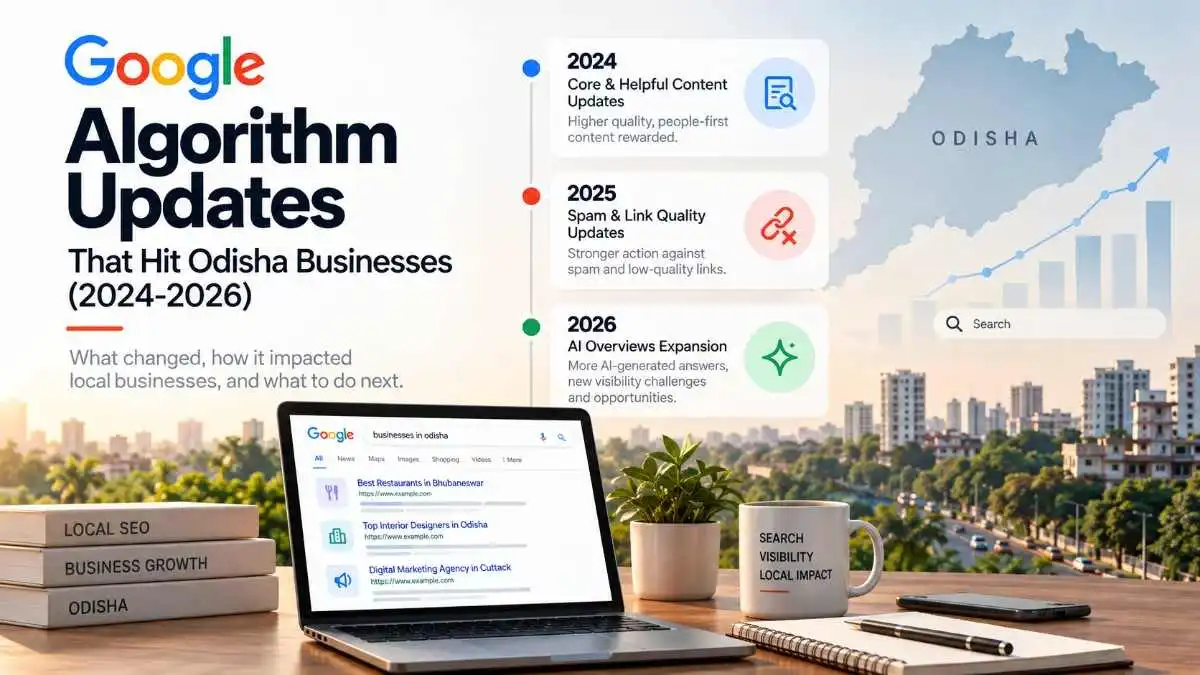
Between March 2024 and August 2026, Google released 18 confirmed algorithm updates. Some were core updates that reshuffled rankings across every industry. Others were spam updates that wiped sites clean off the index. If you run a business in Odisha and your organic traffic dropped at any point in the last two years, there is a good chance one of these updates was responsible. This guide documents every single one, with verified dates, what each update targeted, and what it means for businesses operating in Bhubaneswar, Cuttack, Puri, Rourkela, and across the state.
We need to be upfront about something. There is no published data on how Google algorithm updates affect Odisha specifically. Google does not target geographic regions with its updates, and no credible third-party study has isolated Odisha businesses from the broader impact. What we can do, and what this article does, is take the verified facts about each update, map them against the types of businesses that are common in Odisha, and give you a practical framework for understanding your own vulnerability and recovery options.
Every date in this article comes from Google's Search Status Dashboard, the only authoritative source for confirmed update rollout windows. Every claim about what an update targets comes from Google's own documentation. Where we discuss industry impact, we use a framework based on business characteristics, not fabricated statistics.
[ Table of Content ]
What Is a Google Algorithm Update (and Why Should Odisha Businesses Care)?
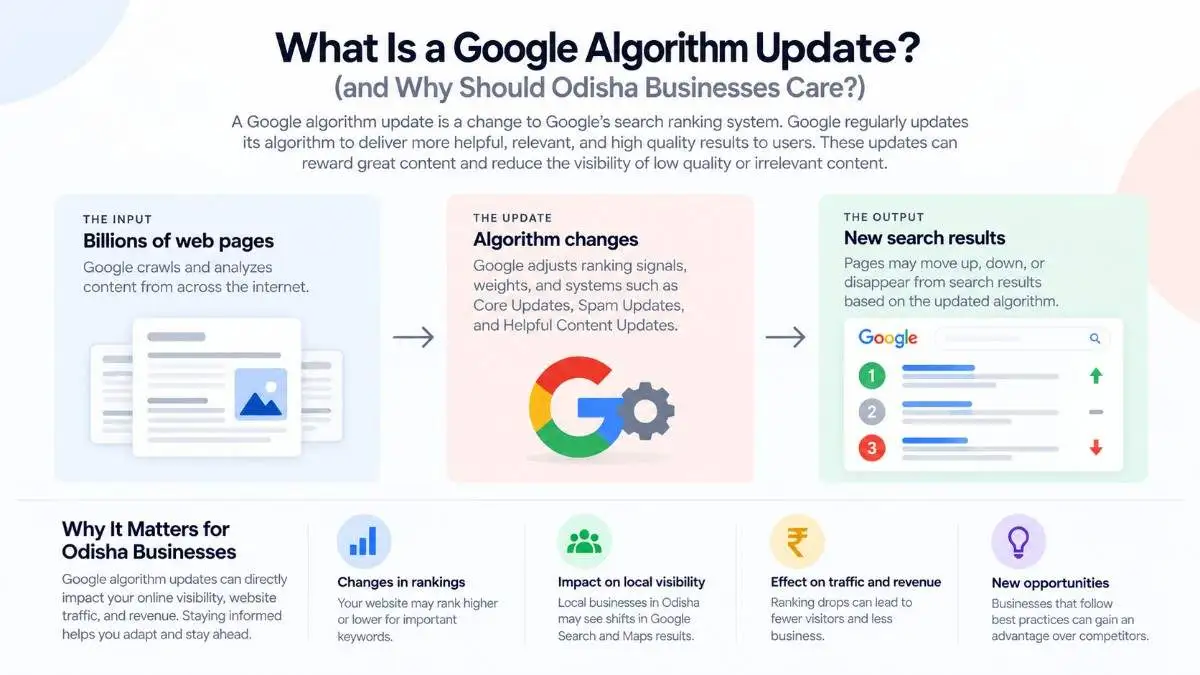
Google's search algorithm is the system that decides which websites appear when someone types a query into Google. It evaluates hundreds of factors, from the words on your page to the quality of sites linking to you, to the speed your page loads on a phone. An algorithm update is when Google changes how that system works. Sometimes the change is small and no one notices. Sometimes it reshuffles rankings across entire industries overnight.
For a business owner in Bhubaneswar, Cuttack, or anywhere in Odisha, this matters for one simple reason: if your website brings in customers through Google search, an algorithm update can increase or decrease that flow without warning. A restaurant in Saheed Nagar that gets 60% of its new customers through Google search could lose half that traffic in a single update if its website falls short of Google's evolving quality standards. A coaching institute in Acharya Vihar that ranks well for "best coaching classes in Bhubaneswar" could drop off the first page entirely.
The uncomfortable truth is that most business owners in Odisha do not know when Google releases an update, do not check whether it affected their site, and only notice when inquiries or sales slow down for reasons they cannot explain. By the time they realize something changed, weeks or months have passed, and the recovery window has narrowed.
Google releases multiple updates every year. In 2024 alone, there were eight confirmed updates. In 2025, there were four. In 2026 so far, there have been six. Each one has the potential to move your rankings up or down. Understanding what these updates target and how to respond is not optional if organic search is part of how your business gets customers.
Key Takeaway
A Google algorithm update is a change to the rules that decide which websites rank and which do not. If your business depends on Google for customers, you need to know when updates happen and whether they affected you. This is not an SEO specialist problem. It is a business problem.
Core Update vs Spam Update: The Difference That Matters
Google releases two main types of algorithm updates, and they work in fundamentally different ways. Confusing the two leads to the wrong diagnosis and the wrong recovery strategy. If your site dropped after an update, the first thing you need to know is which type of update caused it.
What a Core Update Does
A Google core update changes how Google evaluates and ranks all content across its search results. It does not target specific sites, industries, or violations. Instead, it broadly reassesses the quality signals Google uses to decide rankings. Think of it as Google recalibrating what "good content" means. After a core update, some sites go up because their content now better matches Google's updated quality criteria. Other sites go down, not because they did something wrong, but because Google has raised the bar or because competing content now meets the criteria better.
Google has been direct about this. Their official documentation states that a core update drop does not necessarily mean your pages are violating any policy. It means that content published after the previous update is now being assessed more favorably relative to yours. The analogy Google uses is a list of the top 100 movies. If you made that list in 2020 and remade it in 2026, newer films would naturally appear and some older entries would drop, not because they got worse, but because the field changed.
What a Spam Update Does
A Google spam update is targeted. It specifically goes after sites that violate Google's spam policies. These policies cover things like link spam (buying or selling links to manipulate rankings), cloaking (showing different content to Google than to users), scraped content (copying content from other sites), and scaled content abuse (mass-producing low-value content to game search rankings). If a spam update hits your site, it means Google has identified a specific violation, and the impact is usually severe: pages can be demoted, deindexed, or removed from search entirely.
The recovery path for each type is completely different. After a core update, you improve your content quality, build better E-E-A-T signals, and wait for Google to reassess. After a spam update, you identify and fix the specific violation, then submit a reconsideration request. Treating a core update drop like a spam penalty (or the other way around) wastes time and can actually make things worse.
Key Takeaway
Core updates shift the quality bar for everyone. Spam updates penalize specific policy violations. Knowing which type of update affected you determines your entire recovery approach. Check the update type before you change anything on your site.
Complete Google Algorithm Update Timeline (2024 to 2026)
Below is every confirmed Google algorithm update from March 2024 through August 2026. All dates are verified from Google's Search Status Dashboard. The "Duration" column shows how many days the rollout took from start to completion. Use this table as your reference when diagnosing traffic changes in Google Search Console.
Source: Google Search Status Dashboard. Last verified September 2026.
2024 Updates
| Update | Type | Start Date | End Date | Duration |
|---|---|---|---|---|
| March 2024 Core Update | Core | Mar 5, 2024 | Apr 19, 2024 | 45 days |
| March 2024 Spam Update | Spam | Mar 5, 2024 | Mar 20, 2024 | 15 days |
| Site Reputation Abuse Enforcement | Policy | May 5, 2024 | Ongoing | Ongoing |
| June 2024 Spam Update | Spam | Jun 20, 2024 | Jun 27, 2024 | 7 days |
| August 2024 Core Update | Core | Aug 15, 2024 | Sep 3, 2024 | 19 days |
| November 2024 Core Update | Core | Nov 11, 2024 | Dec 5, 2024 | 24 days |
| December 2024 Core Update | Core | Dec 12, 2024 | Dec 18, 2024 | 6 days |
| December 2024 Spam Update | Spam | Dec 19, 2024 | Dec 26, 2024 | 7 days |
2025 Updates
| Update | Type | Start Date | End Date | Duration |
|---|---|---|---|---|
| March 2025 Core Update | Core | Mar 13, 2025 | Mar 27, 2025 | 14 days |
| June 2025 Core Update | Core | Jun 30, 2025 | Jul 17, 2025 | 17 days |
| August 2025 Spam Update | Spam | Aug 26, 2025 | Sep 22, 2025 | 27 days |
| December 2025 Core Update | Core | Dec 11, 2025 | Dec 29, 2025 | 18 days |
2026 Updates (Through August)
| Update | Type | Start Date | End Date | Duration |
|---|---|---|---|---|
| February 2026 Discover Core Update | Core | Feb 5, 2026 | Feb 27, 2026 | 22 days |
| March 2026 Spam Update | Spam | Mar 24, 2026 | Mar 25, 2026 | 1 day |
| March 2026 Core Update | Core | Mar 27, 2026 | Apr 8, 2026 | 12 days |
| May 2026 Core Update | Core | May 21, 2026 | Jun 2, 2026 | 12 days |
| June 2026 Spam Update | Spam | Jun 24, 2026 | Jun 26, 2026 | 2 days |
| August 2026 Spam Update | Spam | Aug 18, 2026 | Aug 21, 2026 | 3 days |
A few patterns worth noticing. Core update rollouts have gotten shorter over time. The March 2024 Core Update took 45 days. By 2026, most core updates complete in under two weeks. Spam updates have always been fast, often finishing in a week or less. Google has also increased the frequency: 2024 had four core updates and three spam updates. 2026 is on pace to match or exceed that.
Key Takeaway
Bookmark Google's Search Status Dashboard. When your traffic drops, cross-reference the dates against this timeline before you change anything on your site. Most traffic drops have a specific, identifiable cause.
March 2024: The Update That Changed Everything
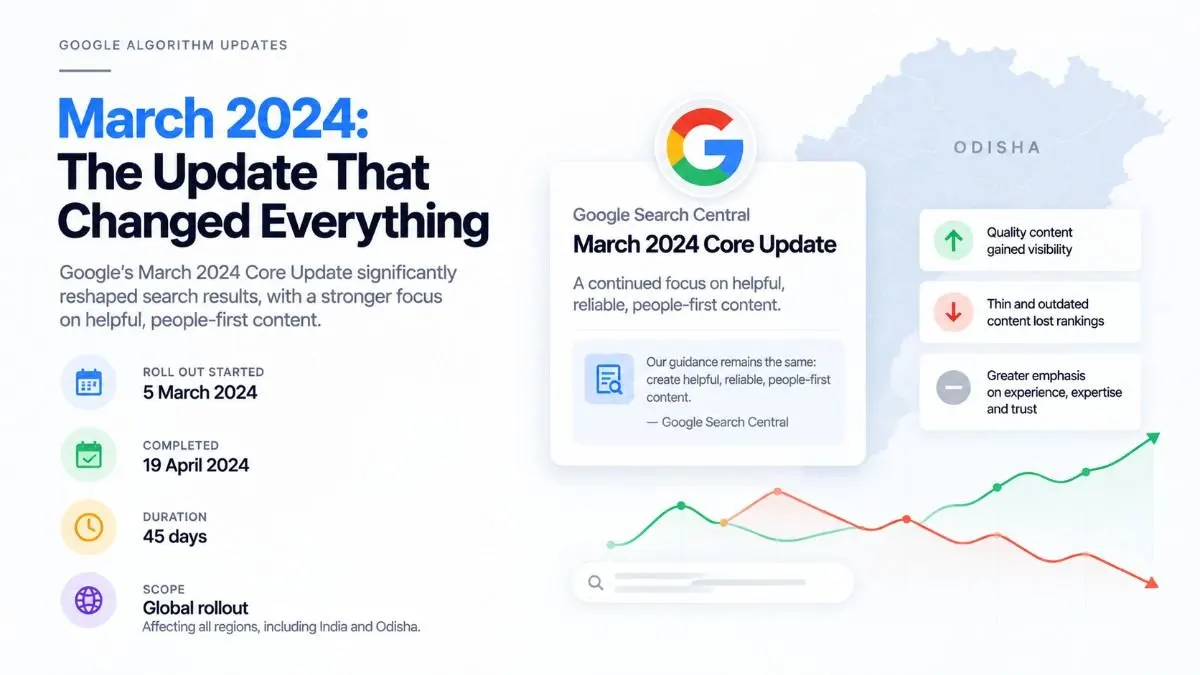
The March 2024 Core Update deserves its own section because it fundamentally reset how Google evaluates content quality. It was not a routine adjustment. It was the most significant algorithm change since the Helpful Content Update of 2023, and its effects are still shaping search results today.
The update rolled out from March 5 to April 19, 2024, making it the longest core update in recent history at 45 days. Google released it simultaneously with a spam update, which was itself unusual. The company stated that the combined updates were expected to reduce "unhelpful content" in search results by 40%. That is not a number Google throws around lightly.
What the March 2024 Update Targeted
Google explicitly identified three forms of content abuse in its announcement. First, scaled content abuse: the practice of generating large volumes of content primarily to manipulate search rankings, regardless of whether a human or AI wrote it. Second, site reputation abuse: when third-party content is published on a reputable domain specifically to inherit that domain's ranking power. Think coupon pages or sponsored articles on newspaper websites. Third, expired domain abuse: purchasing expired domains with existing authority and filling them with low-quality content to exploit the domain's backlink profile.
The impact across the web was immediate and severe. Sites that had been producing high volumes of low-effort content saw traffic drops of 50% to 90%, according to industry tracking tools. Sites relying on parasite SEO (publishing content on high-authority domains to rank) lost visibility almost overnight. For the first time, Google made it clear that the method of content production did not matter. What mattered was whether the content existed primarily to help users or primarily to rank in search.
What This Means for Odisha Businesses
Most local businesses in Odisha do not engage in the tactics this update targeted. A hotel in Puri is not buying expired domains or running parasite SEO campaigns. But there are related vulnerabilities worth understanding. Businesses that hired agencies to produce dozens of blog posts per month with little original value, businesses with website content that was copied or lightly rewritten from competitors, and businesses with landing pages that exist solely to rank for keyword variations without providing distinct value were all in the crosshairs of this update's quality reassessment.
If your website lost traffic in the March to April 2024 window, the March 2024 Core Update is the most likely cause. And because this update's quality signals have been reinforced by every subsequent core update, recovering requires genuinely improving your content, not applying a quick fix.
How Content Quality Standards Evolved (2024 to 2026)
If you look at the full timeline of updates, a clear pattern emerges. Google has been systematically raising the bar for what qualifies as "helpful content" while simultaneously becoming more aggressive at identifying and penalizing content that exists primarily to manipulate rankings. Understanding this trajectory helps you see where the standards are heading, not just where they have been.
2024: The Great Cleanup
2024 was the year Google drew a line. The March update established scaled content abuse as a formal spam policy. The August core update reinforced quality signals, particularly rewarding sites that demonstrated first-hand experience with their topics. The November and December core updates continued this pattern, each rollout further refining Google's ability to distinguish genuinely useful content from content manufactured to rank.
The consistent message across all 2024 updates was this: if your content does not add something that a searcher cannot easily find elsewhere, Google is becoming better at recognizing that and ranking you accordingly.
2025: Quality Signals Get Sharper
The four updates in 2025 built on the 2024 foundation. The March 2025 Core Update placed greater emphasis on topical depth and content coherence. Sites that covered a topic comprehensively, with internal linking that demonstrated genuine topical authority, saw ranking improvements. The August 2025 Spam Update, which was unusually long at 27 days, signaled that Google was expanding its detection capabilities for link manipulation schemes that had evolved to circumvent earlier filters.
2026: The AI and Discover Era
2026 introduced something new: the February 2026 Discover Core Update, which specifically affected how content surfaces in Google Discover feeds. This was a signal that Google is optimizing content quality assessment not just for traditional search but across its entire content distribution ecosystem. The rapid succession of core and spam updates in March, May, June, and August 2026 suggests that Google is now operating on a near-continuous update cycle rather than the discrete, well-spaced rollouts of earlier years.
For business owners, the practical implication is that content quality is no longer something you address once and forget. The standards are tightening with every update cycle, and the frequency of those cycles is increasing.
Key Takeaway
Google is not making random changes. There is a clear, cumulative direction: reward content built on real experience and expertise, penalize content built to game rankings. Every update since March 2024 has reinforced this direction. Align with it now rather than reacting to each update individually.
Does Google Penalize AI Content? The Real Answer
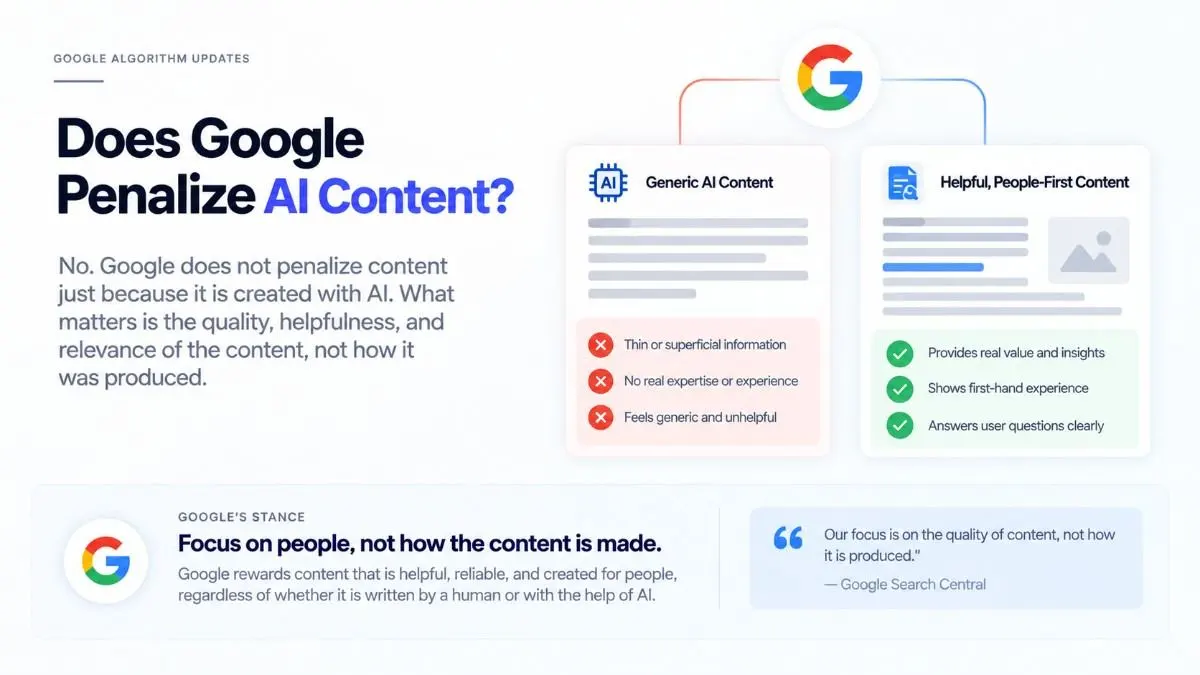
This question comes up in nearly every conversation we have with business owners, and the amount of misinformation around it is staggering. So here is the direct answer, sourced from Google's own statements.
Google does not penalize content simply because it was made with AI tools.
Google's stated position, published in their guidance on AI-generated content, is that they reward high-quality content regardless of how it is produced. The emphasis is on the quality, originality, and usefulness of the content, not on whether a human typed every word or whether an AI tool assisted in the process.
What Google does penalize is scaled content abuse. This means using any method, AI or human, to mass-produce content that exists primarily to manipulate search rankings rather than to help people. A business that uses ChatGPT to generate 500 thin blog posts targeting every keyword variation is engaging in scaled content abuse. A business that uses AI tools to help draft a thoroughly researched, expert-reviewed article about a topic they genuinely understand is not.
Third-party research supports this. An Ahrefs study found that 86.5% of top-ranking pages contain some AI-generated content. That statistic alone should put to rest the idea that Google universally penalizes AI content. The pages ranking well are using AI as part of their production process while still delivering genuine value.
For Odisha businesses, the practical guidance is simple. Use AI tools if they help you produce better content faster. Do not use AI tools to replace the expertise, experience, and local knowledge that make your content worth reading. A Bhubaneswar-based clinic that uses AI to help structure an article about common monsoon illnesses in Odisha, then has their doctor review and add first-hand clinical observations, is doing it right. An agency that generates 50 generic health articles with no medical review and publishes them on that clinic's website is creating exactly the kind of content Google's spam updates are designed to catch.
Which Odisha Businesses Are Most Vulnerable to Algorithm Updates?
Google's algorithm updates are global. They do not single out Odisha or any other region. But the types of businesses that exist in Odisha, and the common characteristics of their websites, create predictable patterns of vulnerability. Based on how each category of update works and the typical web presence of Odisha businesses, here is a framework for assessing your risk.
Before we get into the specifics, an important note: what follows is a framework, not data. There are no published studies on how Google updates specifically affect Odisha businesses. What we can do is map the known characteristics of each update type against the business types and web practices common in Odisha. If your situation matches one of these profiles, it is worth auditing your site proactively rather than waiting for a drop.
| Business Type | Core Update Vulnerability | Spam Update Vulnerability | Priority Recovery Actions |
|---|---|---|---|
| Restaurants and Food Businesses | Low to Moderate | Low | Optimize Google Business Profile, build genuine review volume, add original photography |
| Hotels and Tourism | Moderate | Low to Moderate | Create original destination content, build local backlinks from tourism sites, avoid duplicate descriptions across booking platforms |
| Clinics and Hospitals (YMYL) | High | Moderate | Ensure all medical content is reviewed by qualified practitioners, add author credentials, cite sources for health claims |
| Coaching and Educational Institutes | Moderate to High | Moderate | Replace generic content with original study materials, add instructor credentials, publish real student outcomes |
| Real Estate | Moderate to High | Moderate | Create unique property descriptions, add neighborhood-specific content, demonstrate local market expertise |
| IT Services and Digital Agencies | Moderate | Moderate to High | Replace boilerplate service pages with case studies, demonstrate technical expertise through original content |
| E-commerce and D2C Brands | Moderate to High | Moderate | Write original product descriptions, add genuine customer reviews, build product-specific expertise content |
| Local Retail and Services | Low to Moderate | Low | Focus on Google Business Profile completeness, local citations, and review generation |
Two categories deserve special attention. Healthcare businesses (clinics, hospitals, Ayurveda practitioners, diagnostic centers) fall under what Google calls YMYL: "Your Money or Your Life." Google applies stricter quality standards to content that could affect someone's health, finances, or safety. Every core update since March 2024 has tightened these standards. If your healthcare website publishes medical advice without clear author credentials, without citations, or with content that contradicts established medical consensus, core updates will continue to push your rankings down.
Coaching institutes and educational services are another high-risk category in Odisha, where the competitive exam coaching industry is massive. Many coaching websites use identical language, make unverifiable claims about results, and produce bulk content targeting keyword variations like "best IIT coaching in Bhubaneswar" without providing genuine differentiation. This is exactly the pattern that core updates are designed to devalue.
How Google Updates Affect Local SEO vs Organic Rankings
Business owners often assume that if they have a strong Google Business Profile, algorithm updates will not affect them. This is a dangerous misunderstanding. Local SEO and organic SEO are related but separate systems, and Google updates affect them differently.
The Local Pack: Mostly Insulated
The Local Pack (the map-based results that appear at the top of local searches) has its own ranking system. It is driven primarily by proximity, Google Business Profile completeness, review signals, and local citation consistency. Core updates and spam updates do not directly change Local Pack rankings. If you rank in the map results for "best restaurant in Bhubaneswar," a core update is unlikely to knock you out of that position.
Organic Results: Fully Exposed
The organic search results that appear below the Local Pack are fully subject to core and spam updates. These are the blue link results where your website pages compete against every other relevant page on the internet. If your business relies on organic search traffic to your website, not just your Google Business Profile listing, every algorithm update has the potential to affect you.
Here is why this matters for Odisha businesses specifically. For a local business like a salon or a plumber, the Local Pack often drives most of their search traffic. They may not even notice a core update. But for a business with broader reach, like a Bhubaneswar-based IT company targeting clients across India, a hotel trying to attract tourists, or an e-commerce brand shipping nationally, organic rankings are the primary traffic driver. For these businesses, core updates directly affect revenue.
The smartest approach is to build both systems. A strong local SEO foundation gives you resilience in the Local Pack regardless of algorithm changes. A content strategy built on genuine expertise and E-E-A-T principles protects your organic rankings through core updates. Together, they create a search presence that no single update can dismantle.
Key Takeaway
Local Pack rankings and organic rankings are affected differently by Google updates. If your business depends on organic search traffic beyond just your Google Business Profile, algorithm updates directly affect your bottom line. Build both local and organic SEO to create resilience.
How to Check If a Google Update Affected Your Website
Before you can fix anything, you need to confirm whether a Google algorithm update actually caused your traffic change. Plenty of traffic drops have nothing to do with algorithm updates: seasonal trends, a technical issue on your site, a competitor launching a paid campaign, or even a tracking code that broke. Here is the step-by-step process to diagnose accurately.
Step 1: Check the Update Timeline
Go to Google's Search Status Dashboard and note the rollout dates of any recent updates. Compare these dates to when your traffic changed. If there is no confirmed update during the period your traffic dropped, the cause is probably something else entirely.
Step 2: Open Google Search Console
Log into Google Search Console and navigate to the Performance report. Set the date range to cover at least 28 days before the update started and 28 days after it ended. This gives you a clear before-and-after comparison.
Step 3: Look at the Right Metrics
Clicks tell you how many people actually visited your site from search. A drop in clicks is the most direct indicator of a problem. Impressions tell you how often your pages appeared in search results. If impressions dropped but clicks held steady, it may mean you lost visibility for queries that were not driving traffic anyway. Average Position shows where your pages rank. A move from position 5 to position 15 means you went from the first page to the second, which typically means a significant traffic loss.
Step 4: Identify Affected Pages and Queries
Switch to the Pages tab and sort by the difference in clicks before and after the update. This shows you which specific pages lost (or gained) the most traffic. Do the same with the Queries tab. Are the affected pages concentrated in one section of your site, or is the impact spread across everything? Concentrated drops usually point to a content quality issue in a specific topic area. Sitewide drops may indicate a broader quality reassessment or a technical problem.
Step 5: Cross-Reference with Analytics
Open Google Analytics and look at your organic traffic for the same period. Check whether the drop in Search Console data matches a corresponding drop in actual site visits. Sometimes Search Console shows a position drop, but Analytics shows traffic held steady because users are still clicking. Other times, a small position change causes a disproportionate traffic loss because you dropped from a high-click position (like position 1 or 2) to a low-click position (like position 5 or 6).
Step 6: Rule Out Technical Issues
Before blaming an algorithm update, check for technical problems that could explain the drop independently. Look at the Coverage report in Search Console for new errors or warnings. Check if your site speed degraded (the Core Web Vitals report will show this). Verify that no pages were accidentally noindexed or blocked by robots.txt. A technical SEO audit can rule out these possibilities quickly.
Google Update Impact Diagnostic Checklist
- Confirm the update dates on Google's Search Status Dashboard
- Compare traffic in Search Console: 28 days before vs. 28 days after
- Identify which specific pages and queries lost traffic
- Check if the drop is concentrated (topic-specific) or sitewide
- Cross-reference Search Console data with Google Analytics
- Rule out technical issues: crawl errors, indexing changes, speed degradation
- Determine whether the update was a core update or a spam update
- Document your findings before making any changes
Recovery Strategy: What to Do After a Google Algorithm Update
Once you have confirmed that a Google update caused your traffic drop and identified the affected pages, you need a recovery plan. The approach depends entirely on whether you were hit by a core update or a spam update. Do not mix the two strategies.
Recovering from a Core Update
A core update drop is not a penalty. Google has stated this repeatedly. It means your content quality, relative to the competition, no longer meets the updated assessment criteria. Recovery requires genuine content improvement, not a technical workaround.
Audit your affected pages honestly. Read them as if you were a customer, not a site owner. Ask yourself: does this page answer the question better than the other results on page one? Does it offer something, an insight, a perspective, a piece of data, that those other results do not? If the honest answer is no, that is your starting point.
Add first-hand experience. Google's quality systems increasingly reward content that demonstrates real experience with the topic. If you are a Bhubaneswar-based real estate firm writing about property buying in Odisha, include specific observations from deals you have worked on. If you run a restaurant, your content about food sourcing should reflect your actual sourcing process, not generic information anyone could copy from Wikipedia.
Improve your E-E-A-T signals. Make sure your content has clear author attribution with relevant credentials. Add author bios that demonstrate expertise. Link to authoritative sources that support your claims. Build the supporting signals, like backlinks from relevant sites and mentions in credible publications, that tell Google your site is a trustworthy source on its topics.
Be patient. Core update recovery is not instant. Google typically needs the next core update to fully reassess your improved content. That means recovery can take months, not days. The March 2024 Core Update showed that sites which made genuine improvements recovered during the August 2024 or November 2024 core updates. Those that applied surface-level fixes did not.
Recovering from a Spam Update
A spam update drop is a penalty. Google has identified a specific policy violation on your site. Recovery requires identifying and removing the violation, then requesting reconsideration.
Check for manual actions. Log into Google Search Console and go to the Manual Actions report. If there is a manual action against your site, Google will tell you exactly what the violation is. Fix it, document what you changed, and submit a reconsideration request.
Audit your link profile. If the spam update targeted link manipulation, use Google Search Console's Links report and a third-party tool to identify unnatural links pointing to your site. Disavow links that you cannot get removed and that clearly violate Google's link spam policies.
Remove any scaled content. If your site has pages that were mass-produced to target keyword variations without providing genuine value, remove them or consolidate them into fewer, higher-quality pages. This includes AI-generated content that was published without review and thin pages that exist only to capture search traffic.
Key Takeaway
Core update recovery requires content quality improvement and patience. Spam update recovery requires identifying and fixing a specific policy violation. Never guess which one affected you. Diagnose first using the walkthrough in the previous section, then apply the right recovery strategy.
E-E-A-T and Original Research: Future-Proofing Your Odisha Business
If there is one theme that connects every Google update from 2024 to 2026, it is the increasing importance of E-E-A-T: Experience, Expertise, Authoritativeness, and Trustworthiness. This is the framework Google uses in its Search Quality Rater Guidelines to describe what high-quality content looks like. While E-E-A-T is not a direct ranking factor (Google does not assign an E-E-A-T score to your site), every core update refines Google's ability to identify and reward these qualities algorithmically.
For business owners who are not SEO specialists, here is what each component means in practice.
Experience means the content creator has first-hand, real-world experience with the topic. A hotel owner writing about tourism in Puri has experience that a freelance writer in another state does not. A doctor at a Bhubaneswar clinic writing about managing diabetes has experience that a content mill cannot replicate. Google's systems are getting better at detecting whether content was created by someone who actually knows what they are writing about.
Expertise means the creator has demonstrated knowledge or skill in the subject area. For a healthcare website, this means content written or reviewed by qualified medical professionals. For a legal firm, it means content from practicing lawyers. For a restaurant, it means genuine culinary knowledge. The key is that the expertise is demonstrable, not just claimed.
Authoritativeness means the creator and the website are recognized as reliable sources. This is built over time through consistent, high-quality content, mentions and citations from other credible sources, backlinks from relevant websites, and a clear reputation in your field.
Trustworthiness is the foundation of everything else. Is the site transparent about who runs it? Is the content accurate? Are claims sourced? Is the site secure and well-maintained? Trustworthiness is what Google looks at most carefully, especially for YMYL topics.
Why Original Research Matters More Now
One of the strongest E-E-A-T signals you can build is original research. When you publish data, insights, or analysis that exists nowhere else on the web, you create content that Google cannot help but rank well, because it is by definition the best source for that information. This is true at any scale. A Bhubaneswar restaurant that publishes a guide to Odisha's seasonal ingredients based on their own sourcing experience is producing original research. A real estate firm that publishes market data from their own transaction history is producing original research.
At Oddtusk, this is part of how we approach our own content. Our audit of 20 Bhubaneswar business websites is an example: original data from our own analysis, published with full methodology, creating a resource that no competitor can replicate by copying. This approach to semantic SEO and content marketing is what protects against algorithm updates, because each update rewards exactly this type of content more strongly.
Key Takeaway
E-E-A-T is not a checklist you complete once. It is the direction Google is moving with every update. Invest in demonstrating real experience, building genuine expertise, earning authoritativeness through consistent quality, and maintaining trust through transparency. Original research is the single strongest signal across all four components.
What the SERP Competitors Are Missing (and How Oddtusk Can Help)
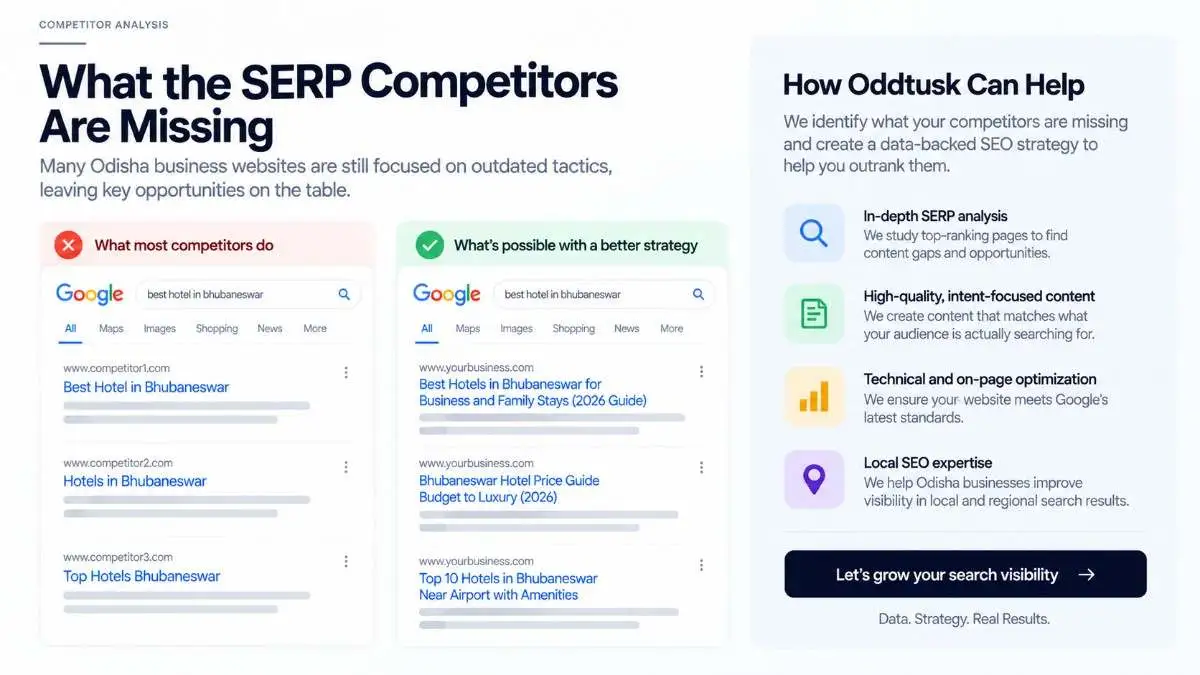
We analyzed the top-ranking pages for "Google algorithm update" and related queries. Most of them are from global SEO tools and publications. They cover the updates themselves well enough. What none of them do is connect those updates to the specific business landscape of a Tier-2 Indian market like Odisha.
That gap is not trivial. A business owner in Bhubaneswar does not need to know every technical detail of how Google's SpamBrain classifier works. They need to know whether their coaching institute's website is at risk after the latest core update, and what to do about it. They need to know whether their hotel's duplicate content across three booking platforms is a vulnerability. They need context that maps global algorithm changes to their specific business situation.
This is where Oddtusk works differently. We do not sell SEO as a package. We build scope around your actual business requirements. That starts with understanding your business, your market, and your competitive landscape, then designing a strategy that addresses your specific vulnerabilities and opportunities. Whether that involves a technical SEO audit, entity SEO, schema markup, or a full SEO strategy, the scope matches what your business actually needs.
If you have been watching your organic traffic decline and are not sure why, or if you want to get ahead of the next algorithm update instead of reacting to it, start a conversation with us. We will tell you what is actually happening with your site and what it would take to fix it.
[ Common questions ]
Google Algorithm Update FAQs
In 2026, Google has released six confirmed updates so far: the February 2026 Discover Core Update (Feb 5 to Feb 27), the March 2026 Spam Update (Mar 24 to Mar 25), the March 2026 Core Update (Mar 27 to Apr 8), the May 2026 Core Update (May 21 to Jun 2), the June 2026 Spam Update (Jun 24 to Jun 26), and the August 2026 Spam Update (Aug 18 to Aug 21). The overall direction continues toward rewarding original, experience-backed content and penalizing manipulative link schemes, scaled content abuse, and site reputation abuse.
The most recent confirmed Google update is the August 2026 Spam Update, which rolled out from August 18 to August 21, 2026. Before that, the June 2026 Spam Update ran from June 24 to June 26, and the May 2026 Core Update ran from May 21 to June 2. All dates are verified from Google's Search Status Dashboard. Core updates adjust how Google evaluates content quality across the board, while spam updates specifically target policy violations like link spam and cloaking.
No. Google does not penalize content simply because it was made with AI tools. Google's stated position is that they reward high-quality content regardless of how it was produced. What Google does penalize is scaled content abuse, which means using any method, AI or otherwise, to mass-produce low-quality content designed to manipulate search rankings. An Ahrefs study found that 86.5% of top-ranking pages contain some AI-generated content. The deciding factor is quality, originality, and genuine usefulness, not the production method.
Based on verified data from 2024 to 2026, Google core updates have taken anywhere from 6 days to 45 days to fully roll out. The March 2024 Core Update was the longest at 45 days. More recent core updates have been shorter: the March 2026 Core Update took 12 days, and the May 2026 Core Update also took 12 days. During the rollout period, rankings can fluctuate significantly before stabilizing. Google advises waiting until the rollout is complete before making major changes to your site.
A core update changes how Google evaluates and ranks all content across search results. It is not targeting specific sites or violations. It reassesses quality signals broadly, which means some sites go up and some go down based on how their content measures against updated criteria. A spam update specifically targets sites that violate Google's spam policies: link manipulation, cloaking, scraped content, or scaled content abuse. If a core update drops your rankings, your content quality needs improvement. If a spam update drops your rankings, Google has identified a specific policy violation.
Yes. Core updates affect all types of search results, including local organic rankings. While the Local Pack (the map-based results) has its own ranking factors like proximity and Google Business Profile signals, the organic results that appear below the Local Pack are fully subject to core update changes. If your business website loses organic rankings after a core update, fewer people will find you through search even if your Local Pack position holds. Businesses in YMYL categories like healthcare and legal services tend to feel core updates more strongly.
Open Google Search Console and go to the Performance report. Set the date range to cover the period before, during, and after the update rollout dates. Look for sudden drops or gains in clicks, impressions, and average position. Compare the same metrics for individual pages and queries. If you see a significant shift that aligns with a confirmed update's rollout window, the update likely affected your site. Verify update dates on Google's Search Status Dashboard. Also check Google Analytics for changes in organic traffic patterns during the same period.
E-E-A-T stands for Experience, Expertise, Authoritativeness, and Trustworthiness. It is a framework from Google's Search Quality Rater Guidelines that describes what high-quality content looks like. It is not a direct ranking factor or a score Google assigns to your site. Instead, it describes characteristics that Google's algorithms are designed to reward. Every core update refines how well Google's systems identify these qualities, which is why E-E-A-T alignment tends to protect sites during algorithm changes. For Odisha businesses, this means demonstrating real local expertise and experience in your content.
Sources and Methodology
Transparency matters to us, and we believe it should matter to you when evaluating any content about SEO. Here is exactly where the information in this article comes from.
Update dates and rollout durations: All dates come from Google's Search Status Dashboard, verified in September 2026. This is the only authoritative source for confirmed Google algorithm update dates.
Update descriptions and targeting: Information about what each update targets comes from Google's official documentation on core updates and Google's spam policies.
AI content data: The statistic about 86.5% of top-ranking pages containing AI-generated content is from third-party research published by Ahrefs. We cite it as third-party research, not as our own finding.
Odisha business impact analysis: As stated throughout this article, there is no published data on how Google updates specifically affect Odisha businesses. Our vulnerability framework is based on mapping known update characteristics against common business types and web practices in Odisha, informed by our experience working with businesses across the state. We have been explicit about this distinction in every section where it applies.
E-E-A-T framework: Our description of E-E-A-T comes from Google's published Search Quality Rater Guidelines, which are publicly available.
If any information in this article is inaccurate or becomes outdated as new updates roll out, reach out to us and we will update it.
