

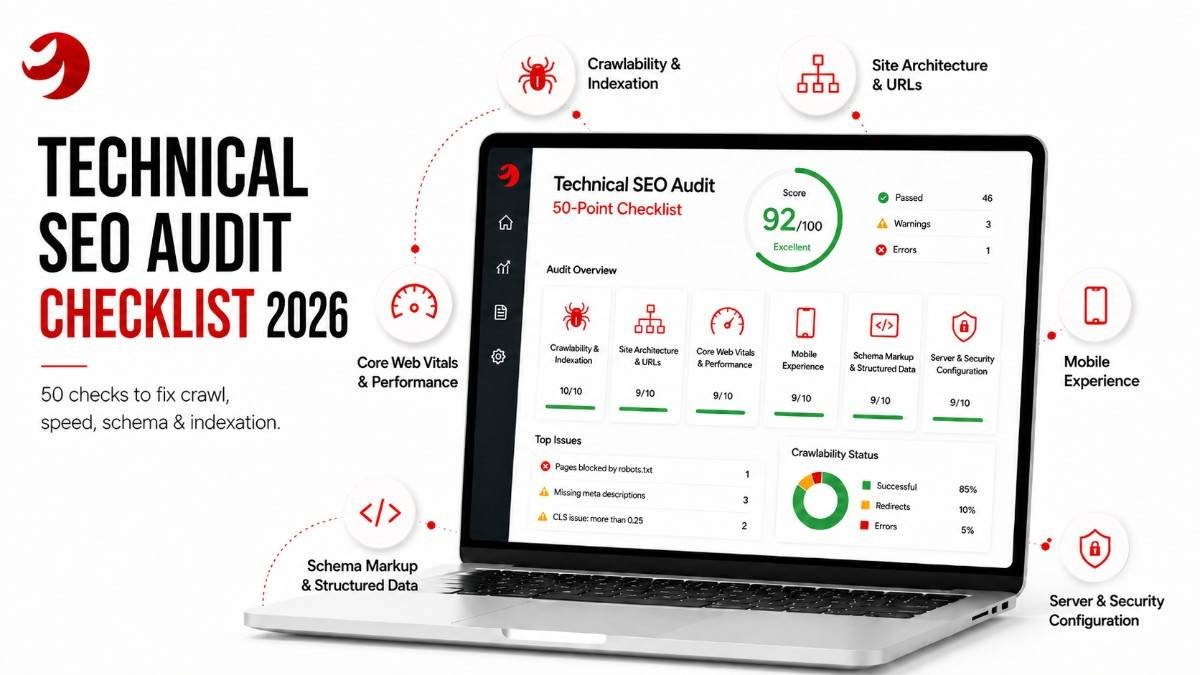
A technical SEO audit checklist of 50 points across crawlability, site architecture, performance, mobile, schema and server setup.
Technical SEO audit checklist: 50 points every website must check in 2026
Date: 07 - 15 - 2026
Time to read: 18 minutes
[ Table of
Content ]
Why a technical SEO audit decides ranking potential
A technical SEO audit finds the backend problems that stop content from reaching the people searching for it. In 2026, relying only on excellent content or strong backlinks while ignoring structural indexing problems leaks measurable revenue. The December 2025 core update raised the weight of technical performance factors significantly. AI answer engines now require machine-readable structured data to cite your content. And the distinction between AI training crawlers and AI retrieval crawlers has turned robots.txt into a strategic policy document.
A technical SEO audit is a systematic, layer-by-layer inspection of every structural element that determines whether search engines and AI systems can crawl, render, index, and rank a website. A technical SEO audit goes deeper than a surface health check and shows whether a site is leaking organic revenue or building it.
This technical SEO audit checklist is the operational framework we use at Oddtusk across every client engagement, from D2C Shopify stores to multi-location healthcare practices. It is built around the audit methodology we run using Screaming Frog, Ahrefs, Google Search Console, server log analysis, Windsor.ai, and PageSpeed Insights. Every section is sequenced in the order you should run the audit, because each layer depends on the one before it.
What a technical SEO audit covers
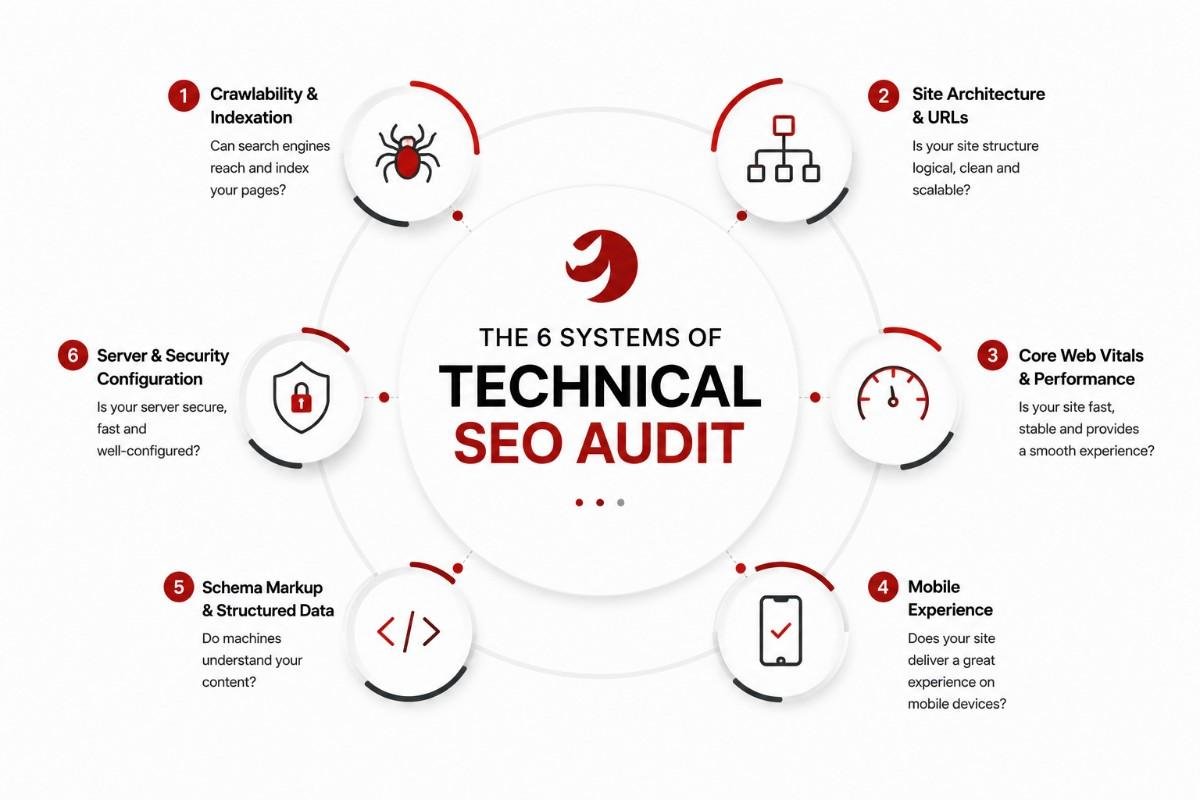
A technical SEO audit evaluates six interconnected systems:
- Crawlability and indexation: Can search engines find your pages?
- Site architecture and URL structure: How is content logically organised?
- Core Web Vitals and page performance: How fast do pages load and respond to interactions?
- Mobile experience: Does the site work properly on the devices most users actually use?
- Schema markup and structured data: Do machines understand what your content is?
- Server-level configuration: Are redirects, security headers, and AI crawler governance properly set?
Each system affects the others, which is why auditing them in isolation produces incomplete results. The 50 checkpoints in this technical SEO audit checklist cover all six.
Section 1: technical SEO audit of crawlability and indexation
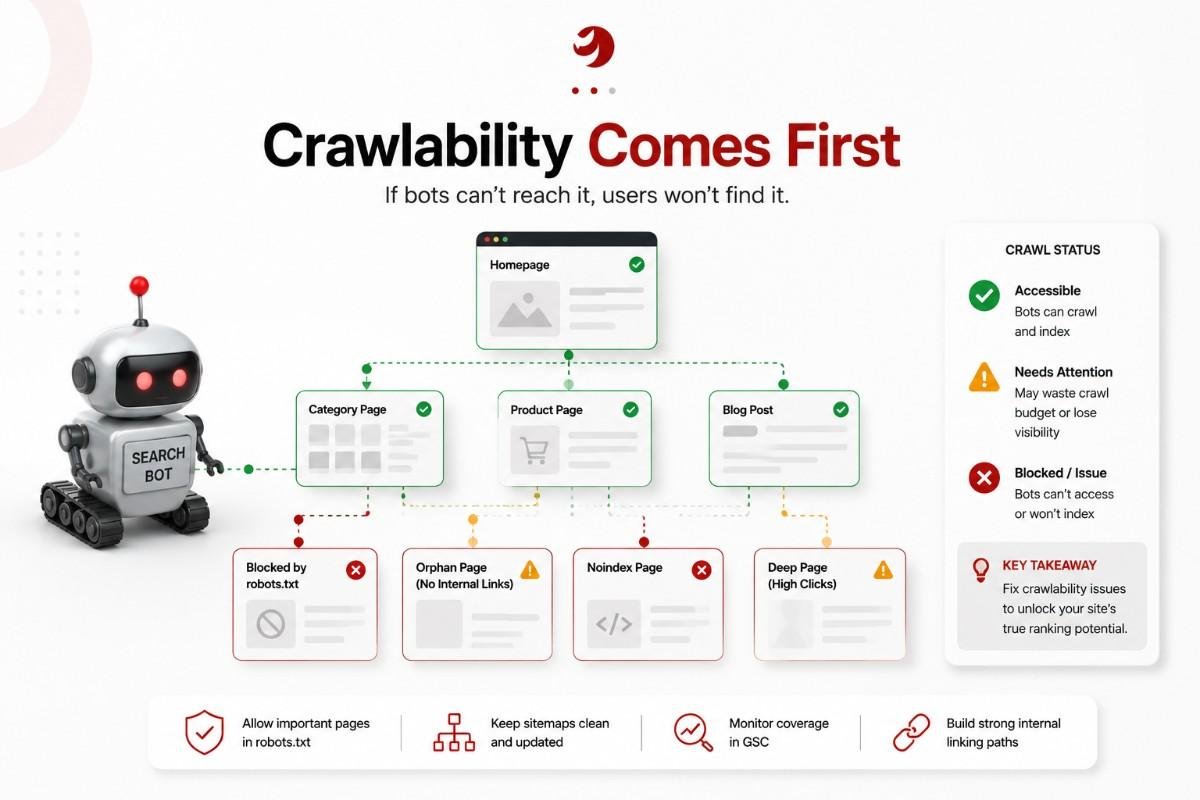
A technical SEO audit starts with crawlability, because nothing else matters if search engines cannot reach your pages. Crawlability issues are the most fundamental technical SEO problems and the most commonly overlooked, especially on sites that have grown organically without technical oversight.
In 2026, a technical SEO audit checks crawlability for AI bots as well as Googlebot. AI answer engines like ChatGPT Search, Perplexity, and Google AI Overviews rely on retrieval bots that fetch your content in real time to cite in AI-generated answers. If those bots cannot access your pages, your content will not appear in AI answers regardless of how well it ranks in traditional search.
- 1. Robots.txt Validation: Confirm that critical pages, CSS, and JavaScript files are not accidentally blocked by your robots.txt file. In 2026, robots.txt has become a governance document that also dictates which AI companies can access your content. A Cloudflare analysis of over 4,000 robots.txt files in Q1 2026 found that GPTBot is the most blocked AI crawler, followed by CCBot and ClaudeBot. The critical distinction is between training bots (GPTBot, CCBot, ClaudeBot, Google-Extended, Meta-ExternalAgent) which scrape content for model weights with no attribution, and retrieval bots (OAI-SearchBot, ChatGPT-User, PerplexityBot, Claude-Web) which fetch content in real time to cite in user-facing answers. Block training scrapers. Explicitly allow retrieval bots.
- 2. XML Sitemap Cleanliness: Include only URLs returning a 200 status code. Remove every URL returning a 3xx, 4xx, or 5xx response. We find sitemap bloat on nearly every ecommerce audit we run. On one Shopify store audit, the sitemap contained over 800 URLs returning soft 404s, silently draining crawl budget away from revenue-generating product pages.
- 3. HTML Sitemap Availability: Maintain a well-structured HTML sitemap page that serves both human visitors looking for a navigational overview and search engine bots looking for link paths to deep pages that may not be reachable through the main navigation.
- 4. Google Search Console Coverage Monitoring: Check the Index Coverage report regularly. It separates pages into indexed, excluded, crawled-but-not-indexed, and error states. Monitoring this report weekly catches crawl drops before they become traffic drops. When we onboarded Not That High, the initial audit revealed significant indexation gaps across their fancy lighter categories. Pages existed but were invisible to search engines. Fixing the crawl architecture was the first move before any content or keyword work could take effect.
- 5. Crawl Budget Efficiency: Reduce the number of low-value, thin, and duplicate pages so that search bots spend their limited crawl allocation on your highest-converting content. In 2026, index budget (the number of pages the search engine deems worth keeping in its index) is a more common bottleneck for ecommerce sites than crawl budget itself.
- 6. Indexing Directives Audit: Check whether your most important transactional and commercial pages have a noindex robots meta tag accidentally set on them. This is especially common after staging-to-production deployments where noindex directives from the staging environment are not removed before going live.
- 7. Log File Inspection: Analyse your server log files to see how Googlebot and AI crawlers actually behave on your site. Log analysis reveals crawl frequency per directory, which bots are consuming the most bandwidth, and whether critical pages are being crawled at the frequency they deserve.
- 8. Deep Orphan Page Discovery: Identify pages with no incoming internal links from the rest of the site. Use Screaming Frog's crawl analysis, cross-referenced with GSC's indexed pages list, to reveal orphan pages that may be indexed but receiving zero internal link equity. Link them or remove them.
- 9. Internal Crawl Depth Limits: Structure your site architecture so any page can be reached within three clicks from the homepage. Every additional click of depth reduces the probability of a crawler reaching and prioritising that page.
- 10. RSS Feed Synchronisation: Maintain and update active content RSS feeds so that search engines and feed-based discovery systems are notified about your latest content immediately upon publication.
Suggested article:How to Do a
Content Gap Analysis for SEO: A Step-by-Step Guide
Section 2: technical SEO audit of site architecture and URL hygiene
A technical SEO audit checks site architecture, which determines how search engines understand the topical relationships between your pages and how link equity flows across your domain. A poorly structured site loses authority at every junction, while a well-structured one builds it up.
- 11. Clean URL Parameters: Use consistent canonical tags across the site to prevent dynamic tracking links, faceted navigation parameters, and session IDs from generating duplicate content at scale. Every variant URL without a canonical pointing to the preferred version is a dilution risk.
- 12. Logic-Driven Folder Structures: Organise content into clear, meaningful category and
subcategory hierarchies that reinforce topical authority. A URL structure
like
/digital-marketing/seo/technical-audit/communicates topical containment far more effectively to both crawlers and AI systems than a flat structure like/technical-audit/. - 13. Self-Referencing Canonical Tags: Every live page should have a canonical link element pointing to itself. This confirms the preferred version of that URL and is the single most reliable way to prevent duplicate content issues caused by URL parameters, trailing slashes, protocol variations, or case differences.
- 14. Breadcrumb Navigation with Schema: Implement logical breadcrumb trails that help user navigation and strengthen internal linking paths. Pair them with BreadcrumbList schema to give search engines explicit navigational context that improves how your pages appear in search results.
- 15. Broken Internal Link Repair: Find all internal links pointing to dead pages (4xx responses) and fix or replace them so that link equity continues to flow through your site rather than leaking into dead ends. Screaming Frog and Ahrefs both surface these efficiently.
- 16. External Link Validation: Audit all outgoing links to confirm they point to live, trustworthy, and relevant destinations. Outbound links to dead pages, redirected domains, or low-quality sites erode your own page's trust signals.
- 17. Pagination Link Directives: For multi-page content such as articles, product listings, and blog archives, provide clear previous/next link relationships to help crawlers navigate the full sequence of content without missing pages.
- 18. Infinite Scroll Anchor Fallbacks: For pages using infinite scroll or lazy-loaded content, provide static anchor tag alternatives so search engine bots can access content beyond the initial viewport load. Most AI crawlers cannot execute JavaScript at all. A Vercel study found that 69% of AI crawlers see a blank page on JavaScript-dependent sites.
- 19. Subdomain SSL Validation: Ensure all subdomains (staging, blog, shop, API) have valid, up-to-date SSL certificates so that data transfers are secure and browsers do not display security warnings that damage user trust.
- 20. Subdomain Consolidation: Evaluate standalone subdomains serving thin content or legacy pages for migration back into the main domain's subfolder structure. Consolidating subdomains into subfolders concentrates domain authority rather than fragmenting it across separate origins.
Example: Maavni Designs, an Odisha-based Pattachitra art brand, had a flat site architecture with no meaningful folder hierarchy when we began the engagement. Collection pages for categories like Jharokha, Wall Plates, and Puja items were structurally disconnected from each other and from the product pages within them. We rebuilt the full Shopify architecture with a dual-navigation system (Shop by Category and Shop by Metal), proper URL nesting, and internal linking that passed authority from collection pages to individual products. The result was significant organic traffic growth and ranking improvements across high-intent Pattachitra and handicraft keywords nationally.
Section 3: technical SEO audit of Core Web Vitals and performance
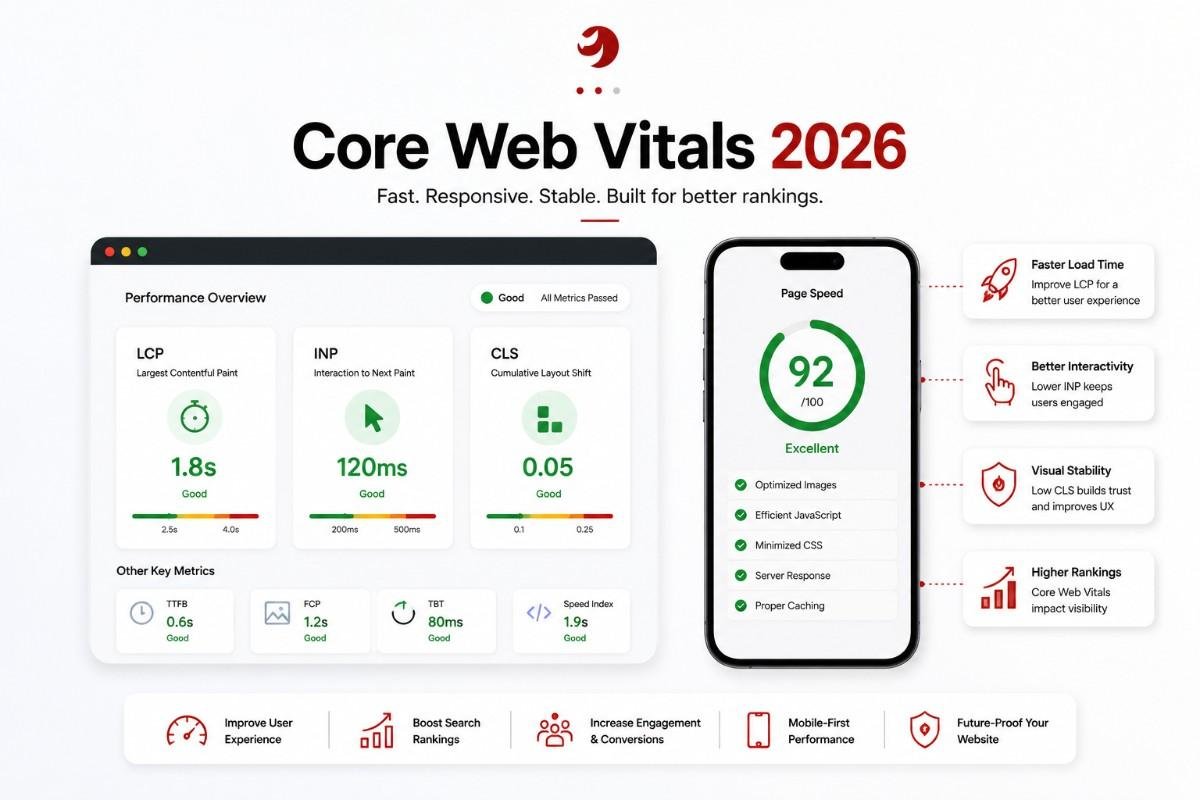
A technical SEO audit treats page performance as a core layer. The December 2025 core update weighted technical performance more heavily than any previous update. Analysis of affected sites found that pages with LCP above 3 seconds experienced measurably more traffic loss than faster competitors with similar content quality. Poor INP scores above 300ms caused significant ranking drops, particularly on mobile.
The three Core Web Vitals in 2026 are LCP (Largest Contentful Paint), INP (Interaction to Next Paint, which replaced First Input Delay in March 2024), and CLS (Cumulative Layout Shift). Each is measured at the 75th percentile of real user experiences.
- 21. Server Response Time (TTFB) Optimisation: Cut Time to First Byte by choosing a quality hosting provider, implementing server-side caching, and serving static assets through a CDN. A fast TTFB under 200ms gives every other performance metric a head start.
- 22. Modern Image Format Conversion: Convert PNG and JPEG images to WebP or AVIF formats. These deliver the same visual quality at substantially smaller file sizes, reducing bandwidth consumption and improving LCP.
- 23. Explicit Media Dimension Attributes: Set precise height and width attributes on every image, video, and iframe element. When the browser knows the dimensions before the asset loads, it reserves the correct space and prevents content from jumping. This directly reduces CLS.
- 24. Critical CSS Inlining: Embed the CSS rules needed to render above-the-fold content directly in the HTML document head. This eliminates the render-blocking round trip required to fetch an external stylesheet before the user sees anything on screen, directly improving LCP.
- 25. Code Minification: Strip unnecessary whitespace, comments, and shorten variable names in CSS and JavaScript source files. Smaller file sizes mean faster downloads and faster parsing, which compounds across every page load.
- 26. Render-Blocking JavaScript Deferral: Load the main layout first by deferring
non-essential scripts with
deferorasyncattributes. JavaScript that does not contribute to the initial visual render should execute after the user sees the main content. This directly improves both LCP and INP. - 27. Browser Cache Configuration: Set long expiration headers (Cache-Control, Expires) on static resources like images, CSS, and JavaScript so that returning visitors load these assets from local cache rather than re-downloading them on every visit.
- 28. CDN Implementation: Serve static assets through a global Content Delivery Network so that users in different geographic locations download files from the nearest edge server. This reduces latency and improves load times across all markets.
- 29. Font Delivery Optimisation: Self-host web fonts where possible and use
font-display: swapto prevent invisible text during font loading. Preload critical font files with<link rel="preload">to eliminate the flash of invisible text that frustrates users and degrades CLS. - 30. Unused Plugin and Script Removal: Audit and remove legacy tracking scripts, abandoned A/B testing code, unused CMS plugins, and third-party widgets that no longer serve a business purpose. Every unused script adds main-thread blocking time that directly degrades INP. Roughly 40% of mobile origins still fail INP in 2026, and third-party script bloat is one of the primary causes.
Example: The Skinstitute, a dermatology clinic in Bhubaneswar, required a complete technical SEO overhaul alongside the content and local SEO strategy. The initial audit revealed speed issues, mobile UX problems, and crawlability gaps that were suppressing rankings before any content strategy could deliver results. After fixing the technical foundation, including Core Web Vitals corrections, structured data implementation, and mobile experience fixes, the site grew from near-zero organic visibility to 600 to 700+ daily organic sessions over 20 months. It now ranks in the local 3-pack for key dermatology searches in Bhubaneswar.
Section 4: technical SEO audit of mobile responsiveness and display
A technical SEO audit tests mobile first, because of mobile-first indexing. The mobile version of your site is the primary version the search engine crawls and ranks. A site that performs well on desktop but breaks on mobile is, for ranking purposes, a broken site. Over 70% of traffic to Indian ecommerce sites comes from mobile devices, so this section matters for any business targeting Indian consumers.
- 31. Responsive Layout Integrity: Build flexible layouts that automatically adjust content size, spacing, and element positioning across desktop, tablet, and smartphone screens without breaking the visual hierarchy or hiding content.
- 32. Clickable Element Target Sizing: Ensure buttons, links, and interactive elements have adequate touch target sizing. Google recommends a minimum of 48x48 CSS pixels with sufficient spacing between adjacent targets so users do not accidentally tap the wrong element on mobile.
- 33. Viewport Meta Configuration: Include the correct viewport meta tag
(
<meta name="viewport" content="width=device-width, initial-scale=1">) so browsers render text, images, and layout at the proper scale for each device type. - 34. Legacy Media Format Removal: Replace Flash, Silverlight, and other legacy media player formats with modern HTML5 video and audio elements that play natively on all mobile devices without requiring additional plugins.
- 35. Font Size Readability: Maintain body text at a minimum of 16px. Text below this threshold forces users to pinch-zoom on mobile, which signals a poor experience and increases bounce rate.
- 36. Intrusive Interstitial Elimination: Remove pop-ups, overlays, and interstitial ads that cover the primary content area on mobile screens. Google has confirmed that intrusive interstitials on mobile pages can result in ranking penalties.
- 37. Cross-Device Content Parity: Present the same content, structured data markup, internal links, and main navigation on mobile as on desktop. If high-value content or structured data only appears on the desktop version, the mobile-first crawler will never see it.
- 38. Dynamic Serving Header Validation: If your site serves different HTML to different device types (dynamic serving), configure Vary: User-Agent HTTP headers correctly so caching layers and search engines know to request and store the appropriate version for each device.
- 39. App Indexing Links: If your brand has a native mobile application, implement app indexing tags (Android App Links, iOS Universal Links) so that mobile users searching for content you cover can be directed into your app when relevant.
- 40. Horizontal Scrolling Elimination: Ensure your layout fits within the device viewport width on all screen sizes. Horizontal scrolling on mobile is a critical UX failure that correlates with higher bounce rates and lower engagement metrics.
Google's December 2025 rendering update clarified that pages returning non-200 HTTP status codes may be excluded from the rendering pipeline entirely. For sites using client-side JavaScript frameworks (React, Vue, Angular, Next.js), this means error pages and misconfigured routes that return incorrect status codes will not have their JavaScript executed by Googlebot. Any content, links, or structured data that depends on JavaScript execution on those pages will be invisible to the indexing systems. Single-page applications using client-side routing should verify that non-existent URLs trigger proper server-side 404 responses rather than 200 status codes with client-rendered error messages.
Section 5: technical SEO audit of schema markup and structured data
In 2026, a technical SEO audit treats schema markup as foundational infrastructure. AI Overviews now trigger for approximately 18.5% of commercial queries. The sites appearing in AI-generated answers are technically clean and also legible, meaning machines can confidently understand what the content is, who created it, and whether it can be cited with confidence.
In a technical SEO audit, schema bridges the gap between a site that is crawlable and a site that is understandable, by both traditional search and AI answer engines.
- 41. JSON-LD Structured Data Implementation: Implement properly formatted JSON-LD schema on every page type. Every content page should carry Article or BlogPosting schema with headline, author (as a Person entity with name and URL, not just a name string), datePublished, dateModified, and publisher. Product pages need Product schema with name, price, availability, reviews, and brand. FAQ content should use FAQPage schema. While Google restricted FAQ rich results in SERPs to government and health sites in late 2025, the FAQ format remains among the most cited structures in AI-generated answers. Apply HowTo schema to any step-by-step content, which is heavily cited in AI Overviews. Use Organisation and LocalBusiness schema to establish your brand as a defined entity in Google's Knowledge Graph.
- 42. Schema Validation and Error Resolution: Test every page with schema markup using Google's Rich Results Test and Schema Markup Validator. Document missing required properties, incorrect type usage, deprecated markup, and validation errors with implementation-ready code blocks. Schema errors are silent failures. They do not produce visible errors for users but they prevent your pages from earning rich results and AI citations.
- 43. Schema Coverage Completeness: Audit your site's schema coverage across all page templates. Common gaps include missing BreadcrumbList schema on navigation pages, missing author Person entities on blog posts (a name string like "Admin" does not satisfy E-E-A-T requirements), and missing aggregate review data on product and service pages.
- 44. Schema-Content Alignment: Verify that structured data accurately reflects the visible page content. Schema that claims a price, rating, or availability that differs from what the user sees on the page violates Google's structured data guidelines. This can result in manual actions or loss of rich result eligibility.
Example: Kansakruti, a heritage brass and metalware D2C brand, launched on Shopify with SEO-ready product architecture from day one. Product schema, collection-level structured data, and Organisation schema were all implemented during the build phase. Over 50 SKUs across Copper, Brass, and Bronze categories went live with correct structured data from the start, giving the store immediate eligibility for rich results and a clean foundation for AI visibility.
Section 6: technical SEO audit of server protocols, redirects and security
A technical SEO audit of server-level configuration shows whether the technical foundation beneath your site is solid or undermining everything built on top of it. Redirect errors, security gaps, and misconfigured server rules are among the most common findings in enterprise-level audits and among the most damaging when left unresolved.
- 45. Redirect Chain Resolution: Collapse every multi-step redirect chain (301 to 301 to 200) into a single direct redirect. Each additional hop wastes crawl budget and dilutes the link equity passed through the redirect. On ecommerce sites, redirect chains accumulate rapidly from product URL changes, category restructuring, and platform migrations that were never cleaned up.
- 46. Custom 404 Page Design: Create an error page that is genuinely useful, with a search bar, main navigation links, and suggestions for popular or related content. Do not leave users at a dead end. The page must also return a proper 404 HTTP status code. Google confirmed in December 2025 that pages with non-200 status codes may not be rendered, so any JavaScript-dependent content on error pages will likely be invisible to Googlebot.
- 47. 301 and 302 Redirect Audit: Confirm that permanent URL moves use 301 redirects (which pass link equity) and that no 302 temporary redirects are being incorrectly used for permanent changes. This is a common finding on sites that have undergone migrations or platform changes where developers used 302s as a temporary measure and never switched them to 301s.
- 48. Hreflang Tag Localisation: For international or multilingual sites, ensure correct hreflang tags on every page so each audience is served the right language and regional version. Avoid IP-based forced geo-redirects. They can prevent search engine crawlers from indexing your international page versions entirely.
- 49. URL Case Normalisation: Force all directory paths to lowercase at the server level to
prevent duplicate content issues caused by case-sensitive configurations that treat
/About-Us/and/about-us/as two separate pages. - 50. HTTP Security Headers: Configure strict security headers including Content-Security-Policy, X-Frame-Options, X-Content-Type-Options, Strict-Transport-Security, and Referrer-Policy. These protect against cross-site scripting, clickjacking, and MIME-type attacks. They also signal to both browsers and search engines that the site takes security seriously.
How a technical SEO audit runs, step by step
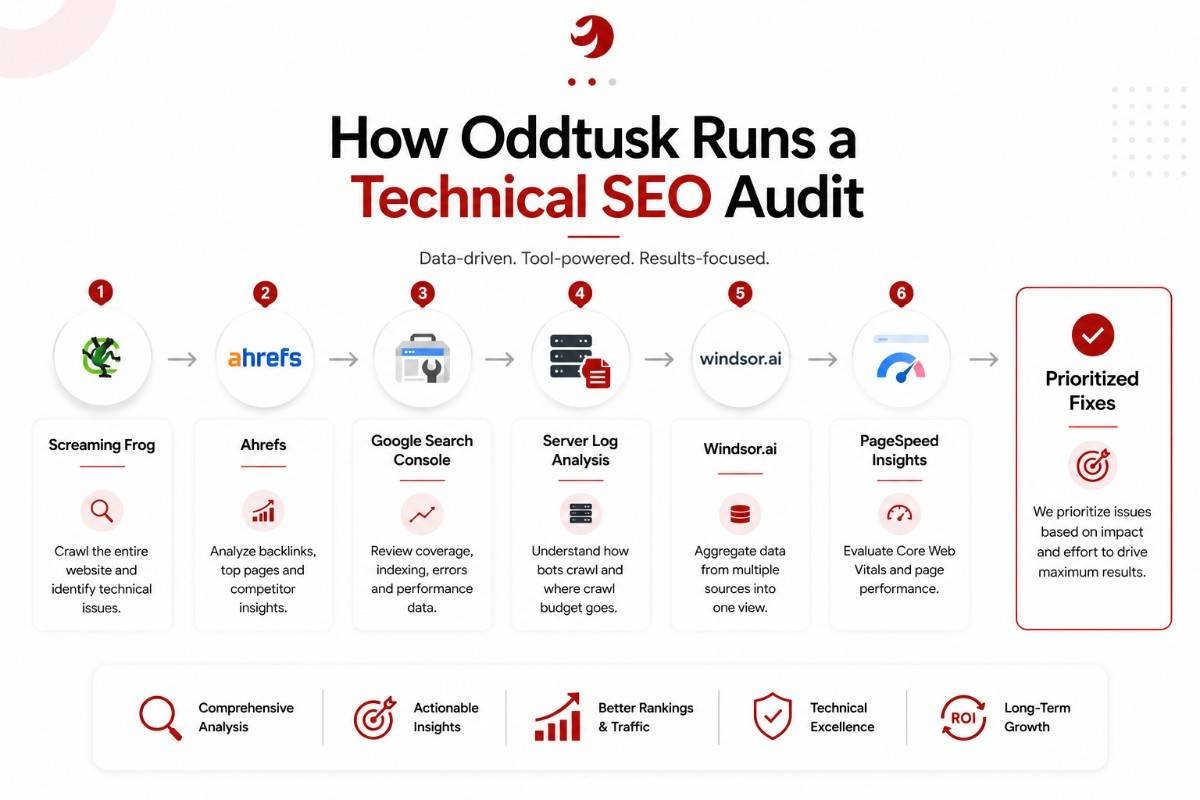
Every technical SEO audit we deliver follows the same operational sequence, because the order matters. Each tool surfaces a different category of evidence, and the sequence ensures nothing is missed or double-handled.
- Step 1: Screaming Frog full site crawl. This surfaces the complete structural picture. Every URL, status code, redirect chain, canonical tag, meta robots directive, heading hierarchy, image alt text, internal link distribution, and crawl depth. For large ecommerce sites, custom extraction is configured to pull schema markup, hreflang tags, and JavaScript rendering data.
- Step 2: Ahrefs backlink and keyword audit. This reveals toxic or broken backlink profiles, keyword cannibalisation between pages, referring domain quality, and competitive positioning. The site audit module surfaces additional technical issues including duplicate content, missing H1 tags, and orphan pages.
- Step 3: Google Search Console analysis. The Index Coverage report, Core Web Vitals report, and Enhancement reports (structured data, mobile usability) provide the search engine's own view of your site's technical health. GSC data is the authoritative source for crawl errors, indexation decisions, and field-measured performance metrics.
- Step 4: Server log file analysis. This reveals actual crawler behaviour. Which bots are visiting, how often, which directories they are hitting, and which pages they are ignoring. Log analysis is the only way to verify whether Googlebot's crawl patterns match your sitemap and internal link priorities.
- Step 5: Windsor.ai data integration. This connects GSC, GA4, Google Ads, and social data into a unified attribution view so technical fixes can be measured against actual revenue impact as well as traffic changes.
- Step 6: PageSpeed Insights analysis. Lab data and field data (from CrUX) for every page template are reviewed for LCP, INP, and CLS failures. The specific elements causing each failure are identified with targeted fix recommendations for your development team.
All findings are compiled into a prioritised report with every issue assigned an impact tier based on its estimated effect on crawlability, indexation, ranking, and revenue. We implement the fixes directly in the CMS, server configuration, or codebase, or deliver implementation-ready documentation that your development team can execute without additional briefing.
Why a yearly technical SEO audit is not enough
Between yearly technical SEO audits, developers change code, content teams publish pages that break redirect logic, server configurations drift, and third-party scripts are added without performance review.
Crawl failure loops develop when backend errors make directories inaccessible. Search engines will rapidly demote or remove pages from their index when crawl failures persist over multiple crawl cycles.
Marketing investment waste is the hidden cost. Investing in premium content strategy, performance marketing, and email marketing produces nothing if backend technical errors prevent the pages receiving that traffic from being indexed, rendered, or loaded at acceptable speeds.
Run a full technical SEO audit annually or after any migration, platform change, or major restructure. Run a lighter quarterly crawl review for ongoing monitoring. Run an immediate audit after any unexplained traffic drop.
Technical SEO audit takeaways
- Crawlability is the prerequisite. Outstanding content and strong backlinks produce zero results if search engines cannot reach, render, and index the pages. Start every audit here.
- AI crawler governance is now a core audit item. In 2026, robots.txt is a policy document. Block training bots (GPTBot, CCBot, ClaudeBot, Google-Extended) while allowing retrieval bots (OAI-SearchBot, PerplexityBot, Claude-Web) to protect server resources without losing visibility in AI answers.
- INP replaced FID. The Core Web Vitals responsiveness metric now captures every interaction throughout a session, along with the first click. Roughly 40% of mobile origins still fail INP.
- Schema is infrastructure. Sites that AI systems can understand and confidently cite are the ones appearing in AI Overviews and generative search results. Competitive visibility now requires schema markup.
- Review quarterly. Sites accumulate technical debt continuously. Quarterly crawl reviews catch indexation and performance regressions before they compound into sustained traffic drops.
- Measure fixes against revenue as well as traffic. A technical SEO audit that produces a checklist but no attribution to business outcomes is incomplete. Track every fix through to its impact on organic sessions, conversions, and revenue using proper analytics infrastructure.
If you want a technical SEO audit conducted on your site with specific, implementation-ready recommendations, talk to our team. See how our technical audit methodology works across real client engagements in our full portfolio, including Skinstitute, Not That High, Rideez Car Rental, Maavni Designs, and Kansakruti.
[ Common questions ]
Technical SEO audit FAQs
A technical SEO audit is a systematic review of every structural element that affects how search engines and AI systems crawl, render, index, and rank a website. In 2026, a technical SEO audit matters more because the December 2025 core update increased the weight of technical performance factors, especially Core Web Vitals and INP. AI answer engines require machine-readable structured data to cite your content. And E-E-A-T requirements now extend beyond YMYL topics to virtually all competitive queries.
Run a full technical SEO audit at least annually for stable sites, and immediately after any site migration, platform change, or major content restructure. For ecommerce sites that regularly add products and categories, run a lighter quarterly crawl review to catch indexation, duplicate content, and performance regressions before they compound. Audit immediately after any unexplained traffic drop.
For a technical SEO audit, our primary stack at Oddtusk includes Screaming Frog for full site crawl data, Ahrefs for backlink analysis and competitive positioning, Google Search Console for indexation and Core Web Vitals field data, PageSpeed Insights for lab-based speed analysis, server log analysis for actual crawler behaviour verification, and Windsor.ai for unified data attribution across GSC, GA4, and Google Ads. Google's Rich Results Test and Schema Markup Validator handle structured data validation.
Crawl budget is the number of URLs a search engine bot is willing and able to crawl on your site in a given timeframe. Index budget is the number of pages the search engine deems worth keeping in its index. In 2026, most sites, especially ecommerce stores, suffer from index budget issues (bloat from thin, duplicate, or low-value pages) rather than crawl budget limitations. Reducing low-value pages concentrates both budgets on your highest-converting content.
No. Blocking GPTBot, Google-Extended, CCBot, or ClaudeBot has no impact on Google Search rankings. Google has confirmed that blocking Google-Extended only controls whether your content trains Gemini and Vertex AI. It does not affect Googlebot or search indexing. However, blocking retrieval bots like OAI-SearchBot removes your content from ChatGPT Search answers, and blocking PerplexityBot removes you from Perplexity results. Block training bots. Allow retrieval bots.
Interaction to Next Paint (INP) replaced FID as the Core Web Vital responsiveness metric in March 2024. FID only measured the delay before the browser began processing the first interaction on a page. INP captures the full latency of every interaction throughout a user's entire session, covering input delay, processing time, and presentation delay. The threshold is 200 milliseconds or less at the 75th percentile. Sites that passed FID easily often fail INP because it exposes slow later interactions that FID never measured.
A technical SEO audit directly affects AEO and GEO readiness. AI answer engines like ChatGPT, Perplexity, and Google AI Overviews can only cite content they can access (robots.txt and crawl accessibility govern this), understand (schema markup makes content machine-interpretable), and trust (E-E-A-T signals including author attribution, publication dates, and organisational credentials build citation confidence). A site with clean technical infrastructure, complete structured data, and proper AI crawler governance is positioned for both traditional search rankings and AI-generated answer citations.
