
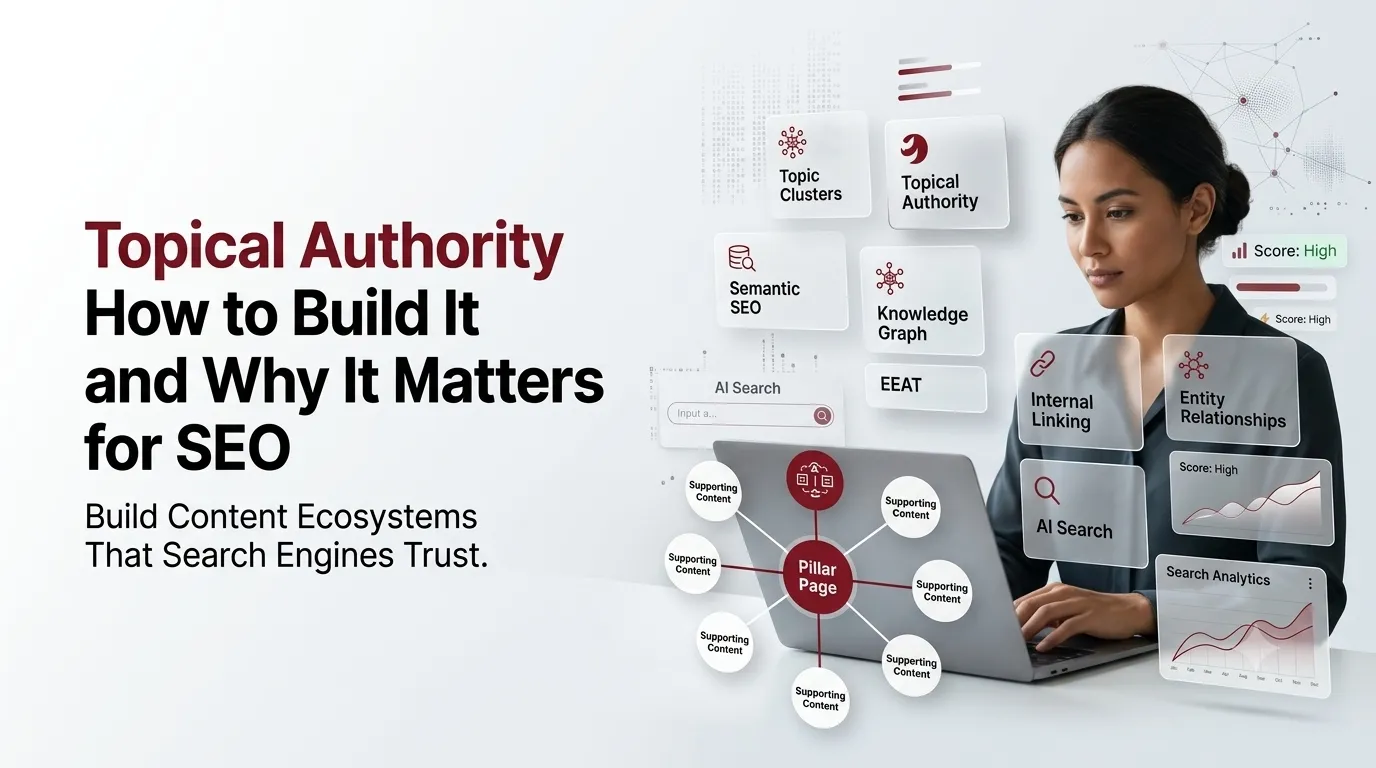
A practical guide to building topical authority through content clusters, internal linking, and semantic coverage that Google rewards.
Google Ranking Factors in 2026: What 131 Experts and Google's Own Data Actually Show
Date: 15 - 09 - 2026
Time to read: 25 minutes
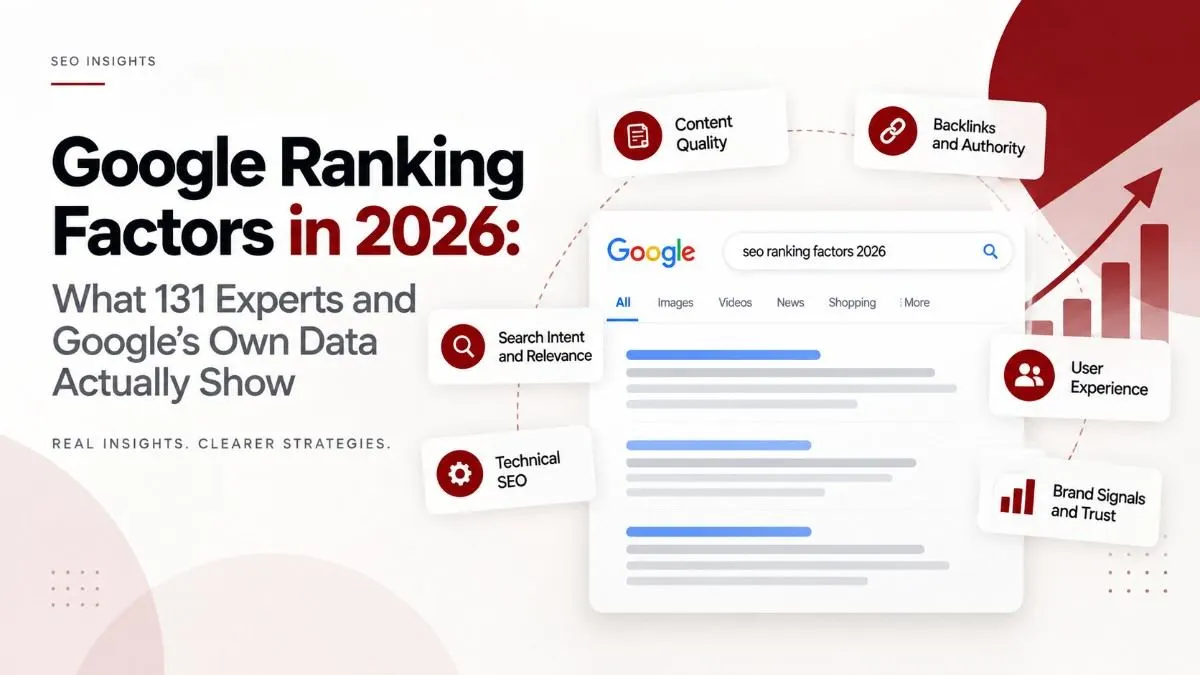
Every year, the SEO industry debates what actually moves Google rankings. Most of those debates are driven by guesswork. This year is different. In early 2026, Cyrus Shepard at Zyppy surveyed 131 SEO professionals and asked them to name the ranking factors that matter most. Those results, combined with Google's leaked API documentation from May 2024 and courtroom testimony from Google's own executives during the US antitrust trial, give us the clearest picture we have ever had of how Google decides who ranks and who does not. This article breaks down what the data shows, where the experts agree, where they disagree with Google's public statements, and what all of it means if you are a brand owner trying to grow through search.
In this article
- The survey at a glance
- Relevance: the factor everyone underestimates
- Backlinks: still alive, just different
- Content quality and the AI question
- Authority, trust, and E-E-A-T
- Click signals and NavBoost
- Brand signals: the factor Google does not talk about
- Topical authority and internal linking
- Technical SEO: necessary but not enough
- What Google will not say publicly
- What this means for brand owners
- FAQs
The Zyppy 2026 Survey: What 131 Experts Actually Said
Cyrus Shepard, the founder of Zyppy and a former Moz executive, asked 131 SEO professionals a direct question: what are the most important Google ranking factors right now? The respondents were not beginners. They included agency heads, in-house leads at major publishers, and independent consultants who work on ranking problems every day.
The results did not produce any single dominant factor. Instead, they showed a layered system where several signals work together. Here is what the experts chose, ranked by the percentage of respondents who included each factor in their top picks.
| Rank | Factor | Expert Agreement |
|---|---|---|
| 1 | Relevance to the search query | 57.1% |
| 2 | Backlinks | 54.8% |
| 3 | Content quality | 47.6% |
| 4 | Authority and trust | 36.5% |
| 5 | User behavior / click signals | 29.4% |
| 6 | Brand signals | 27.0% |
| 7 | User satisfaction | 19.8% |
| 8 | Technical SEO health | 17.5% |
| 9 | Topical authority | 14.3% |
| 10 | Internal links | 11.1% |
Source: Zyppy 2026 Ranking Factors Survey, published by Cyrus Shepard. Percentages reflect the share of 131 respondents who included each factor in their selections.
What stands out immediately is the spread. No single factor crossed the 60% mark. That tells you something important: Google's ranking system is not a checklist. It is a weighted combination of many signals, and the weight shifts depending on the query, the industry, and the competitive landscape.
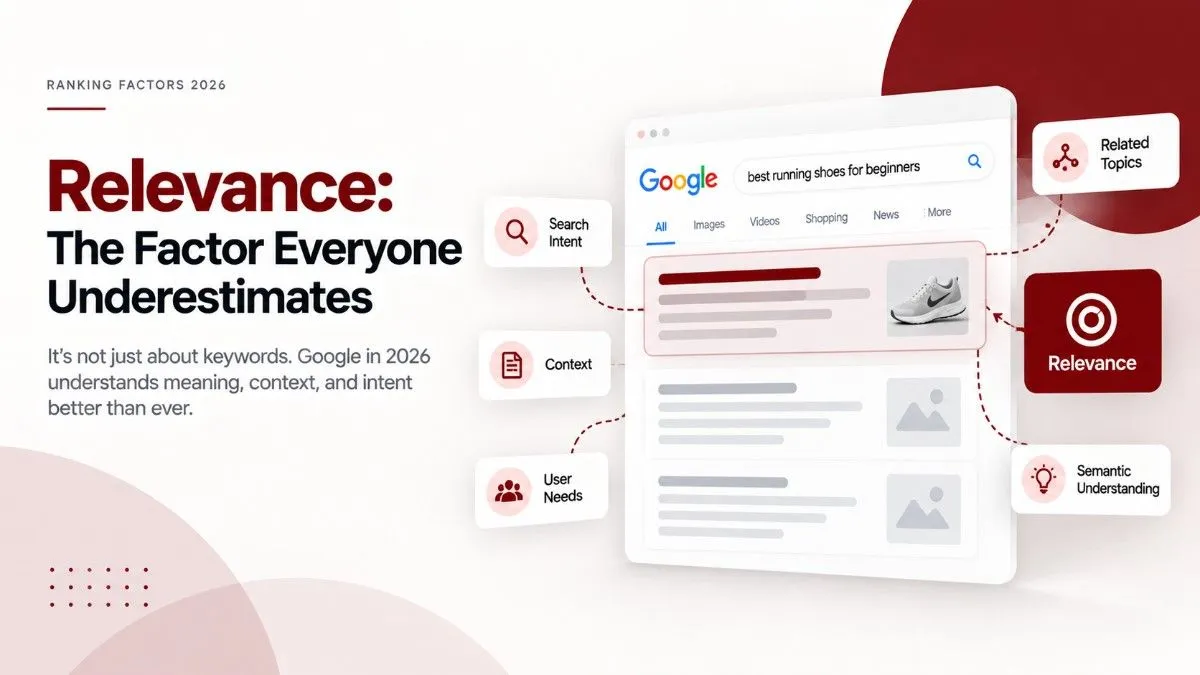
Relevance: The Factor Everyone Underestimates
Relevance took the top spot at 57.1%, and that should not surprise anyone. But the way experts defined relevance goes well beyond matching keywords on a page to keywords in a search query. Google has moved far past keyword matching. It now evaluates whether a page satisfies the actual intent behind a search.
Melissa Popp, one of the survey respondents, put it clearly: "You can have perfect technical content, but if the searcher wanted something else, none of that saves you." This is the part most brand owners miss. A page can be well written, well optimized, and well linked. But if it answers a different question than the one the searcher is asking, it will not rank.
Andy Chadwick expanded on this: "Information gain matters. Once pages match intent, what decides ranking is whether a page adds something others don't." In other words, relevance is the entry ticket. It gets you into the competition. But to win that competition, your content has to offer something the other results do not.
For brand owners, this means your content strategy should not start with "what keywords do we want to rank for?" It should start with "what does someone searching this term actually need, and can we deliver that better than anyone else?" That is a fundamentally different question, and it leads to fundamentally different content.
Key Takeaway
Relevance is not about keyword density. It is about understanding what the searcher needs and delivering it more completely than competing pages. If your content does not match the intent behind the query, nothing else you optimize will compensate.
Backlinks: Reports of Their Death Were Exaggerated
Backlinks ranked second at 54.8%, and the survey generated some of its most direct commentary around this factor. The SEO industry has spent the last few years debating whether backlinks are declining in importance. Google's own statements have fueled that debate.
At Pubcon Pro Austin in September 2023, Google's Gary Illyes said: "I think they are important, but I think people overestimate the importance of links. I don't agree it's in the top three. It hasn't been for some time." That statement was widely reported and led many brand owners to conclude they could stop worrying about links altogether.
The experts in this survey disagree. Cyrus Shepard responded directly to Illyes' statement in the survey results, writing that "the rumor of the death of backlinks has been greatly exaggerated." The data backs him up. Google's leaked API documentation, which became public in May 2024, revealed that link-related attributes remain deeply integrated into Google's ranking systems. The API contained hundreds of link-related fields across dozens of modules.
What has changed is how links are evaluated. The era of accumulating links in volume is over. Andrew Shotland, who specializes in local SEO, offered a concrete observation: "AI increases link value. A Reuters link resulted in a 4x ChatGPT visibility increase over one week." That is a striking data point. A single editorial link from a trusted source delivered more impact than hundreds of low-quality links ever could.
For brand owners, the practical lesson is straightforward. You still need backlinks. But you need them from sources that are genuinely relevant to your industry, authored by people with real editorial judgment, and placed in content that real readers actually engage with. One strong editorial mention in a respected publication is worth more than a hundred directory listings or guest posts on sites nobody reads.
Key Takeaway
Backlinks are not dead. They are harder to earn and more valuable when earned well. Focus on building relationships and creating work that journalists, analysts, and industry writers want to reference. Do not buy links or trade for them. Google's spam systems are specifically designed to catch that.
Content Quality and the AI Question
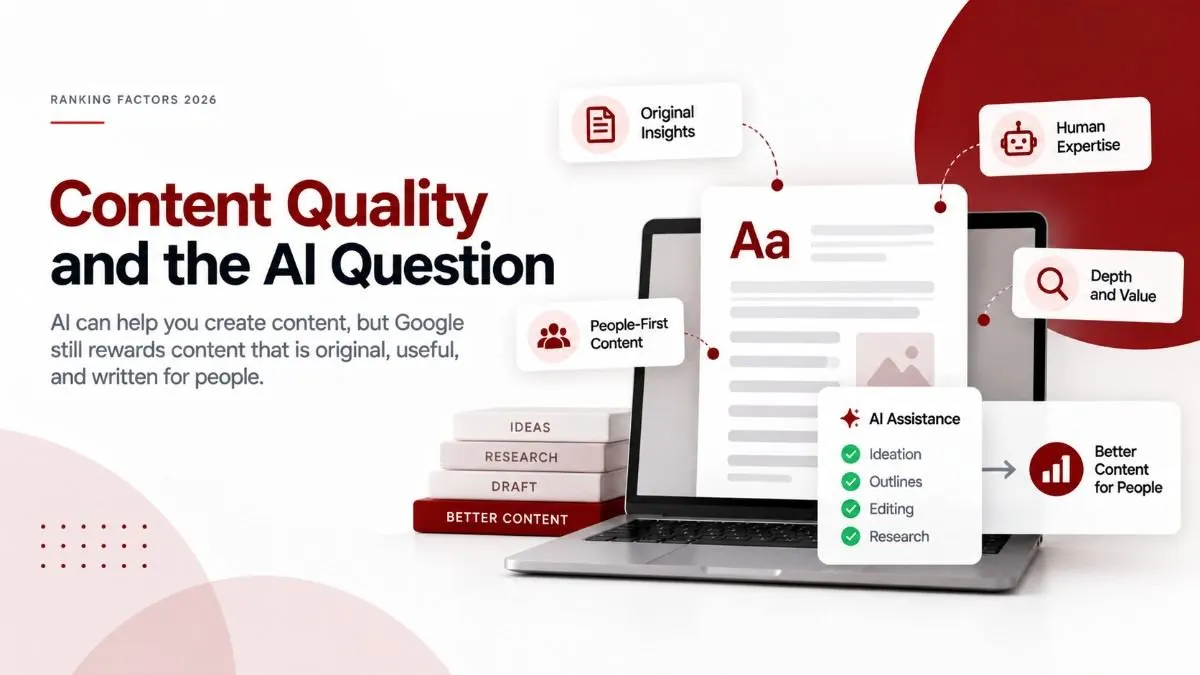
Content quality came in third at 47.6%, and the conversation around it has shifted because of AI. The widespread availability of AI writing tools has made it trivially easy to produce large volumes of content. Google knows this, and their ranking systems have adapted.
Ross Simmonds, a well-known content strategist, framed it sharply: "AI made content cheap. Google knows this. That's why quality filters now. When publishing costs drop, trust costs rise." That single observation explains much of what has happened in search rankings over the past two years. The bar for what counts as "quality" has not lowered. It has risen, precisely because so much content is now being produced so easily.
Everett Sizemore offered the most practical framing for brand owners: "Using AI to publish 10x content in half the time isn't as good as using AI to publish same amount but 10x better quality." This is the distinction that separates brands winning in search from those losing ground. AI is a production tool, not a strategy. The brands that use it to research faster, draft more efficiently, and refine more carefully are getting better results. The brands that use it to publish more content with less editorial oversight are watching their rankings decline.
Google does not penalize content for being AI-generated. They have said this explicitly and repeatedly. What they penalize is content that lacks depth, originality, or genuine usefulness, regardless of how it was produced. The practical test is simple: does this content exist because the brand has something meaningful to say on this topic, or does it exist because someone saw a keyword with search volume and decided to fill a page?
Key Takeaway
Content quality in 2026 means expertise and original perspective, not length or polish. Use AI to work faster, but make sure every piece of content reflects genuine knowledge about your business, your customers, and your market. Volume without depth is a losing strategy.
Authority, Trust, and E-E-A-T
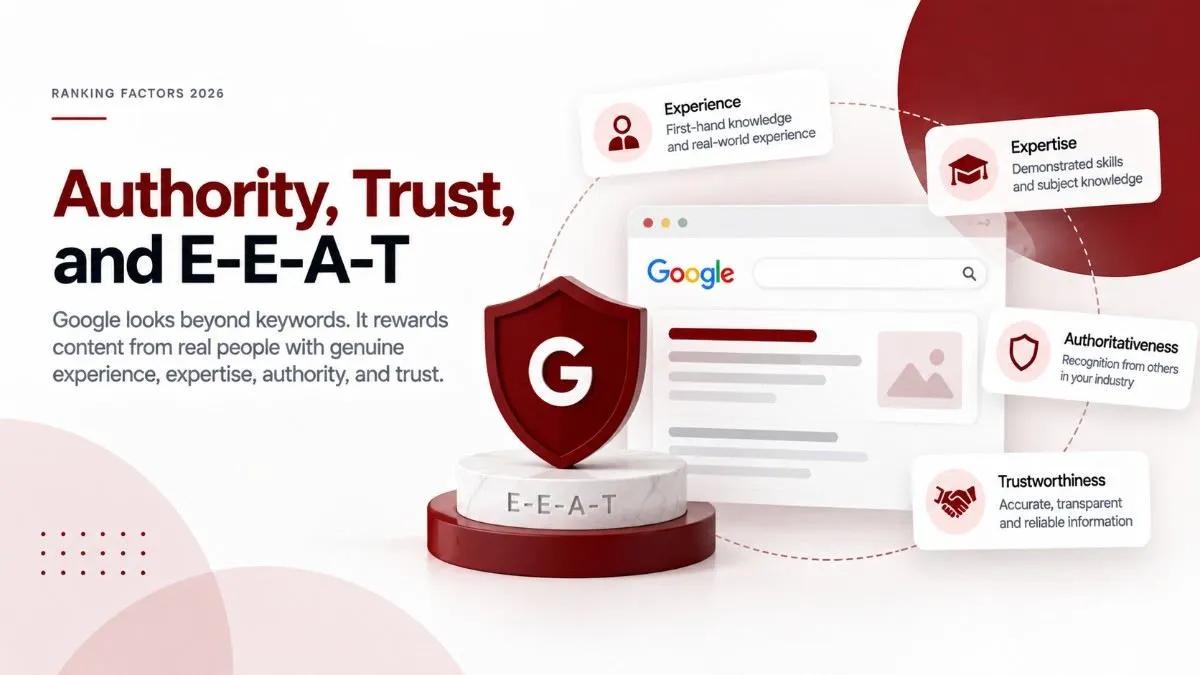
Authority and trust ranked fourth at 36.5%. Google's E-E-A-T framework (Experience, Expertise, Authoritativeness, Trustworthiness) is not a ranking factor in the mechanical sense. Google does not assign an E-E-A-T score. Instead, it describes the qualities that Google's algorithms are designed to identify and reward.
The distinction matters because many brand owners treat E-E-A-T as a checklist: add an author bio, include credentials, cite sources. Those things help. But they are signals of authority, not authority itself. Actual authority comes from a track record of producing reliable, accurate content that other people reference, link to, and recommend.
The leaked API documentation added weight to this. Among the 14,000+ attributes across 2,596 modules, Google tracks a field called siteAuthority. This is notable because Google has publicly denied using anything resembling a domain authority metric. The API data suggests otherwise. While we do not know the exact formula or weight, the existence of the field confirms that Google evaluates sites at the domain level, not just at the page level.
For brand owners in categories Google considers YMYL (Your Money or Your Life), such as healthcare, finance, legal services, and insurance, authority signals carry extra weight. Google applies stricter quality standards to content that could affect someone's health, financial stability, or safety. If your brand operates in one of these sectors, demonstrating real expertise is not optional. It is the foundation of whether your content ranks at all.
Click Signals, NavBoost, and What Google Admits Under Oath
User behavior and click signals ranked fifth at 29.4% in the survey. But the real story here is not the survey data. It is what happened in courtrooms and in leaked documentation.
During the US v. Google antitrust trial in late 2023, Pandu Nayak, Google's Vice President of Search, testified about an internal system called NavBoost. He described it as one of the most important ranking signals Google uses. NavBoost is a click-based re-ranking system that evaluates how real users interact with search results. The system tracks five categories of click data: goodClicks, badClicks, lastLongestClicks, unsquashedClicks, and squashedClicks. It operates on a rolling 13-month data window.
This is significant because Google has historically been careful about acknowledging click data as a direct ranking signal. During the trial, the evidence left little room for ambiguity. Click patterns directly influence where pages rank.
AJ Kohn, a respected independent SEO consultant, summarized it bluntly in the survey: "NavBoost is monster. Sites should create satisfaction metric by page type since click signals create ranking ceiling." In plain language, this means there is a limit to how high your page can rank if users consistently click on it and then leave quickly, or if they skip your result entirely in favor of competitors.
The leaked API documentation, which became public in May 2024 through reporting by Rand Fishkin and confirmed by outlets including Search Engine Land and Search Engine Roundtable, also revealed a module called ChromeInTotal. Google has publicly denied using Chrome browser data for search rankings. The API documentation suggests a different reality.
For brand owners, the implication is clear. Getting someone to click your search result is only half the equation. What they do after they click matters just as much. If visitors land on your page, get what they need, and engage with your site, that behavior feeds into Google's ranking calculations. If they bounce back to the search results within seconds, that sends the opposite signal.
Key Takeaway
Google tracks how users interact with your pages after clicking from search results. A page that earns clicks and keeps visitors engaged will rank better over time than a page that ranks on technical optimization alone. Build pages that actually satisfy the person who clicked.
Brand Signals: The Factor Google Does Not Talk About
Brand signals ranked sixth at 27%, but several experts argued the actual influence is much higher. Jan-Willem Bobbink was the most direct: "Brand signals strongest factor. Bad technical site still ranks if people search and talk about brand." That is a strong claim, and it challenges the common assumption that technical SEO and content optimization are the primary paths to rankings.
Think about what brand signals actually include: the volume of people searching for your brand name directly, direct traffic to your website, mentions of your brand across the web (with or without links), social media conversations about your business, press coverage, customer reviews on third-party platforms, and citations in AI-generated answers. Every one of these sends a signal to Google that your brand is a real entity that real people interact with.
The leaked API documentation reinforced this. The existence of siteAuthority as a tracked field, along with various entity-related attributes, suggests that Google evaluates brands as entities, not just websites. A brand that exists meaningfully in the real world, that people search for, talk about, and reference, carries a fundamentally different weight in Google's systems than a website that exists only to capture search traffic.
For brand owners, this is actually encouraging. You do not need to become an SEO expert to benefit from brand signals. You need to build a business that people know about, trust, and talk about. That is marketing in the broadest sense, and it feeds directly into your search visibility.
Topical Authority and Internal Linking
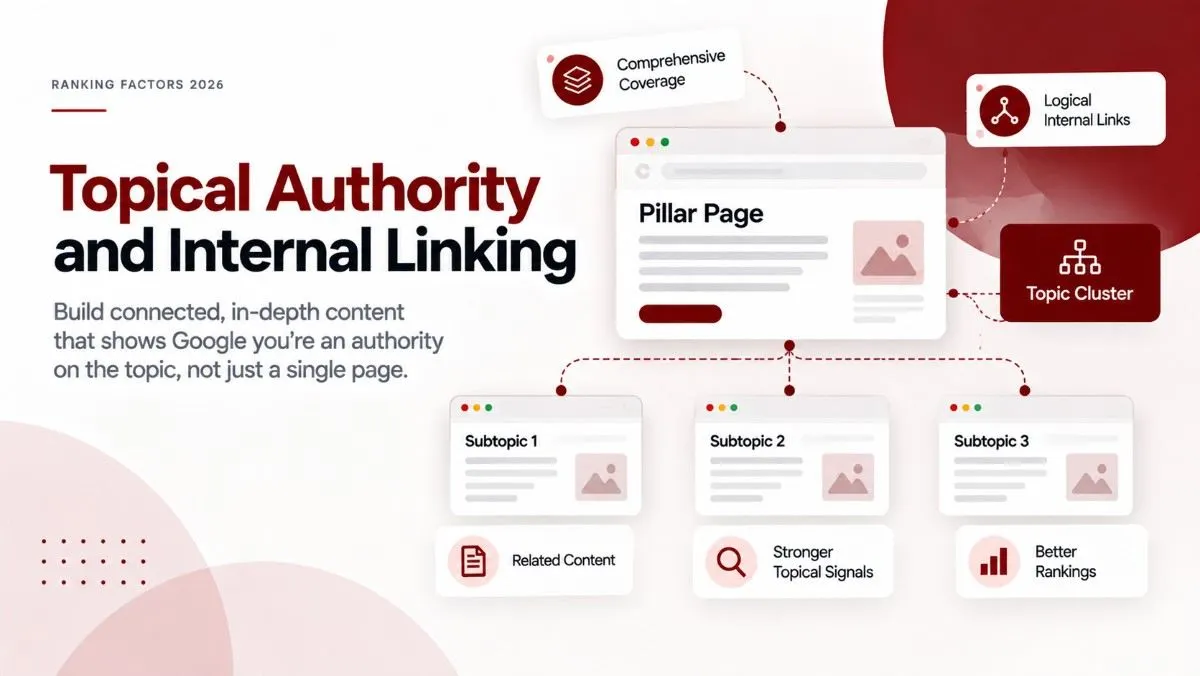
Topical authority ranked ninth at 14.3% and internal links ranked tenth at 11.1%, but treating them separately understates their combined influence. They are two sides of the same coin. Topical authority is about demonstrating deep expertise on a subject across your entire site. Internal linking is the mechanism that connects that expertise into a coherent structure Google can understand.
Publishing a single article on a topic you have never covered before is unlikely to rank well, even if the article itself is excellent. Google's systems evaluate whether your site has a broader body of work that supports and contextualizes that single piece. A site that has published 30 interconnected articles about semantic SEO, all linking to each other in meaningful ways, will outrank a site with one standalone article on the same topic, all else being equal.
Gaston Riera, one of the survey respondents, made a point that many brand owners overlook: "Good internal link as valuable as very good external backlink." That is a significant claim. It means the way you connect your own content matters as much as the links other people give you. And unlike external backlinks, internal links are completely within your control.
For brand owners, this means your content strategy should not be a collection of isolated articles. It should be a connected web of content that covers your core topics thoroughly and links between related pieces in ways that help both readers and search engines understand the relationships between them.
Key Takeaway
Cover your core topics deeply, not broadly. Publish connected clusters of content around the subjects your brand knows best, and use internal links to tie them together. Isolated pages on random topics will not build the topical authority Google rewards.
Technical SEO: Necessary, But Not the Differentiator
Technical SEO ranked eighth at 17.5%. The expert commentary around it was unusually blunt. Marshall Simmonds called it "a commodity at this point. Won't win race but can absolutely lose it." Ryan Jones went further, calling page speed and Core Web Vitals "most overrated things" and noting that "either loads fine or doesn't."
This does not mean technical SEO does not matter. It means it has become a baseline rather than a differentiator. Your site needs to be crawlable so Google can find your pages. It needs to load reasonably fast so visitors do not leave before the content appears. It needs to work properly on mobile devices. It needs correct canonical tags, a clean URL structure, and a valid sitemap. These are the fundamentals.
Dana DiTomaso offered a revealing example of where technical SEO still delivers dramatic results: "Client with wrong canonical pointing set saw almost immediate +60% change in impressions and clicks after fixing." That is a single technical error that was suppressing a site's visibility by more than half. Fix the error, and the traffic comes back. But that is not a competitive advantage. That is removing a self-inflicted penalty.
For brand owners, the practical advice is to invest in a solid technical audit once, fix what is broken, and then shift your ongoing investment toward content quality, backlinks, and brand building. If your SEO partner is spending most of their time on technical refinements and very little on content strategy or link acquisition, the priorities may be misaligned.
What Google Will Not Say Publicly
The most revealing part of this entire picture is not what the experts believe. It is the gap between what Google says publicly and what their own data and testimony show.
In May 2024, an internal Google API documentation set was inadvertently published. Rand Fishkin reported the leak, and it was subsequently confirmed by Search Engine Land, Search Engine Roundtable, and independent analyst Bill Hartzer. The documentation revealed over 14,000 ranking-related attributes across 2,596 modules. Among the findings that contradicted Google's public positions:
Google has said they do not use a domain authority metric. The API documentation contained a field called siteAuthority. Google has said they do not use Chrome data for search ranking. The documentation included a module called ChromeInTotal and other Chrome-related data fields. Google has been careful about acknowledging click data as a direct ranking signal. During the antitrust trial, their own VP of Search described NavBoost, a click-based system, as one of the most important signals they use.
None of this means Google is lying. It may mean their public communications use precise language that is technically accurate but functionally misleading. Or it may mean that different parts of a very large organization have different levels of information about how the ranking system works. Either way, brand owners should not take Google's public statements about ranking factors at face value. Use them as one input, cross-referenced against the kind of evidence discussed in this article.
Key Takeaway
Google's public guidance is useful but incomplete. The API leak and antitrust trial testimony suggest that click data, site-level authority, and Chrome browsing data all play a role in rankings, even though Google has been reluctant to confirm this publicly. Make decisions based on the full body of evidence, not just official statements.
What This Means for Brand Owners
If you run a brand and you are trying to make sense of all this, the picture that emerges from the survey, the API leak, and the trial testimony points to five priorities that matter more than anything else.
First, match the intent behind the searches you want to rank for. Before you write a single word, understand what the person searching that term actually needs. Look at what currently ranks. Ask whether your content delivers a better, more complete answer. If it does not, nothing else will save it.
Second, earn links from sources that matter. Stop chasing link volume. Focus on building relationships with journalists, analysts, and publishers in your industry. Create work that is worth referencing: original research, tools, data, or perspectives that nobody else is offering. One editorial mention in a respected publication will do more for your rankings than a hundred low-quality links.
Third, publish content that demonstrates real expertise. Use AI to work faster, but make sure your content reflects genuine knowledge. Write about what you actually know. Share real observations from your work. Add information that your competitors' content does not include. Google's systems are increasingly good at distinguishing between content that was written to rank and content that was written because the author had something to say.
Fourth, build your brand outside of search. Brand signals feed into rankings. PR coverage, social media visibility, customer reviews, industry speaking engagements, partnerships, and community presence all generate the kind of signals that Google tracks. SEO and brand building are not separate strategies. They reinforce each other.
Fifth, cover your core topics deeply. Pick the subjects your brand knows best and build a connected body of content around them. Link your articles to each other. Create a structure that shows Google your site is a genuine authority on these topics. Do not scatter your efforts across unrelated subjects trying to capture traffic from every possible keyword.
Brand Owner Priority Checklist
- Audit your top 10 target queries. Does your content match what searchers actually need?
- List the industry publications, journalists, and analysts who could reference your work
- Review your recent content. Does it reflect genuine expertise or just keyword targeting?
- Check your branded search volume in Google Search Console. Is it growing or flat?
- Map your site's topic clusters. Are your articles connected through internal links?
- Run a technical audit. Fix crawl errors, broken canonicals, and mobile issues
- Review your content strategy. Are you publishing depth on core topics or breadth across many?
Google's ranking system rewards brands that earn trust, not websites that game algorithms. The experts surveyed in this study, the documentation Google never intended to make public, and the testimony their executives gave under oath all point to the same conclusion. If you build something genuinely useful, promote it through legitimate channels, and give searchers exactly what they need, the rankings will follow.
Related: Explore Oddtusk's SEO Services
[ Common questions ]
Google Ranking Factors FAQs
According to the Zyppy 2026 survey of 131 SEO professionals, the top five factors are relevance (57.1%), backlinks (54.8%), content quality (47.6%), authority and trust (36.5%), and user behavior/click signals (29.4%). These findings are supported by Google's leaked API documentation and antitrust trial testimony, which confirmed that click data through NavBoost is one of Google's most important ranking signals.
Yes. Despite Google's Gary Illyes stating at Pubcon Pro Austin in September 2023 that links are "not in the top three," 54.8% of experts surveyed still rated backlinks as a top factor. The leaked API documentation also showed that link-related attributes remain deeply embedded in Google's systems. The key change is that quality matters far more than quantity. A single editorial link from a trusted publication delivers more impact than hundreds of low-quality links.
NavBoost is Google's internal click-based re-ranking system. It tracks five categories of user interaction data including good clicks, bad clicks, and last longest clicks across a 13-month rolling window. Google's VP of Search, Pandu Nayak, described it as one of the most important ranking signals during the 2023 antitrust trial. For brand owners, this means user engagement on your pages directly influences rankings.
Google has publicly denied using Chrome data for search rankings. However, the leaked API documentation from May 2024 revealed a module called ChromeInTotal and other Chrome-related data fields that appear connected to ranking calculations. The antitrust trial evidence also suggested clickstream data from Chrome contributed to Google's user behavior analysis. The technical documentation and the public statements do not fully align.
Brand signals ranked sixth in the 2026 survey at 27%, but experts argue their real influence is higher. They include branded search volume, direct traffic, web mentions, social presence, and press coverage. The leaked API's siteAuthority field suggests Google evaluates brands at the domain level. Building genuine brand recognition through marketing, PR, and customer satisfaction directly feeds the signals Google uses for ranking decisions.
Topical authority means Google recognizes your site as a thorough, reliable source on a specific subject. It ranked ninth in the survey at 14.3%. Publishing isolated articles on topics you have never covered will not rank well. Building connected content clusters around your core expertise, with strong internal linking between related pages, signals to Google that your site genuinely understands the subject.
Technical SEO ranked eighth at 17.5%. Experts describe it as a prerequisite rather than a competitive advantage. Your site needs to be crawlable, fast, and mobile-friendly. Fix broken canonicals, crawl errors, and structural issues. But once the basics are covered, additional technical refinements will not move rankings the way content quality, backlinks, or brand building will.
Google does not penalize AI-generated content. They penalize low-quality, mass-produced content regardless of method. Use AI to research, draft, and refine, but ensure every piece reflects genuine expertise. The ideas, the perspective, and the editorial judgment need to come from people who understand your business. Publishing more content is not the goal. Publishing better content, faster, is.
