
If your content isn't the problem, this is what agencies actually charge to rebuild the site around it.
7 Reasons Your Bhubaneswar Website Content Isn't Converting Visitors Into Leads
Date: 23 - 10 - 2026
Time to read: 13 minutes

Subscribe to our newsletter
[ Related Post ]
Read more
Read more
Once your content is fixed, here's what it actually costs to rebuild the site it lives on.
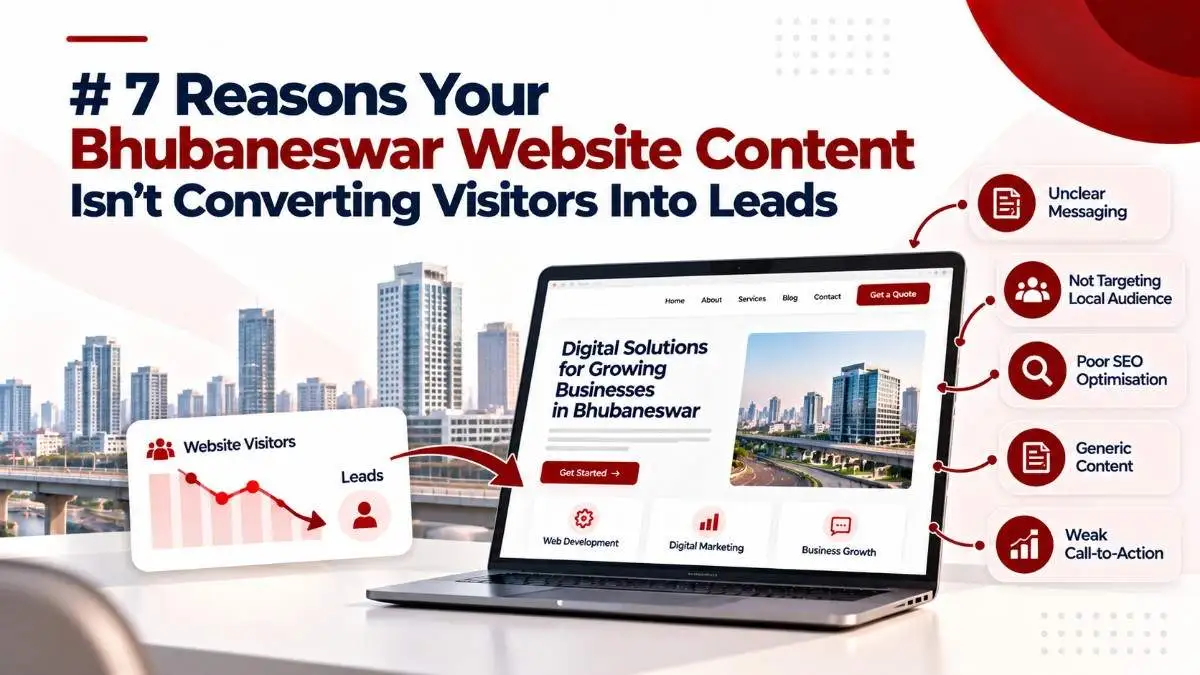
Key Takeaways
- Bhubaneswar website content that gets traffic but no inquiries is usually a content strategy and structure problem, not a content volume problem.
- Search intent mismatch is the most common cause: the page type ranking on your site does not match what the searcher actually wants at that stage.
- Pages under roughly 300 to 500 words that list services without explaining process, audience fit, or outcomes fail Google's Helpful Content system and real visitors alike.
- A page can rank and still get almost no clicks. A click-through rate under 2 percent at positions 4 to 10 in Google Search Console usually points to a weak title tag and meta description, not a ranking problem.
- Keyword cannibalization, several pages competing for one query, makes Google rank the wrong page or none of them well, and it is fixed by merging content, not publishing more.
- A focused content audit using Google Search Console data typically takes about a day and surfaces three to five fixes that are faster to execute than writing new content.
[ Table of Content ]
A Bhubaneswar business website not generating leads is one of the most common problems local business owners bring to us, and it is rarely diagnosed correctly. The usual advice is to add more content: write more blogs, create more pages, post more updates. That advice is wrong far more often than it is right.
Most of the content already on the site was written for no one in particular, optimised for terms nobody is actually searching, and structured so that Google learns nothing useful from it. Publishing more of that content will not fix the problem. It will just make the problem bigger.
If any of this sounds familiar, you've probably already read our deeper breakdown of what a full Bhubaneswar SEO audit actually finds, or you're wondering what the fix would realistically cost to run through a Bhubaneswar SEO pricing guide. Either way, start with the diagnosis below.
This is a diagnostic checklist, not a generic SEO primer. If your site is getting traffic but no inquiries, or getting no traffic at all, these are the seven reasons to check first, in the order we check them during an Oddtusk content audit.
A note from our founder
"Zero leads" is almost never literal. Most of the Bhubaneswar businesses who come to us with this problem are getting some traffic and the occasional inquiry, just nowhere near what their rankings should produce. The honest starting point is admitting the content isn't doing its job yet, not that nothing is happening at all.
Sanjay Ananda, Founder and CEO, OddtuskThe Real Reason Content Fails Locally
Bhubaneswar website content that doesn't generate leads almost always comes down to one root issue: it was built for a broad, generic audience instead of the specific local group actually searching for the service.
Most local businesses here get their content from one of two places: written in-house, where it tends to be thin and generic, or outsourced to a content writer who delivers grammatically correct copy that is just as generic. Either way, it reads like it could belong to any business in any city. It lists the services, works in a few keywords, and stops there. A content writing company that treats SEO and conversion as one job, rather than two tasks handed to two different people, tends to avoid this failure mode entirely.
That approach does not generate leads in 2026. Google's ranking systems, including the E-E-A-T (Experience, Expertise, Authoritativeness, and Trustworthiness) framework, are built specifically to reward content that shows genuine depth and local relevance. Generic content fails that test on both sides: it ranks poorly, and it converts worse than that.
Diagnosing the problem starts with being honest about what your current content is actually achieving, section by section.
1Search Intent Mismatch
Bhubaneswar website content frequently fails to generate leads because it has nothing to do with what the user is actually searching for when they type that query. The page exists; the intent behind the search does not match it.
Take a common example: a coaching institute in Bhubaneswar publishes a blog post titled "The Advantages of Consistent Studying." Someone searching "best coaching for JEE in Bhubaneswar" or "CBSE tuition near Patia" is not looking for a motivational essay. They are looking for a provider to hire. The intent is commercial. The content is purely educational. There is no match, and there is no lead.
Diagnose a search intent mismatch
- Open Google and type your target keyword exactly as a customer would type it.
- Look at what is actually ranking on page one: informational blog posts, service pages, comparison content, or local directory listings.
- Check whether your own ranking page matches that pattern.
If your service pages sit deeper in your site structure than your blog posts, Google has a harder time working out which page you actually want ranked for that query. Content that converts has to match the searcher's stage: "website designer Bhubaneswar" signals someone looking for a service page with case studies and a contact form, not a blog post about the history of web design. Getting that match right page by page is the core of what a content strategy service actually does, rather than just commissioning more posts.
2Thin Content That Covers Nothing Deeply
A large share of Bhubaneswar website content that fails to convert is thin content: pages that are live, indexed, and technically present, but that convey little or no real value to the person reading them.
What counts as thin content
A page that runs under roughly 300 to 500 words, lists services without explaining how they work or who they're for, contains no specific data, examples, or outcomes, and reads like a brochure instead of a resource written by someone who has actually done the work.
Google's Helpful Content system checks whether a page is genuinely useful to the people reading it. A "Digital Marketing Services" page with six bullet points and a phone number is not helpful. It gives the visitor nothing to decide with, and it gives Google nothing to rank the page on.
A service page that actually describes your process, the kind of client you work with, the questions those clients ask before hiring, and the outcomes they want, is content that earns its place. Expanding an existing thin page is usually faster and more effective than writing a brand new one. If you need a starting structure for that, a content brief service or a dedicated content writing company can turn a thin page into one that actually earns its ranking.
3Zero-Click Pages From Weak Titles and Descriptions
Bhubaneswar website content can fail to generate leads even while it ranks, because the page gets almost no clicks. This is the zero-click content problem, and it is specific and easy to overlook: the page shows up in results, but nobody is choosing it.
The usual cause is a generic title tag and meta description. A page titled "Services, ABC Solutions, Bhubaneswar" with a description reading "We offer a range of services for businesses" is effectively invisible, even sitting on page one.
Under 2%
Click-through rate at positions 4 to 10 in Google Search Console, combined with a high number of impressions, is the clearest signal of a zero-click page, not a ranking problem (Oddtusk content audit benchmark, 2026).
Zero-click signals to check in Google Search Console
- High impressions paired with a click-through rate under 2 percent.
- Steady rankings in positions 4 to 10 that never translate into visits.
- Competitors consistently out-clicking you on the same queries at similar positions.
Treat every title and meta description as your top 150-character marketing pitch. Lead with the benefit. Name the place. Give the searcher an actual reason to click your result over the other four on the page. Rich results from schema markup, such as star ratings or FAQ dropdowns, can also pull the eye toward your listing before the click even happens.
4The Content Gap: Pages That Should Exist But Don't
Sometimes a Bhubaneswar business loses leads through its website structure itself: the pages a potential customer expects to find simply are not there.
A content gap analysis compares what your audience is actually searching for against what your site currently offers. For most Bhubaneswar businesses, the same gaps show up repeatedly.
Common content gaps on Bhubaneswar business sites
- No location-specific landing pages for the areas actually served, such as Saheed Nagar, Patia, Khandagiri, Chandrasekharpur, or Unit 4.
- No FAQ pages answering the questions local customers ask before they hire.
- No comparison or "versus" content for service categories where buyers weigh several options.
- No case study or results pages showing what it is actually like to work with you.
- No process pages that explain, step by step, how the service works.
Start the audit in Google Search Console: pull the queries where you rank but not highly, and check whether a page that is actually built to rank for each one even exists. In most cases, it does not. Businesses that blog actively but never build out their service categories or geographic coverage are publishing secondary content instead of the supporting pages that would actually convert. We cover this in more depth in our content gap analysis for SEO, and a local SEO company is usually who builds the missing location pages themselves.
5Keyword Cannibalization
Bhubaneswar website content sometimes fails to generate the right leads because of a more structural problem: multiple pages on the same site competing for the same keyword.
Keyword cannibalization
When two or more pages target the same search query, Google has to choose which one to rank, often ranks neither as well as a single well-built page would, and can swing between the two week to week. Five blog posts loosely about "digital marketing in Bhubaneswar" can rank lower, collectively, than a competitor's single well-structured service page targeting that term directly.
Symptoms of keyword cannibalization
- Your ranking position for a core keyword swings significantly from week to week.
- Different pages on your own site rank for the same query at different times.
- You are ranking but not converting, because the page Google is showing is a blog post, not the service page.
Your content audit should produce a keyword map with one target keyword per page, with no two pages competing for the same term. When you find duplication, merge or redirect the weaker page into the stronger one rather than publishing a new page to compete with both. This is exactly the kind of structural fix our internal linking service handles, and we've written about the approach in more detail in our internal linking strategy guide.
6No Topical Authority on Your Core Topics
A sign that Bhubaneswar website content has stalled over time, even after some early traction, is that it has never built real topical authority in its category.
Topical authority
The degree to which Google treats your site as an authority on a topic cluster, not a single page. A law firm's website with only a generic "legal services" page has none. A law firm with dedicated pages for family law, property disputes, consumer cases, and employment law in Odisha, each backed by supporting content and linked together, has started building it.
Building topical authority involves
- Covering your core service topics thoroughly, not lightly.
- Publishing content that goes deeper than what currently ranks for those same queries.
- Linking relevant pages to each other so Google can recognise the topic cluster.
- Demonstrating E-E-A-T with real credentials, real outcomes, and real team expertise.
Without topical authority, Bhubaneswar website content tends to stagnate: some impressions show up, but momentum never builds, because Google has no evidence the site is an authority on that topic. Our topical authority mapping service exists specifically to close this gap, and our guide on how to build topical authority walks through the full process.
7Content Written for Algorithms, Not Humans
The flip side of thin content is over-optimised, mechanical content: writing that hits the right keywords and the required word count but reads like it came from a template.
The keyword opens every paragraph. A call to action closes every section. The same phrase repeats across every heading. A genuine visitor reads three lines and leaves, because nothing in it sounds like it was written for them specifically.
The quick test
If it reads like a brochure, it will feel like one to the person reading it, and brochures do not build trust on their own.
This failure usually happens because SEO and writing are treated as separate jobs, with keyword placement handled as a background checklist item rather than part of the actual content strategy. The better approach is to write genuine value for a specific person in a specific situation, with their real doubts and questions addressed directly. Keywords follow naturally from that, instead of being bolted on afterward. It's the same standard our blog writing service is held to, and it's the difference between content that ranks and content that also converts.
How to Run a Content Audit for Your Bhubaneswar Site
Bhubaneswar website content that isn't generating leads rarely needs a full rewrite. It needs a systematic content audit, which is faster and cheaper than most businesses expect.
A basic content audit setup
- Export all indexed pages from Google Search Console, with impressions, clicks, and the top query for each page.
- For each page, identify the keyword it was meant to target and check whether that matches what Google is actually showing it for.
- Flag thin pages (under roughly 500 words), zero-click pages (under 2 percent CTR with meaningful impressions), and pages with duplicate intent.
- Map your service categories against your keyword list and identify the content gaps you are missing.
- Check that no two pages are competing for the same keyword.
- Prioritise fixes: expand thin service pages, rewrite weak title tags, and fill the highest-impact content gaps first.
| Problem | Symptom to look for | Fastest fix |
|---|---|---|
| Search intent mismatch | Wrong page type ranking for a commercial query | Rebuild or promote the matching service page |
| Thin content | Under 500 words, no specifics or outcomes | Expand the existing page, don't publish a new one |
| Zero-click pages | High impressions, CTR under 2 percent | Rewrite the title tag and meta description |
| Content gap | Ranking queries with no dedicated page | Build the missing location, FAQ, or process page |
| Keyword cannibalization | Rankings swing between pages week to week | Merge or redirect into one target page |
| No topical authority | Impressions plateau, no ranking momentum | Build out the full topic cluster, then interlink it |
| Content for algorithms | High bounce, low time on page despite ranking | Rewrite for the specific reader, not the keyword |
A focused content audit for a local business site typically takes about a day and usually surfaces three to five high-impact fixes that are quicker to execute than writing new content from scratch. These improvements tend to compound: fixing a thin, already-indexed service page that gets some impressions often produces ranking gains within weeks, not months. If you'd rather see this done end to end on a real site, our Bhubaneswar SEO audit study walks through one, and a technical SEO audit covers the crawl and indexation side this article doesn't.
Conclusion
A Bhubaneswar website getting no leads from its content is not a mystery. It is a diagnosis. Almost every case comes down to one or more of these seven causes: a mismatch between search intent and the content, thin pages, zero-click titles, a content gap, keyword cannibalization, content with no topical authority, or content written for an algorithm instead of a person.
- Traffic without leads is a search intent problem before it is a volume problem.
- A content audit using your own Google Search Console data finds the real issues faster than guessing.
- Fixing existing pages usually beats publishing new ones, and it is almost always cheaper.
At Oddtusk, we run a content audit like this as a standard part of our SEO diagnostic process for every new Bhubaneswar client. What we consistently find is a business that invested in content never designed to convert, never aligned to local search behaviour, and never tested against actual rankings. Getting a real return from content is not about volume. It is about publishing the right pages, built around real search intent, and structured to build topical relevance over time. If you'd rather see the full service, our SEO services page covers how this fits into a broader engagement.
If your website has content and is not generating inquiries, the answer is usually already sitting in your Search Console data. You just need someone who knows what to look for.
How Oddtusk Approaches This
Oddtusk is a Bhubaneswar-based digital marketing agency, and the content audit described in this article is the first thing we run for any new local client, before recommending a single new page.
- Search Console-first diagnosis. We pull your actual impressions, clicks, and query data before suggesting any content work.
- One target keyword per page. We map your existing pages and resolve cannibalization before adding anything new.
- Content gap mapping. We identify the missing location, FAQ, and process pages your competitors already have, usually through a dedicated local SEO engagement.
- Written for the reader first. Keyword placement follows real answers to real buyer questions, not the other way round.
- Fix before you spend. We prioritise expanding and fixing existing pages over commissioning new content when that's the faster, cheaper path to leads.
If your Bhubaneswar website is getting traffic without inquiries, talk to our team and we will walk you through exactly where the content is losing you leads, using your own Search Console data, not guesswork.
Getting traffic but no inquiries?
Send us your Search Console export and we'll tell you honestly which of these seven problems is actually costing you leads. No strings attached.
Get a Free Content Diagnosis
[ Common questions ]
Frequently Asked Questions
Traffic without leads almost always means a search intent mismatch. Your pages are ranking for queries, but the page type Google is showing, an informational blog post, say, does not match what the searcher actually wants, which is usually a service page with pricing context, proof, and a contact form. Checking what page type currently ranks on page one for your core keywords is the fastest way to confirm this.
A page under 300 to 500 words that lists services without explaining process, audience fit, or outcomes is generally considered thin. Google's Helpful Content system evaluates whether a page gives a visitor something they can actually use to decide, not just whether it hits a word count, so a short page with real specifics can outperform a long page that says nothing.
A zero-click page ranks in search results but gets almost no clicks because its title tag and meta description give the searcher no reason to choose it over a competitor. In Google Search Console, a page with high impressions and a click-through rate under 2 percent while ranking in positions 4 to 10 is a strong signal of this problem, and it is usually fixable by rewriting the title and description alone.
Keyword cannibalization happens when two or more pages on the same site target the same search query. Google has to pick one, often ranks neither as high as a single well-built page would, and can swing which page it shows week to week. The fix is to assign one target keyword per page and merge or redirect any page competing with it, rather than publishing a new one.
A content gap analysis compares the queries your audience is searching for against the pages your site actually has. For most Bhubaneswar businesses, the gaps are location pages for specific areas such as Patia or Chandrasekharpur, FAQ pages answering pre-purchase questions, and process pages that explain how the service actually works, none of which a blog post can substitute for.
Topical authority comes from covering every sub-area of your core service in depth rather than publishing loosely related blog posts, and linking those pages together so Google can see the cluster. A law firm that has dedicated pages for family law, property disputes, and employment law in Odisha, each backed by supporting content and internal links, demonstrates topical authority in a way a single generic legal services page cannot.
A focused content audit of a local business site, using Google Search Console export data, usually takes about a day for someone who knows what to look for. It typically surfaces three to five high-impact fixes, such as expanding a thin service page or rewriting a title tag, that are faster to execute than writing new content from scratch.
Yes. Oddtusk runs a content and Search Console audit as a standard part of its SEO diagnostic process for new Bhubaneswar clients, identifying search intent mismatches, thin pages, zero-click titles, content gaps, and keyword cannibalization before recommending any new content, so spend goes toward fixes with evidence behind them rather than more volume.
Sources
- Google Search Central. Creating helpful, reliable, people-first content.
- Google Search Central. E-E-A-T and why it matters for Search.
- Oddtusk content audit benchmarks and Google Search Console data reviews across Bhubaneswar client engagements, 2026.
About the author
Sanjay Ananda
Founder and CEO, Oddtusk
Sanjay Ananda founded Oddtusk in Bhubaneswar. He leads its SEO, content strategy, AEO, and growth engineering work for businesses across India, the US, and the UK, including the content audits described in this article.
